What you'll learn
- How the behaviourist approach explains learning through the environment.
- How classical conditioning works, using the key terms correctly.
- What Watson and Rayner (1920) did in Conditioned emotional reactions.
- How to evaluate the study for AO3, including methodology, ethics and applications.
The behaviourist starting point
The behaviourist approach argues that psychology should study observable behaviour rather than private mental processes. Behaviourists believe much human behaviour is learned through interaction with the environment.
Behaviourist approach
The behaviourist approach is the view that behaviour is learned from the environment and should be studied scientifically by observing measurable responses.
This is important because Watson wanted psychology to become more like a natural science: objective, controlled and based on what can be seen.
Learning by association
The classic behaviourist explanation used in Watson and Rayner’s study is classical conditioning.
Classical conditioning
Classical conditioning is learning by association: a stimulus that originally produces no particular response becomes able to trigger a response after being repeatedly paired with something that naturally produces that response.
Key terms:
- A stimulus is anything in the environment that can trigger a reaction.
- A response is the behaviour or emotional reaction produced by a stimulus.
- A neutral stimulus is something that does not naturally produce the target response.
- An unconditioned stimulus naturally produces a response without learning.
- An unconditioned response is the natural, automatic response.
- A conditioned stimulus is the formerly neutral stimulus after learning has taken place.
- A conditioned response is the learned response to the conditioned stimulus.
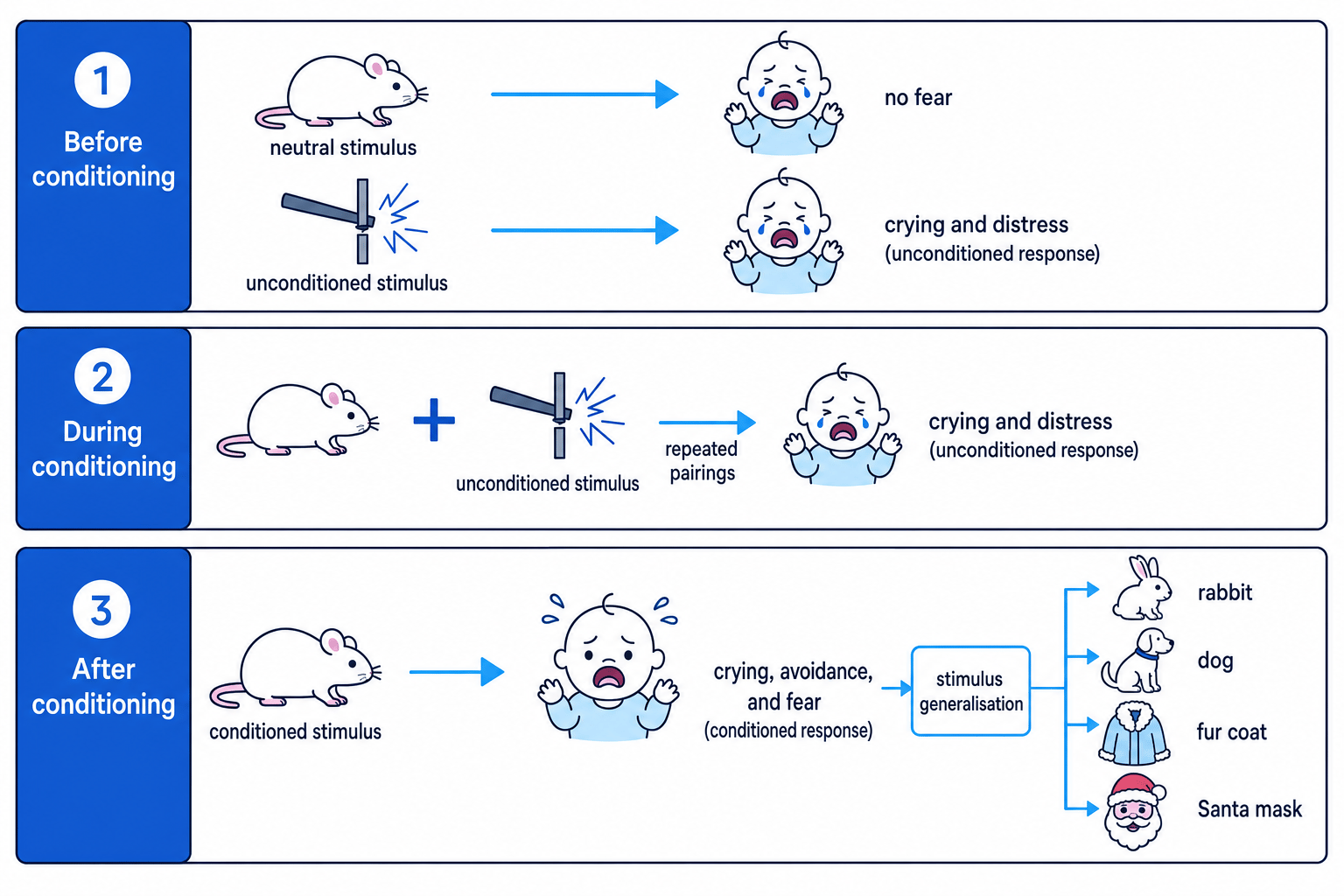
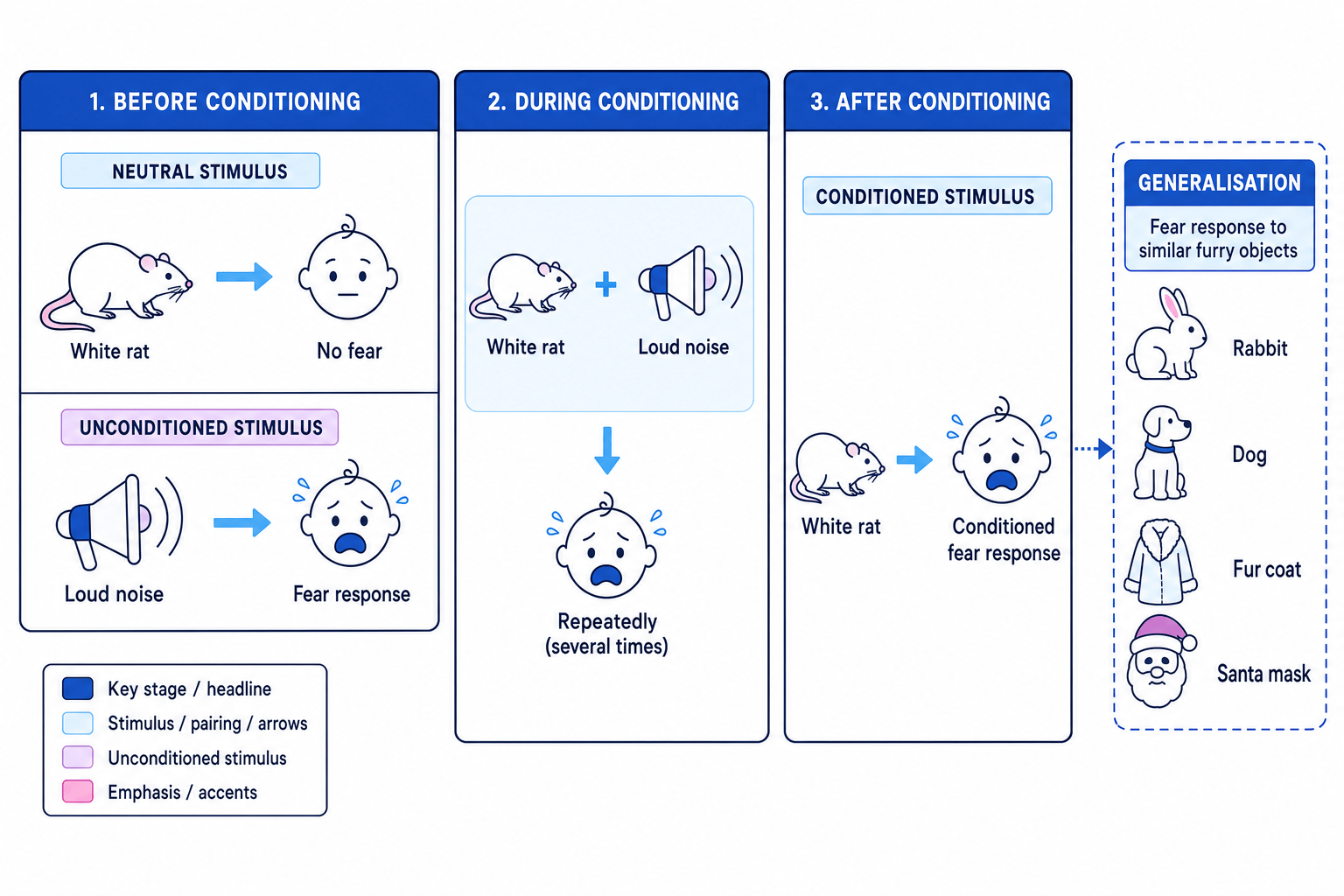
The whole logic of Watson and Rayner’s study is easier to see as a conditioning chain.
Applying classical conditioning to a phobia
- Identify the natural trigger. If a child is badly frightened by a dog barking loudly, the loud bark is the unconditioned stimulus because it naturally produces fear.
- Identify the natural response. The child’s crying or distress is the unconditioned response because it happens automatically after the frightening bark.
- Identify the originally neutral stimulus. Before the event, the dog may not have caused fear, so the dog starts as a neutral stimulus.
- Pair the stimuli. If the dog is repeatedly associated with the frightening bark, the dog becomes a conditioned stimulus.
- Explain the learned fear. The child may then fear dogs even when they are quiet; this fear is the conditioned response.
Watson and Rayner (1920): Conditioned emotional reactions
Watson and Rayner’s study is the named classic research for the behaviourist approach in Eduqas A-Level Psychology.
Aim
Watson and Rayner wanted to test whether a fear response could be conditioned in a human infant. They also wanted to see whether this fear would generalise to similar objects.
Stimulus generalisation
Stimulus generalisation happens when a conditioned response is triggered by stimuli that are similar to the original conditioned stimulus.
Participant
The participant was a baby known as Little Albert, who was around nine months old during initial testing and around eleven months old during the main conditioning procedure.
He was described by Watson and Rayner as emotionally stable. This mattered because they wanted to argue that any later fear response was learned through conditioning rather than already present.
Procedure
Watson and Rayner first tested Albert’s baseline reactions to objects such as a white rat, rabbit, dog, monkey, masks, cotton wool and burning newspapers. Albert did not initially show fear towards the white rat.
They then tested Albert’s reaction to a loud noise made by striking a steel bar with a hammer behind his head. This noise naturally caused distress.
The conditioning procedure paired:
- White rat: neutral stimulus at the start.
- Loud noise: unconditioned stimulus.
- Fear response: unconditioned response.
When Albert reached for the rat, Watson struck the steel bar. After several pairings, Albert began to cry and move away when he saw the rat alone.
Findings
Albert showed fear towards the white rat after conditioning. His fear also generalised to similar furry or white objects, including a rabbit, a dog, a fur coat and a Santa Claus mask.
A follow-up suggested the fear response was still present around a month later, although Albert left the hospital before Watson and Rayner could try to remove the fear.
Conclusion
Watson and Rayner concluded that emotional responses, such as fear, can be learned through classical conditioning.
The big takeaway
Watson and Rayner used Little Albert to argue that fear is not always innate; it can be learned through association with frightening experiences.
AO2: applying the study
In an exam scenario, you may be asked to apply Watson and Rayner to a new situation.
For example, if someone develops a fear of lifts after being trapped in one, you can explain it behaviouristically:
- The lift was originally a neutral stimulus.
- Being trapped was the unconditioned stimulus.
- Panic was the unconditioned response.
- The lift became a conditioned stimulus.
- Panic when seeing or entering lifts became the conditioned response.
- Fear may generalise to small rooms, crowded trains or other enclosed spaces.
Do not overclaim
Watson and Rayner did not prove that Albert developed a lifelong clinical phobia. They showed a conditioned fear response in a controlled setting, but the study did not include long-term clinical evidence.
Component 2 link: research methods and practical investigation
Watson and Rayner’s study is often described as a case study with experimental elements. It focused on one infant in a controlled setting, using observation of behaviour such as crying, crawling away and reaching.
Operationalisation
Operationalisation means turning an abstract concept into something measurable. In this study, “fear” was operationalised through observable behaviours such as crying, distress and avoidance.
If you designed a modern, ethical practical inspired by this topic, you would not condition real fear in a child. You might instead use mild, consenting tasks, such as measuring adults’ ratings of unpleasantness after viewing neutral images paired with harmless sounds.
Useful research-methods links:
- Nominal data: categories, such as “fear shown” or “no fear shown”.
- Ordinal data: ordered ratings, such as a 1–7 fear scale.
- Interval data: scores with equal intervals, such as some standardised psychological scales.
- For descriptive statistics, use median and range for ordinal ratings, and mean and standard deviation only where interval data are appropriate.
- Use tables and suitable graphs: bar charts for categories or ratings, and scatterplots for correlations.
For inferential testing in a practical:
- Use Mann-Whitney U for a difference between independent groups with ordinal data.
- Use Wilcoxon signed-ranks for a difference in related/repeated ordinal data.
- Use Spearman’s rho for a correlation with ordinal or ranked data.
- Use chi-square for associations between nominal categories.
- Use the binomial sign test for related nominal data where only direction of change is counted.
- Use unrelated t-tests or related t-tests for differences using interval data when parametric assumptions are met.
The usual psychology convention is significance at p≤0.05p \leq 0.05p≤0.05. You compare the observed/calculated value with a critical value from a table, using the rule for that specific test. A one-tailed test is used for a directional hypothesis; a two-tailed test is used for a non-directional hypothesis. A Type I error is a false positive, while a Type II error is a false negative.
Choosing a test for fear ratings
- Work out the design. The same participants rate fear before and after a safe conditioning task, so the data are related/repeated measures.
- Work out the level of measurement. A 1–7 fear rating scale is usually treated as ordinal because the order matters but equal intervals are not guaranteed.
- Select the test. Use Wilcoxon signed-ranks because you are testing a difference using related ordinal data.
- Decide the tail. If the hypothesis predicts fear ratings will increase, use a one-tailed test; if it only predicts a difference, use a two-tailed test.
AO3 evaluation
Strength: controlled demonstration of learning
Watson and Rayner manipulated the pairing of the rat and loud noise, which gives the study some experimental control. The baseline testing also helped show that Albert did not initially fear the rat.
This supports the behaviourist aim of studying observable behaviour scientifically.
Strength: real-world application
The study helped develop behaviourist explanations of phobias. If fears can be learned through association, they may also be treated through learning-based therapies such as systematic desensitisation and counterconditioning, where a feared stimulus is gradually paired with relaxation or positive experiences.
Evaluation shortcut
A strong AO3 paragraph often follows this chain: methodological point → why it matters → link back to the conclusion about learned fear.
Weakness: very limited generalisability
The study used one infant. Albert’s temperament, age, health and environment may have made him unusual. This means it is difficult to generalise confidently to all children, adults or phobias.
The sample was also culturally and historically specific, so the findings may not represent behaviour across different societies or time periods.
Weakness: subjective measurement
Watson and Rayner did not use modern objective measures of fear, such as standardised rating scales or physiological measures. Their observations of crying and avoidance were open to researcher interpretation.
This reduces reliability because another observer might not score Albert’s reactions in exactly the same way.
Weakness: alternative explanations
Not all fears are learned through direct conditioning. Some people develop fears through social learning, such as watching someone else react fearfully. Others may be biologically prepared to fear certain stimuli, such as snakes or heights, more easily than neutral objects.
This challenges the idea that classical conditioning alone explains phobias.
Ethical issues
By modern standards, the study is seriously unethical. Using the BPS Code of Ethics and Conduct, you can evaluate it through:
- Consent: Albert was an infant and could not give informed consent; parental consent was not documented to modern standards.
- Protection from harm: the researchers deliberately caused distress.
- Right to withdraw: Albert could not meaningfully withdraw himself.
- Deception: Albert could not understand what was happening.
- Debrief: the fear was not removed because Albert left before deconditioning.
- Confidentiality: “Albert B” was a pseudonym, but later attempts to identify him show confidentiality was not secure by modern expectations.
The study also used live animals as stimuli. A modern ethics review would consider animal welfare, humane handling, distress, and the principles of replacement, reduction and refinement if animals were involved in research.
In the exam
- For AO1, describe the aim, participant, procedure, findings and conclusion clearly, using conditioning terms accurately.
- For AO2, map a new fear scenario onto neutral stimulus, unconditioned stimulus, unconditioned response, conditioned stimulus and conditioned response.
- For AO3, balance strengths with weaknesses: control and application are useful, but ethics, generalisability and measurement are major problems.
- Avoid exaggeration: say the study supports classical conditioning as one explanation of fear, not the only explanation of all phobias.
Check yourself
- Can you explain how the white rat changed from a neutral stimulus to a conditioned stimulus?
- What are two ethical problems with Watson and Rayner’s study using the BPS principles?
- Why is Little Albert difficult to generalise from?