What you'll learn
- The main biological, individual differences and social psychological explanations for autistic spectrum behaviours.
- Key researcher names and dates you can use in AO1 and AO3, including Baron-Cohen, Frith, Bailey, Tyzio, Lai and Bettelheim.
- How to apply explanations to scenarios without using deterministic or blaming language.
- Evaluation points: evidence, methodology, ethics, contradictions and real-world applications.
First: what are we explaining?
Autism is best understood as a spectrum: autistic people can differ greatly in their communication, sensory experiences, interests, routines, strengths and support needs. In Eduqas, the wording “autistic spectrum behaviours” means you are explaining patterns of behaviour associated with autism, not trying to reduce a person to a diagnosis.
Autistic spectrum behaviours
Autistic spectrum behaviours are behaviours associated with autism spectrum condition, such as differences in social communication, restricted or repetitive behaviours, strong interests, preference for routine, sensory sensitivities and detail-focused processing.
A good essay should not argue that there is one simple “cause” of autism. Most modern explanations are interactionist, meaning they see autistic behaviours as arising from a combination of biological development, cognitive processing and social context.
The big picture
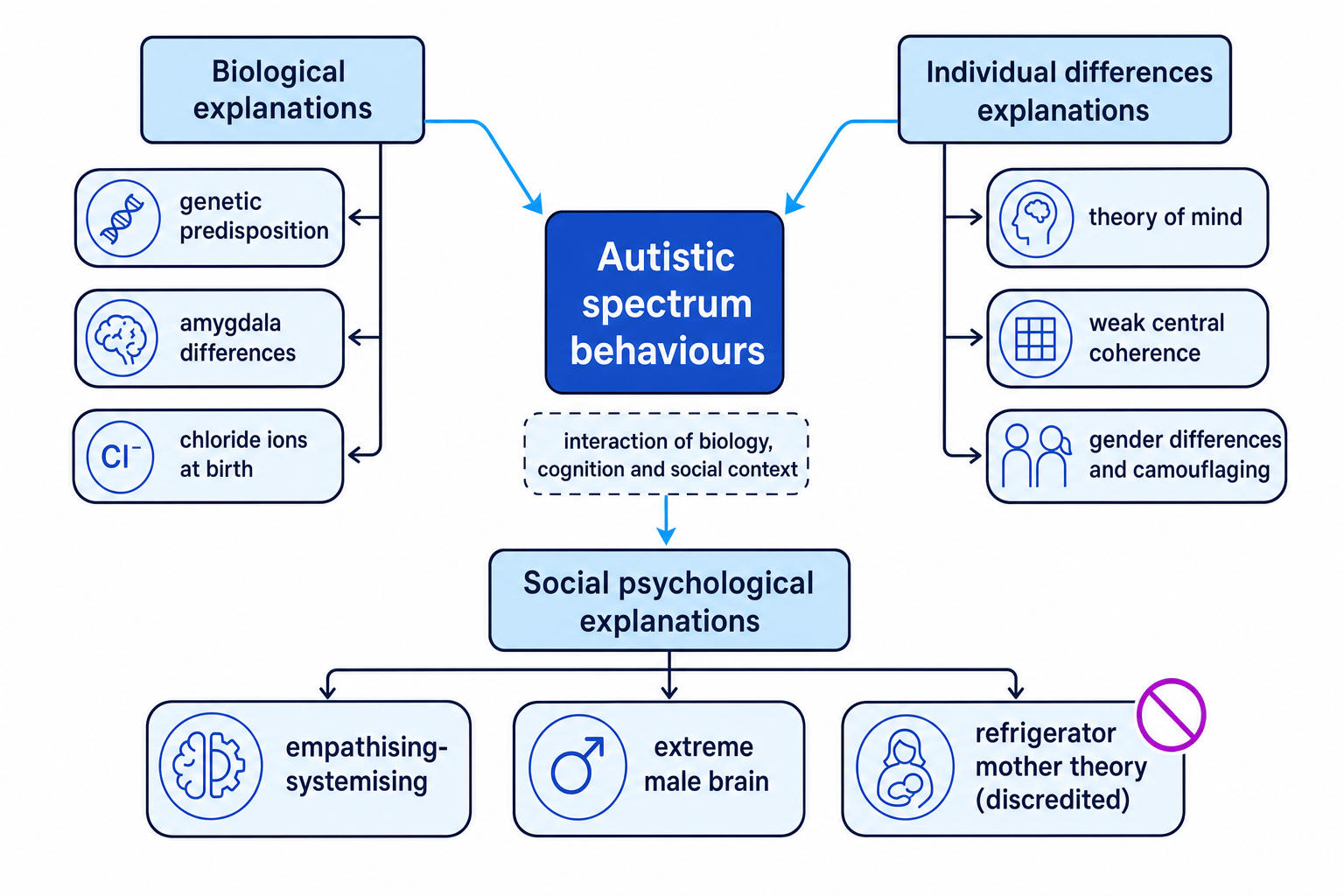
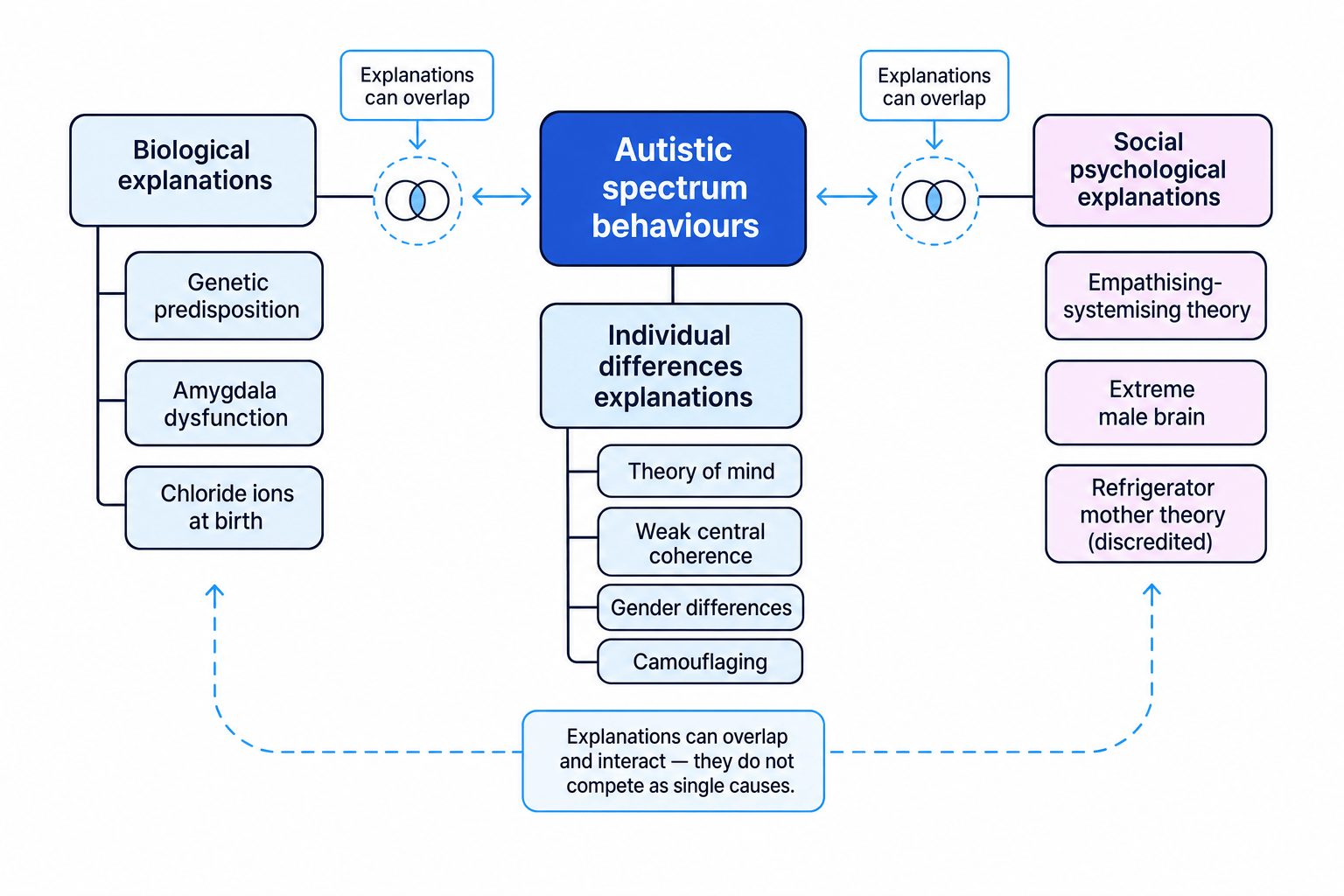
Treat these explanations as overlapping accounts, not as rivals where only one can be correct. Genetics may affect brain development, brain development may affect cognition, and social expectations may shape how behaviours are noticed or diagnosed.
The three branches below are a useful way to organise your essays.
Biological explanations
Biological explanations focus on genes, brain structures, neurotransmitters and early neurodevelopment.
Genetic predisposition
A genetic predisposition means a person has inherited biological factors that increase the likelihood of developing a trait, but do not guarantee it.
Autism is highly heritable, but it is not explained by one “autism gene”. Current research suggests autism is polygenic, meaning many genes contribute small effects, alongside rare mutations and environmental influences during development.
Classic evidence comes from Folstein and Rutter (1977), who studied twins and found higher concordance for autism in identical twins than non-identical twins. Bailey et al. (1995) also reported much higher concordance in monozygotic twins than dizygotic twins, supporting a genetic contribution.
Using concordance to argue for genetics
-
Compare the twin types: monozygotic twins share almost all their genes, whereas dizygotic twins share about half, like ordinary siblings.
-
If monozygotic twins show a much higher rate of both twins having autistic traits, this supports a genetic influence because genetic similarity predicts similarity in behaviour.
-
If concordance is not 100%, you should avoid saying genes “cause” autism by themselves. The better conclusion is that genes create a predisposition that interacts with other developmental factors.
AO3 evaluation: twin studies are useful because they allow comparison between different levels of genetic similarity. However, they cannot perfectly separate genes from shared environment, and diagnoses can depend on assessment methods. Genetic explanations also have ethical issues: researchers must protect confidentiality, avoid stigma, and avoid implying that autistic lives are less valuable.
Amygdala dysfunction
The amygdala is a brain structure involved in emotion processing, threat detection and assigning social significance to stimuli such as faces and eyes.
Some researchers, including Baron-Cohen et al. (2000), proposed that atypical amygdala functioning may help explain difficulties some autistic people experience with eye contact, facial expressions, fear recognition and social judgement. If the amygdala responds differently to social information, faces may feel less rewarding, more confusing or more threatening.
AO3 evaluation: brain scanning evidence is scientific and can be objective, but findings are mixed. Some studies suggest early amygdala enlargement, others focus on under- or over-activation, and not all autistic people show the same pattern. Neuroimaging is also correlational: if amygdala activity differs, that does not prove it caused the behaviour.
Correlation is not causation
Do not write “the amygdala causes autism” just because brain differences are found. A safer phrase is: amygdala differences may be associated with some social and emotional features of autism.
Chloride ions at birth
A more specific biological explanation concerns chloride ions, electrically charged particles involved in early brain signalling.
Before birth, the neurotransmitter GABA can have an excitatory effect. Around birth, changes in chloride levels usually help GABA become more inhibitory, calming neural activity. Tyzio et al. (2014), working with animal models, suggested that if this chloride “switch” does not happen typically, early brain circuits may remain over-excitable, potentially contributing to autism-like behaviours.
AO3 evaluation: this is a precise biological mechanism and has led to interest in drugs such as bumetanide, which affects chloride transport. However, much of the evidence comes from animal research, so applying it directly to humans is difficult. Animal studies also raise ethical issues: researchers must justify harm, minimise suffering and follow the principles of replacement, reduction and refinement.
Be careful with chloride ions
This explanation is promising but not established as a general human explanation for autism. In an essay, present it as one possible neurodevelopmental mechanism, not as a confirmed cause.
Individual differences explanations
Individual differences explanations focus on how people vary in cognitive style, social understanding, perception and presentation.
Theory of mind
Theory of mind is the ability to understand that other people have beliefs, desires, intentions and knowledge that may differ from your own.
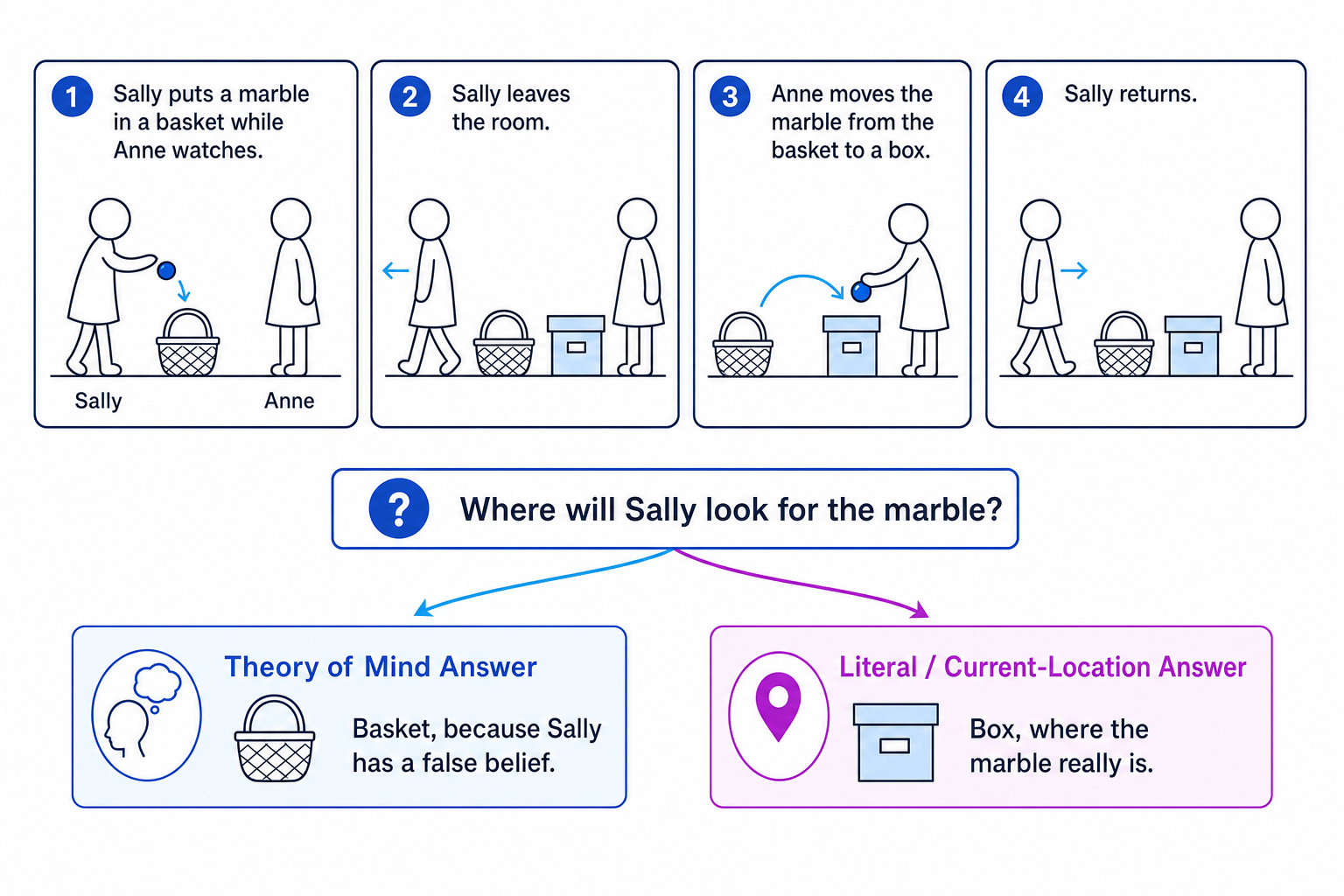
Baron-Cohen, Leslie and Frith (1985) used the Sally-Anne false-belief task. Many autistic children in their sample found it harder to predict that Sally would look where she falsely believed the marble was, rather than where the marble actually was. This supported the idea that some autistic social communication differences may relate to difficulty representing other minds.
Predicting behaviour in a false-belief task
-
Separate the real location from the believed location: the marble is really in the box, but Sally last saw it in the basket.
-
Apply theory of mind: Sally’s behaviour should be predicted from her belief, not from the actual location.
-
Therefore, the theory-of-mind answer is that Sally will look in the basket. If a child answers “box” while passing memory control questions, this may suggest difficulty representing false belief.
AO3 evaluation: theory of mind explains some social-communication features, such as misunderstanding sarcasm, deception or indirect language. However, it does not explain all autistic behaviours, especially sensory sensitivities or repetitive interests. Many autistic adults pass explicit theory-of-mind tasks, and Milton’s (2012) double empathy problem argues that communication difficulties can be mutual between autistic and non-autistic people, not simply a deficit within the autistic person.
Weak central coherence theory
Central coherence is the tendency to integrate information into an overall meaning or “big picture”. Weak central coherence, proposed by Frith (1989) and developed by Happé and Frith (2006), suggests autistic people may process information in a more detail-focused way.
This can explain strengths such as spotting errors, noticing patterns and performing well on tasks like the Embedded Figures Test. It can also explain why some autistic people may find context-dependent social meanings more difficult, because the “whole situation” may not dominate over the details.
AO3 evaluation: this explanation is useful because it accounts for strengths as well as difficulties. However, it may not apply to all autistic people, and it can describe a processing style without fully explaining where that style comes from. It also overlaps with other accounts, such as enhanced perceptual functioning.
AO2 application shortcut
If a scenario mentions someone noticing tiny details, finding hidden patterns, focusing on parts rather than the whole, or being excellent at error detection, weak central coherence is likely to be relevant.
Gender differences
Autism has historically been diagnosed more often in males than females. Loomes et al. (2017) argued that the true ratio may be closer to three males to one female, suggesting that girls and women have often been underdiagnosed.
One explanation is camouflaging, where autistic people consciously or unconsciously mask autistic traits to fit social expectations. Lai et al. (2015) highlighted that autistic women may show different external presentations, such as copying social behaviour or having interests that are less likely to be judged unusual.
AO3 evaluation: gender-difference explanations are important because they improve diagnosis and reduce bias. However, research has often used binary male/female categories and may exclude trans and non-binary autistic people. There is also a risk of stereotyping: not all autistic girls camouflage, and not all autistic boys show “typical male” presentations.
Social psychological explanations
Social psychological explanations focus on social norms, gender expectations, relationships and how society interprets behaviour.
Male behaviour and the “extreme male brain”
Some explanations link autistic behaviours to patterns culturally labelled as “male”, such as direct communication, preference for objects or systems, lower emotional expressiveness, and reduced emphasis on social reciprocity.
Baron-Cohen (2002) developed this into the extreme male brain theory, arguing that autism may involve an extreme version of a typical male cognitive profile: stronger systemising and weaker empathising.
AO3 evaluation: this helps explain why autism has often been associated with males, but it is controversial. It can reinforce sexism and oversimplify both autism and gender. Group averages do not describe every individual, and social expectations may affect diagnosis as much as actual behaviour.
Empathising-systemising theory
Empathising means identifying and responding to another person’s mental or emotional state. Systemising means analysing rule-based systems, such as machines, numbers, timetables, categories or patterns.
According to Baron-Cohen’s (2002) empathising-systemising theory, autistic people are often stronger systemisers and may have more difficulty with cognitive empathy. This can explain preference for routines, intense interests, pattern-based thinking and some social misunderstandings.
AO3 evaluation: the theory is useful because it explains both difficulties and strengths, and it has practical applications in education: teaching can build on systems, routines and clear rules. However, measures such as questionnaires can be affected by self-report bias. Also, “empathy” has different parts: many autistic people experience strong emotional empathy but may find it harder to infer what someone is thinking.
Refrigerator mother theory
The refrigerator mother theory is a discredited explanation claiming autism is caused by emotionally cold parenting, especially by mothers. It was associated with Bettelheim (1967) and partly influenced by earlier psychoanalytic interpretations of Kanner’s (1943) work.
This explanation claimed that children withdrew into autism because their mothers were rejecting or emotionally distant. Modern evidence does not support this. Autism is now understood as a neurodevelopmental condition, not the result of poor parenting.
AO3 evaluation: this theory is useful mainly as a warning about bad science. It relied heavily on case studies, confirmation bias and blame, with little controlled evidence. Ethically, it caused serious harm by stigmatising parents, especially mothers, and may have delayed appropriate support.
Do not present refrigerator mother theory as credible
You can describe it for AO1 because it is on the specification, but your AO3 should make clear that it is unsupported, harmful and contradicted by modern evidence.
Ethics and research methods links
Research into autistic spectrum behaviours often involves children, clinical groups or potentially sensitive personal data. Under BPS ethical principles, researchers should gain informed consent where possible, use parental consent and child assent when needed, protect participants from distress, maintain confidentiality, allow withdrawal and debrief participants clearly.
For Component 2 links, you can also discuss method choice:
- Brain explanations often use scans such as fMRI, but these may be uncomfortable and have small samples.
- Genetic studies need strong confidentiality because results may affect families, not just individuals.
- False-belief tasks with children need control questions so researchers know the child understood the story.
- Gender research should avoid biased samples and should include diverse autistic voices.
If asked about statistics in a methods scenario, match the test to the design and data:
- Use an unrelated t-test for interval data from independent groups, or a related t-test for interval repeated measures.
- Use Mann-Whitney U for ordinal or non-parametric independent groups, and Wilcoxon signed-ranks for ordinal or non-parametric repeated measures.
- Use Spearman’s rho for correlations, chi-square for nominal associations, and the binomial sign test for repeated nominal choices.
- The usual significance convention is p≤0.05p \le 0.05p≤0.05. Use one-tailed tests only for directional hypotheses, compare observed and critical values carefully, and remember Type I errors are false positives while Type II errors are false negatives.
Putting it together for essays
A strong Eduqas answer usually does three things:
- AO1: accurately describe at least two explanations, naming researchers and using key terms.
- AO2: apply the explanation to behaviour in a scenario, such as detail focus, masking, difficulty with false beliefs or preference for routine.
- AO3: evaluate with evidence, methodology, ethics, real-world usefulness and competing explanations.
In the exam
-
If the question names a category, stay in that category: for example, biological explanations should focus on genes, brain structures or neurochemistry.
-
Use cautious language: write “may contribute to” or “is associated with”, rather than “proves” or “causes autism”.
-
Add one balanced evaluation point for each explanation: evidence strength, methodological weakness, ethical issue or practical application.
Check yourself
- How does weak central coherence differ from theory of mind?
- Why is the refrigerator mother theory considered ethically and scientifically problematic?
- How could gender differences lead to underdiagnosis in autistic girls and women?