What you'll learn
- How agonist and antagonist substitution aim to reduce addictive behaviour.
- How aversion therapy uses learning principles to make addictive cues unpleasant.
- How to apply these methods to scenarios using AO2.
- How to evaluate them with evidence, ethics, and research-methods points.
Starting point: what is being modified?
Addictive behaviour
Addictive behaviour is a repeated pattern of substance use or activity that a person finds difficult to control, even when it causes harm. It often involves craving, tolerance and withdrawal.
A treatment does not simply “delete” addiction. It tries to change one or more maintaining factors:
- Positive reinforcement: the behaviour continues because it gives pleasure, excitement or relief.
- Negative reinforcement: the behaviour continues because it removes an unpleasant feeling, such as withdrawal anxiety or cravings.
- Cue learning: places, people, objects or emotions become triggers for the addictive behaviour.
Core idea
Methods of modifying addictive behaviours work by changing the consequences or associations that keep the addiction going.
Method 1: agonist and antagonist substitution
The biological idea: receptors and reward
A neurotransmitter is a chemical messenger in the nervous system. A receptor is a specialised site on a neuron that a neurotransmitter or drug can bind to.
Many addictive substances affect the brain’s reward pathway, especially systems involving dopamine, a neurotransmitter associated with reward, motivation and reinforcement. If a drug strongly activates this pathway, the person may want to repeat the behaviour.
Agonist and antagonist
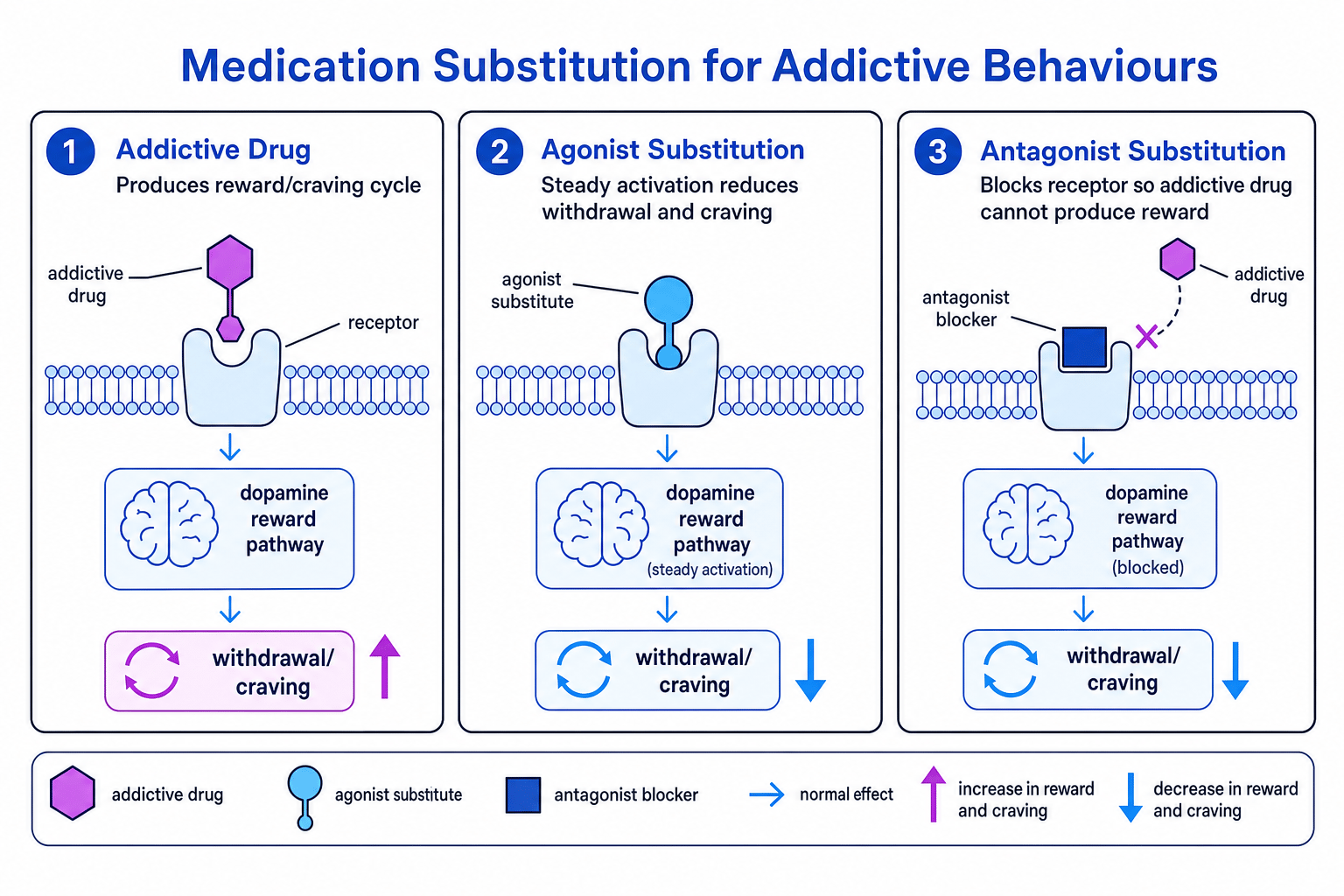
An agonist is a substance that binds to a receptor and activates it. An antagonist is a substance that binds to a receptor and blocks or reduces its activation.
This matters because substitution treatments can either replace the addictive substance with a safer agonist, or block the rewarding effects using an antagonist.
Agonist substitution
In agonist substitution, the person is given a safer, controlled substance that acts on similar receptors to the addictive drug. The aim is not usually immediate abstinence. Instead, it reduces withdrawal and craving so the person can stabilise their life.
Examples include:
- Methadone for heroin dependence: a long-acting opioid agonist, usually taken orally under medical supervision.
- Buprenorphine for opioid dependence: a partial opioid agonist, meaning it activates receptors but has a ceiling effect.
- Nicotine replacement therapy for smoking: patches, gum or sprays provide nicotine without the tar and many toxins in cigarettes.
AO1 description: the substitute keeps receptor activation steadier, reducing the extreme highs and lows caused by the addictive substance. This reduces negative reinforcement because the person no longer needs the addictive substance simply to avoid withdrawal.
Antagonist substitution
In antagonist substitution, the person takes a medication that blocks the rewarding effect of the addictive substance.
Examples include:
- Naltrexone for opioid addiction: blocks opioid receptors, so heroin produces less reward.
- Naltrexone for alcohol dependence: can reduce the rewarding effects of drinking and help prevent heavy relapse.
This works best when the person has already withdrawn from the substance. For example, giving an opioid antagonist too early can trigger severe withdrawal.
Choosing agonist or antagonist treatment
A person with heroin dependence says they want help, but they experience intense withdrawal symptoms whenever they stop.
- The key maintaining factor is withdrawal, so the behaviour is being negatively reinforced: heroin use removes an unpleasant state.
- An agonist substitute such as methadone or buprenorphine is more suitable initially because it activates opioid receptors in a controlled way.
- An antagonist such as naltrexone may be more suitable later, after detoxification, because it blocks reward rather than relieving withdrawal.
AO3 evaluation of substitution
A major strength is that substitution has strong real-world application. Cochrane reviews such as Mattick et al. (2009; 2014) found that methadone and buprenorphine maintenance can improve treatment retention and reduce illicit opioid use. For smoking, Stead et al. (2012) reported that nicotine replacement therapy increases quit rates compared with placebo or no treatment.
Antagonist evidence is also useful. In alcohol dependence, Anton et al. (2006) found that naltrexone helped reduce heavy drinking in the COMBINE study, especially when combined with medical management.
Methodologically, many medication studies use randomised controlled trials, placebo conditions and biological checks such as urine screening, which strengthens internal validity. However, relapse and craving are often measured using self-report, which can be affected by social desirability.
Limitations include side effects, poor adherence and the criticism that agonist substitution may replace one dependence with another. However, this criticism can be too simplistic: reducing overdose risk, criminal activity and withdrawal can be a valid harm-reduction goal.
Mixing up the drugs
Do not say methadone “blocks” heroin. Methadone is an agonist. Naltrexone is an antagonist. Disulfiram, used with alcohol, is better understood as aversion therapy, not antagonist substitution.
Method 2: aversion therapy
The learning idea: classical conditioning
Classical conditioning
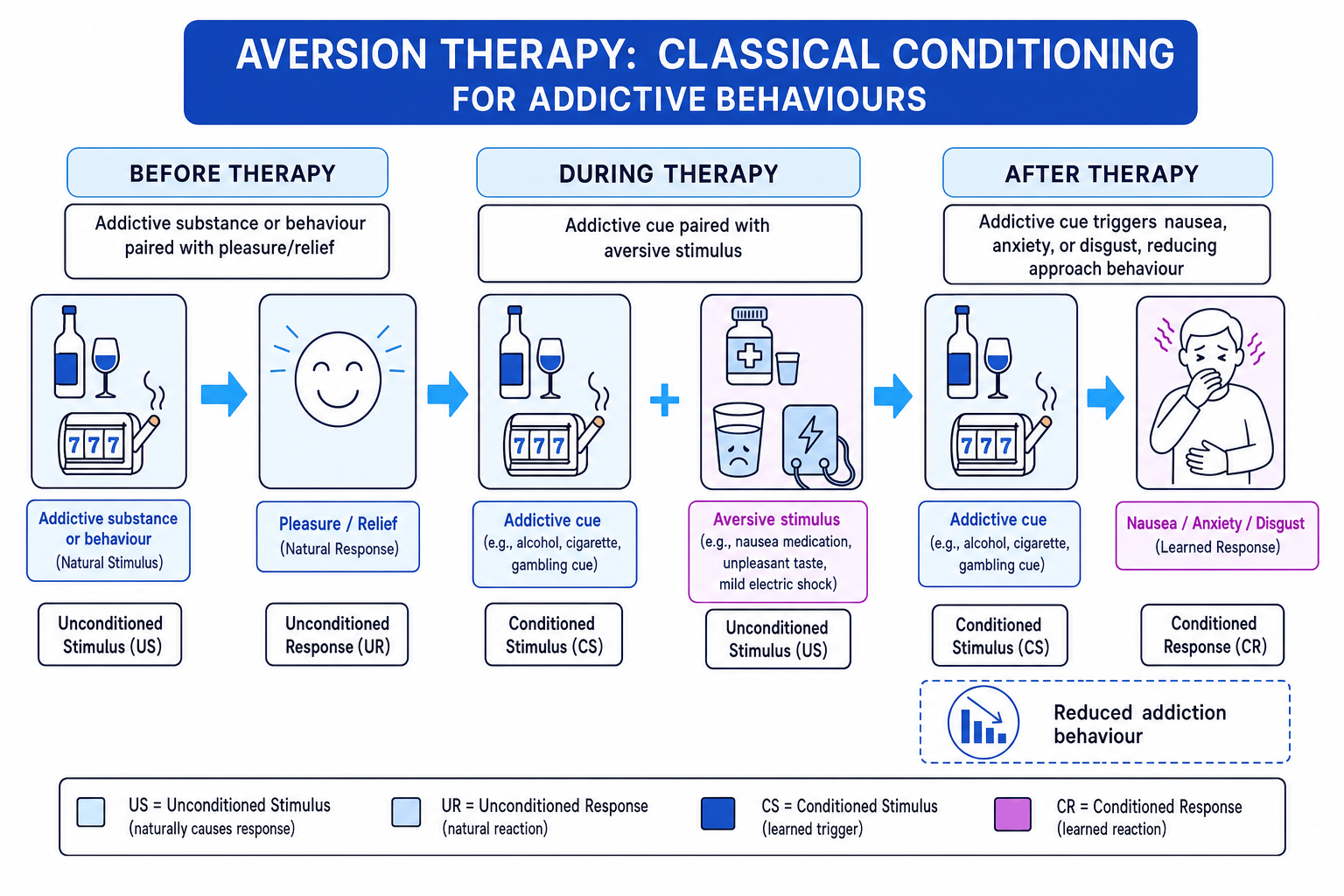
Classical conditioning is learning by association, where a previously neutral stimulus becomes able to trigger a response after being paired with another stimulus.
Aversion therapy is based on the behaviourist approach. It tries to create a new association between the addictive cue and an unpleasant response.
For example, alcohol may previously have been associated with relaxation or confidence. In aversion therapy, alcohol is repeatedly paired with nausea, disgust or another unpleasant experience. Over time, the alcohol cue itself should trigger avoidance.
AO1: how aversion therapy works
The treatment involves pairing the addictive stimulus with an aversive stimulus, meaning something unpleasant.
Examples include:
- Disulfiram for alcohol dependence: if alcohol is consumed, the person experiences unpleasant symptoms such as nausea, headache and palpitations.
- Rapid smoking: the person smokes repeatedly and quickly until the experience becomes unpleasant.
- Covert sensitisation: the person imagines the addictive behaviour followed by a highly unpleasant consequence.
The intended outcome is counterconditioning, where the old pleasurable association is replaced with a new unpleasant association.
Labelling aversion therapy for alcohol
A person takes disulfiram and then experiences nausea after drinking alcohol.
- The unconditioned stimulus is the disulfiram-alcohol reaction because it naturally produces an unpleasant physical response.
- The unconditioned response is nausea or disgust.
- After repeated pairing, alcohol becomes the conditioned stimulus because it predicts the unpleasant reaction.
- The conditioned response is feeling nauseous or avoidant when faced with alcohol, reducing drinking behaviour.
AO3 evaluation of aversion therapy
A strength is that aversion therapy has a clear theoretical basis. It directly targets cue-response learning, so it is easy to apply to scenarios involving specific triggers such as alcohol, cigarettes or gambling cues.
Some evidence supports chemical aversion. For example, Smith, Frawley and Polissar (1991) reported positive abstinence outcomes for alcohol treatment involving chemical aversion, and more recent work such as Elkins et al. (2017) has continued to investigate aversion-based alcohol treatments.
However, findings are mixed. Reviews of aversive smoking treatments, such as Hajek and Stead (2004), suggest that evidence is limited and acceptability is a problem. Aversion may also fail to generalise: a person may avoid the addictive behaviour in the clinic but relapse in real-life situations where the aversive stimulus is absent.
Ethically, aversion therapy is more controversial than substitution. It may involve distress, nausea or discomfort, so practitioners must follow the BPS Code of Ethics and Conduct: informed consent, right to withdraw, protection from harm, confidentiality and debriefing are especially important.
Ethical sensitivity
Aversion therapy should never be described as simply “punishing” the client. In ethical practice, the client must understand the procedure, consent freely and be protected from unnecessary harm.
Comparing the two methods
| Feature | Agonist / antagonist substitution | Aversion therapy |
|---|---|---|
| Main approach | Biological / pharmacological | Behaviourist |
| Main target | Receptors, reward, withdrawal and craving | Learned associations with addictive cues |
| Best suited to | Substance addictions with physical dependence | Addictions with clear cues or rituals |
| Key strength | Strong harm-reduction application | Clear conditioning mechanism |
| Key limitation | Adherence, side effects, possible dependence | Ethical concerns, relapse and poor generalisation |
AO2 shortcut
In a scenario, ask: is the problem mainly withdrawal and craving? Consider substitution. Is the problem mainly a cue linked to pleasure? Consider aversion therapy.
Component 2 link: evaluating treatment research
If you are asked to evaluate evidence, bring in research methods briefly and accurately.
Treatment studies may use:
- Nominal data, such as relapsed / not relapsed.
- Ordinal data, such as ranked craving scores.
- Interval data, such as scores on a standardised dependence questionnaire.
Appropriate inferential tests depend on design and data type:
- Chi-square: nominal frequency data, such as relapse rates in two treatment groups.
- Binomial sign test: related nominal data, such as improved / not improved before and after treatment.
- Mann-Whitney U: difference between two unrelated groups using ordinal data.
- Wilcoxon signed-ranks: difference between related conditions using ordinal data.
- Unrelated t-test: difference between two independent groups using interval data.
- Related t-test: difference between repeated-measures or matched-pairs interval data.
- Spearman’s rho: correlation between two co-variables using ordinal or ranked data.
Use the default significance level p≤0.05p \leq 0.05p≤0.05 unless told otherwise. A directional hypothesis uses a one-tailed test; a non-directional hypothesis uses a two-tailed test. Always compare the observed value with the critical value from the correct table.
Choosing a statistical test
A researcher compares relapse counts in a naltrexone group and a placebo group. Participants are recorded as either “relapsed” or “not relapsed”.
- The researcher is comparing two groups, but the outcome is a set of categories, not scores.
- The data are nominal frequency data, because participants fall into relapse / no relapse categories.
- The appropriate test is chi-square, using the correct critical-value table and usually a two-tailed decision unless a directional hypothesis was stated.
In the exam
- For AO1, describe the mechanism: agonist activates, antagonist blocks, aversion therapy creates an unpleasant learned association.
- For AO2, link the method to the scenario: withdrawal suggests agonist substitution; blocking reward suggests antagonist; cue-triggered behaviour suggests aversion.
- For AO3, include evidence, ethics, adherence, relapse, methodological issues and real-world usefulness.
Check yourself
- What is the difference between an agonist and an antagonist?
- Why might aversion therapy work in a clinic but fail in everyday life?
- Which ethical issues are especially important when using aversive treatments?
