What you'll learn
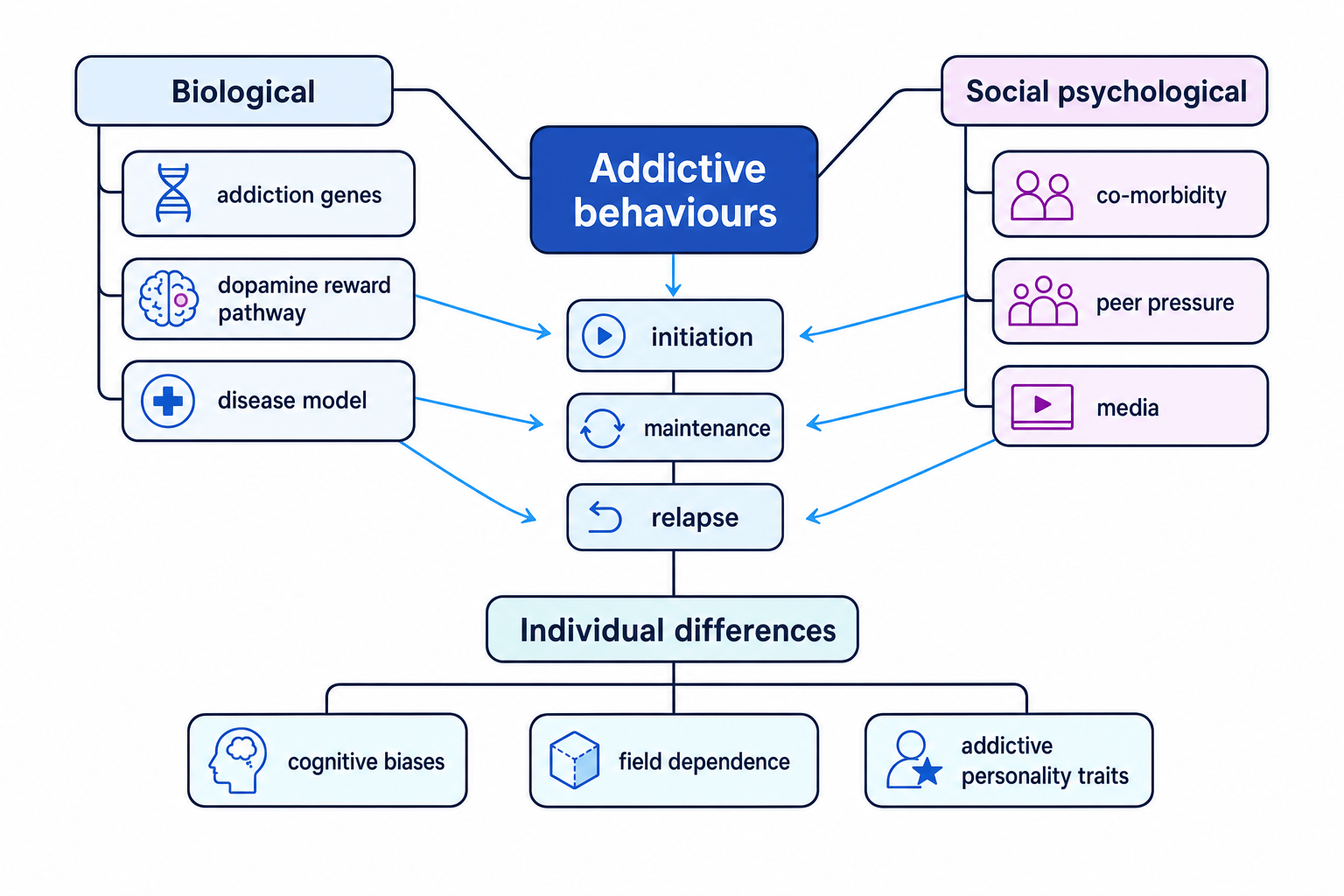
- How psychologists define addiction and explain initiation, maintenance and relapse.
- Three biological explanations: addiction genes, dopamine, and the disease model of the brain.
- Three individual differences explanations: cognitive biases, field dependence, and Lang’s addictive personality traits.
- Three social psychological explanations: co-morbidity, peer pressure, and the role of the media.
Starting point: what is an addictive behaviour?
An addictive behaviour is a repeated behaviour that a person feels driven to continue, even when it causes harm. It can involve a substance such as alcohol, nicotine or cocaine, or a behaviour such as gambling or gaming.
Addiction
Addiction is a pattern of compulsive behaviour involving strong motivation to continue the behaviour, reduced control, and persistence despite negative consequences.
A useful starting model is Griffiths’ components model of addiction, which includes salience (the behaviour dominates thinking), mood modification (it changes how the person feels), tolerance (more is needed for the same effect), withdrawal (unpleasant effects when stopping), conflict and relapse.
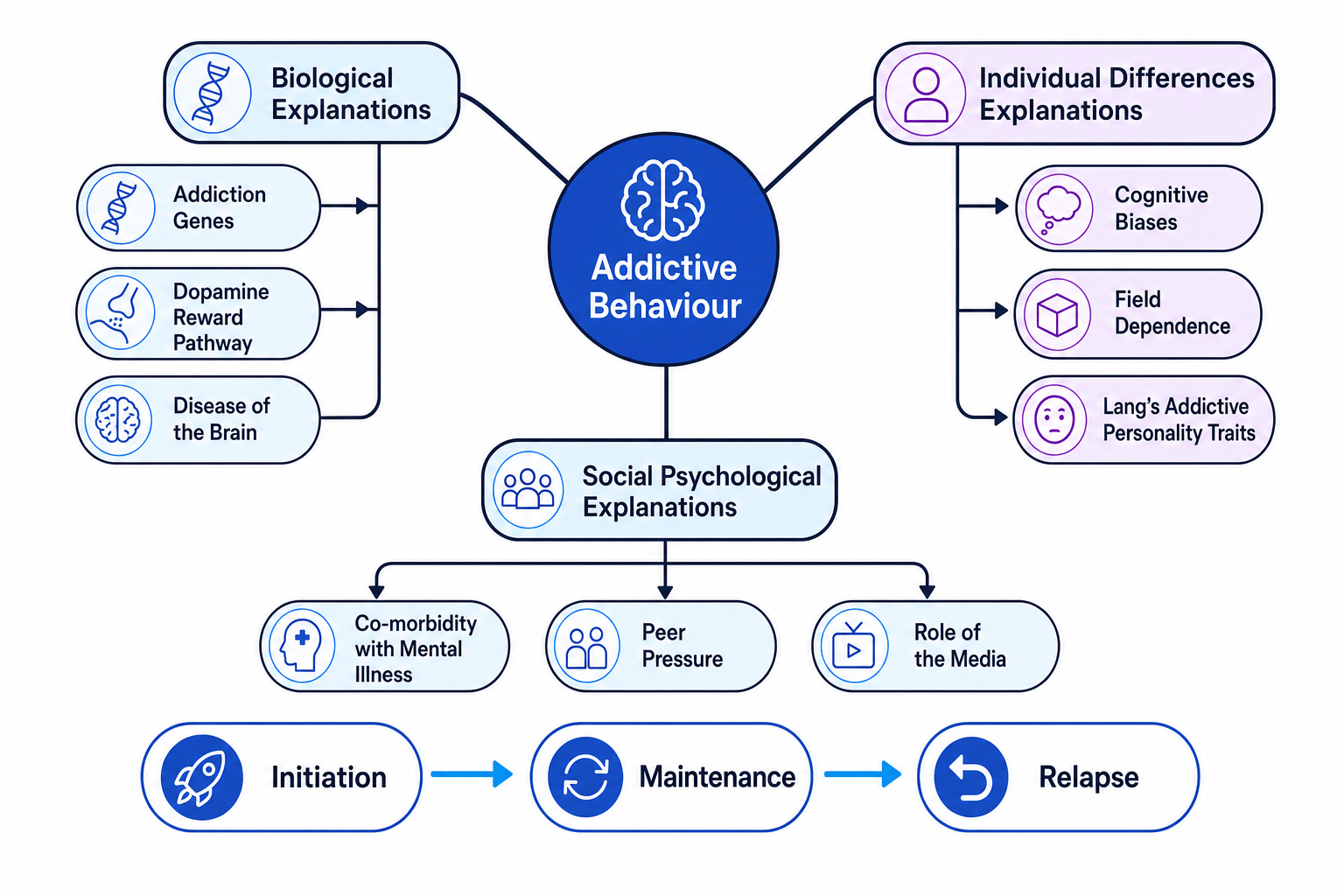
In this topic, an explanation means a theory about why addictive behaviours begin, continue or return.
- Initiation: why the person starts.
- Maintenance: why the behaviour continues.
- Relapse: why the person returns to the behaviour after stopping.
The Eduqas specification organises explanations into biological, individual differences and social psychological levels.
Think biopsychosocial
Strong essays avoid treating one explanation as “the whole answer”. Addiction is usually best explained as an interaction between biology, individual vulnerability and social context.
Biological explanations
Biological explanations focus on genes, brain systems and neurochemistry.
Addiction genes
Genes are inherited sections of DNA that influence biological characteristics. In addiction, researchers look for genetic differences that may make some people more vulnerable to dependence.
An allele is a version of a gene. For example, variation in genes linked to dopamine receptors may affect how strongly a person experiences reward.
Blum et al. (1990) reported an association between the DRD2 A1 allele and severe alcoholism. This suggested that some people may inherit a less efficient dopamine reward system, making them more likely to seek strong rewards through substances or behaviours.
However, genes are not destiny. Addiction is polygenic, meaning many genes are likely to be involved, each with a small effect. Environmental triggers still matter.
Gene does not mean guaranteed addiction
Do not write that a person “has the addiction gene” and therefore must become addicted. A better phrase is: genetic variation may increase vulnerability, especially when combined with environmental risk factors.
Dopamine and the reward pathway
Dopamine is a neurotransmitter: a chemical messenger that passes signals between neurons. It is strongly involved in reward, motivation and learning.
Addictive substances and behaviours can increase dopamine activity in the mesolimbic reward pathway, especially between the ventral tegmental area, the nucleus accumbens and the prefrontal cortex. The brain learns that the addictive behaviour is rewarding, so the person becomes motivated to repeat it.
Over time, repeated exposure may produce tolerance, where the same behaviour gives a weaker effect, so the person needs more of it. Environmental cues, such as a pub, betting advert, phone notification or friendship group, can then trigger craving.
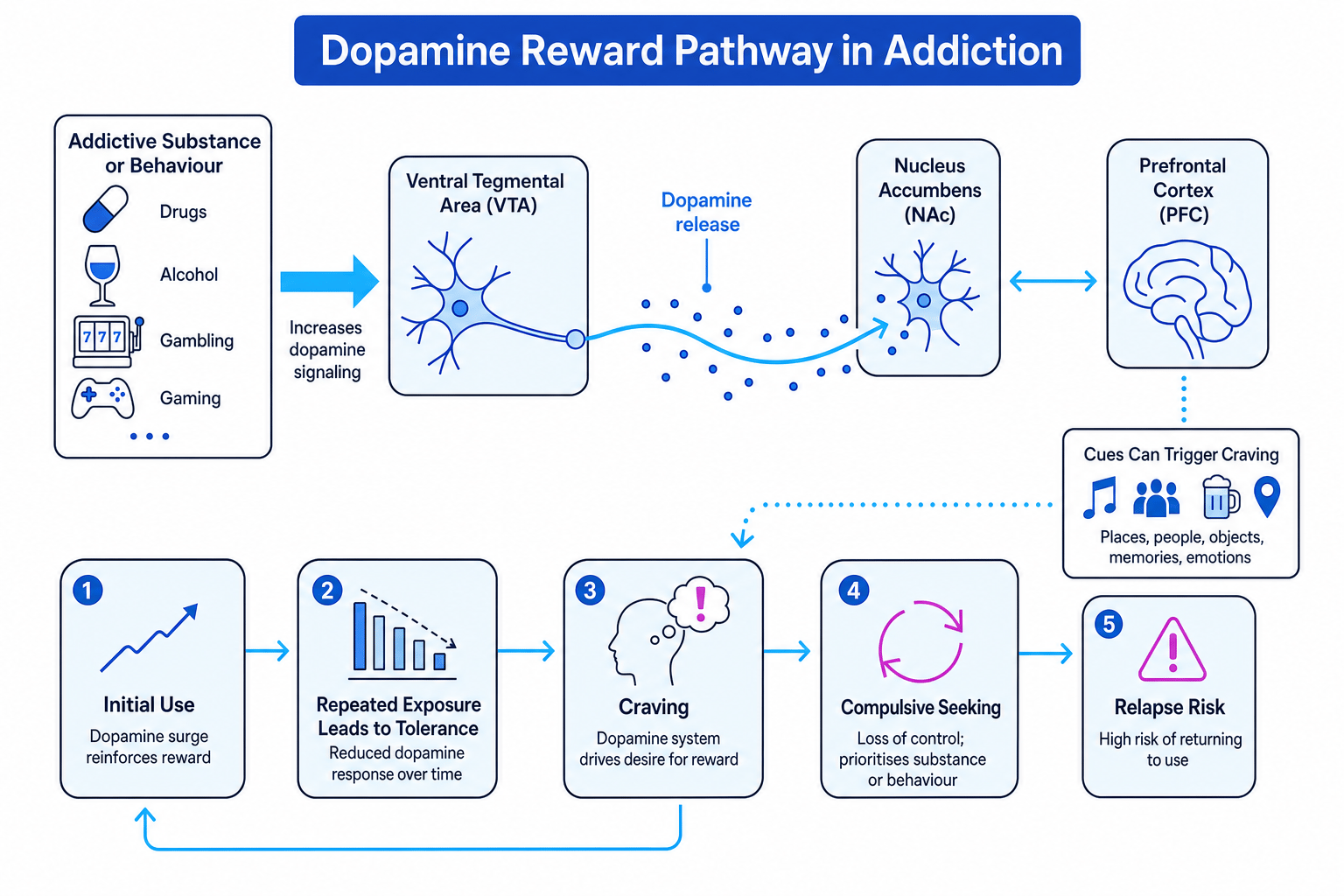
Robinson and Berridge (1993) proposed incentive sensitisation theory. They argued that addiction involves the brain becoming highly sensitive to cues linked with reward. This explains why a person may intensely “want” the behaviour even if they no longer “like” it very much.
Applying dopamine to relapse
A recovering gambler walks past a betting shop and suddenly feels a strong urge to gamble.
- The betting shop acts as a cue because it has been repeatedly paired with gambling rewards in the past.
- Through reward learning, the cue activates dopamine-related motivation systems, particularly pathways involving the nucleus accumbens.
- The urge is therefore not just a “choice”; it reflects learned brain responses that increase craving and relapse risk.
Disease of the brain model
The disease model views addiction as a chronic brain disorder involving changes in reward, self-control and decision-making systems. Researchers such as Volkow and Li (2004) argued that addiction changes the brain in ways that reduce voluntary control.
The prefrontal cortex is important for planning, inhibition and weighing consequences. If addiction disrupts this system, the person may continue despite knowing the harm.
AO3 evaluation is balanced. The disease model is useful because it reduces moral blame and supports medical treatment. Brain imaging also gives objective evidence of changes in brain activity. However, critics argue it can be reductionist, because it may underplay choice, social inequality, trauma and culture. It can also encourage pessimism if people believe they are permanently “diseased”.
Individual differences explanations
Individual differences explanations focus on why some people are more vulnerable than others because of their cognition, personality or perceptual style.
Cognitive biases
A cognitive bias is a systematic error in thinking or attention. In addiction, biases may make the person notice, remember or interpret addiction-related information in a distorted way.
For example, an alcohol-dependent person may show attentional bias, meaning their attention is automatically drawn to alcohol cues. A gambler may show illusion of control, believing they can influence a random outcome, or gambler’s fallacy, believing a win is “due” after several losses.
Field and Cox (2008) reviewed evidence that attentional biases are linked to substance use and craving. This supports the idea that addiction is partly maintained by automatic thinking patterns.
AO3: cognitive explanations are useful because they lead to practical interventions, such as cognitive bias modification and CBT. However, much evidence is correlational: bias may cause addiction, but addiction may also create the bias.
Field dependence
Field dependence is a perceptual and cognitive style originally studied by Witkin and colleagues. A field-dependent person relies more on the surrounding context when making judgements, whereas a field-independent person is better able to separate details from the background.
Applied to addiction, field-dependent individuals may be more influenced by external cues, such as peers, adverts, locations and routines. This could make initiation and relapse more likely when the social environment supports the addictive behaviour.
This explanation links individual differences with social psychology: the person’s style may make them especially sensitive to peer pressure or media cues.
Use field dependence carefully
Field dependence is not an addiction by itself. It is a vulnerability factor: it may make environmental triggers more powerful for some people.
Lang’s addictive personality traits
Lang proposed that some people may have an addictive personality, meaning a cluster of traits that increases vulnerability to addiction. These may include impulsivity, sensation-seeking, non-conformity, emotional instability and difficulty delaying gratification.
The idea is that a person high in these traits may be more likely to try risky behaviours, use substances to manage mood, and struggle to stop once the behaviour becomes rewarding.
AO3: this explanation is easy to apply to individual cases and fits evidence linking impulsivity and sensation-seeking with substance use. However, the idea of one “addictive personality” is controversial. Addicted people are not all alike, and the label can become circular: someone is called addictive because they are addicted.
Social psychological explanations
Social psychological explanations focus on how other people, groups, culture and media influence addiction.
Co-morbidity with mental illness
Co-morbidity means two or more disorders occurring in the same person. Addictive behaviours often co-occur with depression, anxiety, trauma-related difficulties, ADHD or schizophrenia.
One explanation is self-medication, where a person uses substances or behaviours to reduce distress. Another is shared vulnerability, where the same genetic, neurological or environmental risk factors increase the likelihood of both mental illness and addiction.
Regier et al. (1990), using large-scale epidemiological data, found high levels of co-morbidity between mental disorders and substance misuse. This supports the idea that addiction should not be understood in isolation.
AO3: co-morbidity has strong real-world application because treatment may need to address both problems together. However, cause and effect can be hard to untangle: did mental illness lead to addiction, did addiction worsen mental illness, or did both develop from another factor?
Peer pressure
Peer pressure occurs when a person changes behaviour because of real or imagined influence from others. This may be direct, such as being offered drugs, or indirect, such as wanting to fit in with a group norm.
Social learning theory is relevant here. Bandura argued that people learn behaviours by observing and imitating models, especially if the behaviour appears rewarded. In adolescence, peers can provide access, approval and norms that make smoking, drinking or gambling seem acceptable.
Kandel (1978) found that adolescent substance use was strongly related to peer group behaviour. This supports the idea that peer influence affects initiation and maintenance.
Explaining initiation through peer pressure
A student starts vaping after joining a friendship group where vaping is common.
- The group creates a descriptive norm: vaping appears normal because many peers do it.
- The student may expect social reward, such as acceptance, which increases motivation to try it.
- If the behaviour reduces anxiety or gains approval, it is reinforced and more likely to be repeated.
Role of the media
The media includes television, film, advertising, online platforms, influencers and social media. Media can contribute to addiction by normalising behaviour, creating positive expectations, and exposing people to cues.
For gambling, adverts may associate betting with excitement, social success and sport. For smoking or alcohol, media portrayals can make use appear glamorous or adult. Hanewinkel et al. (2012) found that exposure to smoking in films was associated with adolescent smoking, supporting a media influence explanation.
AO3: media explanations are socially important because they support regulation, age restrictions and warning messages. However, many studies are correlational, so it is difficult to prove that media exposure directly causes addiction. People already interested in a behaviour may seek out related content.
Research methods and ethics link
Addiction research often uses questionnaires, correlations, interviews, twin studies, brain imaging and longitudinal designs. Each has strengths and weaknesses.
- Twin and adoption studies help estimate genetic influence, but may be affected by shared environments.
- Brain imaging can show neural correlates, but does not always prove cause and effect.
- Questionnaires can collect large samples, but social desirability may reduce validity.
- Longitudinal studies are useful for tracking initiation and relapse over time, but they can suffer from participant dropout.
If you were analysing a practical investigation, match the statistical test to the design and data. For example, a correlation between impulsivity score and gambling severity could use Spearman’s rho if the data are ordinal. A comparison between two unrelated groups could use Mann-Whitney U for ordinal data or an unrelated t-test for interval data if assumptions are met. The usual significance convention is p≤0.05p \le 0.05p≤0.05.
Ethically, addiction research can involve vulnerable participants, so researchers must follow the BPS Code of Ethics and Conduct: valid consent, right to withdraw, confidentiality, protection from harm and debriefing. Genetic research raises extra concerns about privacy and stigma. Animal research into reward pathways must consider replacement, reduction and refinement, and whether the scientific value justifies possible suffering.
In the exam
- For AO1, organise your answer by explanation type: biological, individual differences and social psychological.
- For AO2, apply the explanation to initiation, maintenance or relapse in the scenario rather than describing it generally.
- For AO3, evaluate with evidence, methodology, ethics and real-world application; avoid simply saying “nature versus nurture” without explaining the interaction.
Check yourself
- How could dopamine explain both the maintenance of addiction and relapse after abstinence?
- Why is “addiction genes cause addiction” too simplistic?
- How might peer pressure and field dependence interact in a real-life case?