If you have ever felt your heart race at the sight of a spider, or felt dizzy looking down from a high balcony, you have experienced a hint of what it is like to live with a phobia. In A-Level Psychology, we look at phobias through the lens of the learning approach (behaviourism).
Because behaviourists believe that phobias are learned through classical conditioning (as demonstrated by Watson & Rayner's 1920 study on Little Albert), they also believe that phobias can be unlearned.
In these notes, we will explore the two primary learning-based treatments for phobias required by the Edexcel specification: Systematic Desensitisation and Flooding.
What you'll learn
- The classical conditioning principles underpinning behavioural treatments.
- How systematic desensitisation uses anxiety hierarchies and reciprocal inhibition to treat phobias.
- How flooding achieves extinction through direct, intense exposure.
- How to evaluate the clinical effectiveness, ethical issues, and practical limitations of both therapies.
Theoretical foundations: How conditioning cures
Before looking at the treatments themselves, we must understand the behavioral mechanisms that make them work. If classical conditioning paired a neutral stimulus (like a dog) with an unconditioned stimulus of fear (like being bitten) to create a phobic conditioned response, treatment must break or replace this association.
Counterconditioning
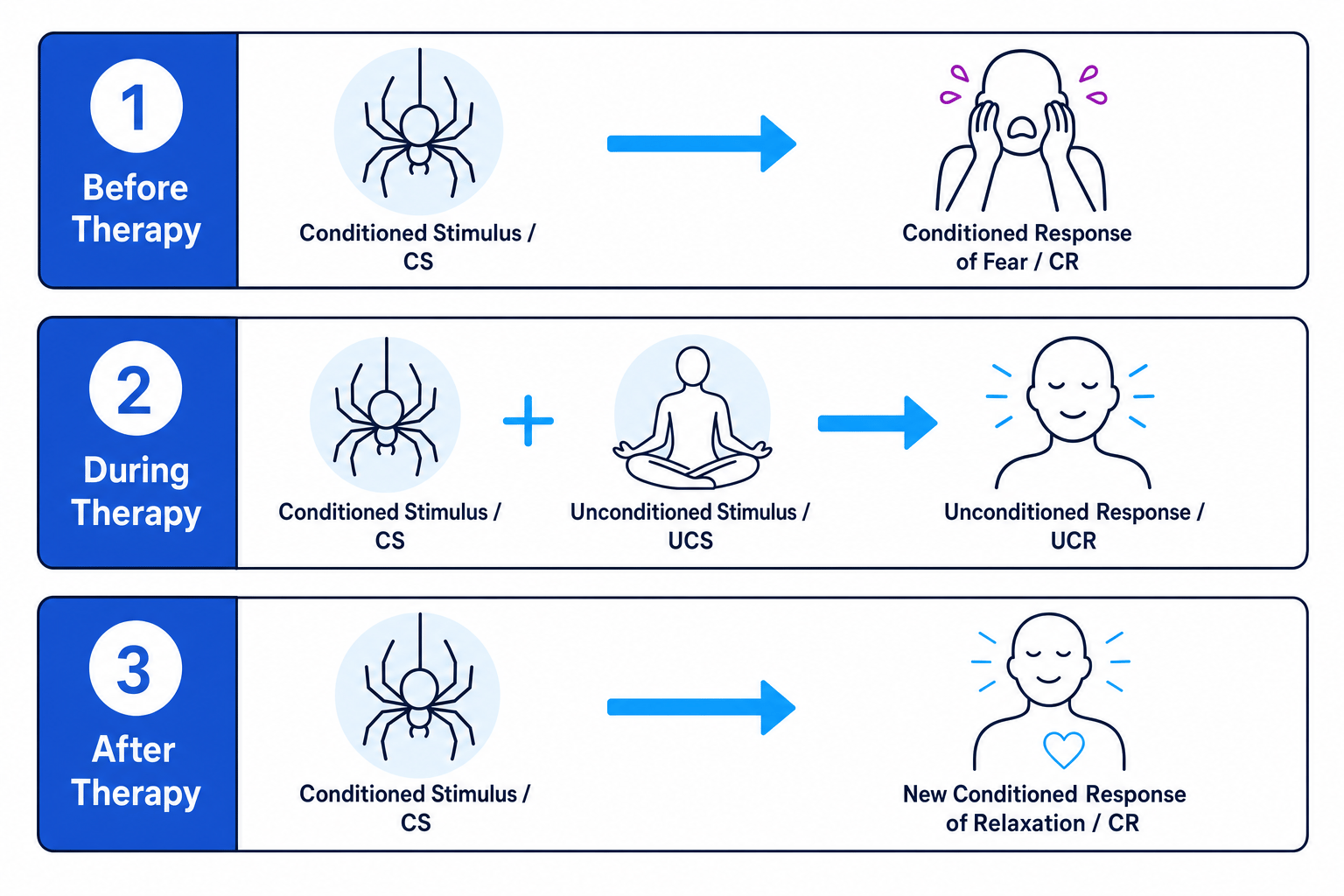
Counterconditioning is a classical conditioning procedure where a new, desirable response (such as deep relaxation) is conditioned to replace an unwanted response (such as fear or anxiety) to a specific stimulus.
To achieve counterconditioning, therapists exploit a biological reality: you cannot physically feel two opposite emotions at the same time. You cannot be intensely relaxed and intensely terrified simultaneously. This is known as reciprocal inhibition.
Reciprocal Inhibition
Reciprocal inhibition is the psychological principle that two incompatible physiological states (e.g., anxiety and relaxation) cannot exist at the same time. The presence of one state actively inhibits the other.
The goal of behavioural therapy
The core objective of behavioural therapy is to replace the conditioned response of anxiety with a new conditioned response of relaxation when exposed to the phobic stimulus.
Treatment 1: Systematic Desensitisation (SD)
Developed by Joseph Wolpe (1958), Systematic Desensitisation (SD) is a behavioural therapy designed to gradually reduce phobic anxiety through classical conditioning. It is a slow, structured process that occurs in three main phases.
1. Relaxation training
The therapist first teaches the patient techniques to achieve deep physiological relaxation. These can include:
- Progressive Muscle Relaxation (PMR): Tensing and then completely releasing different muscle groups.
- Diaphragmatic breathing: Slow, deep breaths to trigger the parasympathetic nervous system.
- Guided imagery: Visualising a calming, safe environment.
2. Designing an anxiety hierarchy
The patient and therapist work together to construct an anxiety hierarchy. This is a stepped list of situations involving the phobic stimulus, ordered from the least frightening to the most terrifying.
3. Graduated exposure
The patient is exposed to the phobic stimulus while practicing their relaxation techniques. This exposure can take two forms:
- In vivo exposure: Real-life, physical contact with the phobic stimulus.
- In vitro exposure: Imagining or using virtual reality to interact with the phobic stimulus.
The therapist starts at the bottom of the anxiety hierarchy. The patient must achieve complete relaxation at a given level before they are allowed to move up to the next step. If they become anxious, they drop back down to a lower level to re-establish relaxation.
In vivo vs. In vitro
To remember the difference, think of the Latin roots: In vivo sounds like "live" (real-life exposure), whereas In vitro sounds like "glass/lab" (artificial or imaginary exposure).
Applying systematic desensitisation to a clinical scenario
Scenario: Amelia has an intense phobia of dogs (cynophobia). She avoids parks, and even seeing a picture of a dog makes her feel highly anxious. Explain how a therapist would use systematic desensitisation to treat Amelia's phobia.
-
Teach relaxation techniques: First, the therapist will train Amelia in physiological coping mechanisms, such as deep diaphragmatic breathing and progressive muscle relaxation, ensuring she can reliably induce a state of calm on command.
-
Construct a personalized anxiety hierarchy: Amelia and the therapist will co-create a graded list of dog-related situations. For example:
- Step 1 (least anxiety-inducing): Looking at a cartoon drawing of a small puppy.
- Step 2: Watching a video of a dog on a leash.
- Step 3: Looking at a real dog through a closed window from 20 meters away.
- Step 4: Standing 10 meters away from a dog on a leash in an open park.
- Step 5 (most anxiety-inducing): Petting a calm, friendly golden retriever.
- Perform graduated exposure: The therapist will present Step 1. Amelia will use her relaxation techniques to counteract her anxiety. Once Amelia reports feeling completely calm while looking at the cartoon drawing (the conditioned response of fear has been successfully replaced by relaxation), they will progress to Step 2. This stepped process repeats until Amelia can comfortably pet a real dog (Step 5) without experiencing fear.
Treatment 2: Flooding
While systematic desensitisation is a gentle, step-by-step climb, Flooding (sometimes called implosion therapy) is an immediate, high-intensity leap.
Flooding
Flooding is a behavioural therapy where a patient is exposed immediately and continuously to an extreme form of their phobic stimulus without any gradual build-up or opportunity to escape.
Unlike SD, flooding does not teach relaxation techniques first, nor does it use a hierarchy. A session of flooding can last several hours, during which the patient is kept in the presence of their feared object (for example, having spiders crawl on their hands, or being locked in a room with harmless dogs).
The mechanism of flooding: Extinction
Flooding works on the principle of extinction. Our body's fight-or-flight response is physiologically limited; the adrenal glands cannot continuously secrete adrenaline at maximum levels indefinitely.
During prolonged exposure, the patient's panic eventually peaks, plateaus, and then rapidly declines as physical exhaustion sets in.
Extinction in flooding
When the patient is exposed to the conditioned stimulus (the phobia) but no negative consequences follow (e.g., they are not bitten or harmed), the association between the conditioned stimulus and the conditioned response of fear is broken. This is called extinction.
Assuming flooding is unethical and illegal
Students often write that flooding is unethical because it causes severe distress, and is therefore not used or is illegal. This is incorrect. Flooding is entirely ethical and legal, provided the patient has given fully informed consent and knows exactly what to expect before the session begins.
Evaluating treatments for phobias (AO3)
When evaluating treatments in your essays, you need to balance their scientific effectiveness against practical limitations and ethical concerns.
1. Clinical effectiveness
- Support for Systematic Desensitisation: There is robust evidence showing that SD is highly effective. For example, Gilroy et al. (2003) followed up 42 patients who had been treated for a spider phobia in three 45-minute sessions of SD. When compared to a control group (who were treated by relaxation without exposure), the SD group were significantly less fearful at both 3 months and 33 months after the treatment.
- Statistical Significance: In clinical trials of SD, researchers typically use inferential statistics to compare anxiety scores before and after treatment. A statistically significant difference (where p≤.05p \le .05p≤.05) between the treatment and control groups confirms that the reduction in anxiety was due to the counterconditioning process, rather than random chance.
- Support for Flooding: Flooding is highly effective and incredibly rapid. Research shows that flooding is often just as effective as SD, but can cure a specific phobia in as little as one single three-hour session, making it highly efficient.
2. Ethics and attrition
- The trauma of Flooding: Flooding is an extremely intense cognitive and physiological experience. Although patients consent to it, the high level of anxiety can lead to high attrition rates (patients dropping out before the therapy is complete).
- The danger of sensitisation: If a patient drops out of a flooding session halfway through because they cannot cope, the therapy can backfire. By escaping the phobic stimulus while still highly anxious, they actually reinforce the phobia. This is called sensitisation, and it leaves the patient more afraid than they were before.
- SD as an ethical alternative: SD has much lower attrition rates because the patient is in complete control of when they move up or down the hierarchy. This makes it a much more ethical choice, particularly for vulnerable groups like children or individuals with learning difficulties.
3. Practicality and suitability
- Cost-effectiveness: Flooding is highly cost-effective because it requires very few sessions compared to SD, saving the NHS time and money.
- Cognitive phobias: Neither treatment is fully effective for complex phobias (such as social anxiety disorder or agoraphobia) that have heavy cognitive elements (like irrational thoughts of social judgment). These complex phobias often require cognitive therapies, like Cognitive Behavioural Therapy (CBT), rather than purely behavioural ones.
- Symptom substitution: Psychodynamic psychologists argue that behavioural therapies only treat the visible symptoms (the behaviour) rather than the underlying psychological cause of the phobia. They claim that if you remove one symptom without treating the root cause, a new symptom will simply take its place (e.g., a hand-washing compulsion replacing a spider phobia).
In the exam
If you are asked to evaluate treatments for phobias in an essay, use the following structural tips:
- Compare and contrast: Frame your evaluation points around comparisons between SD and Flooding (e.g., "While flooding is more cost-effective, SD has a much lower attrition rate...").
- Apply the terminology: Ensure you explicitly use the theoretical mechanisms (counterconditioning, reciprocal inhibition, extinction) to explain why the treatments succeed or fail.
- Bring in the ethics: When discussing flooding, remember to mention that while it causes psychological distress, it is made ethical through rigorous informed consent and the patient’s right to withdraw.
Check yourself
- Why is it physiologically impossible to feel panic while performing progressive muscle relaxation?
- What is the main difference between in vivo and in vitro exposure?
- Why might a patient who drops out of a flooding session experience sensitisation instead of extinction?
