Applying the Concepts
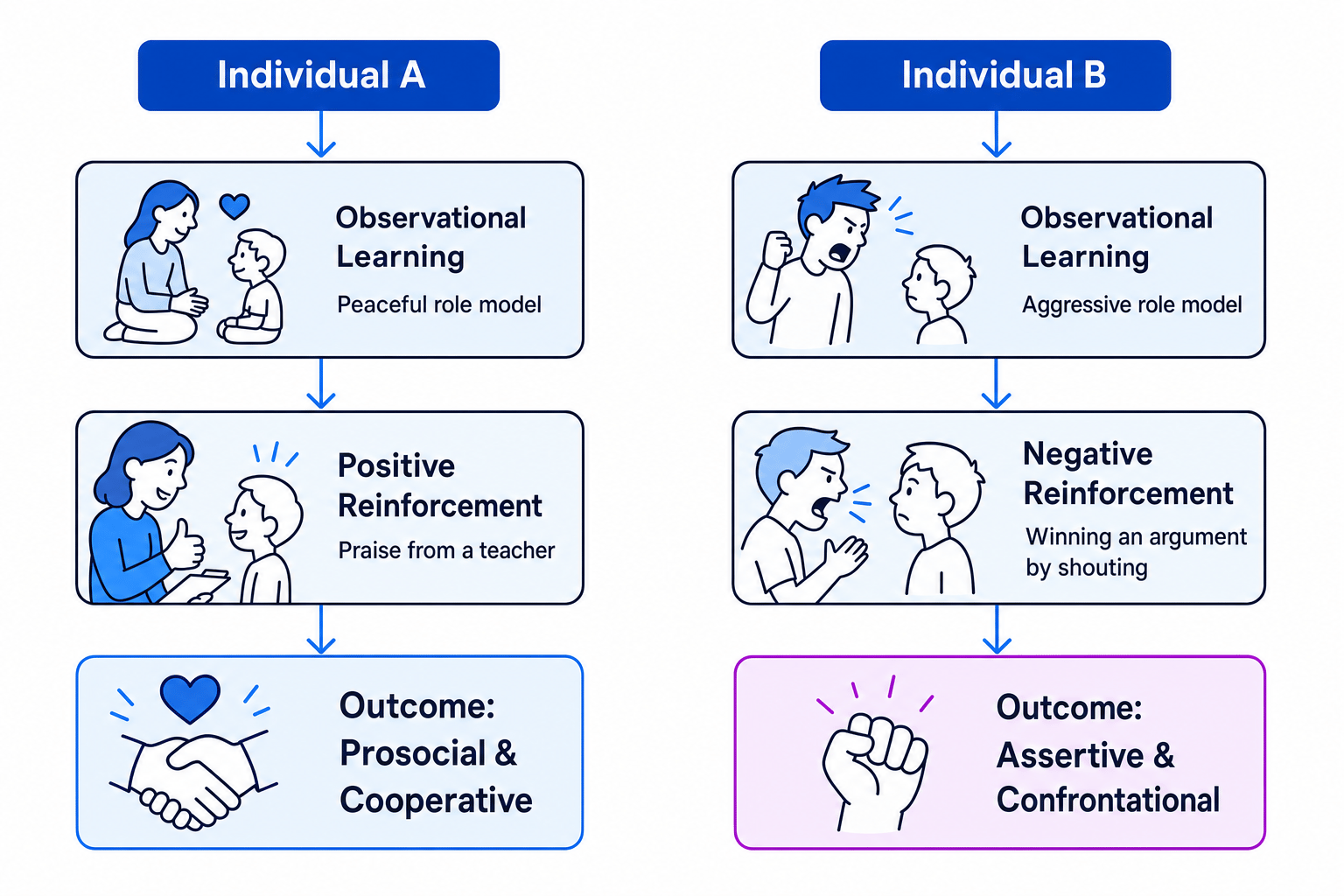
In the exams, you will often be given a scenario describing two people with very different behaviors, and you will be asked to apply your knowledge of learning theories to explain these individual differences.
Explaining a difference in phobias between siblings
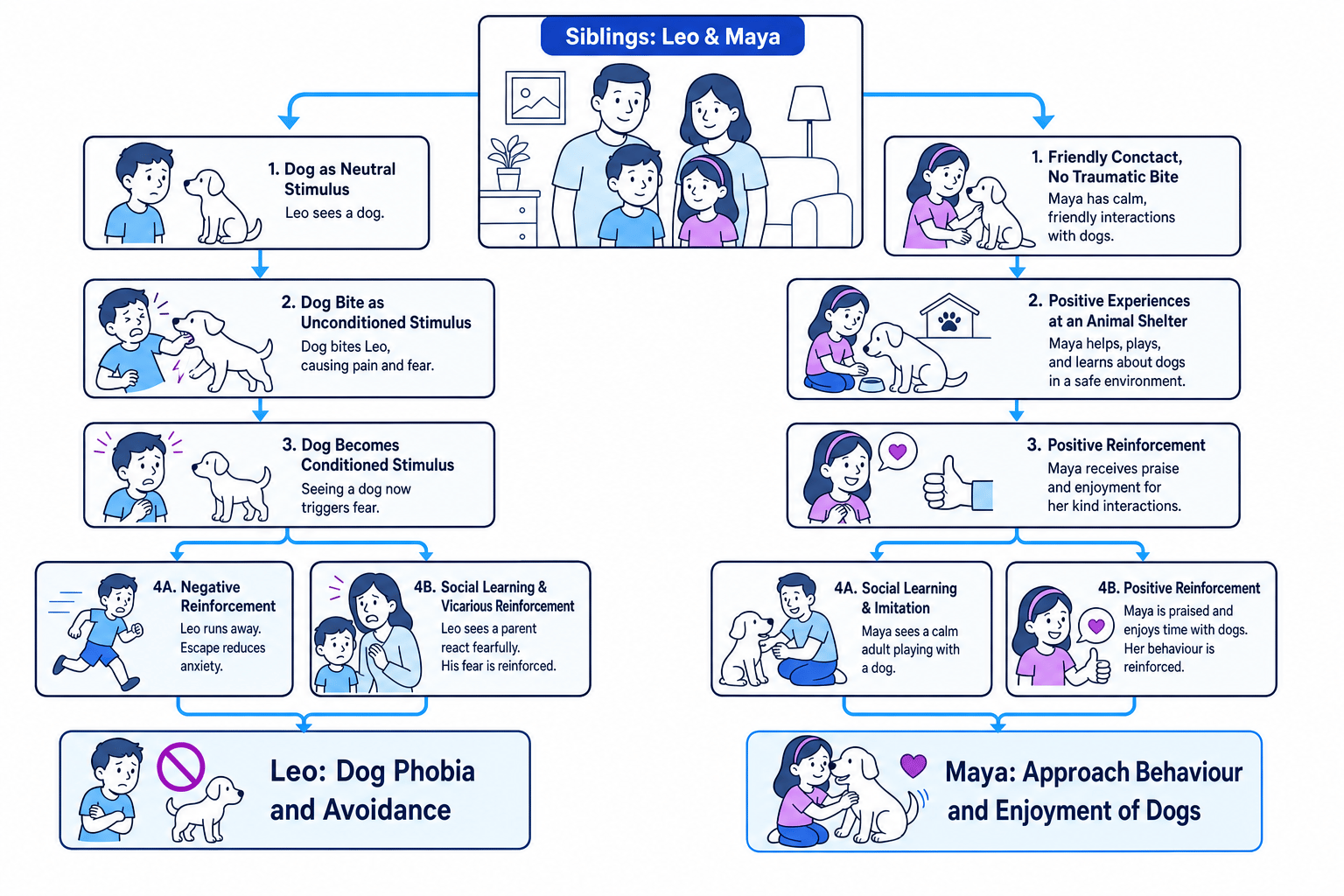
Scenario: Leo and Maya are non-identical twin siblings. Leo is terrified of dogs and runs away whenever he sees one. Maya, on the other hand, loves dogs and frequently volunteers at a local animal shelter. Explain the individual differences between Leo and Maya using learning theories.
Steps to construct your explanation:
- Identify and apply Classical Conditioning (Direct Association): Analyze how Leo might have acquired a fear response that Maya did not. To do this, explicitly trace the Stimulus-Response association. You can state that Leo may have had a direct traumatic experience (e.g., being bitten by a dog). The dog began as a Neutral Stimulus (NSNSNS), the bite was an Unconditioned Stimulus (UCSUCSUCS) causing an Unconditioned Response (UCRUCRUCR) of pain/fear. Through association, the dog became a Conditioned Stimulus (CSCSCS) producing a Conditioned Response (CRCRCR) of fear. Maya, lacking this pairing, did not form this association.
- Identify and apply Operant Conditioning (Reinforcement): Explain how Leo's avoidance behavior is maintained. When Leo sees a dog, he runs away. Running away successfully removes him from the anxiety-provoking situation. This removal of an unpleasant state is negative reinforcement, which strengthens his avoidance behavior over time. Conversely, Maya's volunteer work at the shelter likely results in positive experiences, such as playing with friendly dogs and receiving social praise from staff, which acts as positive reinforcement for her approach behavior.
- Identify and apply Social Learning Theory (Modeling and Vicarious Learning): Explain how their different experiences of observing others contributed to their behaviors. Perhaps Leo frequently observed his mother reacting with panic and screaming when seeing a dog, providing an aggressive/fearful role model. Leo observed this behavior and the mother's escape (vicarious reinforcement), leading him to copy it. Maya, however, may have spent more time with her father, who was calm and playful with dogs, providing a completely different role model to observe and imitate.
Confusing Negative Reinforcement with Punishment
Students often write that Leo running away is "punished" because it stops him from having fun, or they use negative reinforcement as a synonym for punishment. Remember: reinforcement (both positive and negative) always increases the likelihood of a behavior repeating. Leo running away is negatively reinforced because it removes his fear (an unpleasant state), making him more likely to run away next time.
Evaluating the Learning Explanation of Individual Differences
To secure high marks in AO3 essay questions, you need to weigh the strengths and limitations of using learning theories to explain why we differ from one another.
Strengths (AO3)
- Scientific and Testable Methodology: The learning explanations are grounded in empirical, observable concepts. For example, Skinner's work on rats and pigeons demonstrated how reinforcement schedules reliably alter behavior. This high level of experimental control adds scientific credibility to the claim that rewards and punishments shape human differences.
- Practical Applications (Therapy): Understanding that individual differences in behavior are learned has led to highly effective therapies. If maladaptive behaviors (such as phobias or aggression) are learned through environmental conditioning, they can be unlearned.
- Systematic Desensitization is used to dismantle classical conditioning associations.
- Token Economies (based on operant conditioning) are used in psychiatric hospitals and prisons to reward desirable behaviors, successfully altering individual behavioral patterns.
- Accounting for Behavioral Plasticity: Unlike biological explanations, which can be deterministic, the learning approach explains how and why people can change. If a person moves to a new environment with different reinforcement contingencies and role models, their behavior will change. This explains why we behave differently in different social contexts (e.g., quiet at school but loud with friends).
Weaknesses (AO3)
- Environmental Determinism: The learning approach assumes our behavior is determined entirely by external forces (rewards, punishments, models). It ignores free will—the idea that individuals can consciously choose how to behave regardless of their past conditioning.
- Biological Reductionism (The Nature-Nurture Debate): By focusing exclusively on nurture, this explanation ignores powerful biological influences on individual differences:
- Genetics and Temperament: Twin studies consistently show that personality traits (like extraversion or neuroticism) have a high heritability rate of around 40-50%. Some babies are born with a more sensitive autonomic nervous system, making them naturally more prone to developing anxiety or phobias, regardless of their upbringing.
- Hormones and Neurotransmitters: Individual differences in aggression have been linked to levels of testosterone and serotonin, which cannot be explained purely by rewards or observed models.
- Extrapolation from Animal Studies: Much of the foundational evidence for operant and classical conditioning (e.g., Pavlov, Skinner) comes from animal research. Humans have highly complex cognitive processing systems, meaning we do not react to rewards and punishments in the same automatic way that rats or pigeons do.
Integrating Issues and Debates
When evaluating individual differences, always link back to the Nature vs. Nurture debate. The learning approach sits firmly on the nurture side. To show top-tier evaluation, explain how a modern interactionist approach (such as the diathesis-stress model) is a more complete explanation: biology (nature) provides the initial temperament, but the environment (nurture) determines how those traits are expressed.
In the exam
- Unpack the scenario carefully: If an exam question asks you to apply learning theories to a scenario involving individual differences, look for clues. Active behaviors suggest operant conditioning (look for the rewards or escapes), while copied behaviors or specific parental influences suggest social learning theory (look for models and vicarious consequences).
- Explicitly use the terminology: Don't just say "Leo learned to be scared." Say "Leo formed a classical conditioning association between the neutral stimulus of the dog and the unconditioned stimulus of the bite." Precision in terminology is what separates a Grade C answer from a Grade A/A* answer.
- Structure your evaluation essays: If asked to evaluate the learning explanation of individual differences, use the PEEL structure (Point, Evidence, Explanation, Link). Balance the practical strengths (like therapies) against the biological limitations (like genetic predispositions).
Check yourself
- Can you explain how two people living in the same house can develop different behavioral habits using the concept of "reinforcement history"?
- What is the difference between direct reinforcement and vicarious reinforcement in shaping individual differences?
- Why is a purely environmental explanation of individual differences considered reductionist?