What you'll learn
- How classical conditioning can explain the acquisition of a phobia.
- How operant conditioning can explain the maintenance of a phobia through avoidance.
- How social learning theory explains phobias learned by observing others.
- How to evaluate learning explanations using evidence, ethics and real-world applications.
Starting point: what is a phobia?
A phobia is more than a dislike or ordinary fear. It is an intense, persistent fear of an object, situation or activity that leads to avoidance and disrupts everyday life.
For example, someone with a dog phobia may cross the road to avoid dogs, stop visiting friends with pets, or feel panic even when seeing a dog on television.
Phobia
A phobia is an irrational or excessive fear response to a particular stimulus or situation, often involving anxiety, avoidance and disruption to normal functioning.
What do learning theories assume?
Learning theories explain behaviour as something acquired through experience. In this topic, the key idea is that phobias are not necessarily “born” in a person — they may be learned through association, consequences, or observation.
Learning theories are mainly behaviourist, meaning they focus on observable behaviour rather than unconscious thoughts or biological causes.
The big idea
Learning theories explain phobias as fears that are acquired through learning and then maintained because avoidance reduces anxiety.
The diagram below shows the three main learning routes you need for this topic.
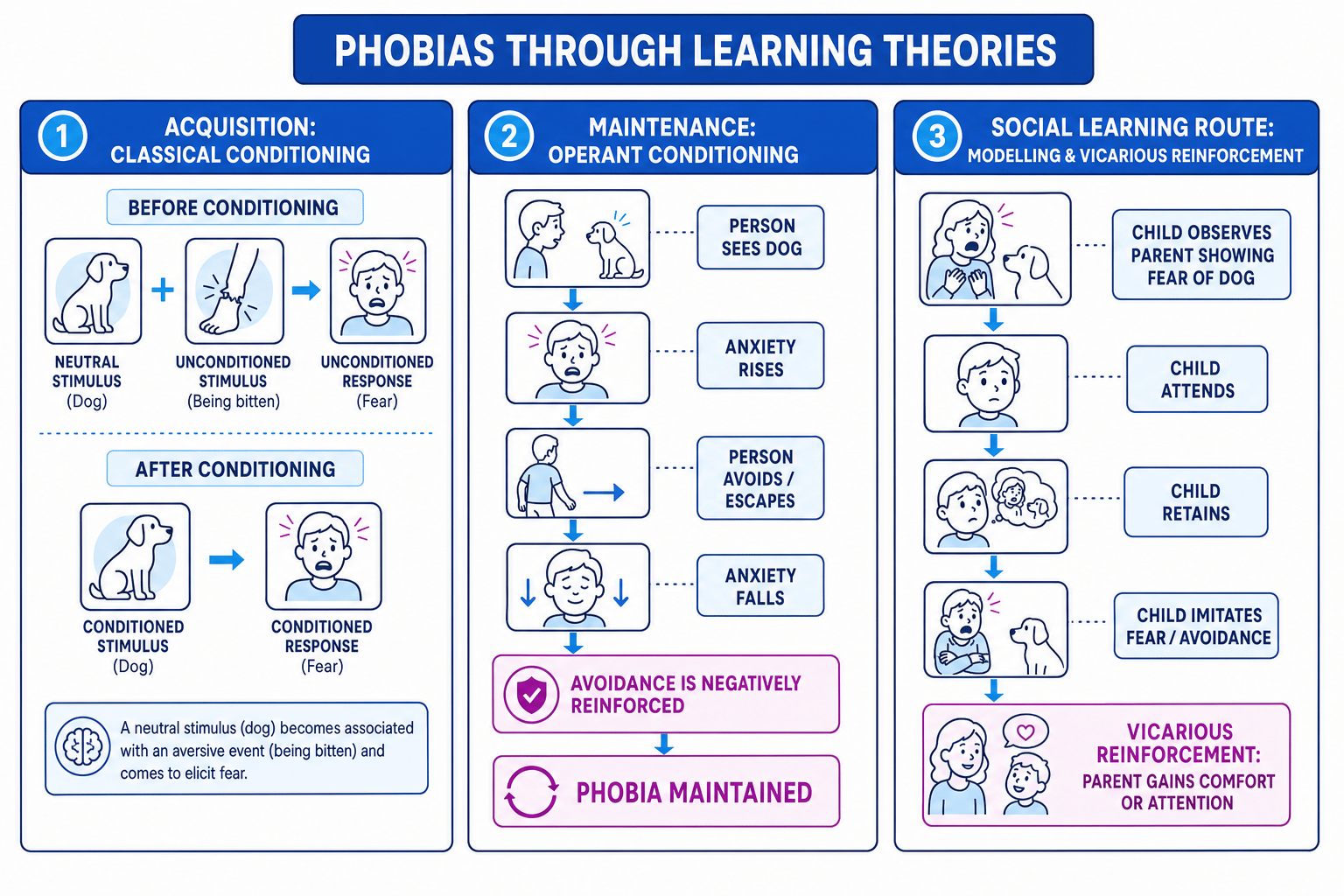
Acquisition: learning the fear
Acquisition means how the phobia is first learned. Learning theories usually explain acquisition through classical conditioning and/or social learning theory.
Acquisition
Acquisition is the process by which a person first develops a fear or phobic response.
Classical conditioning: learning by association
Classical conditioning is learning by association. A person learns to associate a previously neutral stimulus with something frightening or unpleasant.
This idea comes from behaviourist research such as Pavlov’s work with dogs, where dogs learned to associate a bell with food. In phobias, the association is usually between a neutral object or situation and a frightening event.
The key terms
A neutral stimulus is something that does not originally cause fear. For example, a dog may be neutral before a person has a bad experience.
An unconditioned stimulus is something that naturally causes a response without learning, such as being bitten.
An unconditioned response is the natural reaction to the unconditioned stimulus, such as fear or pain after being bitten.
After repeated or powerful association, the neutral stimulus becomes a conditioned stimulus. It now triggers fear by itself.
The fear response is then called a conditioned response because it has been learned.
Classical conditioning
Classical conditioning is learning through association, where a neutral stimulus becomes linked with an unconditioned stimulus and begins to produce a conditioned response.
Acquiring a dog phobia
-
Before the frightening event, the dog is a neutral stimulus because it does not automatically produce intense fear.
-
The bite is the unconditioned stimulus because it naturally produces pain and fear without the person needing to learn that reaction.
-
When the dog and the bite occur together, the person forms an association between the dog and fear.
-
After conditioning, the dog becomes a conditioned stimulus, and fear when seeing a dog becomes the conditioned response.
-
If the person then fears many dogs, not just the original dog, this is stimulus generalisation.
Stimulus generalisation
Stimulus generalisation happens when the fear spreads to similar stimuli. For example, someone bitten by a large black dog may later fear all dogs, barking sounds, parks, or even dog leads.
This helps explain why phobias can become wider and more disruptive over time.
Stimulus generalisation
Stimulus generalisation occurs when a learned response to one stimulus spreads to other similar stimuli.
Watson and Rayner: Little Albert
A classic piece of evidence for classical conditioning is Watson and Rayner’s Little Albert study (1920). They conditioned an infant, Albert, to fear a white rat by pairing the rat with a loud frightening noise. Albert later showed fear towards the rat and similar white fluffy objects.
This supports the idea that fear can be learned through association. However, it is a very ethically problematic study.
Under the BPS Code of Ethics and Conduct (2009), psychologists must consider consent, right to withdraw, protection from harm, confidentiality and debriefing. Little Albert could not give informed consent, was deliberately distressed, and was not properly desensitised afterwards.
Do not overuse Little Albert
Little Albert supports the possibility of learned fear, but it does not prove that all phobias are acquired through classical conditioning. It was a single case, involved an infant, and had serious ethical issues.
Maintenance: why the phobia continues
Maintenance means why the phobia persists over time. The key learning explanation here is operant conditioning.
Maintenance
Maintenance is the process by which a phobia continues after it has first been acquired.
Operant conditioning: learning through consequences
Operant conditioning is learning through consequences. If a behaviour is followed by a rewarding consequence, it is more likely to happen again.
In phobias, the important behaviour is usually avoidance.
For example, a person with a lift phobia avoids lifts and takes the stairs. Their anxiety quickly decreases. This reduction in anxiety acts as a reward, so they are more likely to avoid lifts again.
This is called negative reinforcement.
Negative reinforcement
Negative reinforcement occurs when a behaviour is strengthened because it removes or reduces something unpleasant.
Negative reinforcement does not mean punishment. It means something unpleasant is taken away. In phobias, the unpleasant thing removed is usually anxiety.
Negative reinforcement is not punishment
If avoidance reduces anxiety, the avoidance behaviour is being negatively reinforced. Punishment would make a behaviour less likely, but negative reinforcement makes avoidance more likely.
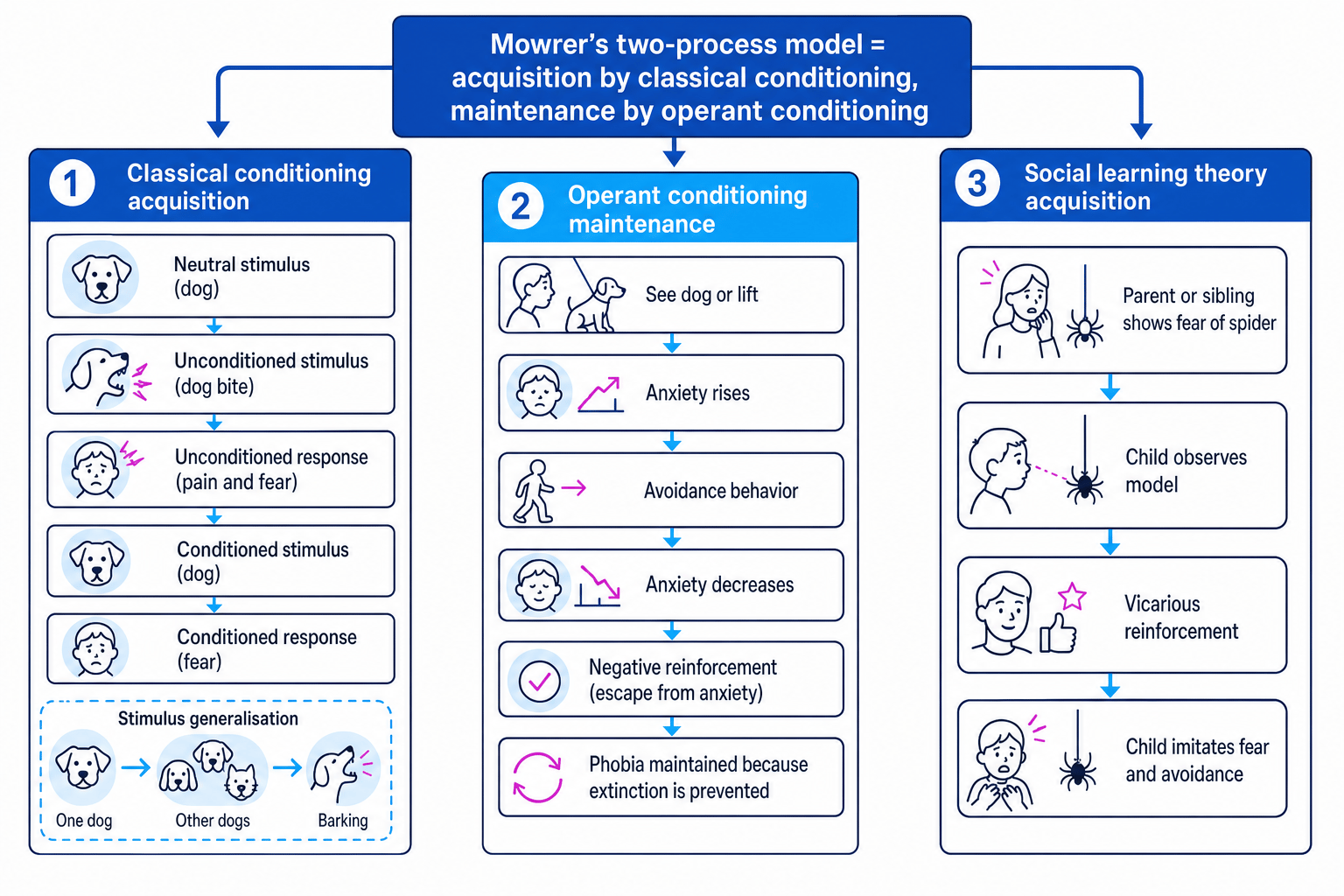
Mowrer’s two-process model
Mowrer’s two-process model (1947) combines classical and operant conditioning.
It says phobias are:
- Acquired through classical conditioning.
- Maintained through operant conditioning.
This is a strong AO1 point because it clearly separates how the phobia starts from why it continues.
Two-process model
Mowrer’s two-process model explains phobias as a two-stage process: fear is learned by association, then avoidance is strengthened because it reduces anxiety.
Maintaining a lift phobia
-
The person has learned to associate lifts with fear, so the lift now acts as a conditioned stimulus.
-
When they see a lift, anxiety rises, so they choose the stairs instead.
-
Taking the stairs removes the unpleasant anxiety, so avoidance is negatively reinforced.
-
Because they keep avoiding lifts, they do not get the chance to learn that lifts are usually safe.
-
This prevents extinction, so the phobia is maintained.
Extinction: why avoidance is a problem
Extinction occurs when the conditioned stimulus is repeatedly experienced without the feared outcome, so the fear response weakens.
For example, if someone gradually spends time near calm dogs without being bitten, the association between dogs and danger may reduce.
Avoidance blocks this process. If the person never goes near dogs, they never gather evidence that dogs can be safe.
Extinction
Extinction is the weakening of a conditioned response when the conditioned stimulus is repeatedly presented without the unconditioned stimulus.
Social learning theory: learning by observing others
Not all phobias begin with a direct frightening experience. Some may be learned by watching other people.
Social learning theory, associated with Bandura (1977), argues that people learn behaviours by observing and imitating models, especially people they identify with, such as parents, siblings or peers.
In phobias, a child might observe a parent screaming around spiders and learn that spiders are dangerous.
Social learning theory
Social learning theory explains behaviour as learned through observing others, imitating them, and noticing the consequences of their behaviour.
Modelling and vicarious reinforcement
Modelling means demonstrating a behaviour that another person may imitate.
Vicarious reinforcement means learning from the consequences another person receives. For example, if a parent avoids a dog and then receives comfort, attention, or relief, a child may learn that avoidance is useful.
Bandura’s Bobo doll study (1961) was not about phobias, but it supports the broader idea that children can imitate observed behaviour. Research by Mineka and Cook (1984) found that monkeys could acquire fear of snakes by observing other monkeys reacting fearfully, which is more directly relevant to phobias.
Learning a spider phobia by observation
-
A child sees their older sibling scream and run away whenever a spider appears.
-
The sibling acts as a model, especially if the child sees them as similar, important, or trustworthy.
-
The child observes that running away reduces distress or brings comfort from others, so avoidance is vicariously reinforced.
-
The child later imitates the fear and avoidance response when they see a spider themselves.
AO3: strengths of learning explanations
They explain both acquisition and maintenance
A major strength of Mowrer’s two-process model is that it explains why phobias persist. Classical conditioning alone explains how fear begins, but operant conditioning explains why avoidance continues.
This is useful because many phobias last for years, even when the person knows the fear is irrational.
They have practical applications
Learning theories have led to effective treatments, especially systematic desensitisation and flooding.
Both are based on the idea that avoidance maintains fear. By safely exposing the person to the feared stimulus, the fear response can weaken through extinction.
This gives learning theories strong real-world value.
AO3 application link
If a theory leads to a successful treatment, that is a strong evaluation point: it suggests the explanation has practical usefulness.
They are supported by evidence
Watson and Rayner’s Little Albert study supports classical conditioning, while Mineka and Cook’s monkey research supports observational learning. These studies show that fear can be learned through association and observation.
However, use this evidence carefully: supporting evidence does not mean the theory explains every case.
AO3: limitations of learning explanations
Not everyone has a traumatic learning experience
Many people with phobias cannot remember a direct conditioning event. For example, someone may have a severe snake phobia without ever being bitten by a snake.
This challenges a purely classical conditioning explanation.
Preparedness may matter
Preparedness, linked to Seligman (1971), is the idea that humans may be biologically prepared to develop fears of things that were dangerous in our evolutionary past, such as snakes, spiders, heights or darkness.
This may explain why some phobias are more common than others. We are more likely to fear spiders than plug sockets, even though plug sockets may be more dangerous in modern life.
So, learning may interact with biological predispositions.
The theory can be reductionist
A reductionist explanation oversimplifies behaviour by focusing on one level of explanation. Learning theories focus mainly on behaviour and experience, but phobias may also involve cognition, genetics, temperament and brain processes.
For example, cognitive explanations would focus on irrational beliefs, attentional bias and catastrophic thinking.
Ethical and methodological issues in evidence
Little Albert is often used as evidence, but it has major ethical and methodological weaknesses. It involved harm, lacked valid consent, and was based on one child, so generalisability is limited.
This weakens the evidence base if it is used too heavily.
How to write this in an essay
For AO1, describe the learning process accurately using the correct terms: neutral stimulus, unconditioned stimulus, conditioned stimulus, negative reinforcement, modelling and vicarious reinforcement.
For AO2, apply the explanation to the specific phobia in the scenario. If the question is about a dog phobia, keep linking each point back to dogs, bites, barking, avoidance and reduced anxiety.
For AO3, evaluate with evidence, applications and limitations. A strong paragraph might say that the two-process model is useful because it explains both acquisition and maintenance, but it may be incomplete because not all phobias follow a clear traumatic event.
In the exam
-
Separate acquisition and maintenance clearly: classical conditioning usually explains the start, while operant conditioning explains persistence.
-
Use the correct behaviourist terms and apply them to the phobic stimulus in the question.
-
For AO3, balance strengths such as supporting evidence and treatment applications with limitations such as ethics, reductionism and preparedness.
Check yourself
-
How would classical conditioning explain a fear of dogs after being bitten?
-
Why is avoidance described as negative reinforcement?
-
How could social learning theory explain a child developing the same phobia as a parent?