When studying Health Psychology for your Edexcel A-Level, you must understand how biological and learning theories are translated into real-world treatments. Addiction is a complex disorder characterized by compulsive drug-seeking behavior and physiological dependence.
This guide covers two distinct treatments for alcohol, heroin, and nicotine addiction, exploring how they work (AO1) and how to critically evaluate their effectiveness, ethicality, and practical use (AO3).
What you'll learn
- How classical conditioning is used in aversion therapy to treat alcohol and nicotine addiction.
- How agonist and antagonist treatments physiologically manage heroin, nicotine, and alcohol dependency.
- How to evaluate the clinical effectiveness, ethical issues, and social implications of these treatments.
1. Aversion Therapy (Psychological/Behavioral)
Aversion therapy is based on classical conditioning (Learning Theory). The goal is to replace a positive, reinforcing association with a negative, unpleasant one, thereby extinguishing the addictive behavior.
This treatment is highly versatile and is used to treat both alcohol and nicotine addictions.
Aversion Therapy
Aversion therapy is a behavioral treatment that pairs an unwanted addictive behavior (such as drinking alcohol or smoking) with an unpleasant stimulus (such as nausea or electric shocks) to condition a strong negative reaction to the drug.
Aversion Therapy for Alcohol Addiction
To treat alcohol addiction, clinicians use a drug called disulfiram (commonly known by the brand name Antabuse).
- The Physiology: Normally, the liver breaks down alcohol into acetaldehyde, which is then quickly broken down into harmless acetic acid. Disulfiram blocks the enzyme that breaks down acetaldehyde.
- The Reaction: If a patient drinks alcohol while taking disulfiram, acetaldehyde builds up rapidly in the bloodstream. This causes an immediate, severe reaction including violent vomiting, blinding headaches, chest pain, and extreme nausea.
- The Conditioning: By experiencing this severe sickness every time they taste, smell, or even see alcohol, the patient associates alcohol (the Neutral Stimulus which became a Conditioned Stimulus) with intense nausea (the Conditioned Response).
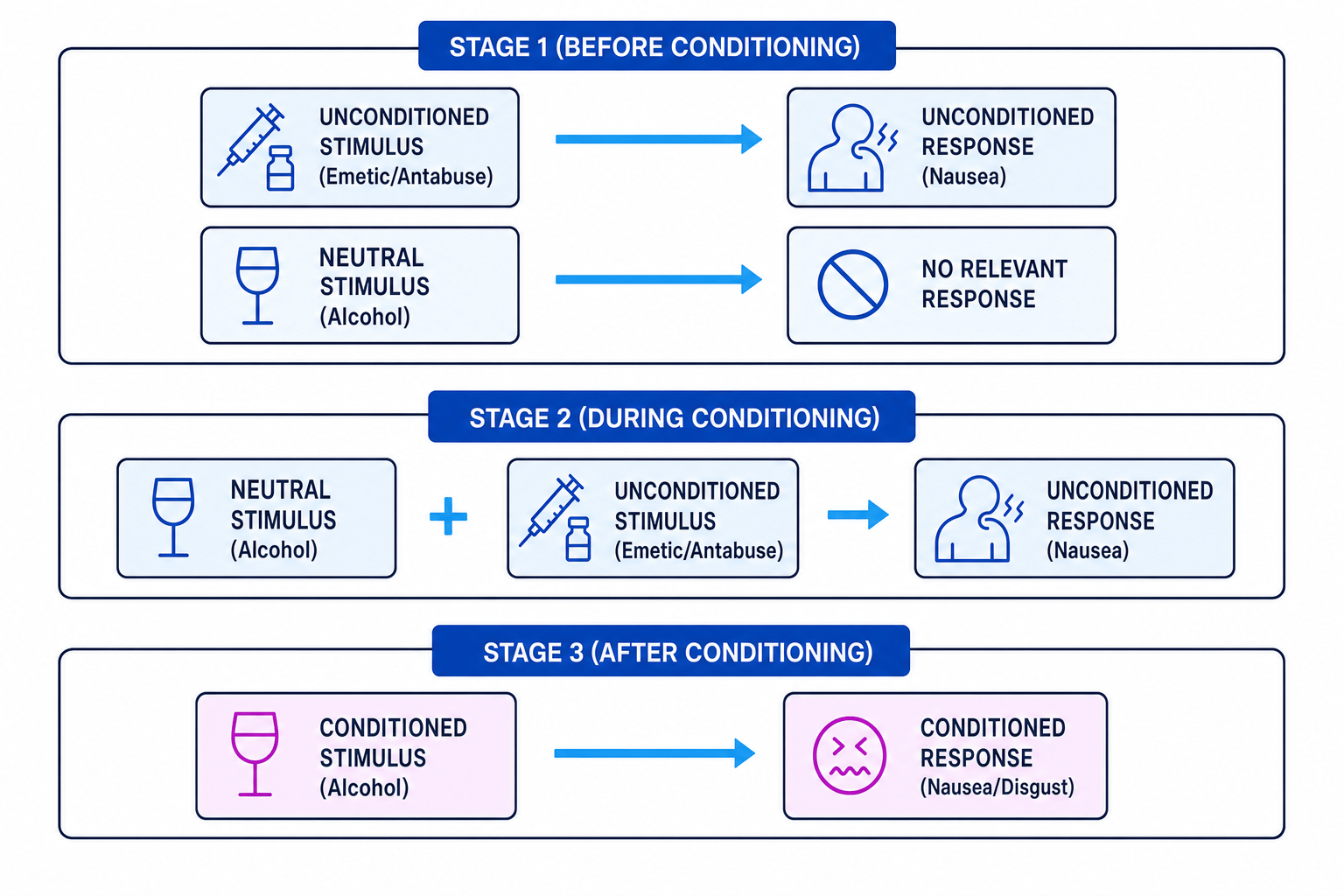
Aversion Therapy for Nicotine Addiction: Rapid Smoking
For nicotine, aversion therapy takes the form of rapid smoking.
- The patient sits in a closed room and is instructed to take a puff of a cigarette every six seconds (far quicker than normal) until they feel physically sick.
- The rapid intake of nicotine leads to mild nicotine poisoning, causing throat irritation, dizziness, and intense nausea.
- Through repeated trials, the smell and taste of cigarettes become paired with this highly distressing physiological sensation of sickness.
The Conditioning Shift
Before therapy, the drug is associated with a positive response (dopamine release, relaxation). Aversion therapy rewires this so the drug is associated with a negative response (nausea, pain), leading to active avoidance.
Mapping classical conditioning variables in aversion therapy
To evaluate or explain aversion therapy in an exam, you must be able to map clinical details onto the classical conditioning model.
Scenario: A clinical psychologist uses rapid smoking to treat a client's nicotine addiction. After several sessions of forced rapid puffing, the client reports feeling physically sick whenever they smell cigarette smoke on someone's jacket.
Here is how you break down and map this scenario:
- Identify the Unconditioned Stimulus (UCS) and Unconditioned Response (UCR): The UCS is the rapid, excessive intake of nicotine (nicotine poisoning/overdose), which naturally and automatically produces the UCR of physical sickness and nausea.
- Identify the Neutral Stimulus (NS): The NS is the smell or taste of cigarette smoke before conditioning occurs, which initially does not cause sickness.
- Explain the pairing process (During Conditioning): The NS (smell of smoke) is repeatedly paired with the UCS (rapid nicotine intake), leading to the UCR (nausea).
- Identify the Conditioned Stimulus (CS) and Conditioned Response (CR): After conditioning, the smell of cigarette smoke alone becomes the CS. This CS now triggers the CR of nausea and disgust, even in the absence of rapid smoking.
Evaluation of Aversion Therapy (AO3)
- Strength: Scientific Foundation. It is built on highly reliable, objective principles of classical conditioning which can be tested and replicated in laboratory settings.
- Weakness: High Relapse Rates (Extinction). Once the patient leaves the clinic, they know that drinking or smoking without the emetic drug or rapid puffing will not make them sick. This cognitive awareness leads to extinction—the conditioned aversion fades over time because the conditioned stimulus is experienced without the unconditioned stimulus.
- Weakness: High Attrition Rates. Because the therapy is physically punishing, many patients drop out before the conditioning is complete, reducing its real-world effectiveness.
Ethical Concerns
Aversion therapy presents significant ethical challenges under the BPS Code of Ethics. It causes deliberate physiological distress (nausea, vomiting), which severely tests the principle of protection from harm.
2. Treatments for Heroin Addiction
Heroin is an opioid that binds to mu-opioid receptors in the brain, causing a massive release of dopamine. Treatments for heroin addiction are primarily biochemical and fall into two categories: agonists and antagonists.
Agonist vs. Antagonist
- Agonist: A drug that binds to a receptor and activates it to produce a physiological response, mimicking the effects of the addictive drug.
- Antagonist: A drug that binds to a receptor but blocks it, preventing other drugs from activating it and producing no physical "high".
Treatment A: Methadone (Agonist Substitution)
Methadone is a synthetic opioid used as a maintenance treatment.
- How it works: Methadone binds to the same opioid receptors in the brain as heroin, satisfying the physical craving and preventing the onset of highly unpleasant withdrawal symptoms.
- Why it is safer: Unlike heroin, which is injected and causes a rapid "rush" and sudden "crash," methadone is taken orally (usually as a liquid) once a day. It is absorbed slowly by the liver, providing a stable, long-lasting level of receptor activation without the euphoric high.
- Harm Reduction: This allows individuals to stabilize their lives, avoid dirty needles (reducing HIV/Hepatitis C risk), and step away from criminal activity to fund their habit. Over months or years, the methadone dose can be gradually tapered down (detoxification).
Treatment B: Naltrexone (Antagonist Treatment)
Naltrexone is an opioid antagonist used for relapse prevention.
- How it works: It binds tightly to opioid receptors but does not activate them. Instead, it acts like a physical shield.
- The Clinical Effect: If a patient on Naltrexone lapses and injects heroin, the heroin cannot bind to the blocked receptors. The user experiences absolutely no euphoric "high" or pain relief.
- Extinction of Behavior: Because the operant reward (the positive reinforcement of the high) is removed, the conditioned behavior of drug-seeking is eventually extinguished.
Confusing Agonists and Antagonists
Students often swap these terms. Remember: Agonists Activate the receptor (e.g., Methadone mimics heroin). Antagonists are antagonistic (hostile) to the receptor—they block it and stop anything from happening (e.g., Naltrexone neutralizes the high).
Evaluation of Heroin Treatments (AO3)
- Strength of Methadone: Public Health and Harm Reduction. Research consistently shows that methadone maintenance programs significantly reduce illicit drug use, criminal activity, and mortality rates. It allows individuals to reintegrate into society and maintain employment.
- Weakness of Methadone: "Substitution" Debate. Critics argue that methadone does not cure addiction; it simply swaps an illegal addiction for a state-sponsored, legal addiction. Methadone withdrawal is actually longer and more painful than heroin withdrawal.
- Strength of Naltrexone: Zero Abuse Potential. Because Naltrexone does not produce a high, it is not addictive and has no black-market street value.
- Weakness of Naltrexone: Motivation and Compliance. For Naltrexone to work, the patient must be fully detoxified first (otherwise it triggers instant, severe withdrawal). Furthermore, patients must actively choose to take their medication daily; highly impulsive individuals often stop taking it so they can get high again.
3. Treatments for Nicotine Addiction
Nicotine is highly addictive due to its rapid action on the brain's acetylcholine receptors, causing dopamine surges. In addition to aversion therapy, smokers frequently use biological treatments.
Treatment A: Nicotine Replacement Therapy (NRT)
NRT is an agonist-based treatment that delivers nicotine to the body without the toxic chemicals found in tobacco smoke.
- Forms of NRT: Nicotine patches (slow-release, steady dose), chewing gum, lozenges, inhalators, or nasal sprays (fast-acting to combat sudden cravings).
- How it works: NRT provides a clean, controlled dose of nicotine to minimize withdrawal symptoms (irritability, anxiety, cravings) while the behavioral habit of smoking is broken. Over a period of 8 to 12 weeks, the nicotine dose is gradually stepped down to zero.
Treatment B: Bupropion (Zyban)
Bupropion is an atypical antidepressant drug taken in tablet form.
- How it works: It is a selective inhibitor of dopamine and noradrenaline reuptake. It works by altering brain chemistry to mimic some of the neurochemical effects of smoking.
- The Clinical Effect: By boosting baseline dopamine levels in the brain's reward pathway, it reduces the severity of nicotine withdrawal symptoms and reduces the urge to smoke. It also blocks some nicotine receptors, meaning that if the person does smoke, it feels less satisfying.
Evaluation of Nicotine Treatments (AO3)
- Strength of NRT: Clear Clinical Efficacy. A Cochrane Systematic Review of over 130 trials found that NRT increases the chances of successfully quitting by 50% to 60% compared to a placebo (p<.05p < .05p<.05). It is safe, accessible over the counter, and has minimal side effects.
- Strength of Bupropion: Non-Nicotine Approach. It does not feed nicotine back into the system, meaning the physical dependence on nicotine is broken immediately when smoking stops.
- Weakness of Bupropion: Side Effects. Bupropion carries risks of side effects including dry mouth, insomnia, headache, and in very rare cases, an increased risk of seizures. This makes it unsuitable for individuals with a history of epilepsy or eating disorders.
Key Summary Table for Revision
| Substance | Treatment 1 (Biological/Agonist) | Treatment 2 (Alternative/Antagonist/Behavioral) |
|---|---|---|
| Alcohol | Acamprosate/Naltrexone (Reduces cravings / blocks euphoric reward) | Aversion Therapy (Disulfiram/Antabuse) (Creates conditioning pairing alcohol with vomiting) |
| Heroin | Methadone (Agonist substitution: mimics heroin slowly to stop withdrawal) | Naltrexone (Antagonist: blocks receptors, preventing any high if heroin is used) |
| Nicotine | Nicotine Replacement Therapy (NRT) (Agonist: patches/gum provide clean nicotine) | Aversion Therapy (Rapid Smoking) (Behavioral: forces rapid puffing to induce sickness) |
In the exam
- Answer the specific prompt: If the question asks for "two treatments for heroin", do not waste time writing about nicotine or alcohol unless using them as a brief evaluative comparison.
- Explicitly link to psychological/biological theory: When describing aversion therapy (AO1), use conditioning terminology (UCS, UCR, NS, CS, CR) to score maximum marks. For drug treatments, use terms like "neurotransmitters", "synaptic transmission", "agonist", and "antagonist".
- Use the AO3 "Double-Whoosh" (Counter-argument): For high-level evaluation, don't just state a strength or weakness. Explain why it matters. For example: "Although methadone reduces illicit drug use and related crime (Strength), it does not cure the psychological root of addiction, meaning patients remain chemically dependent on a synthetic opioid and are highly vulnerable to relapse if they stop treatment (Counter-argument)."
- Distinguish between Naltrexone uses: Be careful—Naltrexone is an opioid antagonist. It is used to block the high of both heroin and alcohol (because alcohol triggers endogenous opioids in the brain). Make sure your context is clear.
Check yourself
- Can you draw and label a classical conditioning diagram showing how Antabuse conditions an aversion to alcohol?
- What is the crucial physiological difference between how Methadone (agonist) and Naltrexone (antagonist) interact with opioid receptors?
- Why does aversion therapy suffer from high rates of "extinction" once a patient leaves a clinical setting?
