What you'll learn
- How classical conditioning, operant conditioning and social learning theory explain addictive behaviour.
- One clear learning explanation for nicotine, heroin and alcohol addiction.
- How to apply these explanations to short scenarios in AO2.
- How to evaluate learning explanations using evidence, applications, ethics and limitations.
The big idea: addiction can be learned
Drug addiction is not explained only by brain chemistry. Learning explanations focus on how behaviour is shaped by a person’s environment, including cues, rewards, punishments, role models and social consequences.
Drug addiction
A drug addiction is a pattern of repeated drug use where the person feels a strong need to continue, often despite harm. It can involve physical dependence — the body adapts and withdrawal symptoms occur without the drug — and psychological dependence — the person experiences craving, anxiety or a perceived need for the drug.
Learning explanation
A learning explanation argues that addiction is acquired and maintained through experience: by associating cues with drug effects, by being reinforced for drug-taking, or by observing other people using drugs.
For this topic, a neat essay structure is: nicotine addiction through classical conditioning, heroin addiction through operant conditioning, and alcohol addiction through social learning theory. These explanations can overlap, so do not treat them as completely separate boxes.
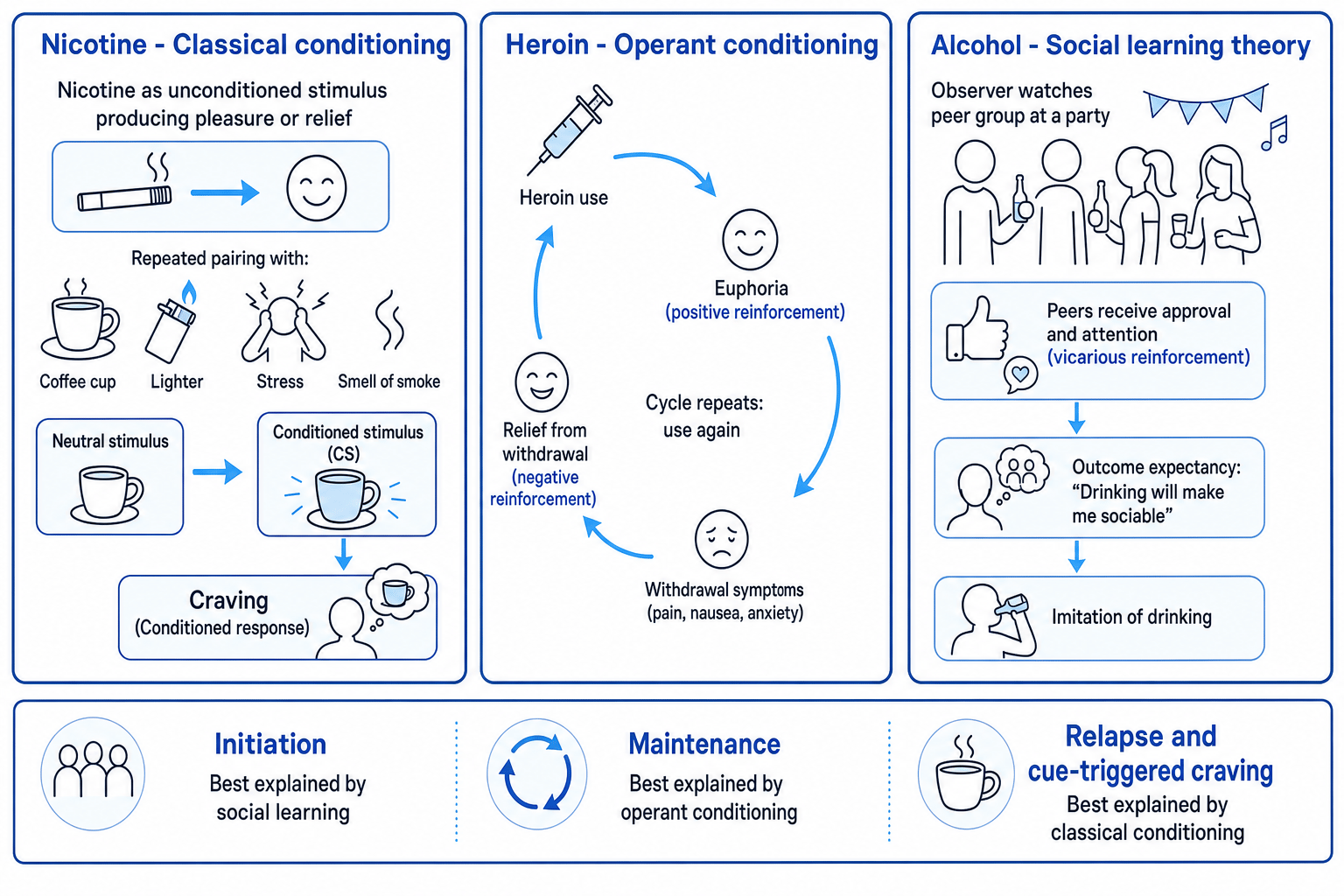
The diagram gives you the overall map of the three learning routes into addiction.
Key building blocks
A stimulus is something in the environment that can trigger a response, such as the smell of smoke, a pub sign or withdrawal discomfort. A response is the behaviour or reaction that follows, such as craving or taking the drug.
Craving means a strong desire or urge to take the drug. Relapse means returning to drug use after a period of abstinence.
AO1 core
Learning explanations are especially useful for explaining maintenance of addiction — why the behaviour continues — and relapse, because learnt cues and reinforcements can still affect a person after detox.
Nicotine addiction: classical conditioning
What is classical conditioning?
Classical conditioning, associated with Pavlov (1927), is learning by association. A person learns that two things go together, so one begins to trigger the response normally caused by the other.
Classical conditioning terms
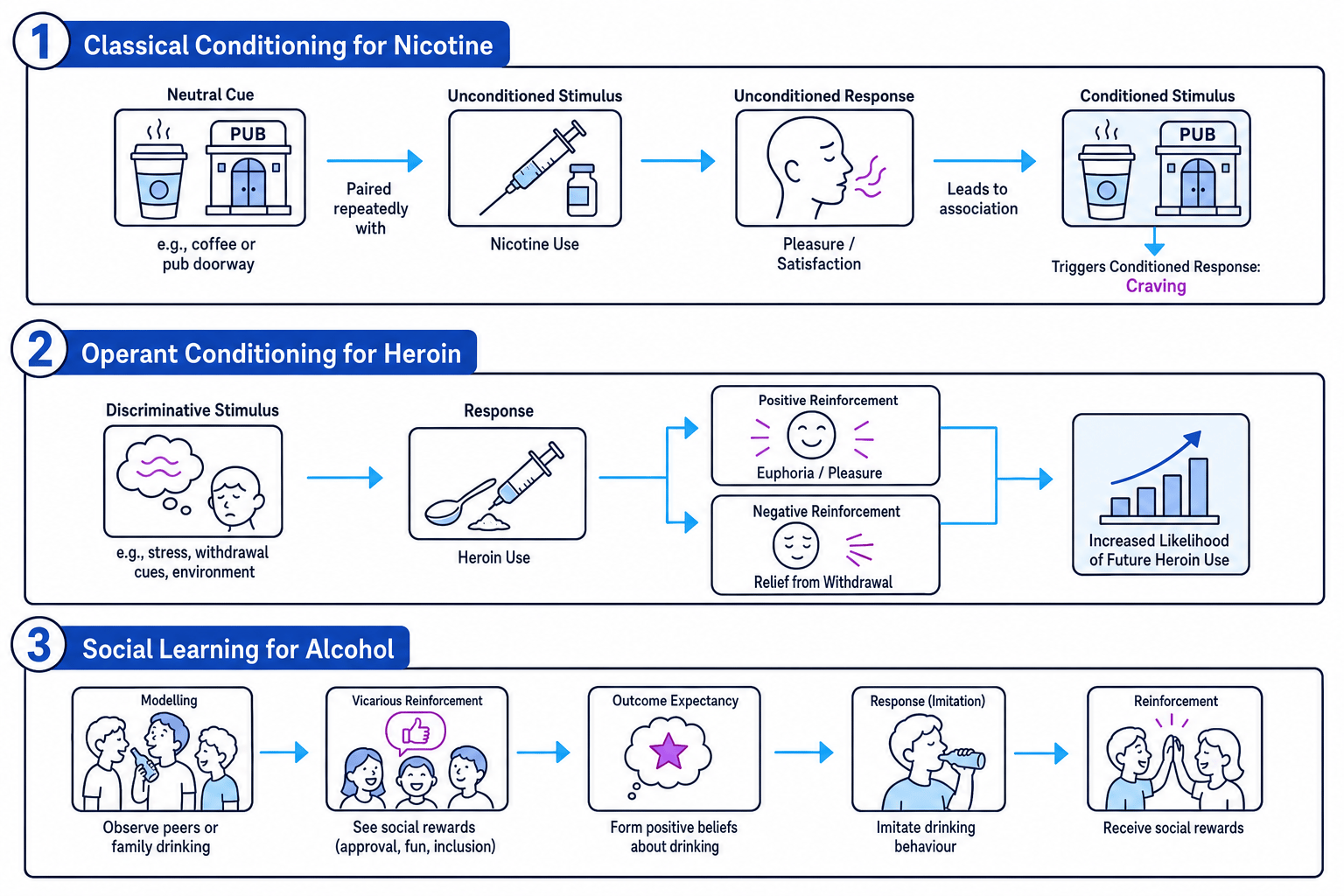
In classical conditioning, an unconditioned stimulus naturally produces an unconditioned response. A neutral stimulus initially produces no special response, but after repeated pairing with the unconditioned stimulus it becomes a conditioned stimulus, producing a conditioned response.
Applying it to nicotine
Nicotine naturally produces rewarding effects, such as pleasure, alertness or reduced irritability. Over time, the smoker repeatedly pairs nicotine with cues such as morning coffee, stress, alcohol, a lighter, the smell of smoke or standing outside with other smokers.
At first, coffee is just a neutral cue. After many pairings, coffee becomes a conditioned stimulus. It can trigger a conditioned response, such as craving, even before any nicotine has been consumed.
This helps explain why smokers may relapse when they return to familiar situations. The person may not consciously decide, “I want nicotine”; instead, the learnt cue automatically triggers craving.
Classifying nicotine cues
A person always smokes while drinking coffee before work. After stopping smoking, they feel a strong craving whenever they smell coffee.
- Identify the original drug effect: nicotine produces pleasure or withdrawal relief, so nicotine acts as the unconditioned stimulus.
- Identify the original response: pleasure, relaxation or craving relief is the unconditioned response.
- Identify the previously neutral cue: coffee used to be unrelated to nicotine, so it began as a neutral stimulus.
- Apply the learning process: repeated pairing of coffee with smoking makes coffee a conditioned stimulus.
- Identify the learnt response: craving when smelling coffee is the conditioned response.
Evaluating classical conditioning
A strength is that it explains cue-induced craving. Research such as Carter and Tiffany’s (1999) meta-analysis found that drug-related cues can increase craving across addictions, supporting the idea that environmental cues become powerful triggers.
It also has useful applications. Treatments may use cue exposure, where someone repeatedly experiences smoking-related cues without smoking, aiming for extinction — the weakening of a conditioned response.
However, cue exposure has mixed success. Real life contains many cues, and cravings may return through spontaneous recovery, where a conditioned response reappears after seeming to disappear.
Forgetting relapse
Do not only write “the cue causes craving”. Link it to addiction: conditioned cues can maintain smoking and trigger relapse after someone has tried to quit.
Heroin addiction: operant conditioning
What is operant conditioning?
Operant conditioning, associated with Skinner (1938), is learning through consequences. Behaviour is more likely to be repeated if it is reinforced.
Reinforcement
Positive reinforcement happens when behaviour is followed by a pleasant consequence, making it more likely to happen again. Negative reinforcement happens when behaviour removes something unpleasant, also making it more likely to happen again.
Applying it to heroin
Heroin can be powerfully reinforcing. Early use may be maintained by positive reinforcement because the drug produces euphoria, pleasure or escape from emotional distress.
As dependence develops, heroin use may increasingly be maintained by negative reinforcement. If the person experiences withdrawal symptoms — such as pain, nausea, sweating, anxiety or agitation — taking heroin removes these unpleasant symptoms. This relief reinforces further use.
So heroin addiction can become a cycle: use heroin, experience short-term relief or pleasure, then experience withdrawal, then use again to remove withdrawal.
Distinguishing positive and negative reinforcement
A heroin user says, “At first I used it because it felt amazing. Now I mostly use it because I feel ill and panicky without it.”
- Separate the two consequences: “felt amazing” is a pleasant added consequence, while “feel ill and panicky without it” is an unpleasant state.
- Apply positive reinforcement: using heroin for euphoria is positive reinforcement because pleasure is added after the behaviour.
- Apply negative reinforcement: using heroin to stop withdrawal is negative reinforcement because an unpleasant state is removed.
- Link to addiction: both consequences increase the likelihood of future heroin use, maintaining dependence.
Negative reinforcement is not punishment
Negative reinforcement does not mean “a bad consequence”. It means behaviour is strengthened because something unpleasant is removed.
Evaluating operant conditioning
A major strength is that it explains why addiction can continue even when the person knows the long-term harms. The immediate reinforcement — pleasure or withdrawal relief — may outweigh delayed consequences.
It also links to real-world treatment. Contingency management uses operant principles by giving rewards for drug-free behaviour, such as clean drug tests or attendance at treatment sessions.
A limitation is that operant conditioning can be too reductionist. It explains behaviour through consequences, but heroin addiction is also affected by biological factors, social deprivation, trauma, mental health and access to treatment.
Alcohol addiction: social learning theory
What is social learning theory?
Social learning theory, developed by Bandura (1977), argues that people can learn behaviours by observing others, not just through direct rewards and punishments.
Social learning theory terms
A role model is someone whose behaviour may be copied. Modelling means displaying behaviour for others to observe. Imitation means copying that behaviour. Vicarious reinforcement means seeing someone else rewarded, which increases the observer’s motivation to copy.
Applying it to alcohol
Alcohol use is often highly social. A young person may see parents, peers, celebrities or influencers drinking and appearing relaxed, confident, popular or funny. If drinking seems to bring approval or status, the observer may develop positive outcome expectancies — beliefs about what will happen if they drink.
For example, they may expect alcohol to make them sociable, reduce anxiety or help them fit in. They are more likely to imitate drinking if the role model is similar, high-status or emotionally important to them.
This explanation is especially strong for initiation of alcohol use: why someone starts drinking in the first place. It can also explain maintenance if drinking continues to bring social rewards.
Applying social learning to alcohol use
A student starts drinking heavily after joining a friendship group where the most popular members drink at parties and receive attention.
- Identify the role models: the popular members of the group are influential because they have status.
- Identify vicarious reinforcement: the student sees them receiving attention and approval after drinking.
- Identify outcome expectancy: the student may believe drinking will make them popular or socially confident.
- Link to imitation: the student copies the drinking behaviour because they expect similar social rewards.
- Link to addiction risk: repeated drinking in rewarding social contexts can increase the likelihood of harmful use over time.
Evaluating social learning theory
A strength is that it explains why alcohol use varies across families, peer groups and cultures. It also helps explain why prevention programmes often target peer norms and challenge beliefs such as “everyone drinks heavily”.
However, much evidence is correlational. If heavy drinkers have friends who drink, this could mean peer influence caused drinking, but it could also mean people choose friends with similar habits. This is a problem of cause and effect.
Social learning theory may also underestimate individual differences. Not everyone who observes drinking becomes addicted, so biological vulnerability, personality, coping skills and mental health still matter.
Pulling the explanations together
| Drug | Learning explanation you can use | How addiction is explained |
|---|---|---|
| Nicotine | Classical conditioning | Cues such as coffee, stress or the smell of smoke become associated with nicotine and trigger craving. |
| Heroin | Operant conditioning | Heroin use is reinforced by euphoria and by relief from withdrawal symptoms. |
| Alcohol | Social learning theory | People observe drinking being rewarded socially and imitate it, forming positive expectations about alcohol. |
Best essay balance
A strong answer usually says which part of addiction the explanation handles best: social learning is strong for initiation, operant conditioning is strong for maintenance, and classical conditioning is strong for cue-triggered craving and relapse.
Wider AO3 evaluation
Strengths
Learning explanations are useful because they produce practical interventions. Classical conditioning suggests cue exposure and relapse-prevention planning. Operant conditioning suggests rewards for abstinence. Social learning theory suggests education, peer-led interventions and changing media or family norms around substance use.
They are also less biologically deterministic than purely genetic or dopamine-based accounts. They show how changing the environment can reduce risk.
Limitations
The explanations can be incomplete on their own. Addiction involves learning, but it also involves biological reward pathways, withdrawal, tolerance, genetics and mental health. A fuller answer can say learning explanations and biological explanations are complementary, not mutually exclusive.
They may also overemphasise external factors. Two people can experience the same cues, rewards or role models but respond differently. This suggests the need to consider individual differences such as impulsivity, stress, coping style and social support.
Ethics and research issues
Research into addiction must follow the BPS Code of Ethics and Conduct (2009). Researchers need valid consent, confidentiality, protection from harm, the right to withdraw and a full debrief. This is especially important because drug users may be vulnerable, and exposing someone to drug cues could increase distress or craving.
There are also methodological issues. Laboratory cue studies can control variables well, but they may lack ecological validity because real-life addiction happens in complex social environments. Self-report studies of alcohol or nicotine use may be affected by social desirability or inaccurate memory.
In the exam
- For AO1, clearly name the learning process and use its specialist terms accurately, such as conditioned stimulus, negative reinforcement or vicarious reinforcement.
- For AO2, apply the process directly to the drug in the question: nicotine cues, heroin withdrawal relief, or alcohol role models and social rewards.
- For AO3, evaluate with a balanced point: use evidence or real-world application, then add a limitation such as reductionism, cause-and-effect problems or ethical issues.
Check yourself
- How would classical conditioning explain a smoker craving nicotine when drinking coffee?
- Why is heroin use to remove withdrawal symptoms an example of negative reinforcement?
- How can vicarious reinforcement contribute to alcohol addiction?