What you’ll learn
- How Talk to FRANK works as an example of an anti-drug campaign.
- The psychological strategies behind the campaign, including fear arousal, social norms, self-efficacy and source credibility.
- How to apply the campaign to real-life scenarios for AO2.
- How to evaluate anti-drug campaigns for AO3, including ethics and effectiveness.
What is an anti-drug campaign?
An anti-drug campaign is a planned attempt to reduce drug use, delay first use, reduce harm, or encourage people to seek support. Campaigns may use adverts, websites, school materials, social media, helplines and public-health messages.
Anti-drug campaign
An anti-drug campaign is a public-health intervention designed to influence people’s knowledge, attitudes, intentions and behaviour around drug use.
In psychology, campaigns matter because drug use is not only a medical issue. It is also shaped by learning, social influence, attitudes, risk perception, peer pressure, stress, identity and access to support.
Named campaign: Talk to FRANK
A strong example for Edexcel 9PS0 Health Psychology is Talk to FRANK, a UK government drug information and advice campaign launched in 2003. It provides confidential information about drugs, their effects, legal risks, and where to get help.
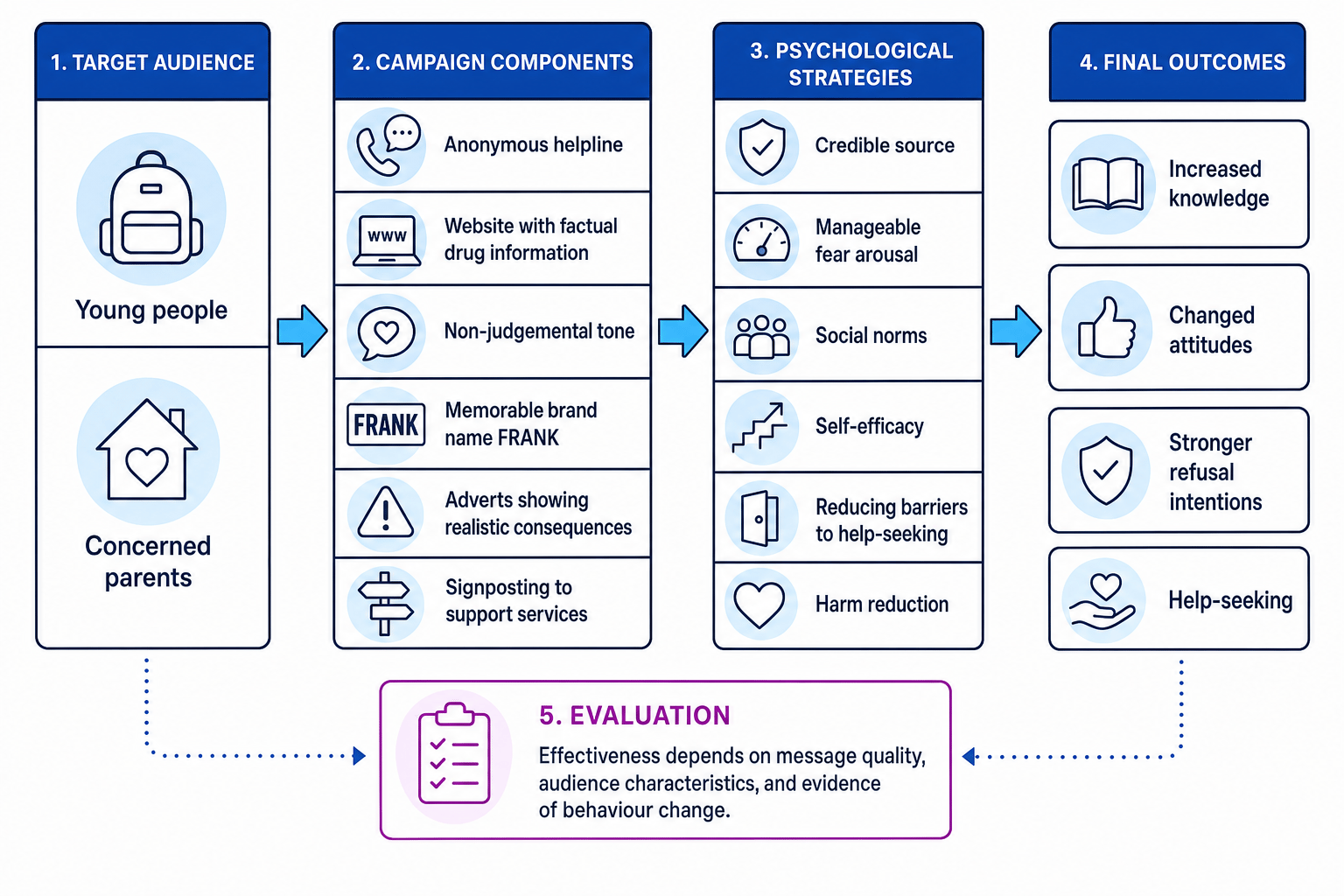
The campaign targets:
- Young people, especially those who may be exposed to drugs through peers, parties or social media.
- Parents and carers, who may need advice about recognising signs of drug use and starting conversations.
- People already using drugs, who may need non-judgemental support rather than only punishment or fear.
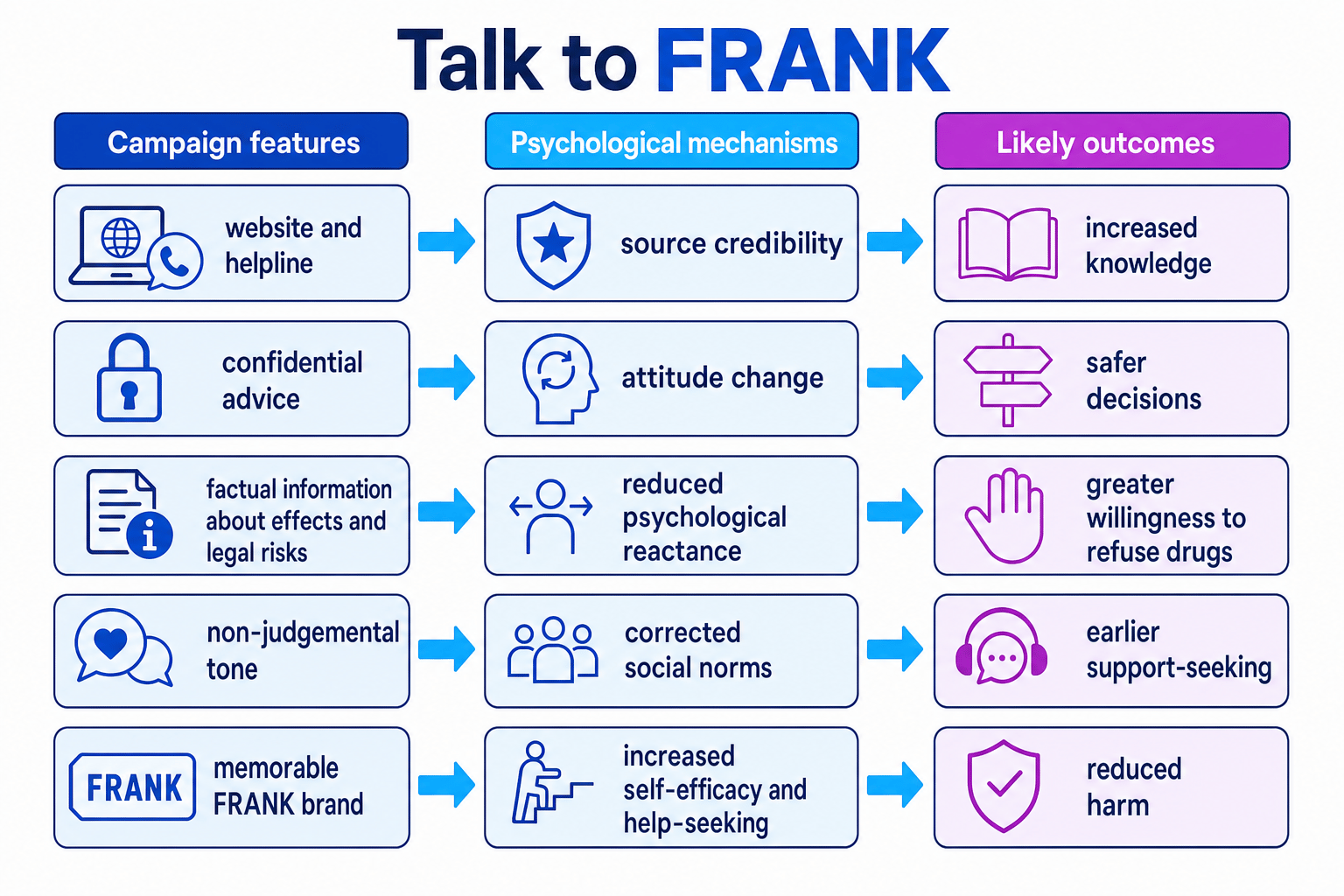
Its main features include a website, helpline, online advice, information about specific substances, and a memorable brand: “FRANK” is presented as a friendly, approachable source.
The big idea
Talk to FRANK does not just say “drugs are bad”. It uses psychological strategies to make information feel credible, reduce barriers to asking for help, and encourage safer decision-making.
Strategy 1: source credibility
Source credibility means how far the audience sees the communicator as trustworthy and knowledgeable.
Source credibility
A credible source is one that the audience believes has expertise, tells the truth, and does not appear to be manipulating them.
Talk to FRANK tries to appear credible by being:
- Informative: it explains effects, risks and legal consequences.
- Confidential: people can ask questions without feeling exposed.
- Non-judgemental: it avoids sounding like a lecture.
- Memorable: “FRANK” works like a simple brand or social cue.
This matters because young people may reject messages that feel too authoritarian. A campaign that feels realistic and respectful may reduce psychological reactance, where someone resists a message because they feel their freedom is being threatened.
AO2 application
If a teenager is worried about cannabis use but does not want to ask a teacher, Talk to FRANK may feel safer because it offers anonymous information. The credibility comes from being official but also approachable.
Only describing the advert
Do not just describe what the campaign looks like. For marks, link each feature to a psychological process, such as credibility, fear arousal, social norms, self-efficacy or help-seeking.
Strategy 2: information and attitude change
An attitude is a person’s evaluation of something, such as whether they see drug use as exciting, risky, normal or unacceptable.
Attitude
An attitude is a learned belief or feeling that influences how someone responds to a person, object, situation or behaviour.
Talk to FRANK aims to change attitudes by giving clear information about:
- Short-term effects, such as panic, accidents or poor judgement.
- Long-term risks, such as dependence or mental-health problems.
- Legal consequences, such as arrest or criminal records.
- Safer choices, such as getting medical help in an emergency.
This fits a cognitive approach because the campaign tries to change what people know and believe. If beliefs change, intentions and behaviour may also change.
However, information alone is often not enough. A student may know that a drug is risky but still use it because of peer pressure, impulsivity, stress or addiction. That is why the campaign also needs emotional and social strategies.
Strategy 3: fear arousal, but with coping advice
A fear appeal is a message that highlights danger in order to motivate behaviour change.
Fear appeal
A fear appeal is a persuasive message that tries to change behaviour by making the audience aware of a serious threat.
Anti-drug campaigns may show consequences such as accidents, addiction, paranoia, overdose or damaged relationships. But fear only works well if the person also believes they can do something useful.
This links to self-efficacy, a concept from Bandura’s social learning theory.
Self-efficacy
Self-efficacy is a person’s belief that they can successfully carry out a behaviour, such as refusing drugs or asking for help.
Talk to FRANK supports self-efficacy by giving practical next steps:
- Find reliable information.
- Contact a helpline.
- Talk to someone confidentially.
- Learn how to refuse or avoid risky situations.
- Get support if drug use has already started.
Evaluating a fear-based drug message
- Identify the threat in the message. For example, an advert might show that taking an unknown pill at a party could lead to panic, injury or hospitalisation.
- Check whether the message gives a coping response. If it only scares the audience, they may deny the risk. If it says “ask for confidential advice” or “call for medical help”, it offers a clear action.
- Judge the likely effect. A moderate fear message plus high self-efficacy is more likely to change intentions than an extreme fear message with no solution.
- Add an ethical point. The advert should not cause unnecessary distress or stigmatise people with addictions; it should signpost support.
Fear needs a way out
In evaluation, say that fear appeals are strongest when they combine threat with efficacy: “this is serious, but you can do something about it.”
Strategy 4: social norms
Social norms are beliefs about what other people do or approve of.
Social norms
Social norms are perceived rules or expectations within a group, such as what friends think is acceptable or typical.
Drug use can be influenced by normative social influence, where someone conforms to fit in or avoid rejection. A young person may take drugs not because they strongly want to, but because they think “everyone else is doing it”.
Campaigns can challenge this by:
- Correcting exaggerated beliefs about how common drug use is.
- Showing that refusal is acceptable.
- Encouraging conversations with trusted adults.
- Making help-seeking seem normal rather than shameful.
Talk to FRANK can therefore reduce the pressure created by false norms. If a young person realises that not everyone uses drugs, refusal may feel easier.
Boomerang effect
Campaigns can backfire if they accidentally make drug use seem more common or exciting. Saying “lots of teenagers take drugs” may normalise the behaviour unless the message is carefully framed.
Strategy 5: harm reduction and help-seeking
Harm reduction means reducing the negative consequences of risky behaviour, even if the behaviour is not completely eliminated.
Harm reduction
Harm reduction is an approach that aims to minimise damage to health and wellbeing, rather than relying only on abstinence.
Talk to FRANK includes harm-reduction elements because it gives realistic information and signposts support. This is important because some people who use drugs may ignore campaigns that only say “never do it”. A non-judgemental campaign can keep communication open.
The campaign also reduces barriers to help-seeking, which means actively looking for support. Barriers include embarrassment, fear of punishment, stigma, or not knowing where to go.
AO2 application
A student who has used ketamine and feels worried may be more likely to search Talk to FRANK than immediately tell a parent or teacher. The anonymity reduces shame, while the information and signposting increase the chance of getting appropriate help.
Applying Talk to FRANK to a scenario
- Start with the person’s problem. A 16-year-old says their friends are taking pills at a festival and they feel pressured to join in.
- Link the campaign to social norms. Talk to FRANK can challenge the belief that “everyone is doing it” and make refusal seem more acceptable.
- Link the campaign to self-efficacy. Practical advice can help the student plan what to say, who to stay with, and how to leave the situation.
- Link the campaign to help-seeking. If the student is worried about a friend, confidential advice makes it easier to ask for support quickly.
AO3: strengths of Talk to FRANK
Real-world application
A major strength is that the campaign is highly practical. It is available outside school or therapy settings, so people can access it privately and quickly. This increases usefulness for young people who may not want face-to-face support.
Non-judgemental tone
The friendly tone may reduce stigma and defensiveness. This is especially important because moralising messages can make people hide drug use, while confidential advice may encourage earlier help-seeking.
Multiple psychological strategies
Talk to FRANK combines several strategies rather than relying on one message. It uses information, credibility, social norms, self-efficacy, fear arousal and signposting. This makes it more psychologically sophisticated than a simple “just say no” campaign.
AO3: limitations of anti-drug campaigns
Behaviour change is hard to prove
It is difficult to show that a campaign directly reduces drug use. Many other factors affect behaviour, including friends, family, school, policing, availability of drugs, mental health and economic factors.
Evaluation studies may rely on self-report, where people say what they did or intend to do. This can be affected by social desirability because drug use is sensitive and sometimes illegal.
Knowledge may not become behaviour
A campaign may increase knowledge without changing behaviour. Someone might understand the risks but still take drugs due to addiction, sensation-seeking, stress relief or peer approval.
Different audiences respond differently
A message that works for one group may not work for another. For example, a young person who has never used drugs may respond well to prevention messages, while someone dependent on drugs may need treatment, counselling or medical support.
Wider evidence is mixed
Research into mass-media health campaigns suggests they can be useful, but effects vary. For example, Wakefield, Loken and Hornik (2010) argued that media campaigns can influence health behaviours, especially when combined with wider support. However, evaluations of some anti-drug media campaigns, such as Hornik et al. (2008) on the US National Youth Anti-Drug Media Campaign, found limited evidence of reduced drug use. This supports the idea that campaigns need careful design and evaluation.
Ethics
Although public campaigns are not the same as laboratory studies, ethical issues still matter. Under the BPS Code of Ethics and Conduct (2009), psychologists should consider protection from harm, respect, responsibility and integrity.
For anti-drug campaigns, this means:
- Avoiding unnecessary distress, especially in fear-based adverts.
- Not stigmatising people with addictions.
- Giving accurate information rather than exaggerating risks.
- Protecting confidentiality in helplines or online support.
- Signposting professional help when needed.
- Evaluating campaigns ethically, with consent, right to withdraw, confidentiality and debrief if participants are involved in research.
Best AO3 judgement
Talk to FRANK is psychologically well-designed because it is credible, accessible and non-judgemental, but its effectiveness depends on whether it changes real behaviour, not just awareness.
In the exam
- Name the campaign clearly: Talk to FRANK is a UK anti-drug information and advice campaign launched in 2003.
- Link each feature to psychology: for example, helpline equals reduced barriers to help-seeking; factual information equals attitude change; realistic consequences equal fear arousal.
- For AO3, avoid saying “it works” too simply. Evaluate evidence, self-report problems, individual differences, possible boomerang effects and ethical issues.
Check yourself
- How does Talk to FRANK use source credibility and a non-judgemental tone?
- Why might fear appeals fail if they do not include self-efficacy?
- What is one strength and one limitation of using mass-media campaigns to reduce drug use?