What you'll learn
- How to compare classic studies across the whole 9PS0 qualification.
- How to use issues and debates to make synoptic AO3 points.
- How to apply research-methods principles to unseen material.
- How to avoid “study-by-study” answers that do not actually compare.
What “synoptic” means
In this part of Psychological Skills, you are not learning a new theory. You are learning how to bring together material from different areas of psychology: social, cognitive, biological, learning, clinical, and your optional applied topic.
Synoptic review
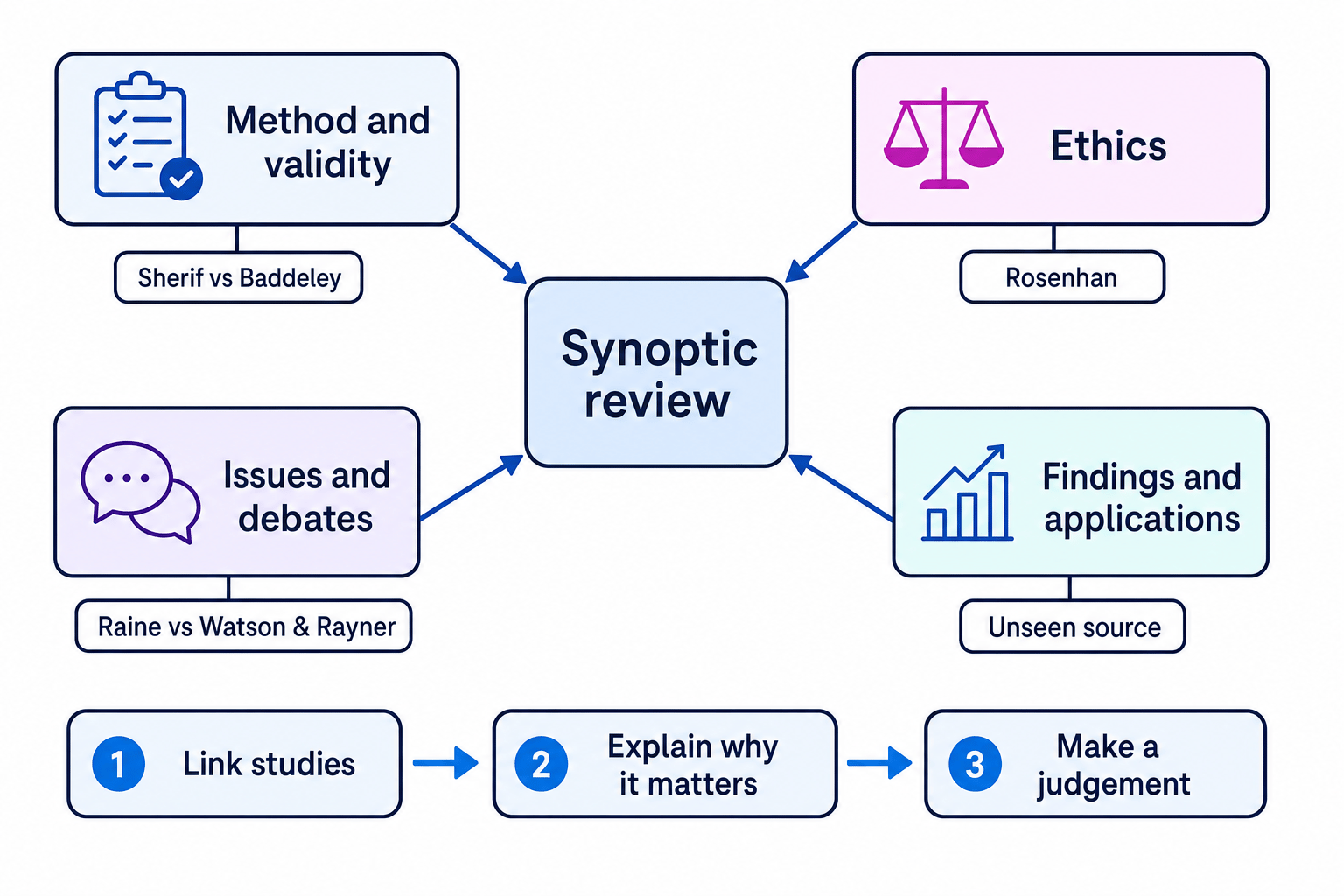
A synoptic review means making links across the course, especially by comparing studies, methods, ethics, findings, and issues or debates to reach a reasoned judgement.
A synoptic answer is not: “Sherif did this. Baddeley did this. Rosenhan did this.”
It is: “Sherif and Rosenhan both used more naturalistic settings than Baddeley, but this created different ethical and control problems.”
The main skill
Synopticity is about connection plus judgement: identify a meaningful similarity or difference, explain why it matters, then decide which study is stronger for a particular purpose.
The building blocks: AO1, AO2 and AO3
Before comparing studies, make sure you know what each assessment objective is asking you to do.
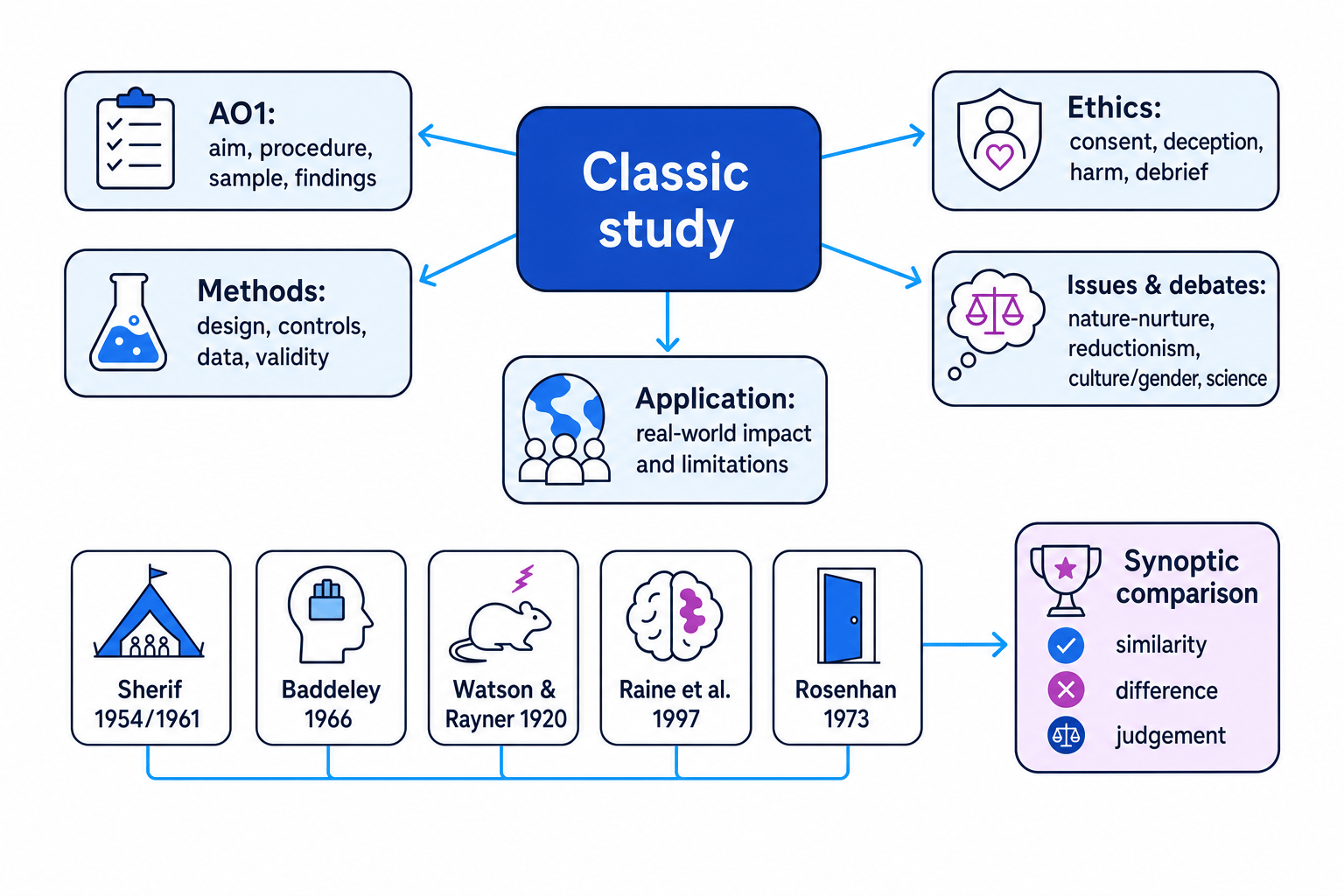
- AO1 means accurate knowledge and understanding: aims, procedures, samples, results, conclusions, and key terms.
- AO2 means application: using psychology to explain a scenario, unseen source, practical investigation, or real-world issue.
- AO3 means analysis and evaluation: strengths, weaknesses, comparisons, methodological issues, ethics, debates, and supported judgements.
A comparison-ready study card
For each classic study, reduce it to five useful parts:
- Aim: what the researchers wanted to find out.
- Sample: who took part and how representative they were.
- Procedure: what participants experienced.
- Findings and conclusions: what was found and what it suggests.
- Evaluation hooks: ethics, validity, reliability, usefulness, and issues or debates.
Turning Rosenhan into a comparison-ready card
- Select the AO1 core: Rosenhan (1973) sent pseudo-patients to psychiatric hospitals reporting false auditory hallucinations, then they behaved normally after admission.
- Extract the finding: staff generally failed to detect that the pseudo-patients were not mentally ill, suggesting problems with the validity of psychiatric diagnosis.
- Turn method into AO3: the field setting increases realism, but the deception created ethical issues for hospital staff and possibly real patients.
- Create a synoptic link: compared with Baddeley (1966), Rosenhan has stronger ecological validity but much weaker control over extraneous variables.
The classic studies you should be ready to compare
The exact set depends partly on your optional topic, but your core comparison toolkit should include the classic studies from the main compulsory areas.
| Study | Main AO1 hook | Useful synoptic evaluation hooks |
|---|---|---|
| Sherif et al. (1954/1961) Robbers Cave | Boys at a summer camp developed intergroup hostility through competition; superordinate goals reduced conflict. | Field experiment, high ecological validity, cultural and gender bias, ethical concerns around deception and conflict. |
| Baddeley (1966) | Word-list experiments showed short-term memory tends to code acoustically, while long-term memory tends to code semantically. | High control, scientific method, artificial tasks, useful evidence for memory models. |
| Watson and Rayner (1920) Little Albert | A fear response was conditioned by pairing a white rat with a loud noise; fear generalised to similar stimuli. | Strong learning/nurture evidence, very poor modern ethics, case study limits generalisability. |
| Raine et al. (1997) | PET scans of murderers pleading not guilty by reason of insanity showed differences in brain activity compared with controls. | Scientific and biological evidence, reductionism, determinism, socially sensitive implications. |
| Rosenhan (1973) | Pseudo-patients were admitted to psychiatric hospitals and normal behaviour was interpreted through diagnostic labels. | Field research, deception, validity of diagnosis, major real-world impact on psychiatry. |
| Your optional classic | For example, Loftus and Palmer (1974), van IJzendoorn and Kroonenberg (1988), or Friedman and Rosenman (1959), depending on your route. | Use it to widen comparisons beyond the core topics. |
Lens 1: methodology and validity
Validity
Validity means whether a study measures what it claims to measure. Internal validity concerns whether the findings are caused by the intended variables. External validity concerns whether findings generalise beyond the study.
Important types of external validity include:
- Ecological validity: whether the setting and task reflect real life.
- Population validity: whether the sample represents the target population.
- Temporal validity: whether findings still apply in a different historical period.
Classic studies vary hugely here. Baddeley (1966) has strong control but uses artificial word lists. Sherif et al. (1954/1961) has a more natural camp setting, but the sample was narrow: boys from a particular cultural background.
Comparing ecological validity
- Identify the setting and task in Baddeley: participants recalled word lists under controlled laboratory conditions, which makes the task unlike everyday remembering.
- Identify the setting and task in Sherif: boys interacted in a summer camp with real competitions and shared goals, so behaviour was closer to everyday group conflict.
- Compare, not just describe: Sherif has stronger ecological validity because the boys’ behaviour occurred in an immersive social setting, whereas Baddeley’s memory task was more artificial.
- Add a judgement: however, Baddeley’s weaker ecological validity is partly balanced by stronger control, making causal conclusions about coding more secure.
Lab study equals bad
Do not automatically say laboratory studies are weak. Labs often improve control, reliability, and replicability. The better point is that control may trade off against ecological validity.
Lens 2: ethics
The BPS Code of Ethics and Conduct (2009) highlights principles such as informed consent, avoidance of unnecessary deception, right to withdraw, protection from harm, confidentiality, and debriefing.
Some classic studies are historically important partly because they would be difficult or impossible to run in the same way today.
- Watson and Rayner (1920) caused distress to Little Albert and did not properly remove the conditioned fear.
- Rosenhan (1973) deceived hospital staff, although the study exposed serious issues in psychiatric diagnosis.
- Sherif et al. (1954/1961) involved deception and deliberately created conflict between children.
Balanced ethics evaluation
A strong ethics paragraph weighs costs against benefits: harm and deception matter, but so do social value, debriefing, and whether modern safeguards could reduce risk.
Lens 3: issues and debates
Issues and debates
Issues and debates are broad arguments that cut across psychology, such as nature versus nurture, reductionism versus holism, free will versus determinism, culture and gender bias, ethics, social control, and psychology as a science.
Use these as comparison lenses.
Nature and nurture
Nature refers to biological or genetic influences. Nurture refers to environmental and learning influences.
- Raine et al. (1997) supports a nature-based explanation of offending through brain differences.
- Watson and Rayner (1920) supports nurture because fear was learned through conditioning.
- Sherif et al. (1954/1961) also supports nurture because hostility changed when the social environment changed.
Reductionism and holism
Reductionism explains behaviour by breaking it into simpler parts, such as brain regions or stimulus-response links. Holism considers the whole person and wider context.
Raine et al. can be criticised as biologically reductionist if brain activity is used to explain complex violence without enough attention to childhood, social learning, poverty, or mental health.
Linking Raine to reductionism and determinism
- Identify the explanation level: Raine et al. (1997) focuses on brain activity, especially areas linked to impulse control and emotion.
- Apply reductionism: violent behaviour is partly explained through biological mechanisms, which may ignore social, cognitive, and developmental influences.
- Apply determinism: if brain abnormalities are treated as causing offending, this may imply behaviour is biologically determined.
- Balance the judgement: the study is still valuable because biological evidence can improve assessment and treatment, but it should not be used alone to predict criminal responsibility.
Culture and gender bias
Culture bias occurs when findings from one cultural group are treated as universal. Gender bias occurs when findings from one gender are overgeneralised or when research reflects gendered assumptions.
Sherif’s Robbers Cave study used boys, so it cannot automatically explain all prejudice in girls, adults, or non-Western cultures. Baddeley’s memory findings are less obviously gendered, but his student-type sample and artificial tasks may still limit generalisation.
Contradictory findings and wider links
A synoptic answer improves when you show that one classic study is not the whole story.
For example:
- Sherif et al. suggests competition creates prejudice, but social identity theory and Tajfel’s minimal group work show in-group bias can occur even without realistic competition.
- Baddeley (1966) supports different coding in short-term and long-term memory, but Bartlett (1932) shows memory can be reconstructive and influenced by schemas.
- Tulving (1972) further develops long-term memory by distinguishing episodic and semantic memory.
- Watson and Rayner supports conditioning, but phobias may also involve biological preparedness, cognition, and social learning.
- Rosenhan criticised diagnosis, but modern diagnostic systems and structured interviews aim to improve reliability.
Contradiction is useful
Contradictory evidence does not “destroy” a study. It helps you make a more precise judgement about when, where, and for whom the findings apply.
Applying synoptic skills to unseen material
In 9.2.3, you may be given a source or unfamiliar study. Treat it like a classic study you have never seen before.
Ask:
- What is the aim?
- What is the sample?
- What method or design is used?
- What type of data is collected?
- What ethical issues arise?
- Which issues and debates are relevant?
- Which classic study offers the best comparison?
Descriptive statistics and graphs
For quantitative data, choose summaries that fit the data.
- Mean: useful for interval or ratio data when there are no extreme outliers.
- Median: useful for ordinal or skewed data.
- Mode: useful for nominal categories.
- Range: shows spread using the highest and lowest values.
- Standard deviation: shows how spread out scores are around the mean.
- Bar chart: best for categories or discrete groups.
- Histogram: best for continuous data grouped into intervals; bars touch.
- Frequency table: shows how often each score or category occurs.
For qualitative data, use thematic analysis: coding repeated ideas, grouping them into themes, and using quotes as evidence. Evaluate subjectivity by considering inter-rater reliability.
Inferential tests you need to recognise
The Edexcel 9PS0 named tests are:
- Mann-Whitney U: test of difference with independent groups.
- Wilcoxon signed-ranks: test of difference with related data, such as repeated measures or matched pairs.
- Spearman’s rho: test of correlation between two ranked or ordinal variables.
- Chi-square: test of association between nominal categories.
A normal distribution is symmetrical and bell-shaped. A skewed distribution is pulled to one side by extreme scores. Skewed or ordinal data often justifies non-parametric tests such as the named tests above.
Use p≤.05p \le .05p≤.05 as the usual significance level unless told otherwise. A more lenient level is p≤.10p \le .10p≤.10 and a stricter level is p≤.01p \le .01p≤.01.
A one-tailed test is used for a directional hypothesis. A two-tailed test is used for a non-directional hypothesis.
Choosing an inferential test for unseen data
A researcher measures anxiety ratings in the same 12 patients before and after CBT. Ratings are ordinal and the hypothesis predicts anxiety will decrease.
- Decide the purpose: the researcher is testing a difference between two sets of scores, not a correlation or category association.
- Check whether the data are related: the same patients are measured twice, so the scores are related.
- Check the data type: the ratings are ordinal, so a non-parametric test is appropriate.
- Select the test: Wilcoxon signed-ranks is appropriate because it tests a difference using related data.
- Apply significance logic: if the critical table gives critical T=14T=14T=14 and observed T=10T=10T=10, then 10≤1410 \le 1410≤14, so the result is significant at the chosen level.
- Link to hypothesis: because the hypothesis predicted a decrease, this would be treated as a one-tailed decision if the direction was stated before analysis.
Observed versus critical values
For Mann-Whitney U and Wilcoxon, the observed value usually needs to be equal to or less than the critical value. For Spearman’s rho and chi-square, the observed value usually needs to be equal to or greater than the critical value.
A Type I error is a false positive: concluding there is a significant effect when there is not. A Type II error is a false negative: missing a real effect. Using p≤.01p \le .01p≤.01 reduces Type I error risk but increases the risk of Type II errors.
In the exam
- Start comparisons with a clear basis: method, ethics, validity, data type, issue/debate, or application.
- Use named studies accurately, including researcher and year, but do not waste time retelling the whole procedure.
- Make each AO3 point comparative: “stronger than”, “weaker because”, “more valid for”, or “less generalisable to”.
- For unseen material, identify the design and data type before choosing a statistical test or graph.
- Finish evaluative paragraphs with a judgement about what the comparison means for psychology.
Check yourself
- Which classic study would you compare with Raine et al. (1997) for the nature-nurture debate, and why?
- How would you explain the difference between ecological validity and control using Sherif and Baddeley?
- When would you choose Wilcoxon signed-ranks rather than Mann-Whitney U?