What you'll learn
- How to use issues and debates as AO3 evaluation in essay answers.
- How ethics, practical design, science, bias, reductionism, nature and nurture shape psychological research.
- How psychological knowledge can help society, but can also be used for social control.
- How to apply these debates to named studies such as Sherif, Baddeley, Bartlett, Tulving and Burger.
Why issues and debates matter
In A-Level Psychology, issues and debates are the “big questions” that cut across topic areas. They help you go beyond describing a theory or study and start judging its value.
Issues and debates
An issue is a problem or concern in psychology, such as whether research is ethical. A debate is an argument between different viewpoints, such as whether behaviour is mainly caused by nature or nurture.
You use these ideas for:
- AO1: describing a debate or issue accurately.
- AO2: applying it to a study, scenario, practical investigation or real-world example.
- AO3: evaluating the strengths, weaknesses and implications of psychological research.
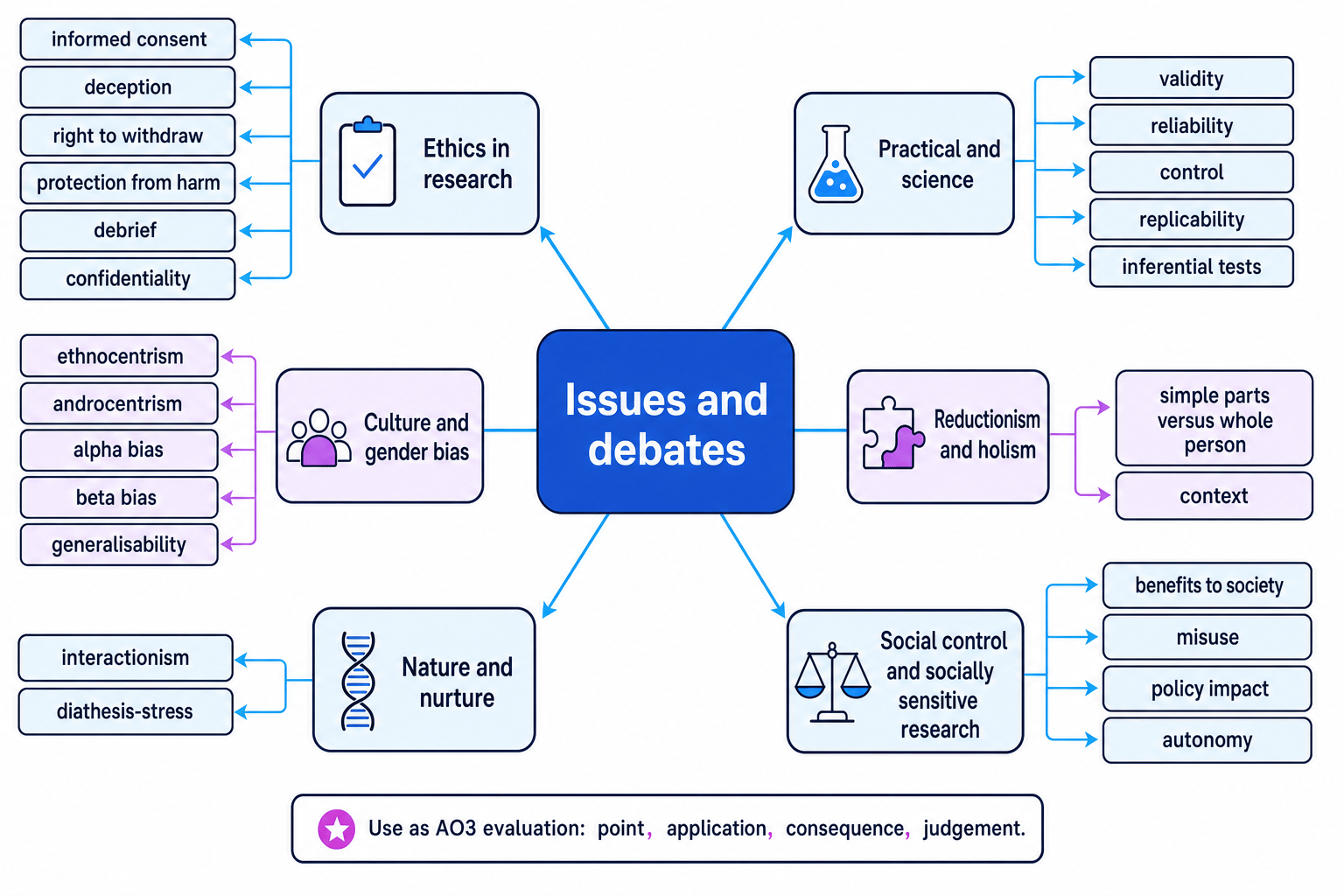
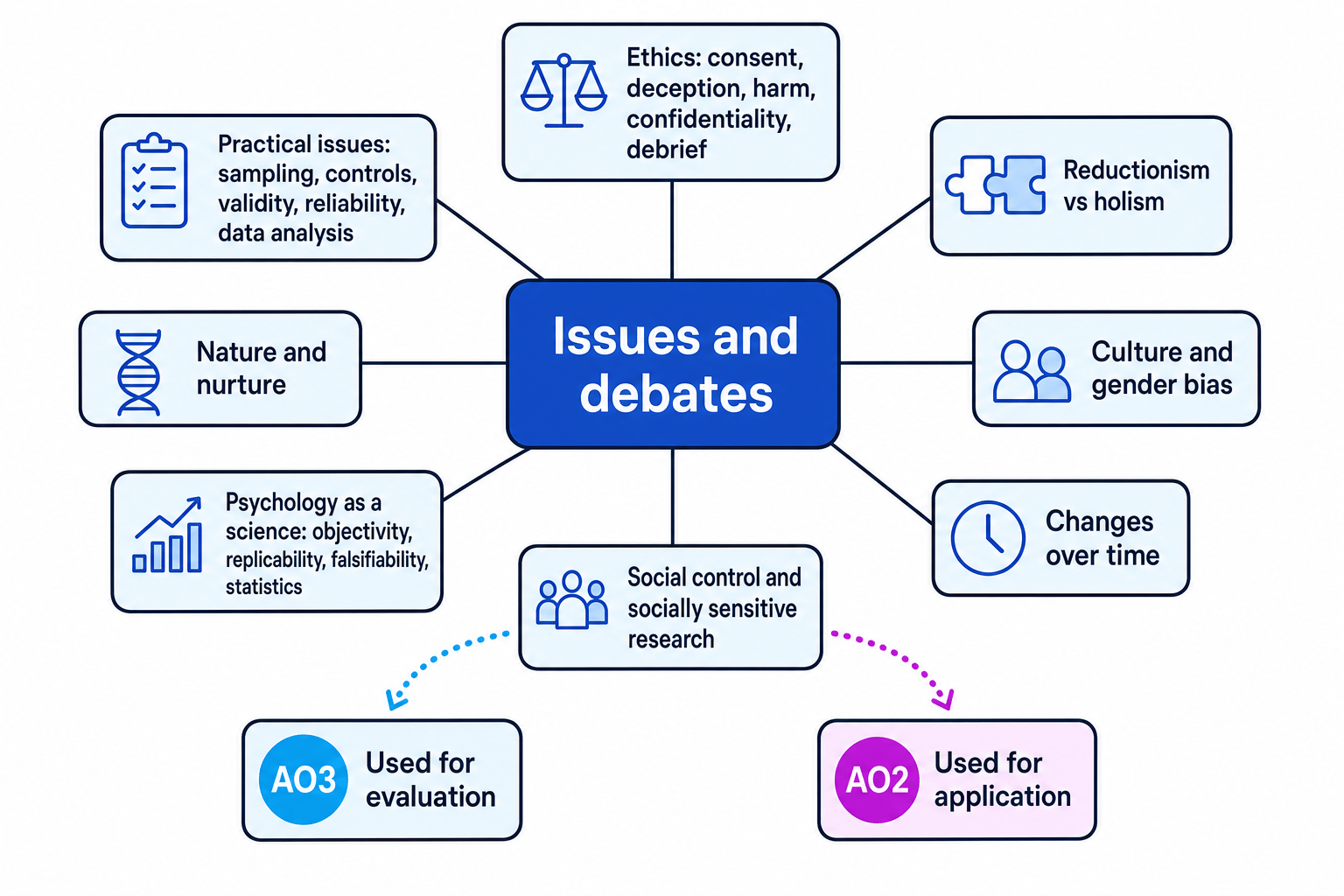
The diagram below gives you the “map” of the topic. Each branch can become an evaluation paragraph in an essay.
The big purpose
Issues and debates are not extra facts to bolt on at the end. They are tools for judging whether a psychological explanation or study is ethical, scientific, useful, biased, reductionist or socially risky.
Ethical issues in research
An ethical issue is a concern about whether research treats humans or animals appropriately. In the UK, human psychological research is guided by the BPS Code of Ethics and Conduct, 2009.
For human participants, key ethical concerns include:
- Informed consent: participants should know what they are agreeing to.
- Deception: misleading participants should be avoided unless justified.
- Right to withdraw: participants should be able to leave without penalty.
- Protection from harm: researchers should avoid physical or psychological harm.
- Confidentiality: personal data should be protected.
- Debrief: participants should be told the true aims afterwards and supported if needed.
Classic studies often raise ethical debates. For example, Sherif’s Robbers Cave study, 1954/1961, involved boys in a summer camp being placed into conflict without full awareness of the study’s aims. Burger, 2009, partly replicated Milgram’s obedience procedure but added modern safeguards, such as screening participants and stopping at 150 volts.
Animal research raises different ethical issues because animals cannot give informed consent. Psychologists therefore consider whether the scientific benefit justifies the harm, and whether the 3Rs have been followed: replacement of animals where possible, reduction in the number used, and refinement of procedures to reduce suffering.
Applying ethics to an obedience replication
A researcher wants to repeat a Milgram-style obedience study using fake electric shocks.
- Identify the ethical risks: the study would likely involve deception, possible distress, and pressure that could weaken the participant’s right to withdraw.
- Compare this with Burger, 2009: Burger reduced harm by screening participants, warning them they could withdraw, stopping at 150 volts, and debriefing them carefully.
- Make a balanced judgement: the replication may be more ethical than the original, but deception and stress still need strong justification through a cost-benefit analysis.
Only listing ethical guidelines
Do not just write “consent, withdrawal, debrief”. Explain how a specific study broke or followed the guideline, and why it matters for the credibility or acceptability of the research.
Practical issues in research design
Practical issues are the real-world problems involved in planning and carrying out research. These include time, cost, access to participants, sample size, controlling variables, standardising instructions, choosing valid measures and analysing data.
A valid measure tests what it claims to test. A reliable measure gives consistent results. For example, Baddeley, 1966, used controlled word-list tasks to investigate short-term memory coding, which improved control and reliability, but the artificial task may have reduced ecological validity.
Researchers also need suitable data analysis. For descriptive statistics, they may use:
- Measures of central tendency: mean, median and mode.
- Measures of dispersion: range and standard deviation.
- Frequency tables, bar charts and histograms.
- Thematic analysis for qualitative data, where repeated meanings or themes are identified in text or interviews.
For inferential statistics, psychologists use tests to judge whether results are likely to be due to chance. Edexcel expects you to know when to use:
- Mann-Whitney U: test of difference using unrelated groups.
- Wilcoxon signed-ranks: test of difference using related data.
- Spearman’s rho: correlation between two variables.
- Chi-square: association between categories.
The usual significance level is p≤.05p \le .05p≤.05. A more lenient level is p≤.10p \le .10p≤.10, while a stricter level is p≤.01p \le .01p≤.01. Researchers compare an observed value with a critical value from a table. They must also decide whether the hypothesis is one-tailed, predicting a direction, or two-tailed, predicting a difference or relationship without a direction.
Choosing an inferential test and decision
A psychologist measures anxiety scores before and after therapy in the same participants. The observed Wilcoxon value is 5 and the critical value at p≤.05p \le .05p≤.05 is 8.
- Choose the test: the study compares a difference between two related sets of scores, so Wilcoxon signed-ranks is appropriate.
- Decide the tail: if the researcher predicted therapy would reduce anxiety, this is one-tailed; if they only predicted a change, it is two-tailed.
- Compare values: for Wilcoxon, the result is significant when the observed value is equal to or smaller than the critical value, so 5 is significant because 5≤85 \le 85≤8.
- Interpret carefully: the researcher can reject the null hypothesis, but there is still a risk of a Type I error, meaning a false positive.
Critical-value direction
For Spearman’s rho and chi-square, larger observed values usually need to meet or exceed the critical value. For Mann-Whitney U and Wilcoxon, smaller observed values usually need to be equal to or below the critical value.
Reductionism and holism
Reductionism
Reductionism explains behaviour by breaking it down into simpler parts, such as genes, brain structures, hormones, reinforcement histories or cognitive processes.
Reductionist explanations can be useful because they are often testable and scientific. For example, a biological explanation of aggression might focus on testosterone or the amygdala. A learning explanation might focus on reinforcement or imitation.
The weakness is that reductionism can oversimplify complex behaviour. Human behaviour is often shaped by several levels at once: biology, cognition, learning, social context and culture.
Holism is the opposite approach. It explains behaviour by looking at the whole person and wider context. Bartlett, 1932, showed that memory is reconstructive and shaped by schemas, which suggests memory cannot be fully understood by only examining simple stimulus-response links.
Comparing explanations of obedience
Imagine a question asks you to compare two explanations of obedience.
- Agency theory explains obedience through an agentic state, where a person sees themselves as carrying out an authority figure’s wishes.
- Social impact theory explains obedience through social forces such as the strength, immediacy and number of people influencing the individual.
- Evaluate the comparison: both are social explanations, but agency theory focuses more on responsibility and authority, while social impact theory is broader and can explain changes in pressure across situations.
Psychology as a science
A science uses systematic observation, objective measurement, hypothesis testing, replicability and evidence-based conclusions. Psychology aims to be scientific, but it studies humans, whose behaviour can be meaningful, emotional and influenced by context.
Laboratory studies often increase control. Baddeley, 1966, is a good example because it used standardised word lists to test memory coding. However, high control can reduce ecological validity. Bartlett, 1932, used a more naturalistic story-recall task, which captured reconstructive memory but was harder to control and replicate.
Normal and skewed distributions also matter. A normal distribution is symmetrical, while a skewed distribution has scores clustered more at one end. Many psychological data sets are not neatly normal, which is one reason non-parametric tests such as Mann-Whitney U, Wilcoxon, Spearman’s rho and chi-square are common at A-Level.
Science is not just lab coats
A study can be scientific if it is systematic, evidence-based and replicable. It does not have to be a laboratory experiment, although experiments often make control easier.
Cultural and gender issues
Culture means the shared values, beliefs and practices of a group. Gender refers to social and psychological aspects of being male, female or another gender identity, while sex usually refers to biological characteristics.
Culture bias occurs when research from one culture is treated as universal. This can involve ethnocentrism, where one culture is judged by the standards of another. Sherif’s Robbers Cave study used American boys, so we should be cautious about generalising its findings on intergroup conflict to all cultures, ages or genders.
Gender bias occurs when research unfairly represents or interprets one gender. Androcentrism means male behaviour is treated as the norm. Alpha bias exaggerates gender differences, while beta bias minimises or ignores them.
Tulving, 1972, developed the distinction between episodic and semantic memory, and cognitive theories often aim to describe universal processes. However, psychologists still need to ask whether samples, materials and interpretations are culturally fair.
Bias affects generalisability
If a study uses a narrow sample but makes claims about “people in general”, you can evaluate it for cultural or gender bias.
Nature and nurture
The nature-nurture debate asks whether behaviour is mainly caused by biological factors or environmental factors.
Nature includes genes, brain structures, hormones and inherited temperament. Nurture includes learning, family, culture, education, trauma and social experience.
Modern psychology usually takes an interactionist view: nature and nurture work together. For example, a person may have a genetic vulnerability to anxiety, but whether they develop a disorder may depend on stress, learning history and social support. This is similar to the diathesis-stress model, where a vulnerability combines with environmental stressors.
Using interactionism rather than either-or thinking
A scenario describes a child who has a biological vulnerability to depression and also experiences bullying.
- Identify the nature factor: the biological vulnerability suggests inherited or neurological risk.
- Identify the nurture factor: bullying is an environmental stressor that may trigger or worsen symptoms.
- Make the stronger conclusion: an interactionist explanation is better than saying depression is “just genetic” or “just caused by bullying”.
How psychological understanding changes over time
Psychology has changed as methods, ethics and social attitudes have changed. Early behaviourists such as Pavlov and Skinner focused on observable behaviour because it could be measured scientifically. Later, the cognitive approach studied internal mental processes, shown by work such as Bartlett, 1932, Baddeley, 1966, and Tulving, 1972.
Technology has also changed psychology. Brain-scanning methods such as fMRI, PET and CAT scans have allowed more biological evidence, although scans still require interpretation.
Ethics have changed too. A study like Milgram’s original obedience research would face much stricter scrutiny today. Burger, 2009, shows how contemporary researchers may adapt classic procedures to meet modern ethical standards.
Social control and psychology in society
Social control means using psychological knowledge to influence, manage or regulate people’s behaviour. This can be helpful, but it can also raise ethical concerns.
Psychology can benefit society through therapies, health campaigns, educational interventions, offender rehabilitation and workplace support. For example, learning theory can help design token economies, while cognitive psychology can improve revision strategies and eyewitness procedures.
However, psychological knowledge can also be used in ways that reduce autonomy. Behaviour modification in prisons, schools or hospitals may be effective, but it raises questions about consent, power and fairness.
Evaluating a token economy
A prison uses tokens to reward prosocial behaviour.
- Identify the explanation: this is based on operant conditioning, because desirable behaviour is strengthened through reinforcement.
- Explain the benefit: it may improve behaviour in a measurable and practical way within the institution.
- Add the debate: it may be criticised as social control if prisoners have limited freedom to consent or if behaviour only changes while rewards are available.
Socially sensitive research
Socially sensitive research
Socially sensitive research is research that may have consequences for individuals or groups beyond the study itself, especially if findings could affect public attitudes, policy, rights or social status.
Examples include research into intelligence, gender differences, aggression, mental illness, criminality and attachment. For instance, Bowlby’s work on maternal deprivation had social implications because it could be used to blame mothers, even though later research took a more complex view of childcare and attachment.
Socially sensitive research is not automatically wrong. It can challenge prejudice, improve support and influence positive policy. The key issue is whether researchers ask responsible questions, use valid methods, avoid overclaiming, and explain limitations clearly.
Thinking sensitive research should be banned
A better evaluation is balanced: socially sensitive research can cause harm if misused, but avoiding the topic may also prevent useful knowledge and social progress.
Turning debates into essay evaluation
A strong essay paragraph usually follows this pattern:
- State the issue or debate clearly.
- Apply it to the specific theory, study or scenario.
- Explain why it matters for validity, ethics, usefulness or generalisability.
- Add a balanced judgement.
For example, instead of writing, “The study is unethical,” write: “Sherif’s Robbers Cave study raises ethical concerns because the boys were deceived and exposed to intergroup conflict without fully informed consent. This weakens the study ethically, although the researchers could argue that deception was needed to observe realistic group behaviour.”
In the exam
- Link every issue directly to the named study, theory or scenario; avoid generic evaluation.
- Use debates as AO3 chains: point, evidence/application, consequence, judgement.
- For research-methods questions, justify the test or method: difference/correlation/association, related/unrelated data, significance level, and one- or two-tailed hypothesis.
Check yourself
- Can you explain why Burger, 2009, was more ethical than the original Milgram procedure?
- Can you give one strength and one weakness of reductionist explanations?
- Can you explain why socially sensitive research can be both risky and valuable?