What you'll learn
- Why the posterior cingulate cortex matters in addiction research.
- How Li et al. used fMRI during rest and drug-cue exposure.
- The main findings about heroin users compared with healthy controls.
- How to evaluate the study using AO3: methodology, ethics, applications and limits.
Where this study fits
Li et al. (2013) is the contemporary study for Edexcel 9PS0 Biological Psychology. Like Raine et al. (1997), it uses brain scanning to investigate a behaviour, but Li et al. focuses on heroin addiction rather than aggression/murder.
The study’s full title is Abnormal function of the posterior cingulate cortex in heroin addicted users during resting-state and drug-cue stimulation task.
The big picture
Li et al. found that heroin-addicted users showed abnormal activity in the posterior cingulate cortex both when resting and when exposed to heroin-related cues. This supports the idea that addiction involves changes in brain functioning, not just “weak willpower”.
Prerequisite: heroin addiction and drug cues
Heroin is an opioid drug that can produce dependence. Addiction means a pattern of compulsive drug use despite harm, often involving craving, tolerance, withdrawal and relapse.
A drug cue is a stimulus associated with drug use, such as a syringe, foil, powder, a location, or a person the user used drugs with.
Cue reactivity
Cue reactivity is the psychological and biological response triggered by drug-related cues. In addiction, these cues can produce craving and may increase the risk of relapse.
Why cue reactivity matters
If someone has repeatedly taken heroin in particular contexts, those contexts can become strongly associated with drug reward. Later, seeing a cue may activate memory, attention and craving systems, even if the person is trying to stay abstinent.
Applying cue reactivity
A person recovering from heroin addiction walks past a place where they used to buy drugs.
- The place acts as a drug-associated cue because it has been repeatedly paired with heroin use.
- The cue may trigger craving because the brain has learned an association between that environment and drug reward.
- In Li et al.’s terms, you could predict increased activation in brain areas involved in self-relevance, memory and craving, including the posterior cingulate cortex.
- This helps explain why relapse can occur even after a period of abstinence: the environment can reactivate drug-related responses.
The key brain area: posterior cingulate cortex
The posterior cingulate cortex, usually shortened to PCC, is a region near the middle-back part of the brain. It is involved in self-related thinking, attention, memory and internally focused thought.
The PCC is also a major part of the default mode network. The default mode network is a set of brain regions that tend to be active when a person is awake but not focused on an external task, such as during daydreaming, remembering or thinking about the self.
Posterior cingulate cortex
The posterior cingulate cortex (PCC) is a brain region linked to self-referential thought, memory and attention. In addiction research, it may be important because drug cues can become highly personally significant.
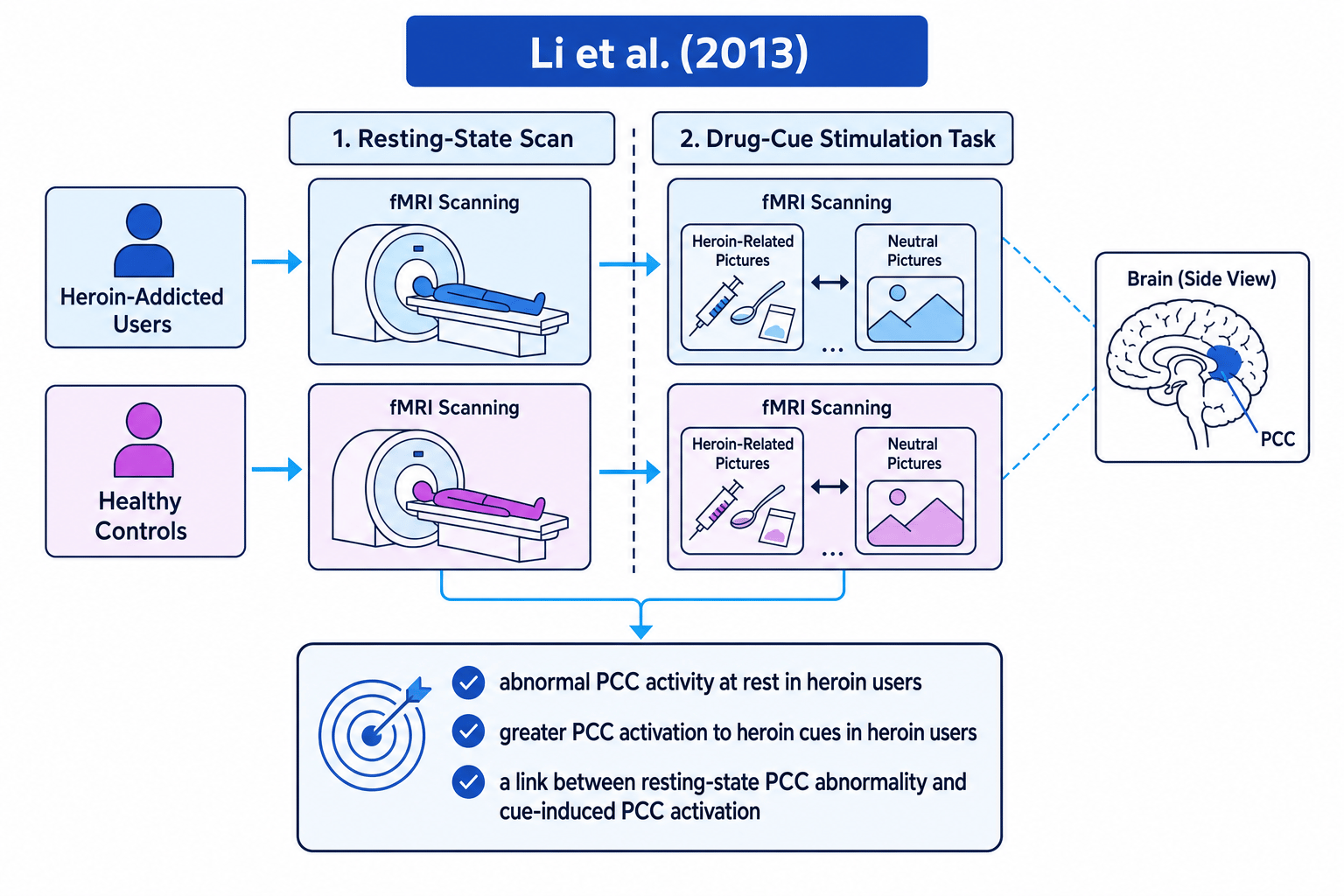
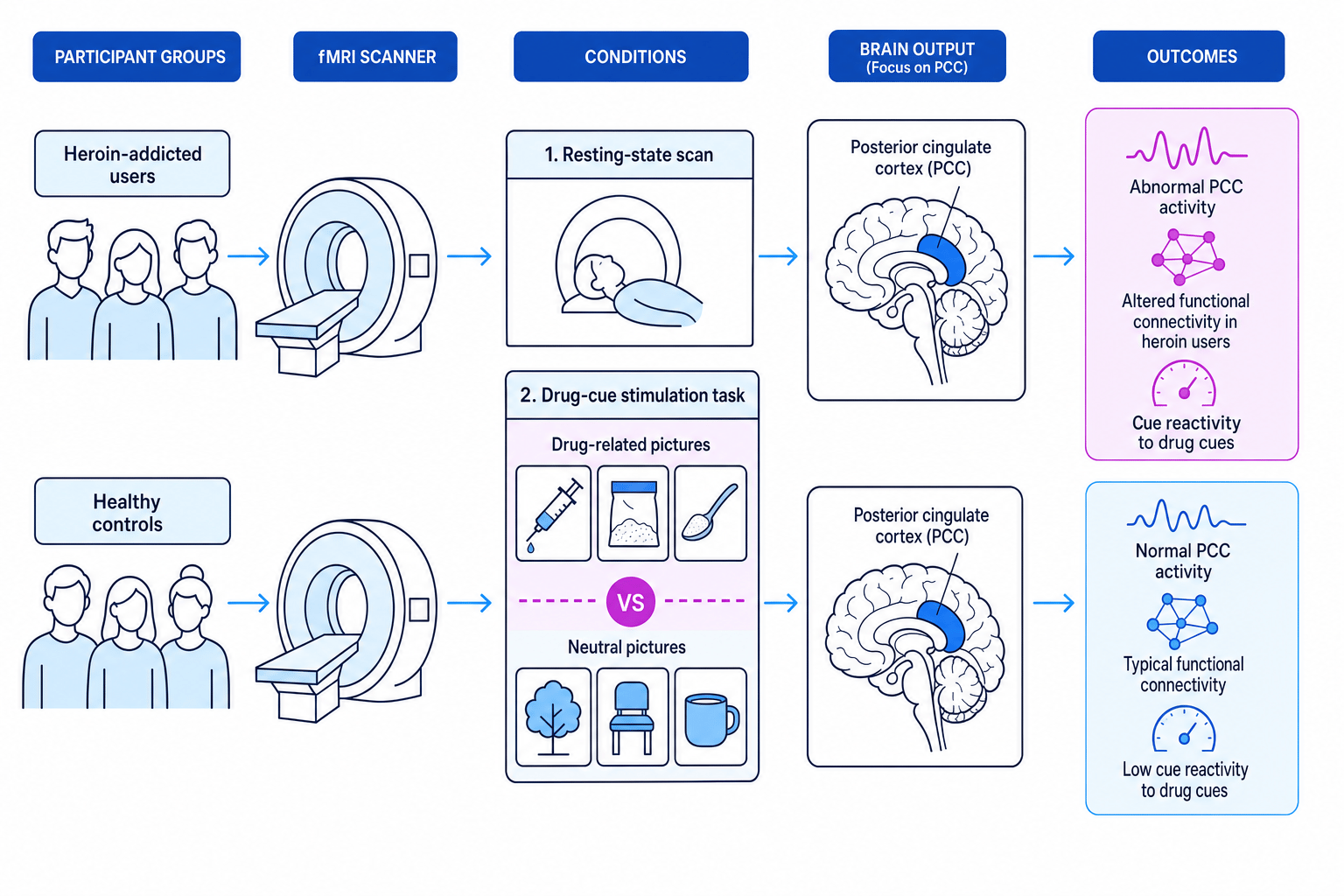
The diagram below shows the basic logic of Li et al.’s study: compare heroin-addicted users with controls, scan them during rest and cue exposure, and focus on PCC activity.
The scanning technique: fMRI
Functional magnetic resonance imaging, or fMRI, is a brain-scanning technique that measures changes in blood oxygenation. These changes are called the BOLD response, meaning blood-oxygen-level dependent response.
When a brain area is more active, it tends to need more oxygen, so blood flow to that area changes. fMRI uses this as an indirect measure of neural activity.
fMRI and BOLD response
fMRI measures changes in blood oxygenation in the brain. The BOLD response is used as an indirect indicator of which brain areas are more active during a task or condition.
fMRI is not mind-reading
Do not write that fMRI “shows thoughts” or “proves craving directly”. It measures blood-flow changes, which researchers interpret as brain activity linked to psychological processes.
Aim of Li et al. (2013)
Li et al. aimed to investigate whether heroin-addicted users showed abnormal PCC functioning:
- during resting-state brain activity
- during a drug-cue stimulation task
- compared with healthy control participants
A resting-state scan measures brain activity when the participant is not completing a specific task. It can show patterns of spontaneous brain activity and functional connectivity, which means the extent to which activity in different brain areas is statistically related over time.
Design and participants
Li et al. used a quasi-experiment. A quasi-experiment compares naturally occurring groups, rather than randomly allocating participants to conditions.
Here, the naturally occurring groups were:
- heroin-addicted users
- healthy controls
The study used a small sample. The published study is commonly summarised as using 14 heroin-addicted users and 15 healthy controls, with participants screened to reduce obvious confounding variables.
Quasi-experiment
A quasi-experiment is a study where the key participant variable already exists. In Li et al., researchers could not ethically or practically allocate people to become heroin-addicted, so addiction status was a naturally occurring difference.
Identifying variables in Li et al.
- The main comparison is between heroin-addicted users and healthy controls, so participant group is a key independent variable.
- The cue task also compares responses to drug-related cues and neutral cues, so cue type is another condition being compared.
- The dependent variables include PCC activity during rest, PCC activity during cue exposure, and measures linked to craving or cue response.
- Because participants were not randomly assigned to addiction status, the study can show an association between heroin addiction and PCC abnormality, but it cannot prove heroin use directly caused the brain differences.
Procedure
Participants underwent fMRI scanning in two main contexts.
Resting-state scan
In the resting-state condition, participants lay in the scanner without performing a task. Researchers measured spontaneous brain activity, especially in the PCC.
This allowed Li et al. to investigate whether heroin users had abnormal brain functioning even when no drug cue was being shown.
Drug-cue stimulation task
Participants were then shown images. These included:
- heroin-related pictures, such as drug paraphernalia
- neutral pictures, which were not drug-related
The researchers compared brain responses to drug cues and neutral cues. The main focus was whether heroin-addicted users showed stronger PCC responses to heroin-related cues.
Main findings
Li et al. found abnormal PCC function in heroin-addicted users.
During resting-state scanning, heroin users showed abnormal activity in the PCC compared with healthy controls. This suggests that addiction may involve ongoing changes in brain functioning, not only responses when a drug is physically present.
During drug-cue stimulation, heroin users showed greater PCC activation when exposed to heroin-related cues. This suggests that drug cues had become especially meaningful or attention-grabbing for them.
Li et al. also reported a relationship between resting-state PCC abnormality and cue-induced PCC activation. In simple terms, participants with more abnormal PCC functioning at rest also tended to show stronger PCC responses to heroin cues.
Core conclusion
The PCC may be involved in heroin addiction because it is active both in the background resting brain and when heroin users respond to drug-related cues.
What the study suggests about addiction
Li et al. supports a biological explanation of addiction. It suggests that repeated heroin use may be linked to changes in neural systems involved in craving, self-relevance, memory and attention.
This does not mean the environment is irrelevant. In fact, the cue task shows the opposite: environmental cues can trigger biological responses. So the study fits well with an interactionist view, where brain functioning and learned environmental associations influence each other.
AO2 link
If a scenario describes a recovering heroin user feeling sudden craving after seeing drug equipment, you can apply Li et al. by saying the cue may activate brain regions such as the PCC, which could increase craving and relapse risk.
AO3: Strengths
Scientific and objective measurement
A strength is that Li et al. used fMRI, which provides objective, biological data rather than relying only on self-report. This increases scientific credibility because brain activity can be measured and compared across conditions.
Use of a control group
The healthy control group allowed researchers to compare heroin users with non-addicted participants. This makes it easier to argue that the abnormal PCC activity was associated with heroin addiction rather than being a general feature of all people.
Controlled cue task
The use of heroin-related and neutral pictures made the procedure more controlled. Researchers could compare responses to different types of stimuli while keeping the scanning environment the same.
AO3: Weaknesses
Small and restricted sample
The sample was small, so findings may not generalise to all heroin users. If the sample was limited in age, culture, gender or treatment background, it becomes harder to apply the results to wider populations.
Cause and effect problem
Because the study was quasi-experimental, it cannot prove that heroin caused the PCC abnormalities. It is possible that some brain differences existed before drug use, or that other factors such as stress, mental health, withdrawal, polydrug use or lifestyle contributed.
fMRI limitations
fMRI is an indirect measure of neural activity. It measures blood oxygenation rather than neurons firing directly. It is also expensive, sensitive to movement, and can be affected by decisions made during data analysis.
Overclaiming the findings
Avoid writing “Li et al. proved heroin damages the PCC.” A safer answer is: “Li et al. found an association between heroin addiction and abnormal PCC functioning.”
Artificial setting
Viewing pictures in an fMRI scanner is not the same as encountering drug cues in real life. The scanner is noisy, restrictive and artificial, so ecological validity is limited.
Ethics
Li et al. involved a potentially vulnerable group: people with heroin addiction. The study therefore raises important ethical issues under the BPS Code of Ethics and Conduct (2009).
Researchers needed informed consent, confidentiality, the right to withdraw and a careful debrief. Protection from harm was especially important because showing heroin-related cues could increase craving or distress. Participants should have had appropriate support and should not have been placed at increased risk of relapse.
Ethical sensitivity
Drug-cue research can be valuable, but it must be carefully managed because deliberately triggering craving could cause psychological discomfort or increase relapse risk.
Real-world applications
Li et al. may help improve addiction treatment. If PCC activity is linked to cue-triggered craving, then treatments could focus on helping users manage cue exposure and relapse risk.
Possible applications include:
- cue-exposure therapy, where people learn to cope with drug-related cues
- relapse-prevention plans that identify high-risk cues and environments
- biological markers that help researchers understand treatment progress
- further research into brain-based interventions, though these need strong ethical safeguards
The study also challenges moralistic explanations of addiction. It supports the view that addiction involves measurable changes in brain systems, which may reduce stigma and encourage treatment-focused responses.
In the exam
- For AO1, describe the aim, sample, fMRI procedure, resting-state scan, drug-cue task, PCC focus and key findings.
- For AO2, apply the study to scenarios involving craving, relapse, drug cues or biological explanations of addiction.
- For AO3, balance strengths such as objective brain scanning and control groups against weaknesses such as small sample, artificial setting, fMRI limitations and inability to prove cause and effect.
Check yourself
- What is the posterior cingulate cortex, and why might it matter in heroin addiction?
- Why is Li et al. a quasi-experiment rather than a true experiment?
- Give one ethical issue raised by showing heroin-related cues to addicted participants.