What you'll learn
- What Raine et al. (1997) investigated using PET brain scanning.
- How the sample, controls and procedure were set up.
- The key brain abnormalities found in the murderer group.
- How to evaluate the study for AO1, AO2 and AO3 essay answers.
Why this study matters
Raine et al. (1997), formally titled Brain abnormalities in murderers indicated by positron emission tomography, is the classic biological psychology study for this section. It explores whether violent offending may be associated with differences in brain functioning.
The study is not saying “a brain scan can identify a murderer”. Instead, it provides evidence that some people who commit extreme violence may show reduced or unusual activity in brain areas linked to impulse control, emotion and decision-making.
The core claim
Raine et al. found that people pleading not guilty by reason of insanity for murder showed different patterns of brain activity from matched controls, especially in the prefrontal cortex, limbic areas and corpus callosum.
Prerequisite idea: biological explanations of offending
A biological explanation looks for physical causes of behaviour, such as genes, hormones, brain structures or neurotransmitters. In this study, the focus is brain functioning: how active different brain areas are while a person performs a task.
This matters because aggression and violent offending are complex behaviours. A biological study can show a possible association between the brain and offending, but it cannot fully explain social factors such as childhood experiences, poverty, learning, culture or relationships.
PET scans and glucose metabolism
Positron emission tomography
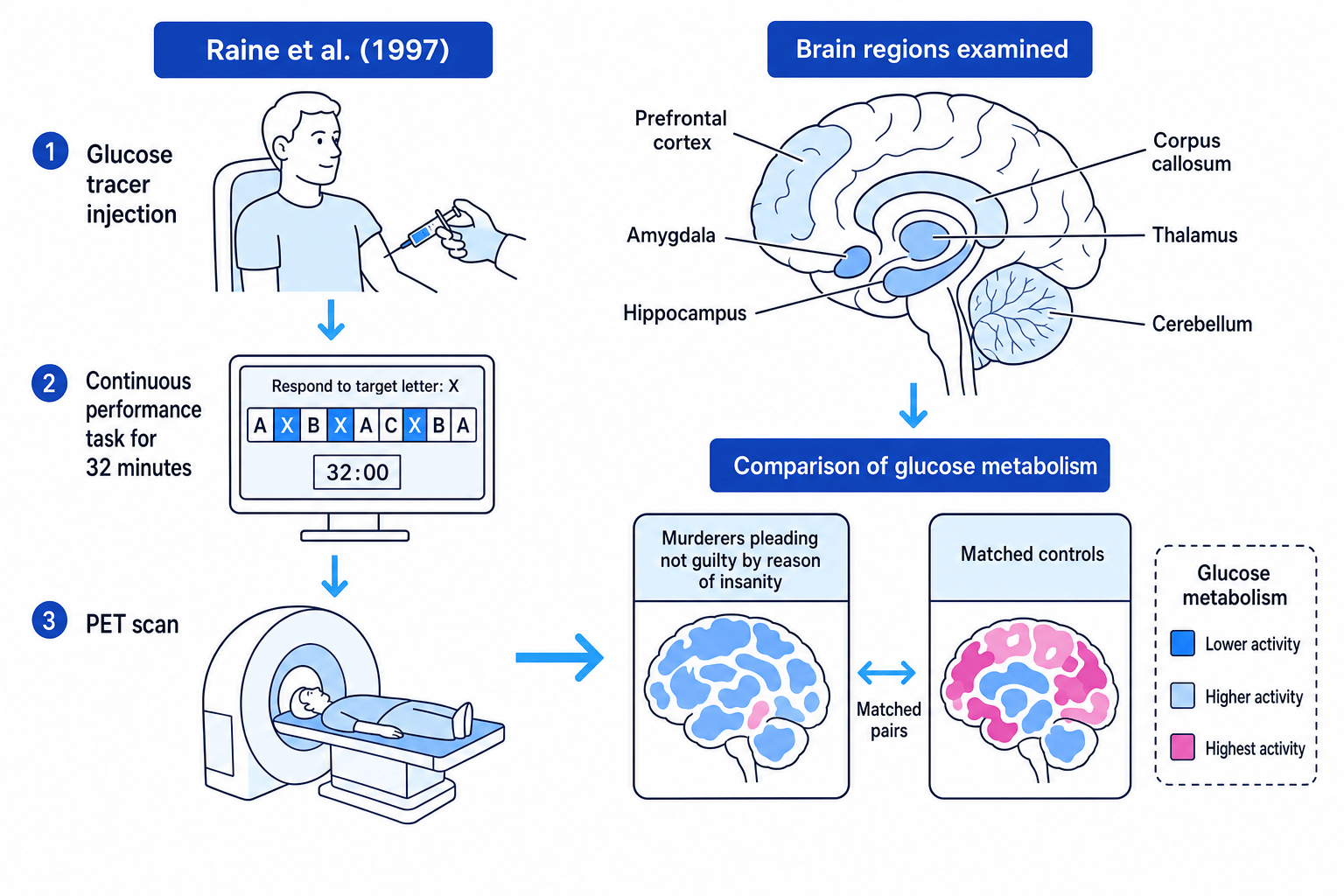
Positron emission tomography (PET) is a brain-scanning technique that uses a radioactive tracer to measure activity in the brain. More active brain areas use more glucose, so PET can estimate glucose metabolism, meaning how much energy different brain regions are using.
In Raine et al., participants were injected with a glucose tracer and completed a continuous performance task for 32 minutes. A continuous performance task is a simple attention task where participants respond to target stimuli over time. The task was used to keep brain activity reasonably consistent while the tracer was taken up.
Brain areas you need to know
You do not need to become a neuroscientist, but you should be able to link the main regions to behaviour:
- Prefrontal cortex: involved in planning, decision-making, self-control and inhibiting impulsive behaviour.
- Amygdala: part of the limbic system, involved in emotion, fear and aggression.
- Hippocampus: involved in memory and emotional learning.
- Thalamus: helps relay sensory information and is connected to emotional processing.
- Corpus callosum: a bundle of fibres connecting the left and right hemispheres of the brain.
- Limbic system: a group of brain structures involved in emotion, motivation and memory.
Turning association into destiny
Avoid writing that abnormal brain activity “causes murder” on its own. Raine et al. found differences between groups, but the study cannot prove that those differences directly caused the offences.
AO1: What Raine et al. did
Aim
The aim was to investigate whether people charged with murder and pleading not guilty by reason of insanity showed brain abnormalities compared with a control group.
Not guilty by reason of insanity, often shortened to NGRI, is a legal plea where the defendant argues that, because of mental disorder at the time of the offence, they should not be held fully legally responsible in the usual way.
Participants and design
Raine et al. used a quasi-experiment. A quasi-experiment compares naturally occurring groups rather than randomly assigning participants to conditions. Here, the researchers could not randomly allocate people to be murderers or controls, so group membership already existed.
The sample included:
- 41 people in the murderer group, mostly male, who had pleaded NGRI.
- 41 control participants.
- Controls were matched as closely as possible on variables such as age and sex.
- Some controls with schizophrenia were included to match participants in the murderer group who also had schizophrenia.
The independent variable was group membership: murderer/NGRI group or control group. The dependent variable was brain activity, measured through PET glucose metabolism in different brain regions.
Procedure
Participants were injected with the radioactive glucose tracer, then completed the continuous performance task for 32 minutes. After this, PET scans measured glucose metabolism in different brain areas. The same general procedure was used for both groups, which helped make the comparison more controlled.
The researchers compared activity levels in cortical areas, such as the prefrontal cortex, and subcortical areas, including limbic structures.
Results
The main findings were:
- The murderer group showed lower activity in the prefrontal cortex than controls.
- They also showed lower activity in areas including the corpus callosum.
- There were abnormal patterns in limbic areas, including the amygdala, hippocampus and thalamus.
- A key pattern was unusual left-right asymmetry: some emotional-processing areas showed lower activity on the left and higher activity on the right.
Conclusions
Raine et al. concluded that brain dysfunction may be associated with violent offending, especially where areas involved in self-control and emotional regulation are affected.
Lower prefrontal activity may link to impulsivity and poor inhibition. Limbic abnormalities may link to emotional instability, aggression or difficulty processing fear. Corpus callosum abnormalities may suggest poorer communication between the brain’s hemispheres.
Linking a brain finding to behaviour
-
Start with the finding that the murderer group showed lower glucose metabolism in the prefrontal cortex than the matched controls.
-
Connect that region to its function: the prefrontal cortex is involved in inhibition, planning and controlling impulsive responses.
-
Apply the function to offending: if this area is underactive, a person may be less able to stop an aggressive impulse during provocation.
-
Add the necessary caution: because this was a quasi-experiment, the finding shows an association between brain activity and violent offending, not a simple cause-and-effect relationship.
AO2: Applying the study
If a scenario describes someone with poor impulse control, emotional outbursts or aggression following brain injury, Raine et al. can be applied by linking these behaviours to reduced prefrontal functioning.
If a scenario focuses on fear, emotional learning or aggression, you can apply the limbic system findings, especially the amygdala and hippocampus.
If the question is about criminal responsibility, use the study carefully. Brain abnormalities may help explain behaviour, but they do not automatically remove responsibility or predict future violence.
Research methods links
Raine et al. is useful for research-methods AO2 because it includes matched controls, quantitative data and brain-imaging technology.
The data were mainly quantitative, meaning numerical. Researchers could compare mean glucose metabolism across regions, look at variation using the range or standard deviation, and display group differences using bar charts. A histogram could be used to check whether scores are normally distributed or skewed. Thematic analysis would not be suitable for the PET data because that method is for qualitative material, such as interview transcripts.
Inferential statistics link
For an Edexcel-style methods question, remember that Mann-Whitney U tests a difference between two unrelated groups, Wilcoxon signed-ranks tests a difference between related or matched data, Spearman’s rho tests a correlation, and chi-square tests an association between categories. The usual significance level is p≤.05p \leq .05p≤.05; p≤.01p \leq .01p≤.01 is stricter and reduces Type I error risk, while p≤.10p \leq .10p≤.10 is more lenient and increases it.
Choosing a test for a Raine-style dataset
-
If you compare PET scores from each NGRI participant with their matched control, the question is about a difference between two conditions, not a correlation.
-
Because the participants are matched pairs, the related-data test from the Edexcel list would be Wilcoxon signed-ranks, especially if the distribution is skewed or the data are treated as non-parametric.
-
If the groups were not matched, the better Edexcel test would be Mann-Whitney U because it compares two unrelated groups.
-
If using a critical-value table, Wilcoxon T and Mann-Whitney U are significant when the observed value is equal to or smaller than the critical value; Spearman’s rho and chi-square are significant when the observed value is equal to or larger than the critical value.
AO3: Evaluating Raine et al.
Strengths
One strength is the use of PET scanning. This gave objective, scientific and quantitative data rather than relying on self-report. Brain imaging also allows researchers to study biological processes directly, which increases credibility for biological explanations of aggression.
Another strength is the matched control group. Matching participants on age and sex helped reduce participant variables, making it more likely that differences were linked to offender status rather than basic demographic differences.
The study also has real-world application. It may help psychologists and legal professionals understand how brain injury, poor impulse control or emotional-processing problems could contribute to violent behaviour. It can also support rehabilitation approaches that consider neurological and psychological needs.
Weaknesses
A major weakness is that the study cannot establish cause and effect. Brain differences may have contributed to offending, but they may also have resulted from head injury, substance use, mental illness or other life experiences.
The sample is also limited. These were not all murderers; they were people pleading NGRI. This means the findings may apply more to mentally disordered or neurologically unusual offenders than to murderers in general.
There are also issues of reductionism and determinism. Reductionism means explaining a complex behaviour using only one level of explanation. Murder involves moral, social, cognitive and situational factors as well as biology. Determinism is the idea that behaviour is controlled by forces outside free will. Raine et al. may encourage deterministic interpretations, so you should balance it with environmental explanations.
Finally, later research has not shown that all violent offenders have the same brain pattern. Many people with brain abnormalities never offend, and some violent offenders may not show the abnormalities Raine et al. found. This weakens any simplistic prediction claim.
Ethics: BPS Code of Ethics and Conduct
The BPS Code of Ethics and Conduct (2009) is useful for evaluating this study.
Consent and right to withdraw are important because the participants were involved in serious legal and psychiatric contexts. Researchers would need to make sure participation in research was voluntary and not confused with legal assessment.
Protection from harm is also relevant because PET involves a radioactive tracer, although this is used in controlled medical contexts. Participants may also experience psychological harm or stigma if labelled as biologically abnormal.
Confidentiality was essential because the data involved serious offences and mental health information. Deception was likely limited because the scanning procedure needed explanation, and debriefing should clarify the purpose and use of the results.
In the exam
-
For AO1, describe the aim, sample, PET procedure, key findings and conclusion in a clear sequence.
-
For AO3, balance scientific strengths, such as objective PET data and matched controls, with weaknesses such as lack of causality and limited generalisability.
-
Avoid deterministic wording: say brain abnormalities are associated with violent offending, not that they automatically cause murder.
Check yourself
- Which brain area did Raine et al. link most clearly to poor impulse control?
- Why was the study a quasi-experiment rather than a true experiment?
- What is one ethical issue raised by using PET scans with NGRI participants?
