What you'll learn
- What Brendgen et al. (2005) investigated about social aggression in 6-year-old twins.
- How twin studies separate genetic and environmental influences.
- The study’s aim, sample, procedure, findings and conclusions for AO1.
- How to evaluate the study using methodology, ethics and real-world application for AO3.
Why this study matters
Brendgen et al. (2005) is the contemporary study for the Biological Psychology topic. It supports the idea that aggression is not only learned from the environment: some individual differences in aggression may also be linked to genetic influences.
This study focuses on a less obvious form of aggression: not hitting or kicking, but damaging someone’s friendships, reputation or social status.
Key background: what is social aggression?
Social aggression
Social aggression is behaviour intended to harm another person through their social relationships or social status, such as excluding them from a group, spreading rumours, or persuading others not to be friends with them.
This is different from physical aggression, which involves direct physical harm or threat, such as hitting, kicking, pushing or fighting.
Social aggression can be harder for adults to spot because it often happens through peer groups. For example, a teacher might not see one child quietly telling others not to play with another child, but classmates may notice it clearly.
Aggression is not just physical
Brendgen et al. are important because they studied aggression that happens through relationships, not just aggression that involves physical harm.
Key background: twin studies
A twin study compares similarities between different types of twins to estimate the influence of genes and environments on behaviour.
Monozygotic and dizygotic twins
Monozygotic and dizygotic twins
Monozygotic twins, often called MZ twins, come from one fertilised egg and share virtually 100% of their genes. Dizygotic twins, or DZ twins, come from two fertilised eggs and share about 50% of their segregating genes, like ordinary siblings.
If MZ twins are more similar than DZ twins for a behaviour, this suggests that genetic factors may be involved.
However, this does not mean the behaviour is “caused by genes” in a simple way. It means genetic differences may help explain why some children are more socially aggressive than others within that population.
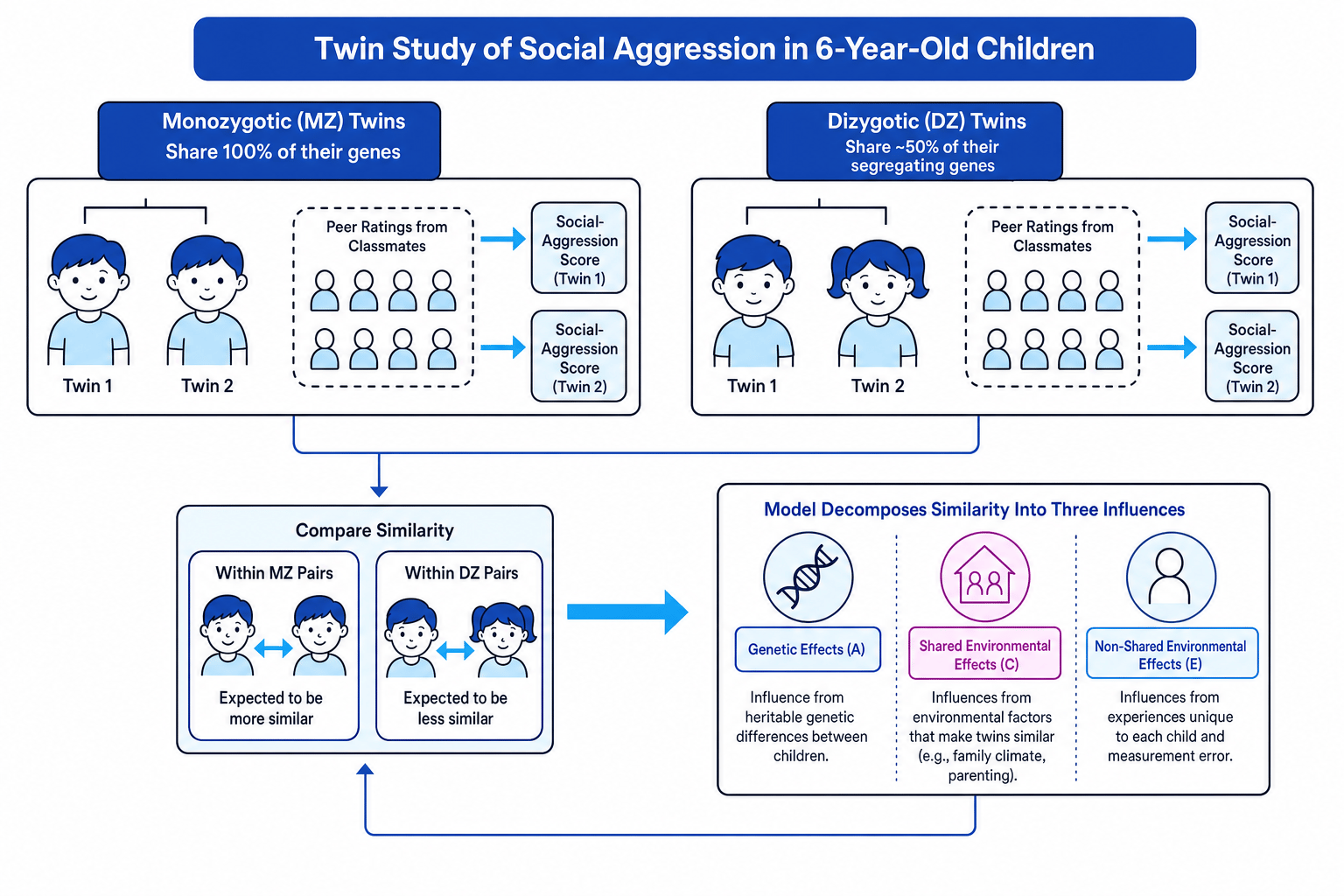
Heritability, shared environment and non-shared environment
Heritability
Heritability is the proportion of variation in a behaviour within a group that can be statistically linked to genetic differences between individuals.
Twin studies often divide influences into three broad categories:
- Genetic influences: differences linked to inherited genetic variation.
- Shared environmental influences: experiences that make twins similar, such as family background, neighbourhood or some parenting factors.
- Non-shared environmental influences: experiences that make twins different, such as different friends, different peer experiences, illness, accidents, or being treated differently. This category also includes measurement error.
Heritability does not mean destiny
Do not write that “60% heritable” means 60% of one child’s aggression is caused by genes. Heritability describes variation across a group, not a fixed percentage inside an individual child.
Inferring genetic influence from twin similarity
Imagine a twin study finds that MZ twins are much more similar than DZ twins for social aggression.
-
Compare the twin correlations: if rMZr_{\text{MZ}}rMZ is higher than rDZr_{\text{DZ}}rDZ, MZ twins resemble each other more strongly than DZ twins.
-
Apply the genetic logic: because MZ twins share virtually all their genes while DZ twins share about half, the extra similarity in MZ pairs suggests a genetic contribution.
-
Estimate the direction of influence using the rough twin-study rule:
h2≈2(rMZ−rDZ) h^2 \approx 2(r_{\text{MZ}} - r_{\text{DZ}}) h2≈2(rMZ−rDZ)A bigger gap between rMZr_{\text{MZ}}rMZ and rDZr_{\text{DZ}}rDZ gives a larger estimate of heritability.
-
Interpret carefully: this supports genetic influence, but it does not prove a single “aggression gene”, and it does not rule out environmental influences.
AO1: Brendgen et al. (2005)
Full title
Brendgen et al. (2005) conducted the study “Examining genetic and environmental effects on social aggression: A study of 6-year-old twins.”
Aim
The main aim was to investigate the extent to which genetic factors, shared environmental factors and non-shared environmental factors influence social aggression in young children.
The researchers also considered the relationship between social aggression and physical aggression, because children who harm others socially may also be more likely to show direct physical aggression.
Sample
The study used a sample of 6-year-old twins from Quebec, Canada. The sample included both MZ and DZ twin pairs, allowing the researchers to compare how similar each type of twin was for aggression.
This is a natural experiment because the researchers did not manipulate whether children were MZ or DZ twins. Twin type is naturally occurring.
Procedure
The researchers gathered information about children’s aggressive behaviour using peer nominations.
Peer nomination
A peer nomination is a method where children identify classmates who fit particular behavioural descriptions, such as “starts fights” or “gets others to exclude someone.”
Classmates were asked to identify children who showed behaviours linked to social aggression and physical aggression. For social aggression, this included behaviours such as excluding others or damaging friendships. For physical aggression, this included behaviours such as hitting, kicking or fighting.
The researchers then compared the similarity of MZ twin pairs with the similarity of DZ twin pairs.
Findings
The main pattern was that MZ twins were more similar than DZ twins for social aggression. This suggests that genetic factors contributed to individual differences in social aggression.
The study found that social aggression was influenced mainly by:
- genetic factors, explaining a substantial proportion of the variation;
- non-shared environmental factors, also explaining an important proportion;
- little or no clear influence from shared environmental factors.
Brendgen et al. also found that social aggression and physical aggression were related, meaning children who showed one type of aggression were more likely to show the other. However, social aggression was still worth studying separately because it is a distinct form of harmful behaviour.
Conclusion
Brendgen et al. concluded that social aggression in young children has a genetic component, but it is also shaped by non-shared environmental experiences.
Main conclusion
Brendgen et al. support a nature-and-nurture view: social aggression is partly linked to genetic differences, but unique environmental experiences also matter.
AO2: Applying the study
You can use Brendgen et al. in essays about biological explanations of aggression.
For example, if a scenario describes a child who often excludes others from games or spreads rumours, you could apply Brendgen et al. by saying this behaviour is an example of social aggression. The study suggests that such behaviour may be partly influenced by genetic factors, especially if close biological relatives show similar patterns.
However, you should also apply the environmental side. A child’s unique peer experiences, friendship group, classroom position or experiences of rejection could also shape their social aggression.
Best AO2 phrase
A strong application sentence is: “This behaviour is social aggression because it harms another child through relationships rather than through physical force.”
Research-methods link
Brendgen et al. is useful for research methods because it uses:
- correlational reasoning: comparing how strongly twin scores are related;
- quantitative data: aggression scores from peer nominations;
- a natural experiment: MZ and DZ twin status is naturally occurring;
- matched participants by design: twins are the same age and often share many background factors.
In Edexcel research methods, remember the named inferential tests:
- Spearman’s rho: used for a correlation between two ranked or ordinal variables.
- Mann-Whitney U: used for a difference between two independent groups.
- Wilcoxon signed-ranks: used for a difference between related or repeated-measures data.
- Chi-square: used for an association between categories.
For significance, the usual convention is p≤.05p \le .05p≤.05, with p≤.10p \le .10p≤.10 being more lenient and p≤.01p \le .01p≤.01 being stricter. In exam questions, you may compare an observed value with a critical value from a table, and you must notice whether the hypothesis is one-tailed or two-tailed.
Aggression scores may be skewed because many children receive few nominations while a small number receive many. In that case, non-parametric tests and careful descriptive statistics, such as median, range and frequency distributions, may be more appropriate than assuming a normal distribution.
AO3: Evaluation
Strength: good fit between method and aim
A twin design is well matched to the aim because it allows researchers to estimate genetic and environmental contributions. Comparing MZ and DZ twins gives a clearer biological test than simply asking whether aggressive children have aggressive parents.
Strength: peer nominations may improve validity
Peer nominations can be a valid way to measure social aggression because classmates often see subtle exclusion, rumour-spreading and friendship manipulation. Teachers and parents may miss these behaviours.
This improves ecological validity, because the study measured behaviour in the child’s real social world rather than in an artificial laboratory task.
Weakness: twin studies rely on assumptions
Twin studies often rely on the equal environments assumption. This is the idea that MZ and DZ twins experience equally similar environments.
If MZ twins are treated more similarly than DZ twins, or are more likely to share friends and activities, then their greater similarity might be partly environmental rather than genetic.
Overstating genetic evidence
Do not say Brendgen et al. “proved aggression is genetic.” The study estimated genetic influence statistically; it did not identify specific genes or directly manipulate biology.
Weakness: non-shared environment includes measurement error
The non-shared environment estimate includes real unique experiences, but it also includes errors in measurement. For example, classmates may misunderstand a question or nominate someone based on popularity rather than actual aggression.
This means the study can show that unique environmental factors matter, but it cannot precisely identify which unique experiences caused the aggression.
Weakness: generalisability
The participants were 6-year-old twins from Quebec. Findings may not generalise fully to:
- older children or adolescents;
- children from different cultures;
- non-twin children;
- forms of aggression outside school settings.
Social aggression may change with age because older children have more complex friendships, online communication and social hierarchies.
Ethical considerations
Because the participants were young children, ethical care was especially important.
Relevant BPS Code of Ethics and Conduct principles include:
- consent: parents or guardians should give consent, and children should give age-appropriate assent;
- right to withdraw: families and children should be able to stop taking part;
- protection from harm: children should not be labelled publicly as “aggressive”;
- confidentiality: individual aggression scores should not be shared with classmates;
- debrief: children, parents and schools should be informed appropriately after participation;
- deception: if the full purpose was not explained to children beforehand, this should be justified and followed by debriefing.
Real-world application
The study has practical value for schools and early-years interventions. It suggests that social aggression should be taken seriously, even when there is no physical violence.
However, interventions should not treat aggression as biologically fixed. Since non-shared environmental factors also matter, schools can still reduce social aggression through social skills training, anti-bullying policies, conflict resolution and support for peer relationships.
Balanced conclusion
Brendgen et al. supports biological explanations of aggression, but the best conclusion is interactionist: genes may create vulnerability, while environments influence how behaviour develops.
How to use Brendgen et al. in essays
For AO1, describe the study clearly: aim, twin sample, peer nominations, comparison of MZ and DZ twins, and findings about genetic and non-shared environmental effects.
For AO3, avoid just listing “strength” and “weakness.” Link each evaluation point to the study’s conclusion. For example, the equal environments assumption matters because it could exaggerate the apparent genetic influence.
In the exam
-
Define social aggression before describing the study, so the examiner sees you understand the behaviour being measured.
-
When evaluating, use twin-study language accurately: MZ, DZ, heritability, shared environment and non-shared environment.
-
Give a balanced conclusion: Brendgen et al. supports genetic influence, but it also shows that unique environmental experiences are important.
Check yourself
- Why does greater similarity in MZ twins than DZ twins suggest a genetic influence?
- What is the difference between shared and non-shared environmental influences?
- Give one methodological strength and one ethical issue in Brendgen et al. (2005).
