What you'll learn
- What Li et al. (2013) investigated about high-quality childcare and child development.
- How the study was designed, including its longitudinal method and use of standardised tests.
- The main findings about cognitive, language and preacademic development.
- How to evaluate the study for AO3, including methodology, ethics and real-world applications.
Why this study matters
Li et al. (2013) is a contemporary study in Child Psychology. It is useful because it looks at a very practical question: does the timing of good-quality childcare matter for children’s later development?
Rather than simply asking “Is childcare good or bad?”, Li et al. asked a more precise question: when might high-quality childcare be most useful, and for which developmental outcomes?
Core idea
Li et al. (2013) found that higher-quality childcare was generally linked with better child development, but the timing of that childcare mattered differently for different skills.
Key background concepts
Childcare
In this study, childcare means regular care provided by someone other than the child’s mother, such as a nursery, daycare centre, childminder, relative or other caregiver.
This does not mean that parents are unimportant. The study looked at childcare alongside family factors, because children’s development is shaped by many influences at once.
High-quality childcare
High-quality childcare refers to care that is warm, responsive, sensitive to the child’s needs, and cognitively stimulating — for example, adults talking with children, encouraging play, and supporting learning.
Developmental outcomes
Li et al. focused on three types of outcome.
Cognitive development refers to thinking skills, such as problem-solving, memory, attention and understanding.
Language development refers to skills such as understanding words, using vocabulary and communicating effectively.
Preacademic development refers to early school-readiness skills, such as recognising letters, numbers and basic concepts that prepare children for formal education.
Preacademic skills
Preacademic skills are early abilities that help a child prepare for school learning, such as basic literacy, numeracy and concept knowledge.
AO1: What Li et al. (2013) did
Aim
Li et al. (2013) aimed to investigate the relationship between the timing of high-quality childcare and children’s later cognitive, language and preacademic development.
The researchers were especially interested in whether high-quality childcare in the infant-toddler period and the preschool period had different links with later outcomes.
Sample
The study used data from the large American NICHD Study of Early Child Care and Youth Development. This was a major longitudinal study following children from early life.
The original sample included over 1,000 children recruited from different locations in the USA. Children and families were followed over time, rather than tested only once.
Longitudinal study
A longitudinal study follows the same participants over an extended period, allowing researchers to look at development and change over time.
Design and procedure
Li et al. used a longitudinal, correlational design. The researchers did not randomly allocate children to childcare conditions. Instead, they observed naturally occurring childcare experiences and analysed how these related to later development.
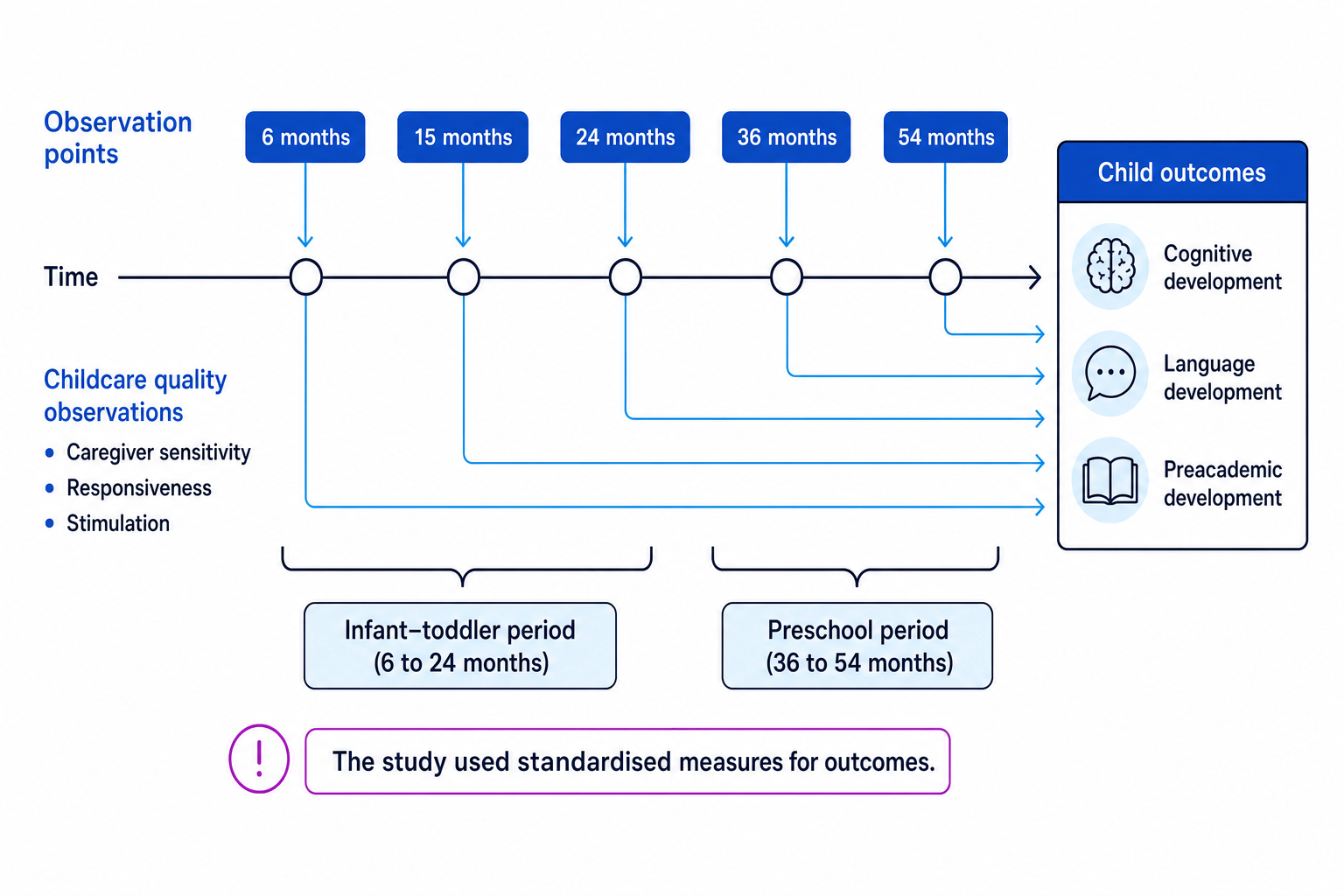
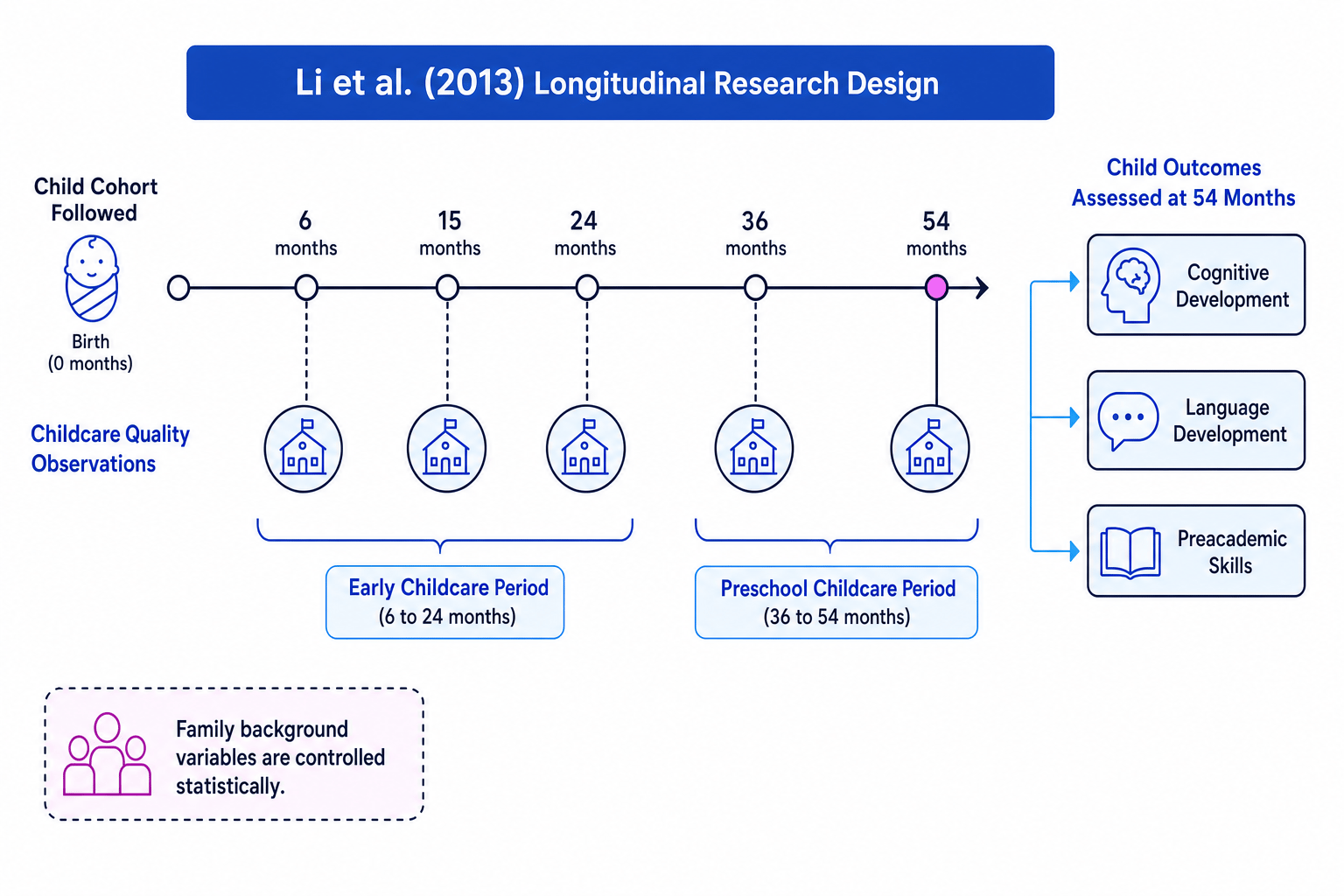
Childcare quality was observed at several points in early childhood, including around 6, 15, 24, 36 and 54 months. Researchers assessed the quality of care using structured observations, looking at features such as caregiver sensitivity, stimulation and responsiveness.
The study separated childcare timing into broad periods:
- Infant-toddler period: roughly 6 to 24 months.
- Preschool period: roughly 36 to 54 months.
Children’s developmental outcomes were then assessed using standardised measures of cognitive, language and preacademic ability.
The diagram below shows the basic logic of the study design.
Main findings
The overall pattern was that high-quality childcare was associated with better developmental outcomes.
Li et al. also found that timing mattered. High-quality care during earlier infancy and toddlerhood was linked with foundations for later cognitive and language development, while high-quality care during the preschool period was especially relevant for preacademic skills.
This makes developmental sense: very young children may benefit strongly from sensitive language-rich interaction, while preschool children may particularly benefit from structured activities that prepare them for school.
How to remember the findings
Think: early warmth and talk support thinking and language; preschool stimulation supports school readiness.
Conclusion
Li et al. concluded that high-quality childcare can support child development, but researchers and policymakers should pay attention to when children receive that care.
The study does not show that childcare automatically causes better development. It shows that, in this large sample, high-quality childcare was associated with stronger developmental outcomes after taking account of several background factors.
Interpreting the study carefully
Correlation is not causation
Because this was a natural longitudinal study, children were not randomly assigned to high- or low-quality childcare. Families who access high-quality childcare may differ in other ways, such as income, parental education, home learning environment or parental working patterns.
Li et al. used statistical controls to reduce this problem, but controls cannot remove every possible confounding variable.
Confounding variable
A confounding variable is an extra factor that may affect the outcome and make it difficult to know whether the variable being studied is truly responsible.
Avoiding a causal conclusion
A student writes: “Li et al. proved that high-quality childcare causes better language development.” Improve this answer.
-
Identify the design: Li et al. used a longitudinal correlational design, not an experiment with random allocation.
-
Apply the limitation: because families chose or accessed different childcare naturally, other factors such as parental education or home stimulation could also affect language development.
-
Write the safer conclusion: Li et al. found an association between high-quality childcare and better language development, but the study cannot prove direct cause and effect.
Overstating the study
Do not write that Li et al. proved childcare causes higher intelligence. The study measured several developmental outcomes and found associations with childcare quality and timing.
AO3: Strengths of Li et al. (2013)
Large longitudinal data set
A major strength is the use of a large longitudinal sample. Following children over several years allowed Li et al. to examine how early experiences related to later development.
This is stronger than a one-off snapshot because development happens over time. It also allowed the researchers to compare different childcare periods.
Real-world childcare settings
The study looked at naturally occurring childcare rather than an artificial laboratory task. This increases ecological validity, because the findings relate to the kinds of childcare arrangements families actually use.
Ecological validity
Ecological validity is the extent to which research findings apply to real-life settings and behaviour.
Structured observations and standardised measures
Childcare quality was assessed using structured observation, and child outcomes were measured using standardised tests. This improves reliability because researchers were not simply relying on vague opinions about whether care was “good”.
Standardised measures also make it easier to compare children fairly across a large sample.
AO3: Weaknesses of Li et al. (2013)
Lack of random allocation
The biggest limitation is that the study was not a true experiment. Children were not randomly allocated to high-quality or lower-quality childcare.
This means selection bias is possible. For example, families who can access high-quality childcare may also provide more books, language interaction and educational support at home.
Selection bias
Selection bias occurs when the groups being compared differ in important ways before the study variable is measured.
Cultural and historical limits
The data came from children in the USA, with childcare experiences from a particular social and historical context. Childcare systems, parental leave, nursery funding and educational expectations vary between countries.
This means the findings may not generalise perfectly to all children, including children in the UK today.
Measuring “quality” is difficult
Although Li et al. used structured observations, childcare quality is complex. A short observation may not capture every aspect of a child’s daily experience.
For example, a nursery might score well during an observation but vary across staff members, days or activities. Also, what counts as “high-quality” may partly depend on cultural expectations about adult-child interaction.
Ethics
Li et al. used data involving young children, so ethical issues are important. Under the BPS Code of Ethics and Conduct (2009), key principles include consent, right to withdraw, protection from harm, confidentiality and debriefing.
Parents would need to give informed consent for their child’s participation. Children’s data should be kept confidential, especially because family background and developmental scores are sensitive information.
The study was low risk because it involved observation and testing rather than manipulating children’s care. However, researchers still needed to ensure that children were not distressed and that families were treated respectfully.
Ethics with child participants
Young children cannot give fully informed adult consent, so researchers rely on parental consent while still watching for signs that the child is uncomfortable or unwilling to continue.
Real-world applications
Li et al. has clear practical value. The findings support investment in high-quality early years provision, especially care that is responsive, language-rich and developmentally stimulating.
The study can be used to argue that childcare policy should focus not only on availability and cost, but also on quality. Training caregivers, improving staff-child interactions and supporting early language activities may help children’s development.
The findings are also useful for parents. They suggest that the question is not simply whether a child attends childcare, but what kind of care the child experiences.
Practical takeaway
For real-world application, focus on improving the quality of childcare rather than assuming all childcare has the same effect.
Using Li et al. in essays
For AO1, describe the aim, sample, longitudinal design, measures of childcare quality, developmental outcomes and main findings.
For AO2, apply the study to scenarios involving nursery quality, early years policy or children’s school readiness.
For AO3, evaluate the study using strengths and weaknesses such as sample size, ecological validity, correlational design, cultural generalisability, measurement issues and ethics.
In the exam
-
Start by naming the study clearly: Li et al. (2013), and state that it examined the timing of high-quality childcare and child development.
-
For AO3, avoid generic evaluation only. Link each point directly to the study, such as its longitudinal design, natural childcare settings or lack of random allocation.
-
Be precise with conclusions: say “associated with” or “linked to” unless you are explicitly discussing the limits of causal claims.
Check yourself
- What did Li et al. mean by high-quality childcare?
- Why is the longitudinal design a strength of this study?
- Why should you avoid saying that Li et al. proved childcare causes better development?