What you'll learn
- What Gagnon-Oosterwaal et al. (2012) investigated about international adoption and later behaviour.
- How the study measured pre-adoption adversity and self-reported behaviour problems.
- How to describe the study for AO1 and apply it for AO2.
- How to evaluate the study using methodology, ethics and real-world usefulness.
The big picture
Gagnon-Oosterwaal et al. (2012) is a contemporary study in Child Psychology. It explores whether difficult experiences before adoption are linked to behaviour problems reported by children themselves at around age seven.
This matters because many adoption studies rely on adults — parents, teachers or clinicians — to report children’s behaviour. This study is important because it takes the child’s own perspective seriously.
Core takeaway
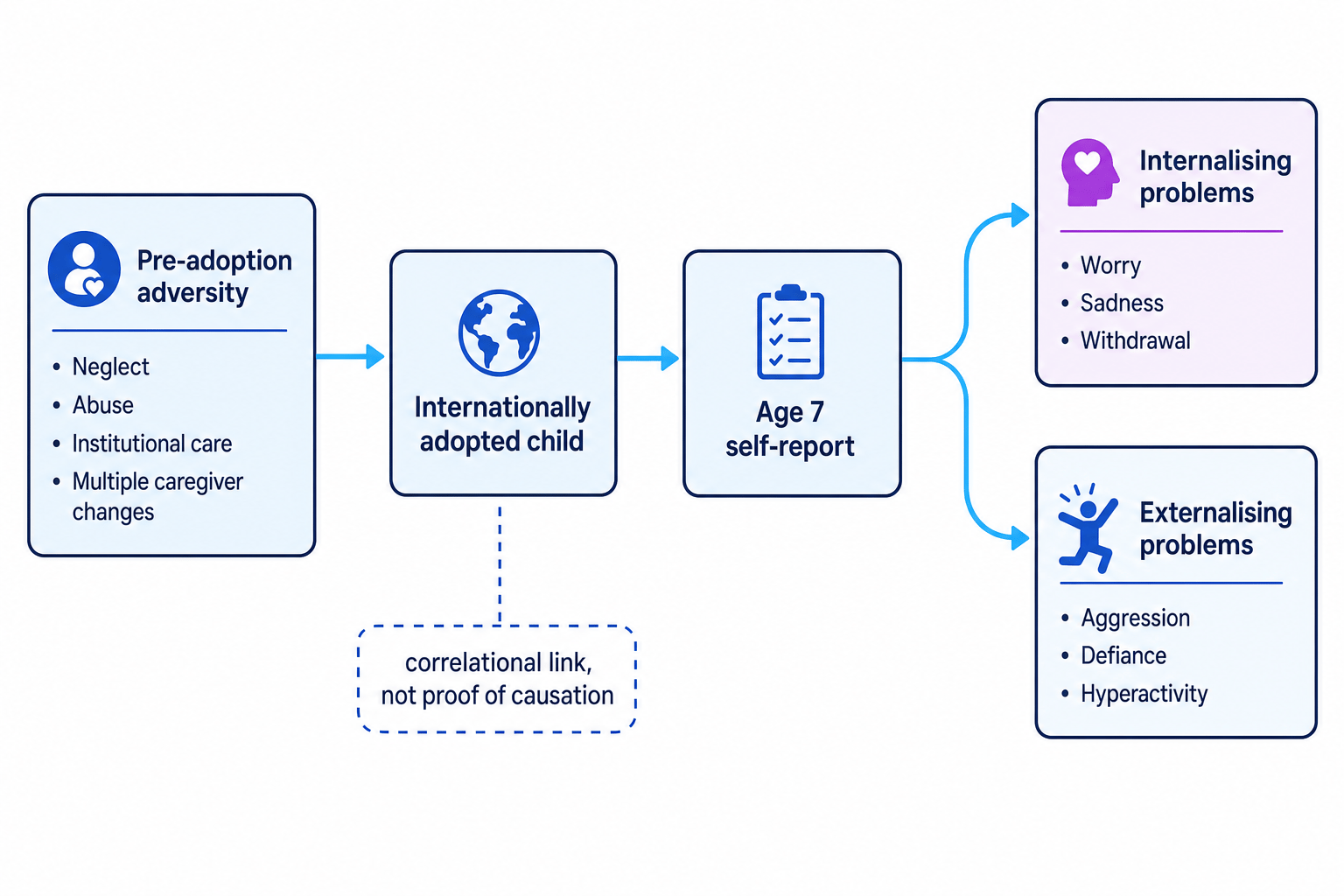
Gagnon-Oosterwaal et al. found that early adverse experiences before international adoption can be linked to later behaviour problems, but the study is correlational, so it cannot prove that adversity directly caused those problems.
Key background concepts
International adoption
International adoption
International adoption is when a child is legally adopted by parents in another country, often after spending early life in foster care, institutional care, or other temporary care settings.
International adoption is useful for psychologists to study because it creates a natural situation where children move from one early environment into a different caregiving environment. Researchers can then ask whether early experiences still predict later development.
This does not mean adoption is an experiment. Researchers do not manipulate children’s lives. They observe naturally occurring differences.
Pre-adoption adversity
Pre-adoption adversity
Pre-adoption adversity means negative experiences a child may have had before being adopted, such as neglect, abuse, poor physical care, malnutrition, institutional care, or several changes of caregiver.
In adoption research, adversity is often treated as a risk factor. A risk factor is something that increases the likelihood of a later difficulty, but does not guarantee it.
For example, a child who experienced neglect before adoption may be at greater risk of anxiety or aggression later. However, a stable, sensitive adoptive family may help reduce that risk.
Adversity is not destiny
Do not write as if all adopted children will develop behaviour problems. The study is about increased risk and statistical association, not a fixed outcome for every child.
Behaviour problems: internalising and externalising
Internalising and externalising problems
Internalising problems are difficulties directed inward, such as anxiety, sadness, withdrawal or low self-esteem. Externalising problems are difficulties directed outward, such as aggression, defiance, hyperactivity or rule-breaking.
This distinction is useful because early adversity may not affect all behaviour in the same way. Some children may become withdrawn and anxious, while others may show more disruptive behaviour.
Classifying behaviour problems
A child says they often worry about being left alone, avoid new children at school, and sometimes hit classmates when frustrated.
- The worry about being left alone is an inward emotional difficulty, so it fits internalising problems.
- Avoiding new children also suggests withdrawal, so it also fits internalising problems.
- Hitting classmates is outwardly directed behaviour, so it fits externalising problems.
- In an essay, you would avoid simply saying “behaviour problems” if you can be more precise about which type is being discussed.
The study: Gagnon-Oosterwaal et al. (2012)
Aim
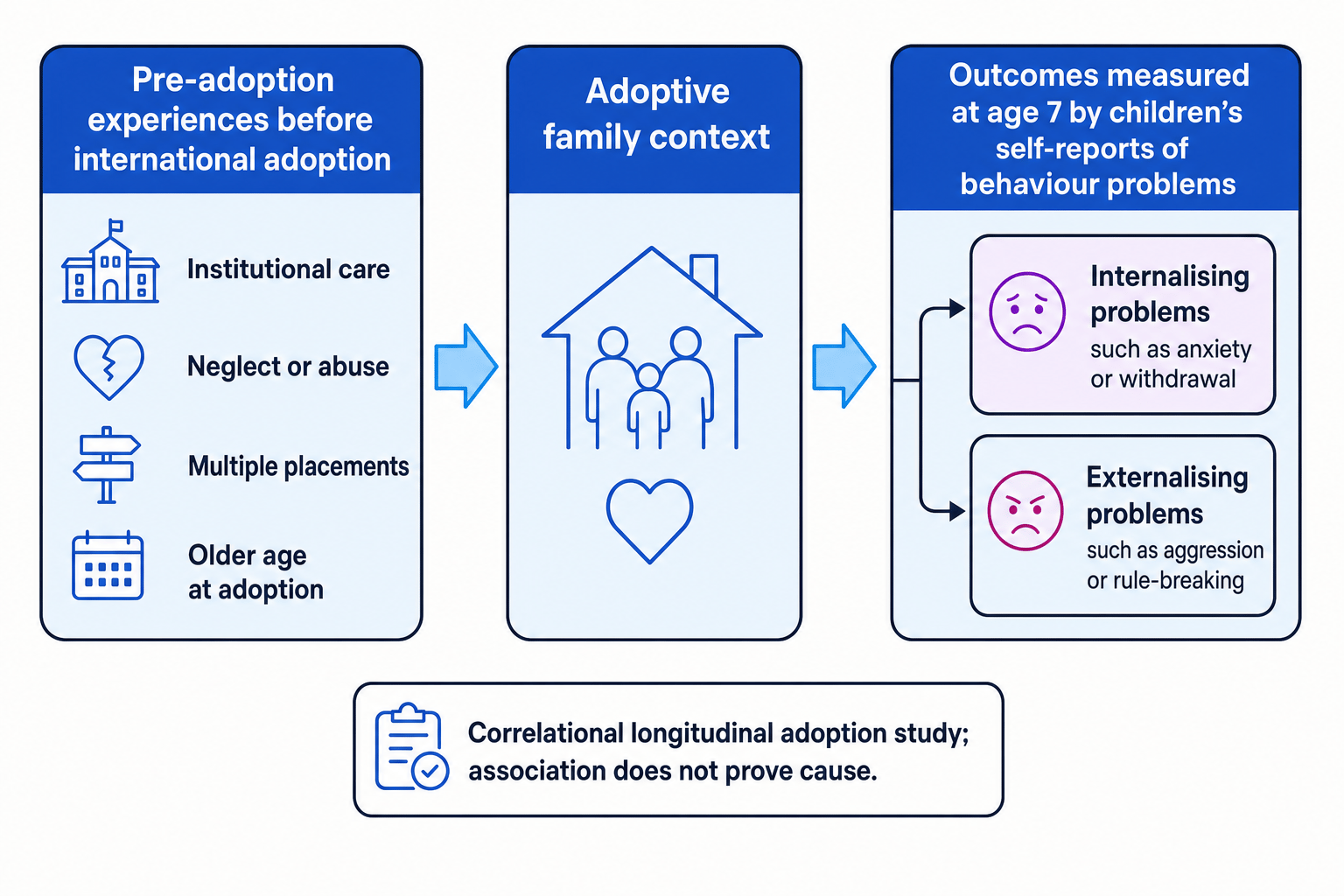
Gagnon-Oosterwaal et al. aimed to investigate whether pre-adoption adversity was associated with self-reported behaviour problems in 7-year-old children who had been internationally adopted.
A more exam-friendly version:
The study investigated whether children who had experienced more adversity before international adoption reported more internalising or externalising behaviour problems at age seven.
Design
The study used a correlational longitudinal adoption design.
Correlational longitudinal design
A correlational design looks for a relationship between variables without manipulating them. A longitudinal design follows participants over time or uses information from different time points in their development.
The researchers were interested in the relationship between:
- pre-adoption adversity, such as neglect, abuse, institutional care or multiple placements
- self-reported behaviour problems at age seven
Because the researchers did not create the adversity or randomly allocate children to conditions, this was not a true experiment.
Participants
The participants were internationally adopted children, around seven years old, and their adoptive families. They had been adopted into a Western family context, with researchers using information about their early pre-adoption histories.
For A-Level answers, the most important participant features are:
- the children were international adoptees
- they were studied at about seven years old
- the sample was relatively specialist, so generalisation is limited
- information came from both child measures and background adoption information
What to prioritise for AO1
If you cannot remember every sample detail, focus on the logic of the sample: internationally adopted children, pre-adoption adversity as the predictor, and self-reported behaviour at age seven as the outcome.
Procedure
The researchers gathered information about children’s early pre-adoption experiences. This may include records or adoptive-parent information about adversity such as institutional care, neglect, abuse, health problems or changes in caregivers.
At age seven, the children reported on their own behaviour problems. Studies with young children often use structured, child-friendly methods rather than adult-style questionnaires. For example, a structured interview or puppet-based method can help children express whether statements apply to them.
Self-report
A self-report is when participants provide information about their own thoughts, feelings or behaviour, usually through questionnaires, interviews or rating scales.
Using self-report is important here because some behaviour problems, especially internalising problems such as worry or sadness, may be less visible to adults.
Findings
The study found an association between pre-adoption adversity and later behaviour problems reported by the children.
A careful way to phrase the findings is:
- children with more difficult pre-adoption experiences tended to report more behaviour difficulties
- the relationship was especially relevant to emotional or internalising difficulties in some interpretations of the study
- not all adopted children showed behaviour problems
- the findings support the idea that early adversity can remain relevant even after adoption
Balanced conclusion
The study suggests early adverse experiences can have long-term links with children’s development, but good adoptive care and individual resilience mean outcomes vary.
Research methods link
This study is useful for research-methods questions because it involves variables, measurement, correlation and ethics.
Variables
Because this is not a true experiment, it is often better to talk about co-variables or a predictor and outcome rather than a strict independent variable and dependent variable.
- Predictor variable: level of pre-adoption adversity
- Outcome variable: self-reported behaviour problems at age seven
Descriptive statistics
Behaviour-problem scores could be summarised using:
- a mean or median as a measure of central tendency
- a range or standard deviation as a measure of dispersion
- a frequency table to show numbers of children in different adversity categories
- a bar chart for categorical groups, such as low, medium and high adversity
- a histogram if showing a continuous distribution of behaviour-problem scores
If scores are skewed because most children report few problems, the median and range may be more appropriate than the mean and standard deviation.
Inferential statistics
For Edexcel research methods, remember these common choices:
- Spearman’s rho: tests a correlation between two co-variables, especially ordinal, ranked or skewed data.
- Mann-Whitney U: tests a difference between two independent groups.
- Wilcoxon signed-ranks: tests a difference between two related conditions or matched pairs.
- Chi-square: tests an association between categories.
For a study like Gagnon-Oosterwaal et al., a correlation test such as Spearman’s rho would be the most relevant Edexcel test if you were analysing the association between adversity scores and behaviour-problem scores.
Choosing and interpreting a correlation test
Imagine a researcher ranks 30 adopted children by pre-adoption adversity and also ranks them by self-reported internalising problems. The observed correlation is rs=.42r_s = .42rs=.42. The critical value table gives a critical value of .31 for a one-tailed test at p≤.05p \le .05p≤.05.
- The researcher should choose Spearman’s rho because there are two co-variables and the data are ranked or suitable for ranking.
- The hypothesis is directional if it predicts that greater adversity will be linked to greater internalising problems, so a one-tailed test is appropriate.
- For Spearman’s rho, the observed value must be equal to or greater than the critical value to be significant. Here, rs=.42r_s = .42rs=.42 is greater than .31.
- The researcher can conclude there is a significant positive correlation at p≤.05p \le .05p≤.05, but must not conclude that adversity caused the behaviour problems.
Observed versus critical values
For Spearman’s rho and chi-square, larger observed values usually indicate significance. For Mann-Whitney U and Wilcoxon signed-ranks, smaller observed values are usually significant. Always check which test you are using.
AO2: Applying the study
You can apply this study to scenarios about adopted children, early deprivation, care settings or child mental health.
For example, if a question describes a child who experienced several foster placements before international adoption and later reports anxiety at school, you could apply Gagnon-Oosterwaal et al. by saying:
- the child has experienced pre-adoption adversity
- anxiety would be an internalising problem
- the study suggests such adversity may be linked to later self-reported behaviour difficulties
- however, you should not claim the early experience definitely caused the anxiety
This study is also useful for explaining why adoption services may need to collect detailed early histories and provide support after adoption.
AO3: Evaluating the study
Strength: child’s own perspective
A major strength is that the study used self-report from children. This is valuable because adults may miss internal experiences such as sadness, fear or worry.
This improves validity because the study is not relying only on parent or teacher observations.
Strength: real-world relevance
The study has strong practical value. It can help adoption agencies, schools and clinical services understand that children with difficult pre-adoption histories may need monitoring and support.
It also supports early intervention. If professionals identify risk factors early, they can provide parenting support, therapy or school-based help.
Weakness: correlation does not prove causation
The study cannot prove that pre-adoption adversity caused later behaviour problems.
Other factors may also affect outcomes, such as:
- genetic influences
- prenatal experiences
- quality of post-adoption care
- age at adoption
- child temperament
- missing or inaccurate early records
This means causal conclusions must be cautious.
Weakness: self-report with young children
Seven-year-olds can give useful information, but they may have limited insight into their own behaviour. They may misunderstand questions, give socially desirable answers, or respond in a way they think adults want.
Child-friendly methods reduce this problem, but they do not remove it completely.
Weakness: generalisability
The sample was specific: internationally adopted children living with adoptive families. Findings may not generalise to:
- domestic adoptees
- children in foster care
- children who remain in institutions
- children adopted at much older ages
- children from very different cultural or social contexts
Ethics
The study involves sensitive topics, so ethical issues are important.
Under the BPS Code of Ethics and Conduct (2009), researchers should ensure:
- informed consent from adoptive parents and appropriate assent from children
- no unnecessary deception
- the right to withdraw
- protection from harm, especially because questions may touch on difficult experiences
- confidentiality of adoption histories and behaviour data
- debriefing for children and families
In the exam
- For AO1, describe the aim, sample, method, self-report measure and the link between pre-adoption adversity and behaviour problems.
- For AO2, apply the study carefully: identify the adversity, classify the behaviour as internalising or externalising, and avoid deterministic claims.
- For AO3, balance strengths such as child self-report and real-world application against weaknesses such as correlation, self-report limitations and restricted generalisability.
Check yourself
- What is the difference between internalising and externalising behaviour problems?
- Why is it useful that Gagnon-Oosterwaal et al. used children’s self-reports?
- Why can’t this study prove that pre-adoption adversity caused later behaviour problems?