What you'll learn
- How to apply major issues and debates to child psychology.
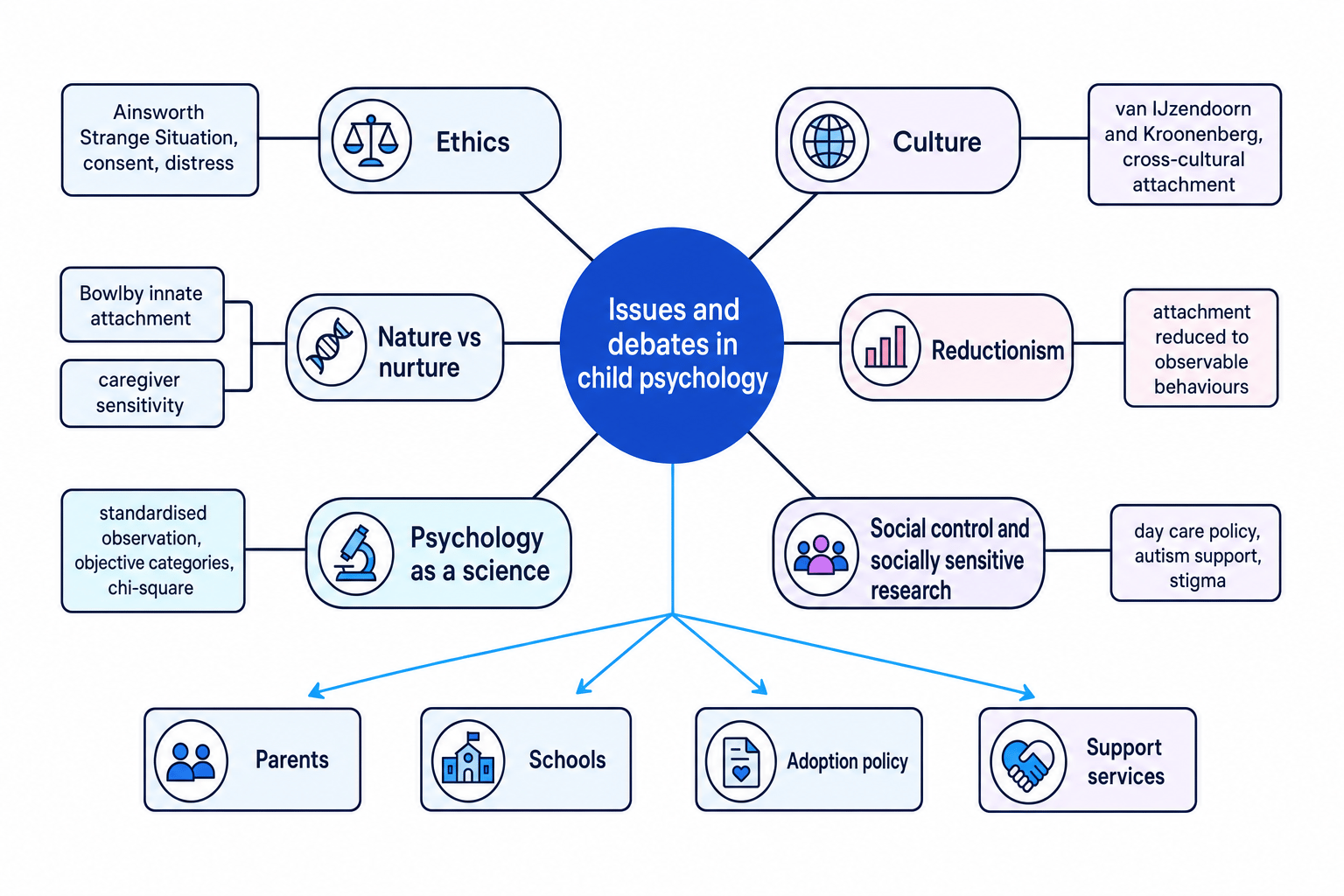
- How ethics, culture, nature-nurture and reductionism shape research on attachment, deprivation, day care and autism.
- How to turn each issue into strong AO3 evaluation in essays.
- How research can be useful in society, but also socially sensitive or used for social control.
Big picture: what are “issues and debates”?
In A-Level Psychology, an issue is a broad problem that affects how research is done or used, such as ethics or social sensitivity. A debate is a disagreement about how behaviour should be explained, such as nature versus nurture.
Child psychology is especially rich for issues and debates because researchers often study children, who may be more vulnerable than adults, and findings can influence parents, schools, day care, adoption policy and autism support.
The essay skill
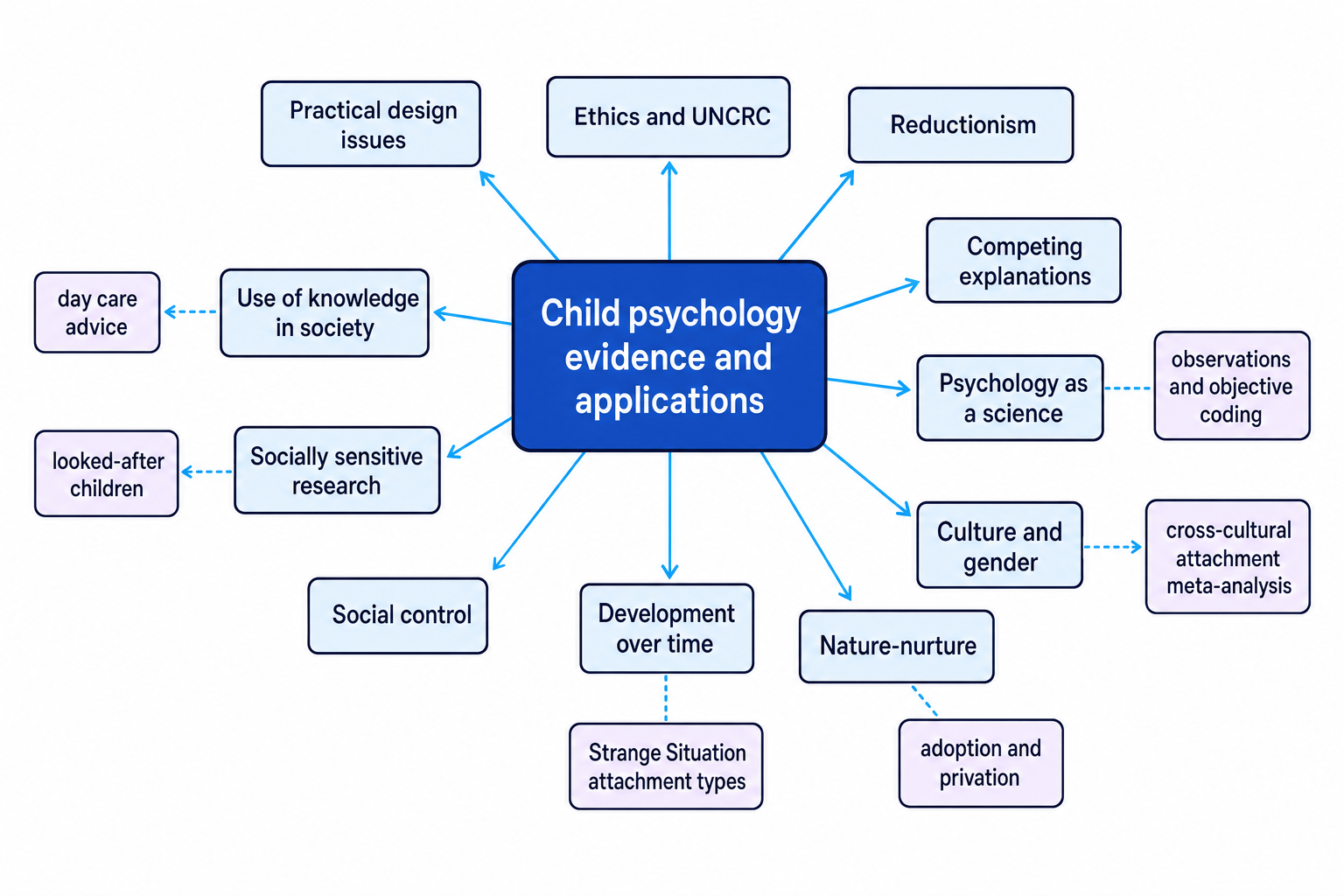
For AO1, describe the theory or study accurately. For AO2, apply it to the child-development topic or scenario. For AO3, judge the wider issue: ethics, culture, evidence quality, social impact, or whether the explanation is too narrow.
Ethics in child psychology
Ethics
Ethics are moral principles that guide research, including how participants should be treated before, during and after a study.
In the UK, psychologists are guided by the BPS Code of Ethics and Conduct, 2009. Key principles include informed consent, avoiding unnecessary deception, the right to withdraw, protection from harm, confidentiality and debriefing.
Child research adds an extra difficulty: children may not fully understand what they are agreeing to. Researchers often need parental consent, but the child’s own willingness still matters.
The UNCRC means the United Nations Convention on the Rights of the Child. Two important ideas are:
- Participation rights: children should be listened to and involved where possible.
- Protection rights: children should be protected from harm, exploitation and distress.
This creates a balance. If researchers protect children too much, children’s experiences may be ignored. If researchers focus only on participation, children may be exposed to stress.
For example, Ainsworth et al.’s Strange Situation (1978) involved brief separations from a caregiver to assess attachment type. This produced important evidence, but some infants became distressed, so protection from harm is a key ethical issue.
Applying ethics to attachment research
- Identify the participants’ vulnerability: infants cannot give fully informed consent, so the researcher must use parental consent and still monitor the infant’s distress.
- Weigh participation against protection: the study may help psychologists understand attachment, but the separations must be brief and stopped if distress becomes excessive.
- Add safeguards: the caregiver should be nearby, the child should be reunited quickly, the procedure should be explained to parents, and a debrief should be provided.
- Make the evaluation balanced: the research can be ethically acceptable if distress is mild and temporary, but it still raises stronger ethical concerns than adult research.
Consent is not enough
Do not say a child study is ethical just because parents consented. You also need to consider the child’s distress, right to withdraw, protection from harm and debriefing.
Practical issues in research design
Meta-analysis
A meta-analysis combines findings from several studies to look for an overall pattern in the evidence.
A key example is van IJzendoorn and Kroonenberg’s cross-cultural meta-analysis of attachment (1988). They compared Strange Situation studies from different countries and found that secure attachment was the most common classification overall, but there were cultural differences in insecure-avoidant and insecure-resistant attachment.
Meta-analyses are useful because they use a larger total sample than one study. However, they can be difficult because the original studies may differ in procedure, sample size, age of children, social class, country and interpretation of behaviour.
Observations also raise practical issues. In child psychology, researchers often observe behaviour because young children may not explain their thoughts clearly. But observations need objectivity, meaning the researcher records behaviour in a way that is not biased by personal opinion.
Objectivity
Objectivity means collecting and interpreting evidence in a way that is based on clear rules rather than personal judgement.
The Strange Situation improved objectivity by using standardised episodes and behavioural categories, such as proximity seeking, exploration and stranger anxiety. However, reducing attachment to observable behaviours in a brief laboratory setting may miss the wider caregiver-child relationship.
Evaluating cross-cultural attachment evidence
- Start with the strength: van IJzendoorn and Kroonenberg (1988) used many studies, so the overall conclusion is based on more evidence than a single Strange Situation sample.
- Add the design problem: the studies came from different cultures, but they still used a method developed in the USA, so the same behaviour may not mean the same thing everywhere.
- Apply this to interpretation: high separation anxiety might suggest insecure-resistant attachment in one culture, but in another culture it may reflect normal child-rearing practices where infants are rarely left with strangers.
- Reach a judgement: the meta-analysis supports some universality in attachment, but cultural bias limits how confidently we can compare attachment types across societies.
Reductionism
Reductionism
Reductionism means explaining complex behaviour by breaking it down into simpler parts, sometimes so much that the full complexity is lost.
Child psychology often needs some reductionism to make behaviour measurable. For instance, the Strange Situation reduces attachment to behaviours during reunion, separation and contact with a stranger. This helps researchers classify infants as secure, insecure-avoidant or insecure-resistant.
The strength is that reductionism can make research more scientific and replicable. The weakness is that attachment is not just a short laboratory reaction. It may involve temperament, parenting style, culture, family stress, day care and previous experiences.
Balanced reductionism
Reductionism is not automatically bad. It becomes a problem when a simple measure is treated as if it captures the whole child.
Comparing explanations: Bowlby, Ainsworth and evolution
Bowlby’s theory of attachment, developed from the 1950s and 1960s, argued that infants have an innate tendency to form an attachment because it has survival value. He proposed monotropy, meaning one special attachment is especially important, and the internal working model, meaning early attachment forms a mental template for later relationships.
Ainsworth et al. (1978) focused more on individual differences in attachment quality, using the Strange Situation to classify attachment types. This links more strongly to caregiver sensitivity and the child’s learned expectations about care.
Nature-nurture debate
The nature-nurture debate asks whether behaviour is mainly influenced by biological inheritance and evolution, or by learning, experience and environment.
Bowlby’s theory leans towards nature because attachment is seen as evolved and biologically prepared. Ainsworth’s work gives more room to nurture because caregiver responsiveness and child-rearing practices shape attachment behaviour.
Evolutionary ideas can explain why infants seek proximity to caregivers, but they may be less good at explaining cultural variation. For example, the same behaviour may be adaptive in one family context but interpreted differently in another.
Psychology as a science
Psychology as a science
Psychology is scientific when it uses systematic methods, testable hypotheses, controlled procedures, objective measurement and evidence-based conclusions.
Child psychology can be scientific. The Strange Situation is standardised, observations can use behavioural categories, and cross-cultural findings can test whether attachment patterns are universal.
Research methods also matter. For descriptive data, psychologists might use means, medians, ranges, standard deviations, frequency tables, bar charts and histograms. For qualitative data, such as interviews with parents or children, researchers may use thematic analysis, which means identifying repeated themes in what people say.
When inferential statistics are needed, Edexcel expects you to know which test fits which design:
- Mann-Whitney U: difference between two independent groups, such as children in day care versus children not in day care.
- Wilcoxon signed-ranks: difference between two related conditions, such as the same children before and after an intervention.
- Spearman’s rho: correlation, such as hours in day care and social-development score.
- Chi-square: association between categories, such as attachment type and country.
The usual significance level is p≤.05p \le .05p≤.05. Researchers may use p≤.01p \le .01p≤.01 for stricter evidence or p≤.10p \le .10p≤.10 when reducing the chance of missing an effect is more important. They compare an observed value with a critical value from a table, using a one-tailed test if the direction is predicted and a two-tailed test if it is not.
Type I and Type II errors
A Type I error is finding a significant effect when there is not really one. A Type II error is failing to find a significant effect when there really is one.
Child-development data may be skewed, meaning scores bunch at one end rather than forming a symmetrical normal distribution. This is one reason non-parametric tests, medians and histograms can be useful.
Culture and gender
Culture
Culture refers to the shared values, practices and expectations of a group, including child-rearing beliefs.
Culture is crucial in attachment research. Van IJzendoorn and Kroonenberg (1988) suggested secure attachment was common across cultures, which supports a possible universal pattern. However, variation within countries was often greater than variation between countries, so it is too simple to label whole cultures as having one attachment style.
Gender is not always a direct focus in child psychology, but studies may still compare boys and girls in areas such as day care, social development, emotional development and cognitive development. Be careful not to turn small group differences into stereotypes.
Cultural difference is not cultural deficit
Do not write as if Western attachment patterns are the “correct” standard. A behaviour can be different because child-rearing expectations differ, not because development is worse.
Development of psychological understanding over time
Psychological knowledge changes as evidence develops. Bowlby’s early work on maternal deprivation, including his research on 44 juvenile thieves (Bowlby, 1944), suggested that early separation from the mother could have serious long-term effects.
Later research, such as Rutter’s work on Romanian adoptees, gave a more nuanced picture. Severe early deprivation can affect development, but recovery is possible, especially when children receive sensitive care early enough. This moved psychology away from a simple “mother must always be present” message towards a more flexible understanding of risk, resilience and quality of care.
Privation
Privation means a child has had little or no opportunity to form an attachment, often due to extreme neglect or institutional care.
This matters for day care too. Modern research is less likely to ask “Is day care good or bad?” and more likely to ask about quality, staff-child ratios, stability of care and individual differences.
Social control and use of knowledge in society
Social control
Social control is when psychological knowledge is used to influence, regulate or direct people’s behaviour.
Child psychology can be very useful. It can improve parenting advice, guide day care policy, support looked-after children, and help develop interventions for problem behaviour or autism.
However, it can also be used in controlling ways. For example, attachment research has sometimes been used to pressure mothers to stay at home, even when evidence about day care is more complex. Advice may reflect economic or political priorities as well as scientific findings.
Research into autism can support better understanding and therapy, but it can also become problematic if it treats autistic children only as needing to be “normalised” rather than supported.
Socially sensitive research
Socially sensitive research
Socially sensitive research is research that may have consequences for the people or groups being studied, especially if findings affect stigma, policy or self-esteem.
Child psychology includes many socially sensitive areas: autism, socio-economic status, adoption, privation, day care and parenting style. Findings can affect how parents are judged, how children are labelled, and how resources are allocated.
This does not mean psychologists should avoid these topics. Instead, they should design studies carefully, protect confidentiality, avoid blaming language, and explain limitations clearly.
Strong AO3 phrase
A useful evaluative phrase is: “The issue is not just whether the finding is true, but how it may be interpreted and used in society.”
In the exam
- Link every issue directly to child psychology: name the study or theory, such as Bowlby (1944), Ainsworth et al. (1978), van IJzendoorn and Kroonenberg (1988), or Rutter’s deprivation research.
- Make evaluation balanced: give both the contribution and the limitation, especially for ethics, culture, reductionism and applications.
- Use precise debate language: participation versus protection, nature versus nurture, universality versus cultural bias, scientific control versus ecological validity.
- For socially sensitive topics, discuss both benefits and risks: research can improve support, but it may also stigmatise families or justify social control.
Check yourself
- How can the UNCRC create a tension between children’s participation rights and protection rights?
- Why might the Strange Situation be criticised as reductionist or culturally biased?
- How can child psychology be useful in society while also being socially sensitive?