What you'll learn
- What hormones are and how they differ from neurotransmitters.
- How testosterone may influence aggression through brain systems such as the amygdala and prefrontal cortex.
- Why the link is not as simple as “more testosterone = more aggression”.
- How to evaluate this explanation using research evidence, methodology, ethics and real-world applications.
1. Starting point: what is a hormone?
A hormone is a chemical messenger released by glands in the endocrine system. Hormones travel in the bloodstream and can influence organs, tissues and brain activity.
This is slightly different from a neurotransmitter, which is a chemical messenger released across a synapse between neurons. Neurotransmitters usually act very quickly and locally, while hormones tend to have slower, longer-lasting effects across the body.
Hormone
A hormone is a chemical messenger released by an endocrine gland into the bloodstream, where it affects target cells with the right receptors.
In aggression, the key hormone you need to know is testosterone. The Edexcel specification says hormones “e.g. testosterone”, so testosterone is the main example, while other hormones such as cortisol can be used for extra evaluative detail.
2. Defining aggression carefully
In psychology, aggression usually means behaviour intended to harm another person, either physically or psychologically.
Aggression
Aggression is behaviour directed towards another person with the intention of causing harm, where the other person is motivated to avoid that harm.
That definition matters because not all forceful or competitive behaviour counts as aggression. For example, tackling in rugby may be physical, but if it is within the rules and not intended to harm, it is not automatically aggression.
3. Testosterone: the main hormone in this explanation
Testosterone is an androgen, meaning a hormone involved in typically male physical development and reproductive functioning. It is found in all sexes, but average levels are usually higher in males because much of it is produced in the testes. Smaller amounts are also produced by the adrenal glands and, in females, the ovaries.
Testosterone
Testosterone is an androgen hormone linked to sexual development, dominance-related behaviour and, in some contexts, aggression.
A hormonal explanation argues that testosterone can make aggressive behaviour more likely by affecting brain systems involved in threat, dominance and impulse control.
4. The HPG axis: how testosterone is released
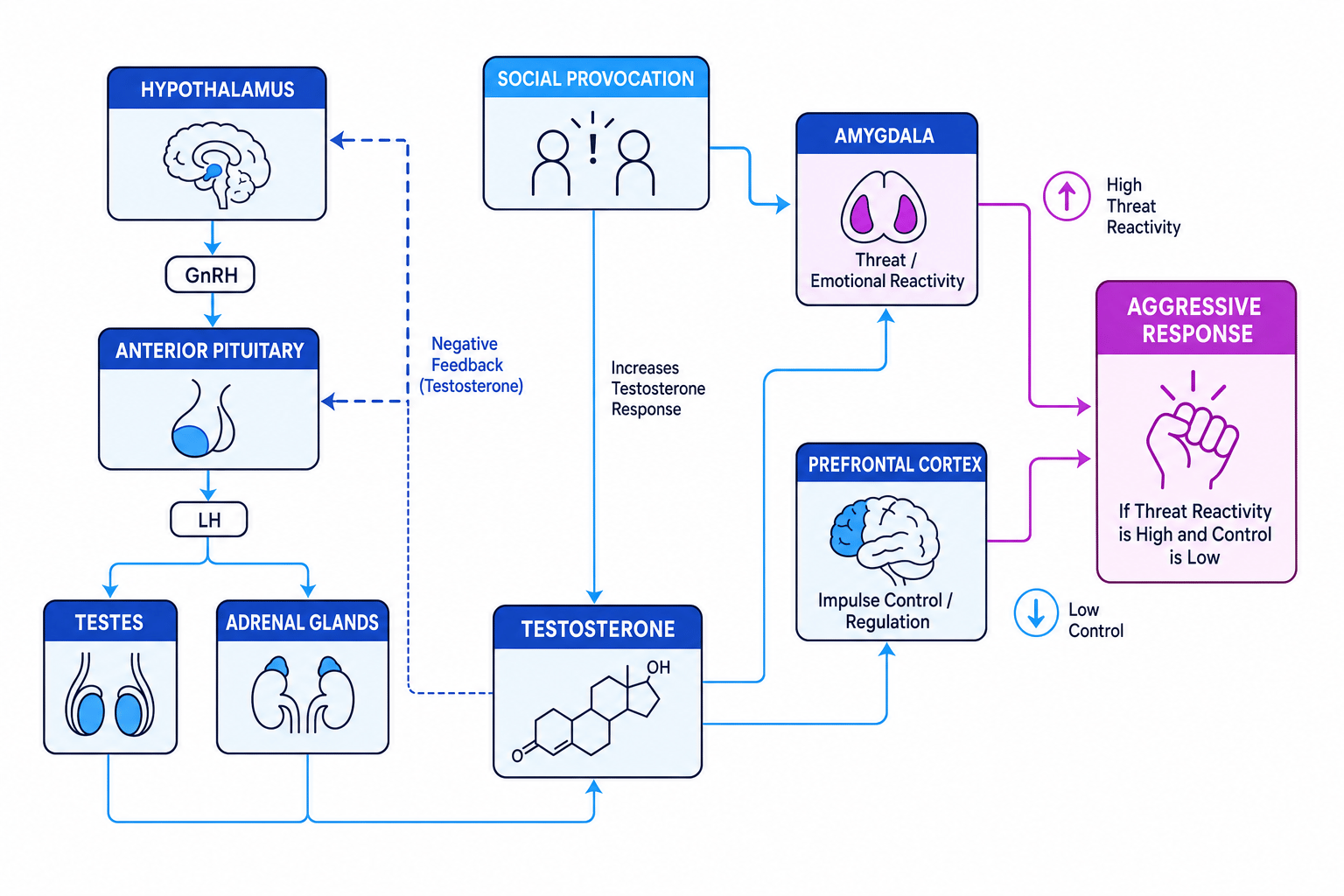
Testosterone is regulated by the hypothalamic-pituitary-gonadal axis, usually shortened to the HPG axis.
- The hypothalamus is a brain area that helps regulate hormones and basic drives.
- The pituitary gland is often called the “master gland” because it releases hormones that control other glands.
- The gonads are the testes or ovaries.
In simple terms, the hypothalamus signals the pituitary gland, the pituitary signals the gonads, and the gonads release testosterone. Testosterone then feeds back to the brain to help regulate the system.
Core idea
Testosterone does not directly “cause” aggression like pressing a button. It may increase the likelihood of aggression by making threat, dominance and status challenges feel more important, especially when self-control is weak or provocation is high.
5. How testosterone may influence aggression
Testosterone and the amygdala
The amygdala is a brain structure involved in emotional processing, especially fear, threat and anger. Higher testosterone may increase amygdala reactivity to threatening or provocative cues.
That means a person may be more likely to interpret another person’s behaviour as disrespectful, hostile or challenging.
Testosterone and the prefrontal cortex
The prefrontal cortex is involved in planning, judgement and impulse control. If prefrontal control is weaker, a person may be less able to inhibit an aggressive impulse.
So aggression is more likely when:
- a situation is interpreted as threatening or humiliating;
- testosterone supports dominance or retaliation;
- the person has poor impulse control;
- social learning or peer norms make aggression seem acceptable.
Too deterministic
Avoid writing that testosterone “causes aggression”. A stronger answer says testosterone may increase the probability of aggression, depending on context, cognition, personality and social learning.
6. Baseline testosterone and reactive testosterone
It helps to separate two ideas.
Baseline testosterone means a person’s usual level of testosterone. Some research asks whether people with higher typical testosterone are generally more aggressive.
Reactive testosterone means changes in testosterone after a situation, such as competition, provocation or a status threat.
For aggression, reactive testosterone can be especially important. A person may not be aggressive all the time, but after being insulted or challenged, testosterone may rise and support a dominance response.
Challenge hypothesis
The challenge hypothesis suggests testosterone rises in response to social challenges, such as competition or status threats, and this can promote dominance-related behaviour.
This fits well with Mazur’s (1985) biosocial model of status, which argues that testosterone is linked more broadly to dominance and status-seeking. Aggression may occur if aggression is seen as a way to gain or defend status.
7. AO2: applying the explanation to behaviour
Imagine a student is publicly mocked by a peer. A hormonal explanation would not simply say “they have high testosterone”. Instead, it would explain how the situation may trigger a biological and psychological response.
Applying the testosterone explanation to provocation
-
Identify the social trigger: public mocking is a status threat, because the student may feel humiliated in front of others.
-
Link the trigger to hormone activity: the challenge may produce a testosterone response, making dominance or retaliation feel more rewarding.
-
Connect this to brain mechanisms: testosterone may increase sensitivity to threat through the amygdala, while weak prefrontal control may reduce the ability to pause and choose a non-aggressive response.
-
Add a balanced conclusion: aggression is more likely if the student has learned that retaliation gains respect, but less likely if they have strong self-control, fear of punishment or prosocial norms.
8. Research evidence
Dabbs et al. (1995)
Dabbs et al. (1995) studied male prison inmates and found that those with higher testosterone were more likely to have committed violent crimes and to break prison rules.
This supports the idea that testosterone is associated with aggressive and dominance-related behaviour.
However, this was correlational. We cannot conclude that testosterone caused the aggression. It is also possible that aggressive lifestyles, prison conflict or repeated dominance contests affected testosterone levels.
Book, Starzyk and Quinsey (2001)
Book, Starzyk and Quinsey (2001) carried out a meta-analysis and found a small positive relationship between testosterone and aggression, often reported around r≈.14r \approx .14r≈.14.
This is useful because a meta-analysis combines findings across several studies, making the evidence base broader. But the effect size is small, suggesting testosterone is only one factor among many.
Klinesmith, Kasser and McAndrew (2006)
Klinesmith et al. (2006) found that men who interacted with a gun showed increased testosterone and later behaved more aggressively in a laboratory task involving hot sauce allocation.
This supports the idea that environmental cues can affect testosterone and aggressive behaviour. However, the measure of aggression was artificial, so it may not fully represent real-world violence.
Carré et al. (2017)
Carré et al. (2017) showed that testosterone’s effects depend on personality and context. Testosterone does not make everyone aggressive; it is more likely to affect behaviour when combined with dominance motivation, impulsivity or provocation.
This is a useful contemporary point because it makes the theory less biologically deterministic.
9. Cortisol: a useful extra evaluative point
Cortisol is a hormone released during stress. It is part of the HPA axis, the hypothalamic-pituitary-adrenal system.
Some psychologists suggest a dual-hormone hypothesis: high testosterone may be more strongly linked to dominance or aggression when cortisol is low. Low cortisol may mean less fear, less anxiety about punishment, or reduced social inhibition.
Dual-hormone idea
Aggression may be especially likely when testosterone is high and cortisol is low, because dominance motivation is high while fear or inhibition is low.
You do not need to make cortisol the centre of the answer, but it is a strong AO3 point because it shows the testosterone explanation is too simple on its own.
10. AO3 evaluation
Strength: biological plausibility
The explanation is biologically plausible because testosterone can affect brain areas involved in threat processing and impulse control. It fits with evidence from prisons, laboratory studies and meta-analyses.
It also links neatly with other biological explanations of aggression, such as the role of the amygdala and prefrontal cortex.
Strength: objective measurement
Hormones can be measured using saliva or blood samples, which may be more objective than asking people to self-report aggression.
However, hormone measurement is not perfect. Testosterone varies by time of day, age, stress, medication, alcohol use and recent competition. This daily fluctuation is called diurnal variation.
Weakness: correlation does not prove causation
Many studies only show an association between testosterone and aggression. They do not show the direction of cause.
For example:
- testosterone might increase aggression;
- aggression or winning might increase testosterone;
- a third factor, such as impulsive personality or peer culture, might affect both.
Weakness: aggression is hard to operationalise
To operationalise a variable means to define exactly how it will be measured. Aggression can be measured through criminal records, questionnaires, teacher ratings, noise blasts or hot sauce allocation.
Each measure has problems. Criminal records miss unreported aggression. Questionnaires may be affected by social desirability bias. Laboratory tasks may lack ecological validity.
Research-methods link
If you investigated this topic, different inferential tests could apply depending on the design.
- Spearman’s rho would suit a correlation between ranked testosterone levels and aggression scores.
- Mann-Whitney U would suit a difference between two independent groups, such as high-testosterone and low-testosterone participants.
- Wilcoxon signed-ranks would suit repeated measures, such as aggression before and after a competitive task.
- Chi-square would suit an association between categories, such as high/low testosterone and violent/non-violent offence type.
Psychology usually uses p≤.05p \le .05p≤.05 as the default significance level, with p≤.10p \le .10p≤.10 being more lenient and p≤.01p \le .01p≤.01 being stricter. You compare the observed value with a critical value from a table, and whether you use a one-tailed or two-tailed test depends on whether the hypothesis predicts a direction.
Ethical and social issues
Hormone research must follow the BPS Code of Ethics and Conduct (2009): consent, right to withdraw, protection from harm, confidentiality and debrief are all important.
This topic is also socially sensitive. If badly explained, it could encourage the stereotype that males or people with high testosterone are naturally violent. A balanced answer should emphasise that biology interacts with environment, learning, culture and self-control.
Strong AO3 phrasing
A sophisticated evaluation says testosterone is a risk factor or moderating influence, not a complete explanation of aggression.
11. Real-world applications
Understanding hormones may help explain why aggression sometimes increases in competitive or status-threatening environments, such as prisons, gangs or contact sports.
It may also support interventions that focus on:
- reducing provocation and status threats;
- improving impulse control;
- changing peer norms around dominance;
- managing stress and emotional arousal.
In rare clinical contexts, hormone-based treatments may be considered, but this raises serious ethical issues around consent, side effects and personal freedom.
In the exam
-
Start with clear AO1: define testosterone, explain the HPG axis briefly, and link testosterone to amygdala reactivity, dominance and reduced impulse control.
-
Avoid determinism: write that testosterone can increase the likelihood of aggression, especially under provocation or status threat.
-
Evaluate with evidence and method: use Dabbs et al. (1995), Book et al. (2001) or Klinesmith et al. (2006), then discuss correlation, measurement validity, ethics and social sensitivity.
Check yourself
- Why is it inaccurate to say testosterone directly causes aggression?
- How might a public insult lead to aggression according to the challenge hypothesis?
- What is one methodological problem with using prison studies to support the testosterone explanation?
