What you'll learn
- How Freud’s psychodynamic explanation links aggression to unconscious drives.
- The roles of the id, ego and superego in controlling aggressive impulses.
- What catharsis means and why it matters for aggression.
- How to evaluate Freud’s explanation against a biological alternative.
The starting point: what does “psychodynamic” mean?
Psychodynamic explanation
A psychodynamic explanation argues that behaviour is caused by inner psychological forces, especially unconscious conflicts, instincts and emotions. In Freud’s view, people are not always fully aware of why they behave as they do.
Freud’s approach is very different from a simple “person chooses to be aggressive” explanation. He believed that aggression can come from deep mental processes that are partly hidden from conscious awareness.
In aggression, the key idea is that humans have instinctive aggressive energy. If this energy is blocked, repressed or poorly managed, it may build up and be expressed through aggressive behaviour.
Freud’s basic claim
Aggression is not just a response to the situation in front of you; it can be an expression of unconscious instinctive drives that the personality is trying to control.
The unconscious mind
Unconscious
The unconscious is the part of the mind containing thoughts, wishes, fears and impulses that a person is not directly aware of, but which can still influence behaviour.
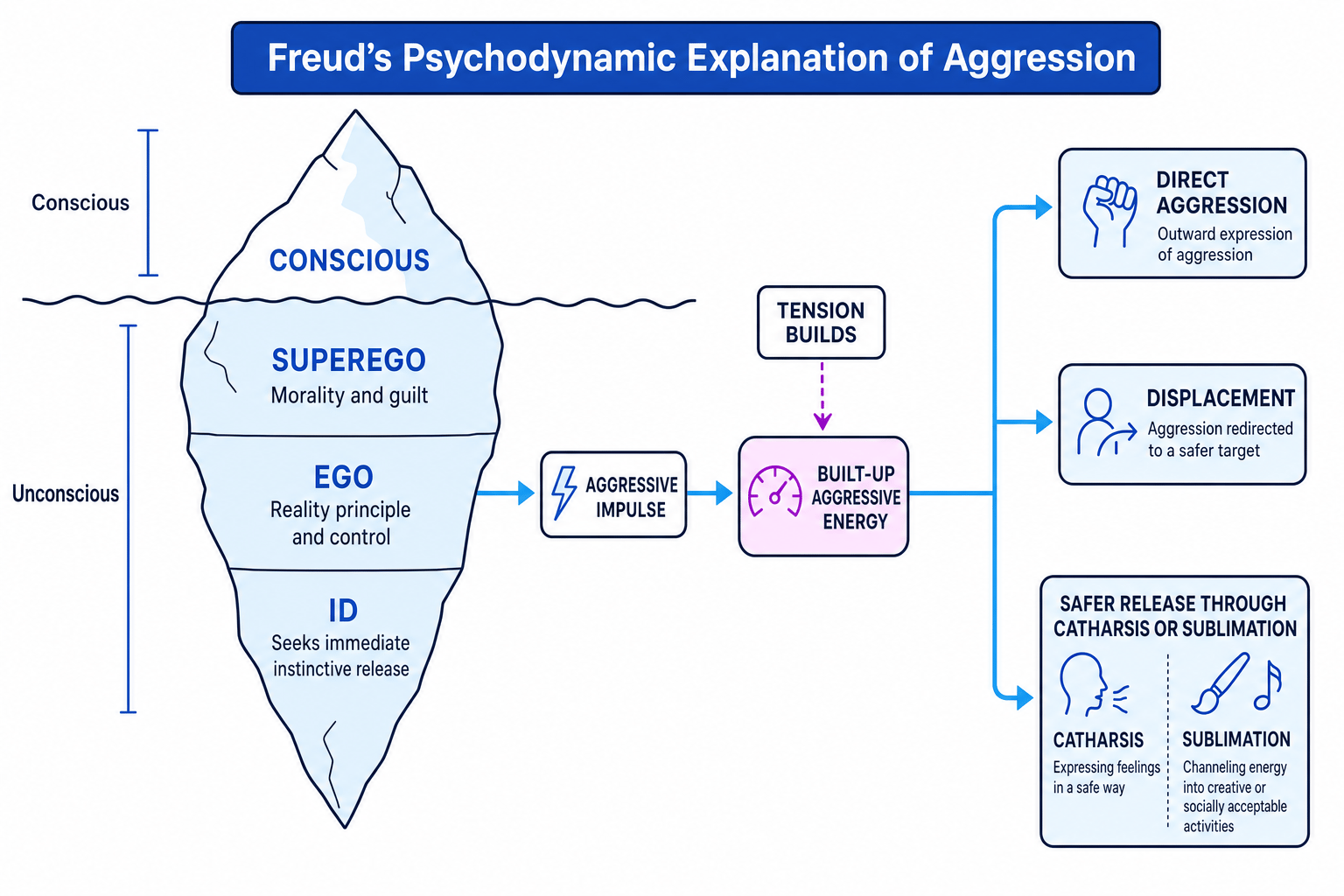
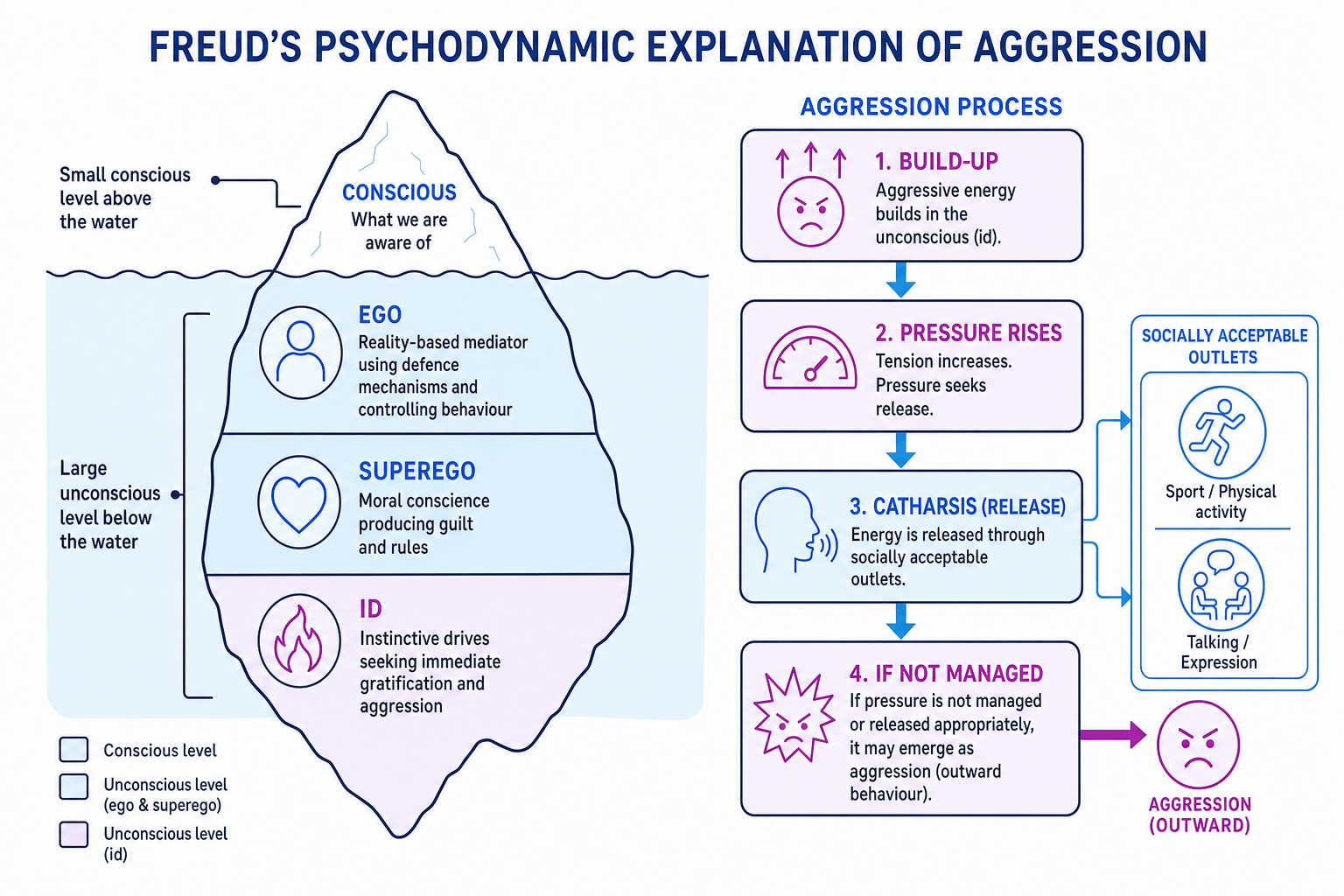
Freud compared the mind to an iceberg: only a small part is visible above the surface, while much more is hidden below. For aggression, this matters because someone might not consciously think “I want to hurt that person”, but unconscious anger, jealousy or frustration may still shape their behaviour.
For example, a person might snap at a friend after being criticised by a teacher. Freud would suggest the visible behaviour is only the surface; the deeper cause may be unconscious conflict or displaced aggression.
The structure of personality
Freud argued that personality has three interacting parts: the id, ego and superego. These are not physical brain structures. They are theoretical parts of the personality.
The id: instinctive impulses
Id
The id is the primitive, instinctive part of personality. It operates according to the pleasure principle, meaning it seeks immediate satisfaction of desires and impulses.
The id is present from birth and is unconscious. It wants immediate release of tension. In aggression, the id may produce an impulse such as “hit back”, “shout”, or “destroy what is frustrating me”.
Freud also linked aggression to destructive instinctive energy. In his later theory, he described this as part of the death instinct, sometimes called Thanatos: an unconscious drive towards destruction that can be directed outwards as aggression.
The ego: realistic control
Ego
The ego is the rational part of personality that operates according to the reality principle. It tries to satisfy the id’s impulses in ways that are realistic and socially acceptable.
The ego acts like a mediator. It has to manage the id’s aggressive demands while considering consequences: punishment, guilt, rejection, injury or social rules.
The ego may use defence mechanisms, which are unconscious strategies that reduce anxiety. For aggression, two useful examples are:
- Displacement: redirecting aggression from a dangerous target to a safer target.
- Sublimation: channelling unacceptable impulses into socially acceptable activities, such as sport or creative work.
The superego: morality and guilt
Superego
The superego is the moral part of personality. It represents internalised rules, values and ideals, and can create guilt when a person behaves wrongly.
The superego develops through childhood as children internalise parental and social standards. In aggression, the superego might say, “It is wrong to hurt someone.” This creates conflict with the id, which may want immediate aggressive release.
The personality conflict
Aggression can be explained as a conflict between the id’s aggressive impulses, the ego’s realistic control, and the superego’s moral restrictions.
Catharsis: releasing aggressive energy
Catharsis
Catharsis means the release of built-up emotional tension. In Freud’s explanation, releasing aggressive energy in a controlled or symbolic way may reduce the likelihood of direct aggression.
Freud’s explanation is sometimes described as a hydraulic model. This means aggression is imagined like pressure building inside a system. If pressure builds for too long, it needs an outlet.
Catharsis could involve physical activity, talking through anger, fantasy, humour or other forms of expression. However, this does not mean that all aggressive behaviour is healthy or helpful.
Catharsis is not simply ‘violence is good’
Do not write that Freud believed people should just be aggressive to feel better. Catharsis means releasing emotional tension, ideally in a safer or socially acceptable way. Also, research evidence for catharsis is mixed.
How Freud’s explanation works as a chain
A clear AO1 chain looks like this:
- The id produces aggressive impulses from unconscious instinctive drives.
- These impulses create internal tension or anxiety.
- The ego tries to manage the impulse realistically.
- The superego adds moral pressure and possible guilt.
- If the impulse is not controlled or redirected, aggression may be expressed directly.
- If the energy is released safely, catharsis may reduce tension.
Applying Freud to a conflict
A student is humiliated by a teacher, says nothing in class, then later goes home and shouts at their younger sibling.
- The humiliation creates anger, but the student’s ego recognises that shouting at the teacher may lead to punishment, so the aggressive impulse is held back.
- The aggressive impulse remains active at an unconscious level. The id still seeks release, while the superego may also create guilt about wanting to be aggressive.
- The student later shouts at a safer target: the younger sibling. This can be explained as displacement, because aggression is redirected from the original source to someone less threatening.
- A stronger cathartic or sublimated outlet, such as talking through the anger or playing sport, might have reduced the tension without direct aggression towards another person.
Biological explanation as an alternative
The specification asks you to know Freud’s psychodynamic explanation alongside a biological explanation of aggression as an alternative.
Biological explanation
A biological explanation argues that behaviour is caused by physical processes, such as brain structures, hormones, neurotransmitters, genes or evolutionary pressures.
A biological explanation might focus on:
- The amygdala, a brain region involved in threat detection and emotional responses.
- The prefrontal cortex, which is involved in impulse control and decision-making.
- Serotonin, a neurotransmitter often linked to impulse control; lower serotonin has been associated with impulsive aggression.
- Testosterone, a hormone sometimes linked to dominance and aggressive behaviour.
- Genetic influences, such as inherited vulnerability to impulsive or aggressive behaviour.
This alternative is more directly measurable than Freud’s explanation. For example, researchers can use brain scans, hormone tests or genetic comparisons. Freud’s id, ego and superego cannot be directly observed in the same way.
Comparing two explanations
A person reacts aggressively after being insulted in a pub.
- A psychodynamic explanation would focus on unconscious anger, the id’s aggressive impulse, the ego’s failure to control it, and possible lack of cathartic release.
- A biological explanation would focus on physical mechanisms, such as high physiological arousal, reduced impulse control from the prefrontal cortex, or hormonal influences.
- The key comparison is level of explanation: Freud explains aggression through hidden mental conflict, while biology explains aggression through bodily processes.
AO3 evaluation: strengths of Freud’s explanation
It explains hidden emotional causes
A strength is that Freud’s explanation recognises that aggression may not always be rational or conscious. People often behave aggressively and later say, “I don’t know what came over me.” The psychodynamic approach can explain this by referring to unconscious impulses and conflict.
It has useful real-world applications
Freud’s idea of catharsis influenced some therapeutic approaches. Talking therapies and anger-management programmes often encourage people to express anger safely rather than suppress it completely. Sublimation also has practical value: aggressive energy may be channelled into sport, exercise or creative activities.
Useful AO3 phrase
A balanced point is: Freud’s theory may be useful for understanding emotional conflict, but it is difficult to test scientifically because its key concepts are unconscious and not directly observable.
AO3 evaluation: weaknesses of Freud’s explanation
It is difficult to test scientifically
A major weakness is that the id, ego, superego and unconscious aggressive drives cannot be directly measured. This makes the explanation hard to falsify, meaning it is difficult to prove wrong. If someone is aggressive, Freud can say the id broke through; if they are not aggressive, Freud can say the ego controlled the impulse. This can make the theory circular.
Evidence for catharsis is mixed
The catharsis idea is controversial. Some research suggests that “venting” anger can actually maintain or increase aggression rather than reduce it. For example, Bushman (2002) found that participants who hit a punch bag while thinking about a person who had angered them later behaved more aggressively than those who did not vent in this way.
This challenges the Freudian claim that releasing aggressive energy necessarily reduces later aggression.
It may be culturally biased
Freud developed his theory from clinical work in a particular historical and cultural context, mainly with middle-class Viennese patients. This means it may not generalise well to all cultures, ages or social groups.
Biological explanations may be more objective
Biological explanations can use more objective methods, such as brain imaging, hormone measurement and genetic analysis. This can make them more scientific than Freud’s theory. However, biological explanations can also be reductionist, because they may oversimplify aggression by focusing too much on the body and not enough on emotions, upbringing, social learning or context.
Do not evaluate only with ‘Freud is outdated’
Saying Freud is “old” is not enough for AO3. Explain why that matters: his concepts are hard to measure, his evidence base was limited, and later research challenges catharsis.
Ethics and studying aggression
When psychologists research aggression, they must consider the BPS Code of Ethics and Conduct (2009). This includes informed consent, protection from harm, confidentiality, right to withdraw, and debriefing.
Aggression research can be ethically sensitive because participants may be made angry, embarrassed or stressed. Researchers must avoid causing lasting psychological harm and should debrief participants carefully, especially if deception is used.
Putting it into an essay
For AO1, describe the explanation clearly: unconscious drives, id, ego, superego and catharsis.
For AO2, apply the theory to a scenario: identify the aggressive impulse, the conflict, the defence mechanism or the cathartic outlet.
For AO3, evaluate using evidence and comparison: scientific testability, catharsis evidence, biological alternatives, reductionism, determinism and ethical issues.
In the exam
- Build a clear chain: id impulse → ego control → superego guilt → unconscious conflict → aggression or catharsis.
- When evaluating, make the criticism specific: “hard to test because unconscious processes cannot be directly observed” is stronger than “Freud is unscientific”.
- Use the biological alternative for comparison: Freud explains aggression through mental conflict, while biology explains it through brain, hormones and neurotransmitters.
Check yourself
- How do the id, ego and superego each contribute to Freud’s explanation of aggression?
- What is catharsis, and why is it a controversial idea?
- How is a biological explanation of aggression different from Freud’s psychodynamic explanation?