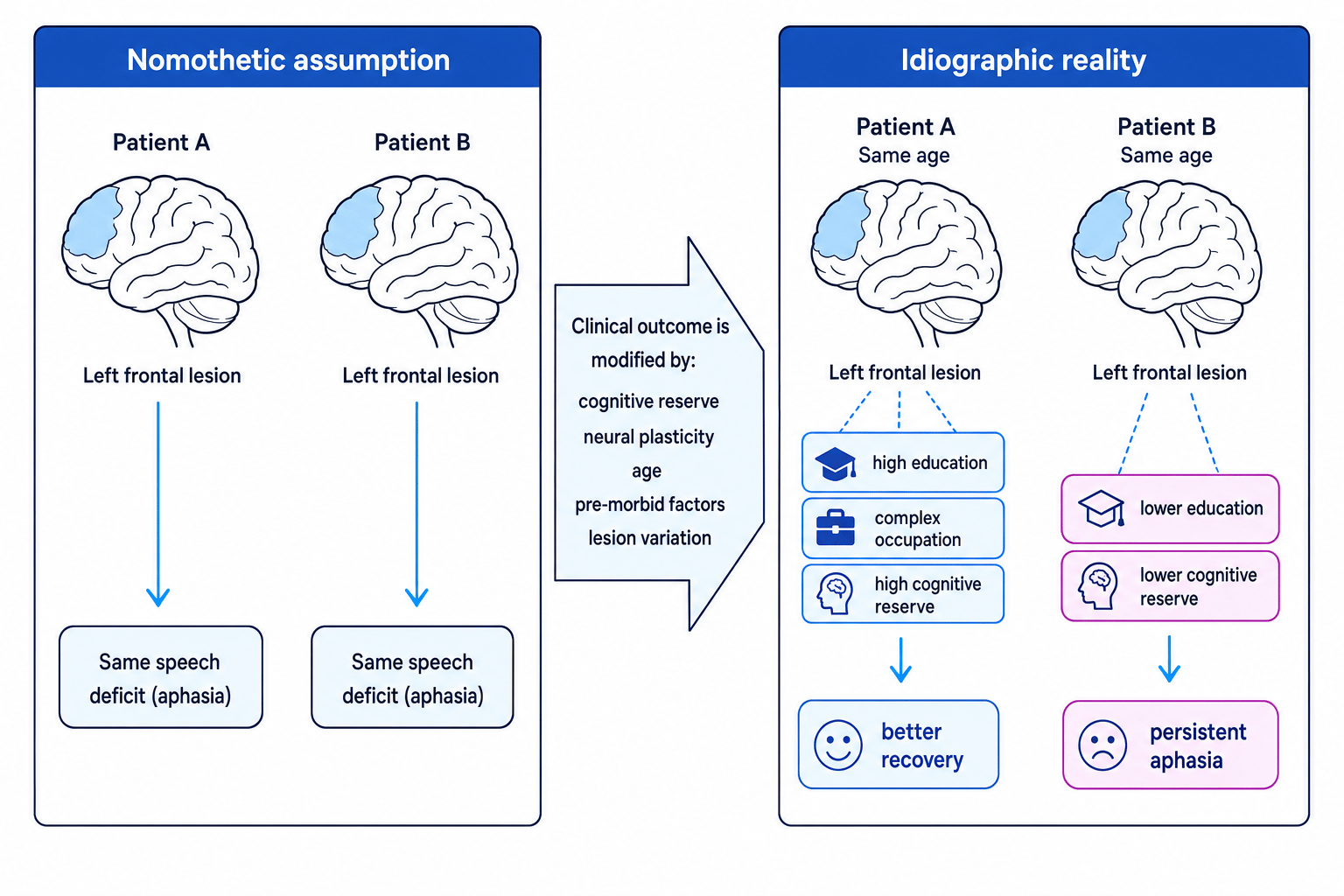
In Biological Psychology, we often search for universal laws of behavior—such as which brain structure is responsible for memory or how neurotransmitters control mood. However, humans are not identical carbon copies. This topic explores individual differences, focusing on how unique biological backgrounds affect recovery from brain damage and how Freud explained the development of unique personalities.
What you'll learn
- Why the traditional "nomothetic" assumption in neuropsychology is flawed when studying brain-damaged patients.
- How individual factors like cognitive reserve and neural plasticity alter clinical outcomes.
- How Sigmund Freud's psychodynamic perspective explains the development of unique personalities.
Brain damage and individual differences
For decades, cognitive neuropsychologists have studied brain-damaged individuals (such as Phineas Gage or Henry Molaison / Patient HM) to map the functions of the human brain. These studies often operate under a nomothetic assumption.
Nomothetic approach
The nomothetic approach is an attempt to establish general laws and generalizations that apply to all people. In neuropsychology, it assumes that human brains are structurally and functionally identical, meaning a lesion in a specific area will produce the same deficit in anyone.
In reality, case studies of brain-damaged patients are deeply affected by individual differences. An idiographic approach (focusing on the unique individual) reveals that no two brain injuries, and no two brains, are identical.
The assumption vs. reality
While textbook diagrams suggest a simple direct link between a damaged brain area and a lost function, the actual clinical outcome is heavily modified by the individual’s pre-existing brain characteristics, age, and lifestyle.
Factors driving individual differences in brain damage
- Cognitive Reserve: This refers to the brain's resilience—its capacity to improvise and find alternative ways of getting a job done. Individuals with higher levels of education, active intellectual lives, or complex occupations build up a richer network of synaptic connections. When damage occurs, their brains can easily reroute signals.
- Neural Plasticity: This is the brain's ability to reorganise itself by forming new neural connections throughout life. Plasticity is highly individual and decreases with age, meaning younger patients often show far superior recovery profiles.
- Pre-morbid Personality and Health: "Pre-morbid" refers to the state of the patient before the onset of their illness or injury. A patient who was highly motivated, optimistic, or physically active prior to trauma will engage differently with rehabilitation, leading to radically different recovery rates.
- Lesion Variation: No two accidental brain lesions are identical in shape, depth, or precise location. Even if two patients are diagnosed with "damage to the prefrontal cortex," the microscopic boundaries of their damage will differ.
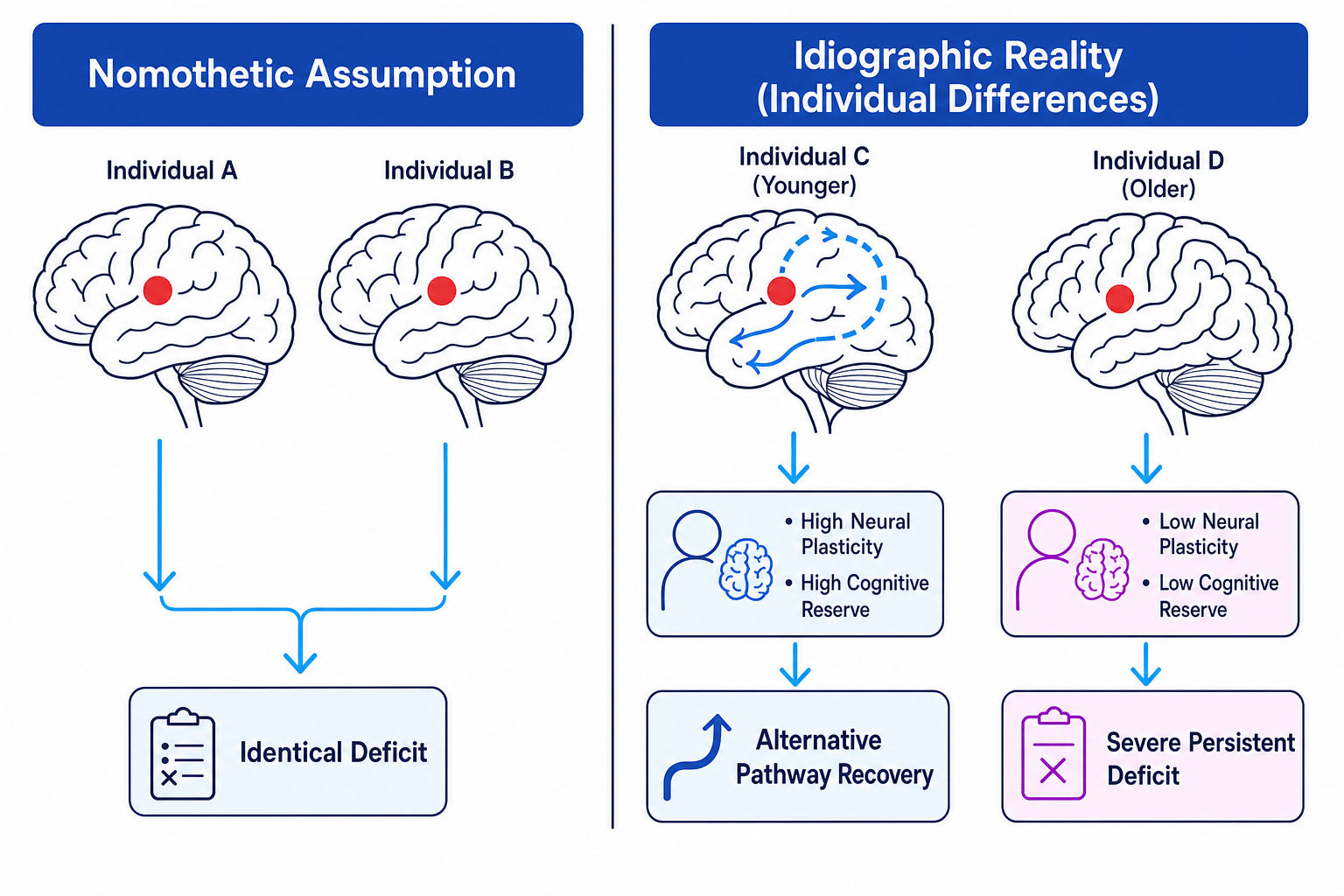
Evaluating cognitive outcomes in neural damage
Two patients, Patient A (a 58-year-old university professor) and Patient B (a 58-year-old manual laborer with minimal formal education), both suffer a localized ischemic stroke in the left hemisphere, damaging Broca’s area.
Walk through how a neuropsychologist uses individual differences to explain why Patient A recovered functional speech within six months, while Patient B suffered persistent, severe expressive aphasia.
- Identify the constant and variable factors: Both patients are the same age (585858) and have damage to the same anatomical region (Broca's area). The primary variable is their pre-morbid lifestyle, occupation, and educational background.
- Apply the concept of cognitive reserve: Patient A, through decades of complex linguistic and intellectual work, has built up a high level of cognitive reserve. This means they have a denser network of synaptic connections and alternative cognitive strategies.
- Formulate the recovery explanation: Although the primary speech center was damaged in both individuals, Patient A's high cognitive reserve allowed their brain to recruit alternative neural pathways to bypass the damaged tissue. Patient B, having lower pre-morbid linguistic cognitive reserve, lacked these redundant pathways, resulting in a permanent deficit.
Freud's view of personality and individual differences
While biological psychology looks at physical structures, the psychodynamic perspective looks at the mind. Sigmund Freud argued that personality is not fixed at birth, but rather develops through a series of stages, with individual differences arising from how we resolve these stages.
The tripartite personality
Freud proposed that the human personality is divided into three components. The dynamic balance between these three determines an individual's unique character.
- The Id: Operating on the pleasure principle, it is entirely unconscious and demands immediate gratification of basic drives.
- The Ego: Operating on the reality principle, it acts as the mediator, balancing the unrealistic demands of the Id and the moralistic constraints of the Superego.
- The Superego: Operating on the morality principle, it represents our internalized conscience and moral standards learned from parents and society.
Ego strength
Ego strength is the Ego's ability to effectively resolve conflicts between the Id and Superego. An individual with low ego strength may develop an impulsive personality (dominated by the Id) or an overly anxious, guilt-ridden personality (dominated by the Superego).
Psychosexual development and fixation
Freud argued that everyone passes through five psychosexual stages. Individual differences in adult personality are the direct result of fixation—getting "stuck" in a stage due to over-gratification or under-gratification of bodily pleasures.
| Stage | Focus of Pleasure | Cause of Fixation | Resulting Adult Personality Traits |
|---|---|---|---|
| Oral (0–18 months) | Mouth (sucking, biting) | Premature weaning or over-feeding | Oral-receptive (gullible, dependent) or Oral-aggressive (sarcastic, argumentative) |
| Anal (1.5–3 years) | Anus (withholding/expelling feces) | Strict or overly lax toilet training | Anal-retentive (orderly, obsessive, stingy) or Anal-expulsive (messy, disorganized, generous) |
| Phallic (3–6 years) | Genitals (Oedipus/Electra complex) | Failure to identify with the same-sex parent | Reckless, vain, sexually dominant, or highly anxious and submissive |
Ego defence mechanisms
To cope with the anxiety generated by conflicts between the Id and Superego, the Ego uses unconscious defence mechanisms. Individuals differ in which mechanisms they habitually rely upon:
- Repression: Pushing threatening thoughts entirely out of conscious awareness into the unconscious mind.
- Denial: Refusing to accept the reality of an anxiety-provoking event.
- Displacement: Redirecting an impulse from its true target onto a safer, substitute target (e.g., snapping at a sibling instead of a boss).
Equating 'personality' with 'biology'
Students often write that Freud believed personality is purely biological because of the psychosexual stages. Do not make this mistake! While the drive (libido) is biological, the individual differences in adult personality are caused by environmental interactions (e.g., how parents handle toilet training or weaning). It is an interactionist view.
Evaluating individual differences
When writing an essay on individual differences in brain damage or personality development, your AO3 (evaluation) should weigh up the scientific rigor of these ideas.
Strengths
- Clinical utility of cognitive reserve: Acknowledging individual differences has revolutionized brain rehabilitation. Therapy is now tailored to a patient's pre-morbid interests and cognitive style, rather than using a one-size-fits-all approach.
- Rich qualitative insights: Both case studies of brain damage (like HM) and Freud’s psychoanalytic case studies (like Little Hans) provide incredibly rich, detailed qualitative data that structured experiments cannot capture.
Weaknesses
- The Problem of Generalisability: If every brain-damaged patient is unique, we cannot easily generalize findings from one patient to the general population. This threatens the reliability of cognitive neuropsychology.
- Unscientific and Unfalsifiable: Freud’s explanations of individual differences (like the Oedipus complex) cannot be empirically tested. If a phallic-fixated person acts incredibly bold, Freud would say they are displaying their fixation; if they act cowardly, he would claim they are using reaction-formation to hide their fixation. Because the theory can explain any outcome, it is unfalsifiable.
In the exam
- Unpick the scenario (AO2): If the exam question describes a patient recovering from a stroke or brain injury, look for clues about their background (e.g., job, hobbies, age). Use these clues to explain why their recovery might differ from standard expectations.
- Deconstruct the nomothetic assumption (AO3): In essays on brain damage, argue strongly that assuming "no individual differences" creates a threat to internal validity in research.
- Use precise psychodynamic terminology (AO1): When discussing Freud, do not just say "he believed in personality." Explicitly name the Id, Ego, and Superego, and explain how an imbalance between them creates individual variation.
Check yourself
- Why does a highly educated patient often show better cognitive recovery after a stroke than a patient with limited formal education?
- How does an imbalance in the tripartite personality lead to individual differences in adult behavior?
- What are the methodological limitations of relying on unique, individual case studies of brain-damaged patients to create general models of human memory?