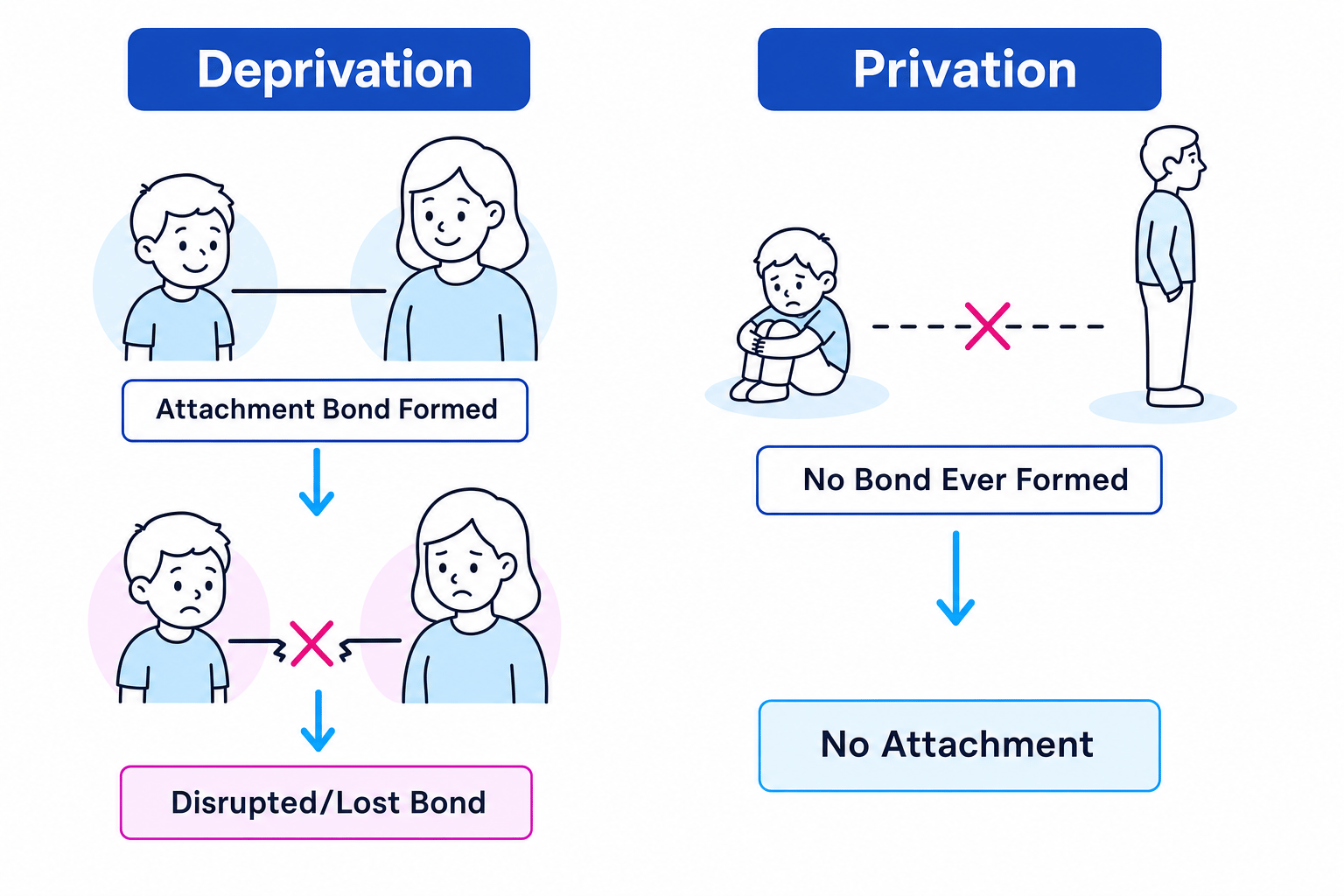
When John Bowlby formulated his famous Maternal Deprivation Hypothesis, he argued that breaking the maternal bond during the first few years of life would lead to permanent, irreversible cognitive and emotional damage. However, later psychologists noticed a critical flaw in his reasoning: Bowlby failed to distinguish between losing a bond that had already been formed, and never having the chance to form a bond at all.
These study notes break down the crucial concept of privation, explore key research studies, and evaluate whether the devastating effects of early emotional neglect can ever truly be reversed.
What you'll learn
- The crucial theoretical distinction between maternal deprivation and privation.
- Key case studies of privation, including Genie and the Czech Twins.
- Modern institutional research into privation, specifically Rutter's Romanian Orphan Study.
- The clinical factors that determine whether the negative effects of privation can be reversed.
1. Deprivation vs. Privation: The Crucial Distinction
To master this topic, you must first understand the distinction made by British psychologist Michael Rutter (1981). Rutter argued that Bowlby confused two completely different experiences under the single label of "deprivation".
Deprivation
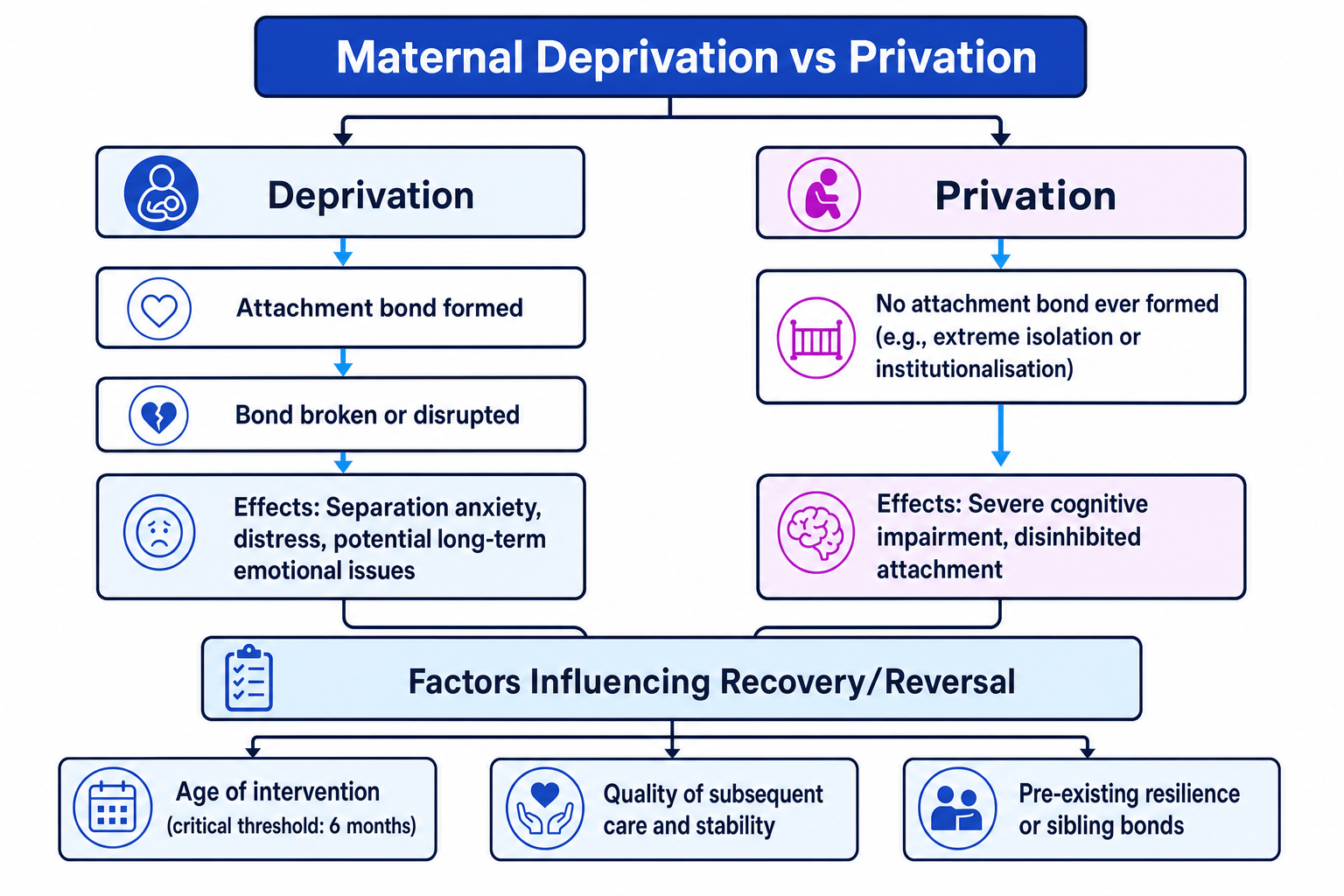
Deprivation occurs when a child has formed an initial attachment bond with a primary caregiver, but that bond is subsequently broken, disrupted, or lost (e.g., due to parental death, divorce, or prolonged hospitalisation).
Privation
Privation occurs when a child has never had the opportunity to form any attachment bond with a caregiver in the first place. This is typically seen in cases of extreme neglect, abuse, or early institutionalisation.
While deprivation causes distress and temporary regression, it is privation that is associated with the most severe, long-lasting developmental and psychological damage.
Confusing the two terms
In exam essays, students frequently use 'deprivation' and 'privation' interchangeably. This will cost you valuable marks. Always ask yourself: Did this child ever have a stable primary attachment figure in their early life? If the answer is no, you are looking at privation.
2. Case Studies of Extreme Privation
Because it is highly unethical to deliberately isolate children for research purposes, psychologists must rely on natural experiments and clinical case studies of children who have suffered extreme, real-world privation.
Two classic, contrasting case studies illustrate the differing outcomes of privation.
Case Study A: The Czech Twins (Koluchová, 1972, 1991)
- The Background: Identical twin boys were kept in a cold, dark cellar from the age of 18 months to 7 years by their stepmother. They were regularly beaten, starved, and had no social contact except with each other.
- The Discovery: When found at age 7, they had severe rickets, could not walk properly, lacked speech, and had a very low measured IQ.
- The Recovery: They were placed in a nurturing foster home with two dedicated sisters. By age 11, their speech was normal, and by adulthood, they had achieved average IQs, formed healthy romantic relationships, and built successful careers.
- The Verdict: The devastating effects of severe early privation were fully reversed.
Case Study B: Genie (Curtiss, 1977)
- The Background: Genie was discovered in California in 1970 at the age of 13. Her father had kept her locked in a dark room strapped to a potty chair since she was 20 months old. She was beaten if she made noise and had virtually zero human interaction.
- The Discovery: When rescued, Genie was severely malnourished, could not stand upright, and possessed no language skills.
- The Recovery: Despite intensive therapy from psychologists and linguists, Genie's recovery was highly limited. While she learned some vocabulary and non-verbal communication, she was never able to master grammar or syntax. Her social skills remained severely impaired, and she eventually regressed after being placed in a series of unstable foster homes.
- The Verdict: The negative effects of her privation could not be fully reversed.
The 'Scaffold' Analogy
Think of early attachment as the biological scaffold for human language and emotional development. If the scaffold is taken down for a short period (deprivation), the building might tilt but can be repaired. If the scaffold is never put up during key construction phases (privation), the building struggle to stand at all—unless a strong alternative support structure is introduced early enough.
3. Institutional Research: The Romanian Orphan Studies
While case studies provide deep, qualitative insight into individual lives, they suffer from small sample sizes. To see if these patterns hold true across larger populations, we look to institutional studies.
Following the fall of the Ceaușescu regime in Romania in 1989, more than 100,000 children were discovered living in state-run orphanages under conditions of extreme physical and emotional privation. Staff-to-child ratios were very low, meaning babies rarely received individual attention, comfort, or stimulation.
Rutter et al. (2011): The English and Romanian Adoptees (ERA) Study
Rutter and his colleagues set up a longitudinal study to track the development of 165 Romanian orphans adopted by British families, comparing them to a control group of 52 British children adopted before the age of 6 months.
The Romanian children were divided into three groups based on the age at which they were adopted:
- Adopted before the age of 6 months.
- Adopted between 6 months and 2 years.
- Adopted after the age of 2 years.
Key Findings
The researchers assessed the children at ages 4, 11, and 15:
- Cognitive Development: Upon arrival in the UK, the Romanian children showed severe cognitive impairment and malnutrition. However, those adopted before 6 months caught up completely with their British peers, achieving an average IQ of 102 by age 11. Those adopted after 2 years showed long-term intellectual deficit, with an average IQ of 77.
- Attachment Type: Children adopted after 6 months frequently displayed a unique attachment style called disinhibited attachment.
Disinhibited Attachment
A pattern of behaviour characterised by attention-seeking, clinginess, and inappropriate familiarity or friendliness towards unfamiliar adults, paired with a lack of selective attachments.
The 6-Month Threshold
The Romanian Orphan Studies demonstrated a clear developmental cut-off. If a child experiencing privation is placed in a nurturing family environment before the age of 6 months, they are highly likely to make a complete cognitive and emotional recovery. After 6 months, the damage becomes much more difficult to reverse.
4. Why Can Some Children Recover While Others Cannot?
If we compare Genie, the Czech Twins, and the Romanian Orphans, we can identify several critical variables that determine whether the negative effects of privation can be reversed:
- Age of Intervention: The younger the child is rescued and placed in a loving environment, the better their recovery. The critical period for attachment is widely believed to be under 2 years, with the first 6 months being the absolute gold standard for intervention.
- Quality of Subsequent Care: The Czech Twins received exceptionally high-quality, stable, and loving care from foster mothers who were highly committed. Genie, by contrast, was subjected to changing therapists, custody battles, and abusive foster homes after her rescue.
- The Presence of a Companion: The Czech twins were isolated together. Having each other allowed them to form a primitive attachment bond, shielding them from the total social isolation experienced by Genie.
- The Age of Privation Onset: Genie's abuse began slightly later (20 months) than the Czech twins, but her physical confinement was far more absolute and lasted much longer (over 11 years compared to 5.5 years for the twins).
Worked Example: Applying Privation Research to a Scenario
Classifying attachment disruption and predicting recovery
Scenario:
Aria was abandoned at birth and spent her first 18 months in an understaffed state institution where carers only interacted with her briefly during feeding and changing times. At 18 months, she was adopted by a highly supportive, affluent couple who provided her with a stable, enriched environment and access to speech therapy.
Using your knowledge of research into privation, explain:
- Whether Aria’s early experience is an example of deprivation or privation.
- The likely developmental impacts Aria might face.
- The extent to which these impacts can be reversed.
Step-by-step Solution:
- Classify the experience (Deprivation vs. Privation): Identify whether an initial bond was ever formed. Aria was abandoned at birth and kept in an understaffed institution where carers only completed task-based duties. Therefore, she never had a primary attachment figure. This must be classified as privation, not deprivation.
- Predict developmental impacts using research: Apply findings from the Romanian Orphan Studies (Rutter et al.). Because Aria spent her first 18 months in an institution, she is past the critical 6-month threshold. She is highly likely to display signs of disinhibited attachment (e.g., showing inappropriate friendliness to strangers, attention-seeking behaviour). She may also show initial cognitive impairment or developmental delay.
- Assess the likelihood of reversal: Weigh up the positive and negative prognostic factors. On the negative side, Aria was institutionalised for 18 months (past the 6-month mark), which limits the speed and completeness of her cognitive and social recovery. On the positive side, she has been adopted into a highly supportive, stable, and enriched environment. Based on Rutter's ERA study, while she may experience ongoing challenges with disinhibited attachment, her supportive environment and early intervention mean she can still make significant cognitive and language gains over time, even if some mild social impairments persist.
5. Evaluation of Privation Research (AO3)
When writing an 8- or 12-mark essay on this topic in your Edexcel exam, you must balance your description of the research (AO1) with strong evaluation (AO3).
Methodological Strengths
- Longitudinal Design: Studies like Rutter’s ERA study track children over decades. This allows researchers to see the long-term developmental trajectories of children rather than just taking a brief snapshot, giving us a genuine answer to the question of whether privation can be reversed.
- Triangulation of Data: Case studies of privation (like Genie and the Czech Twins) use multiple methods—such as IQ tests, physical measurements, linguistic analysis, and direct observation. This rich data increases the validity of the clinical findings.
Methodological Weaknesses
- The "Idiosyncrasy" of Case Studies: Case studies deal with unique individuals in extreme circumstances. For example, Genie may have suffered from congenital mental retardation from birth (as her father claimed), which would act as a confounding variable to her recovery. This makes it very difficult to generalise findings to the wider population of neglected children.
- The Problem of Attrition: Longitudinal studies suffer from participant drop-out over time. Families move away or withdraw consent, meaning the remaining sample at age 15 might only represent the most stable or successful adoptive families, skewing the results.
Ethical Considerations
- The BPS Code of Ethics (2009): Researching highly vulnerable individuals requires strict adherence to ethical guidelines. In Genie’s case, there were severe conflicts of interest between her scientific value as a "subject" and her therapeutic needs as a patient. Researchers were accused of overtesting her for scientific prestige, failing to protect her from harm, and breaching her confidentiality by releasing videos of her therapy sessions.
Real-World Application
- Changing Social Policy: This research has had a massive, positive impact on childcare practices. Children's homes now avoid large numbers of rotating staff, instead using a key-worker system where one or two carers form a primary emotional bond with a specific child. Additionally, adoption policies now focus on placing children with foster/adoptive families as early as possible (under 6 months) rather than keeping them in temporary care.
In the exam
- Never evaluate a case study by saying it 'lacks ecological validity'. Case studies are real-world, natural events; their ecological validity is actually very high. Instead, argue that they lack generalisability due to their unique, idiographic nature.
- Be ready to apply research to scenarios (AO2). Exam questions often present a fictional child adopted from an orphanage. Use exact numbers from Rutter's study (such as the 6-month cut-off) to make precise predictions about their future.
- Explicitly link your AO3 points back to the essay title. If the question asks "To what extent can the effects of privation be reversed?", don't just describe Rutter's study. Conclude each paragraph with a sentence like: "This suggests that while cognitive deficits can be reversed with early intervention, emotional deficits like disinhibited attachment are far more resistant to change."
Check yourself
- Can you explain the difference between deprivation and privation using a real-world example of each?
- Why did the Czech Twins recover fully while Genie did not? Identify three distinct differences in their circumstances.
- What specific intellectual and emotional outcomes did Rutter et al. (2011) discover in Romanian children adopted after 2 years of age compared to those adopted before 6 months?