In developmental psychology, the bond between an infant and their primary caregiver is considered a crucial foundation for healthy emotional and social growth. But what happens when this bond is disrupted, damaged, or completely severed?
These notes explore the psychological impacts of deprivation and privation, look closely at key theories and empirical evidence, and examine how we can apply this research to minimize the negative developmental impacts on children.
What you'll learn
- The vital distinction between separation, deprivation, and privation.
- The short-term effects of deprivation through Robertson and Robertson's PDD model.
- The long-term effects of deprivation through John Bowlby’s Maternal Deprivation Hypothesis.
- Practical, evidence-based methods for reducing the negative consequences of deprivation in real-world settings.
Clarifying the Basics: Separation, Deprivation, and Privation
Before exploring the research, we must establish clear definitions. In everyday conversation, "deprived" and "deprived of" are used loosely. In A-Level Psychology, however, these terms have precise, distinct meanings.
Separation
Separation occurs when an infant is temporarily removed from the primary caregiver's presence (for hours or days). It does not necessarily cause long-term harm if appropriate substitute care is provided.
Deprivation
Deprivation occurs when an attachment bond has been successfully established in early infancy but is subsequently lost, broken, or severely disrupted for an extended period.
Privation
Privation occurs when a child fails to form any initial attachment bond with a primary caregiver in early life. This is often seen in cases of extreme neglect or institutionalisation.
The Golden Rule
Deprivation is the loss of an existing bond, whereas privation is the complete absence of any initial bond.
Short-Term Effects of Deprivation: The PDD Model
When children suffer short-term separation or deprivation, they display a highly predictable sequence of distress behaviors. This was documented by James and Joyce Robertson (1971) and is known as the PDD model (Protest, Despair, Detachment).
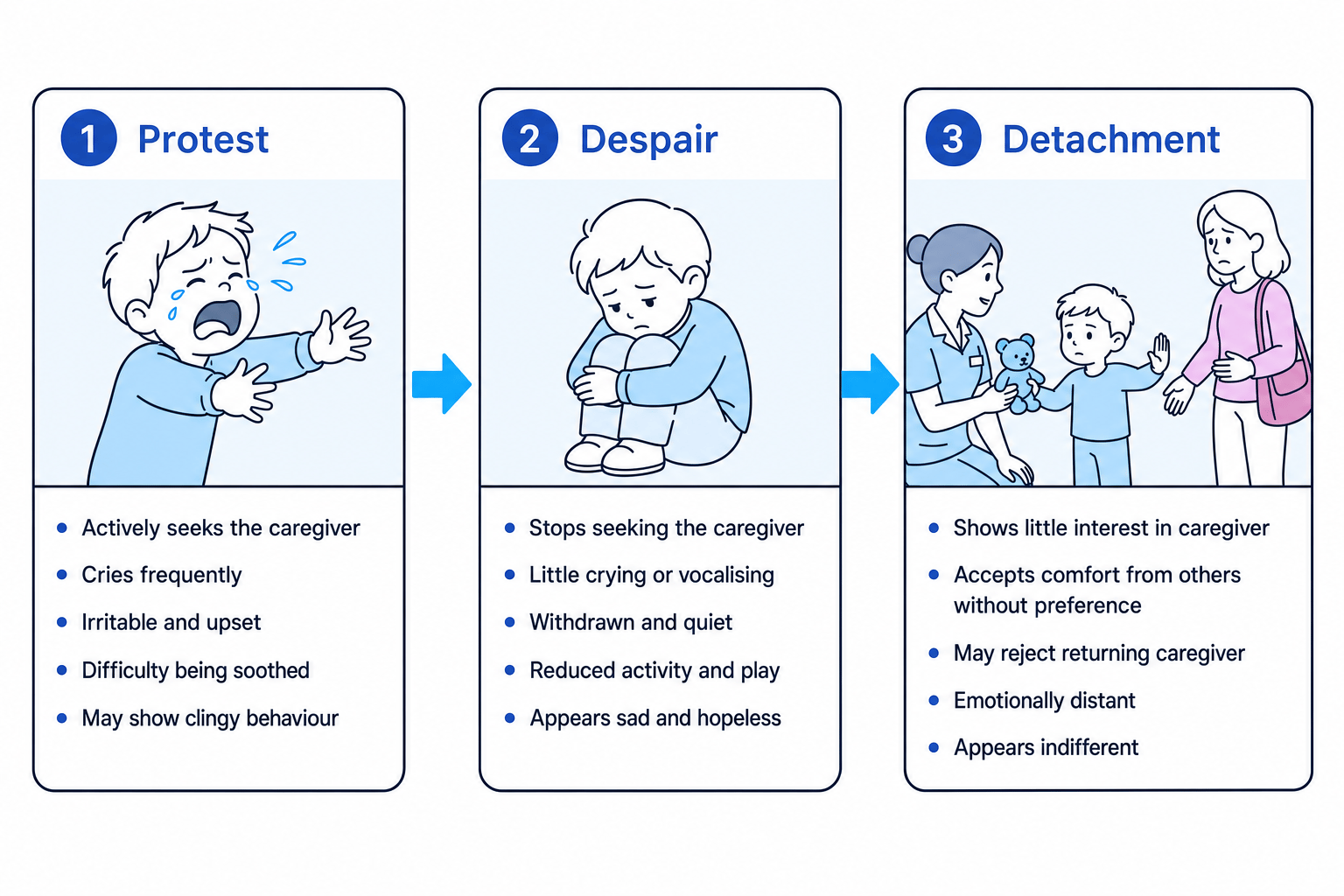
The Three Stages of PDD
- Protest: The child cries intensely, screams, struggles, and rejects comfort from unfamiliar adults. They actively seek their primary caregiver and show outward signs of panic.
- Despair: The active distress gives way to passive, withdrawn behavior. The child is quiet, seemingly calm, but deeply sad. They may refuse to eat or play and frequently seek comfort from a security object (such as a blanket or soft toy). They are in a state of mourning.
- Detachment: If the separation continues, the child appears to recover. They interact with others and may seem sociable. However, this is a coping mechanism. When the primary caregiver returns, the child does not run to them; instead, they show indifference, turn away, or actively reject them.
Key Evidence: The Case of John (1969)
The Robertsons filmed several young children undergoing short-term separations. Their most famous case study was John, a 17-month-old boy who stayed in a residential nursery for nine days while his mother was giving birth.
Because the staff were busy and changed shifts constantly, John received no consistent, personalized emotional care. Over the nine days, John progressed rapidly through protest and despair. When his mother returned, John was detached; he refused to look at her, struggled to get away from her, and took months to rebuild their bond.
Long-Term Effects of Deprivation: Bowlby's Maternal Deprivation Hypothesis (1951)
While the Robertsons focused on short-term responses, John Bowlby turned his attention to the permanent, long-term developmental damage caused by maternal deprivation.
Maternal Deprivation Hypothesis (MDH)
Bowlby’s Maternal Deprivation Hypothesis states that continuous, unbroken care from a mother (or mother-substitute) is absolutely essential for normal psychological, intellectual, and emotional development.
Core Tenets of the MDH
- The Critical Period: Bowlby argued that the first 2.5 years (30 months) of life represent a critical period for attachment. If a child is separated from their mother for an extended period without a suitable substitute during this time, psychological damage is inevitable. He also identified a sensitive period extending up to age 5.
- The Internal Working Model: Early deprivation damages the child's internal working model—their mental template for relationships. This limits their ability to trust others or build healthy relationships in adulthood.
Long-Term Consequences of Deprivation
Bowlby outlined several severe developmental consequences if a child experiences prolonged deprivation during the critical period:
- Intellectual Retardation (Low IQ): Deprived children show delayed cognitive development. This was supported by Goldfarb (1943), who found that children fostered after spending their early years in institutional care had significantly lower IQs than children fostered much earlier.
- Affectionless Psychopathy: This is an inability to experience deep empathy, guilt, or strong affection for others. Affectionless psychopaths struggle to form meaningful relationships and show a lack of remorse for their actions, which makes them highly vulnerable to criminal behavior and delinquency.
Confusing Deprivation and Privation in Exams
In exam questions, students often mistakenly cite Bowlby's Maternal Deprivation Hypothesis as an explanation for the effects of being raised in an orphanage. If a child has been in an institution since birth and never formed a bond, this is privation, not deprivation. Use your terms carefully to avoid losing AO1 marks.
Analyzing short-term distress in a clinical scenario
Scenario: Amelie (20 months old) is admitted to a hospital ward for an emergency 10-day treatment cycle. Due to strict hospital policies, her parents are only allowed to visit for 30 minutes each evening. On Day 2, Amelie is screaming, crying, and clinging to her father's coat when he tries to leave. By Day 5, she is sitting quietly in her cot, clutching her teddy bear, and ignoring the nurses. On Day 10, when her mother arrives to take her home, Amelie turns her face away and refuses to be held.
Using your knowledge of the PDD model, identify the stages of distress Amelie displays across the 10 days, and explain why her behavior changed.
Step-by-Step Analysis:
- Identify the first behavioral stage (Day 2): Look at the behaviors on Day 2: screaming, crying, and physically clinging to the father. This matches the Protest stage. Amelie is actively resisting the separation and trying to prevent her caregiver from leaving.
- Identify the second behavioral stage (Day 5): Look at the behaviors on Day 5: sitting quietly, clutching a security object (teddy bear), and ignoring the environment. This matches the Despair stage. The active panic has subsided into a passive, withdrawn state where she is mourning the loss of her parents' presence.
- Identify the final behavioral stage (Day 10): Look at the behaviors on Day 10: turning away from her mother and refusing comfort upon reunion. This matches the Detachment stage. Amelie has structurally suppressed her emotional attachment to protect herself from further pain, leading to temporary rejection of the primary caregiver upon reunion.
Reducing the Negative Effects of Deprivation
Psychological research should ideally be used to improve people's lives. By understanding how and why deprivation causes harm, psychologists have developed practical methods to prevent or minimize these negative effects.
1. High-Quality Substitute Care (Fostering over Institutionalisation)
In their research, the Robertsons did not just film children who suffered (like John). They also took young children into their own home as foster carers while their mothers were hospitalised.
The Robertsons provided a warm, structured environment, stuck to the children's normal routines, and talked about their mothers regularly to keep the memory alive. Consequently, these fostered children (such as Jane, Lucy, and Thomas) did not experience the PDD cycle and adjusted well. This showed that substitute emotional care can prevent deprivation.
2. Hospital Care Reforms
Historically, hospitals restricted parental visits to keep wards sterile and quiet, which inadvertently caused severe maternal deprivation.
Research by Bowlby and the Robertsons transformed pediatric hospital care. Today, pediatric wards:
- Encourage parents to stay overnight with their children (rooming-in).
- Provide 24/7 open visiting hours.
- Train staff to meet children's emotional needs, not just their physical medical needs.
3. Key Worker Systems in Early Years Settings
In modern nurseries and daycare centers, a key worker scheme is used. Each child is assigned a specific staff member who is responsible for their primary physical and emotional care.
This ensures that the child has a consistent adult figure to interact with, reducing the potential for emotional disruption when parents are away.
Evaluating the Research (AO3)
When evaluating research into deprivation for a high-scoring 8- or 12-mark essay, you must balance its strengths, weaknesses, and real-world utility.
Methodological Strengths
- Rich Qualitative Data: The Robertsons used naturalistic observation and film recording. This allowed for detailed, objective, and verifiable records of children's behavior, which could be re-analyzed by other researchers to confirm validity.
- Real-World Application: This body of research completely transformed social policy, childcare practices, and pediatric medicine, significantly reducing the trauma of hospitalisation for millions of children globally.
Methodological Weaknesses
- Individual Differences: Not all children respond to separation in the exact same way. Bowlby et al. (1956) studied children who had spent months in a tuberculosis sanatorium before age 4. Although they suffered maternal deprivation, the majority showed no serious long-term intellectual or emotional damage, suggesting some children are more resilient than others.
- Correlation vs. Causation: Much of the evidence supporting the long-term effects of deprivation is correlational (e.g., Bowlby's retrospective 44 Thieves study). We cannot definitively prove that maternal deprivation caused the delinquency or affectionless psychopathy; other confounding variables, such as family poverty or parental mental health, could be responsible.
Theoretical Limitations
- The Deprivation vs. Privation Debate: Michael Rutter (1981) argued that Bowlby confused deprivation with privation. Rutter claimed that the severe, long-term damage Bowlby observed in institutionalized children was actually due to privation (never having formed an attachment in the first place) rather than deprivation (losing an attachment). Rutter argued that privation has far more severe consequences than deprivation.
In the exam
- Differentiate early on: If you get a question about deprivation, make sure your introduction clearly defines separation, deprivation, and privation. Demonstrating this precise conceptual boundary immediately shows the examiner you have high-level AO1 knowledge.
- Link studies to the spec criteria: When discussing the PDD model, explicitly name the Robertsons (1971) and use the case study of John (1969) to illustrate your points. For long-term effects, cite Bowlby (1951) and Goldfarb (1943).
- Use the "How to Reduce" angle for AO2/AO3: Be prepared to write about how psychological research has changed real-world practice. Always link the PDD model or MDH directly to interventions (e.g., hospital visiting hours, key worker systems, foster care) to show how theoretical psychology informs applied practice.
Check yourself
- Can you explain the difference between deprivation and privation using a concrete example for each?
- What are the three stages of the PDD model, and how does a child’s outward behavior change in each stage?
- What major critique did Michael Rutter make regarding John Bowlby's Maternal Deprivation Hypothesis?
- What practical changes were introduced in pediatric hospitals as a direct result of research by Bowlby and the Robertsons?
