What you'll learn
- What psychologists mean by day care and why it is difficult to research.
- The main advantages and disadvantages of day care for children’s development.
- What makes day care good quality or poor quality.
- How to evaluate day-care research for AO3, including methodology, ethics and real-world application.
Starting point: what is day care?
Day care
Day care is care provided for a child by someone other than the child’s parent or main caregiver, usually outside the home, for part of the day. It can include nurseries, childminders, pre-schools and playgroups.
In this topic, you are not being asked to say “day care is good” or “day care is bad”. A better answer is more balanced: the effects of day care depend on quality, age of the child, hours spent in care, family background and the child’s temperament.
Researchers often look at outcomes such as:
- Attachment: the emotional bond between a child and caregiver.
- Social development: how children interact with peers and adults.
- Cognitive development: thinking, language, memory and problem-solving.
- Emotional development: confidence, independence and ability to regulate feelings.
The core argument
Day care is not a single “thing”. High-quality day care can support social and cognitive development, while poor-quality or very extensive day care may be linked with stress, aggression or weaker attachment security.
Why day care research is complicated
Day care happens in real families, not controlled laboratories. Children who attend day care may differ from children who do not attend in many ways, such as parental income, parental education, home environment, culture and work patterns.
This means much day-care research is correlational.
Correlation
A correlation is a relationship between two variables. For example, number of hours in day care may be related to behaviour ratings. However, correlation does not prove that one variable caused the other.
A child who shows strong language skills after attending nursery may have benefited from nursery — but they may also have parents who read to them often, talk to them frequently and choose a high-quality nursery.
Avoiding a causal claim
A study finds that children who attend high-quality pre-school score higher on language tests at age five than children who do not attend pre-school.
- Compare the two variables: the first is pre-school attendance/quality, and the second is language score.
- Ask whether other variables could explain the relationship: parents choosing high-quality pre-schools may also provide more books, conversation and educational support at home.
- Make the careful conclusion: the study suggests an association between high-quality pre-school and better language, but does not prove pre-school alone caused the improvement.
Advantages of day care for the child
Social development
Day care gives children regular contact with other children. This can help them learn:
- sharing and turn-taking
- cooperation
- resolving minor conflicts
- empathy
- confidence with unfamiliar adults and peers
Shea (1981) observed children in nursery over their first 10 weeks and found that they became more sociable and showed more peer-directed behaviour over time. This suggests day care may help children practise social interaction.
Cognitive and language development
High-quality day care can provide structured play, books, conversation and problem-solving activities. The EPPE project by Sylva, Melhuish, Sammons, Siraj-Blatchford and Taggart (2004) followed thousands of children in the UK and found that high-quality pre-school was linked with better intellectual and social development, especially for children from disadvantaged backgrounds.
Independence and confidence
Day care may encourage children to try activities without immediate parental help. They may become more confident with routines, choices and self-care tasks, such as tidying up or putting on coats.
Best-supported advantage
The strongest evidence for benefits is usually found for high-quality pre-school, especially when it offers warm adult interaction, language-rich play and structured learning.
Disadvantages of day care for the child
Possible effects on attachment
Some researchers have argued that long hours in non-parental care, especially in infancy, could interfere with the development of a secure attachment to the main caregiver.
Belsky and Rovine (1988) reported that infants who spent more time in non-maternal care were more likely to be classified as insecurely attached in the Strange Situation. This became controversial because it seemed to suggest that early day care might be risky.
However, later research is more cautious. The NICHD Early Child Care Research Network (1997, 2001) found that maternal sensitivity was usually a stronger predictor of attachment security than day care itself. In other words, the quality of the parent-child relationship matters greatly.
Possible aggression or externalising behaviour
Some studies have linked long hours in day care with more externalising behaviour, meaning outwardly directed behaviours such as aggression, disobedience or impulsivity. The NICHD research suggested that more hours in care could be associated with slightly more behaviour problems, but again this depended on quality and family factors.
Stress and tiredness
Very young children may find long days tiring, especially if the setting is noisy, crowded or inconsistent. Poor-quality day care may increase stress because children receive less sensitive adult attention.
Writing a one-sided answer
Do not write that “day care causes aggression” or “day care damages attachment” as if this is always true. The evidence is mixed, and quality, hours, age and home environment all matter.
What makes good-quality day care?
Psychologists often distinguish between structural quality and process quality.
Structural and process quality
Structural quality refers to the organised features of a setting, such as staff-to-child ratio, group size, staff qualifications and safety. Process quality refers to what actually happens in the child’s daily experience, such as warmth, sensitivity, language interaction and play.
Good-quality day care usually includes:
- low staff-to-child ratios, so children receive enough attention
- small group sizes, reducing noise and stress
- trained staff, who understand child development
- sensitive caregivers, who respond warmly and consistently
- low staff turnover, so children can form stable relationships
- stimulating activities, such as pretend play, stories, songs and problem-solving
- clear routines, helping children feel secure
- partnership with parents, so care is consistent between home and nursery
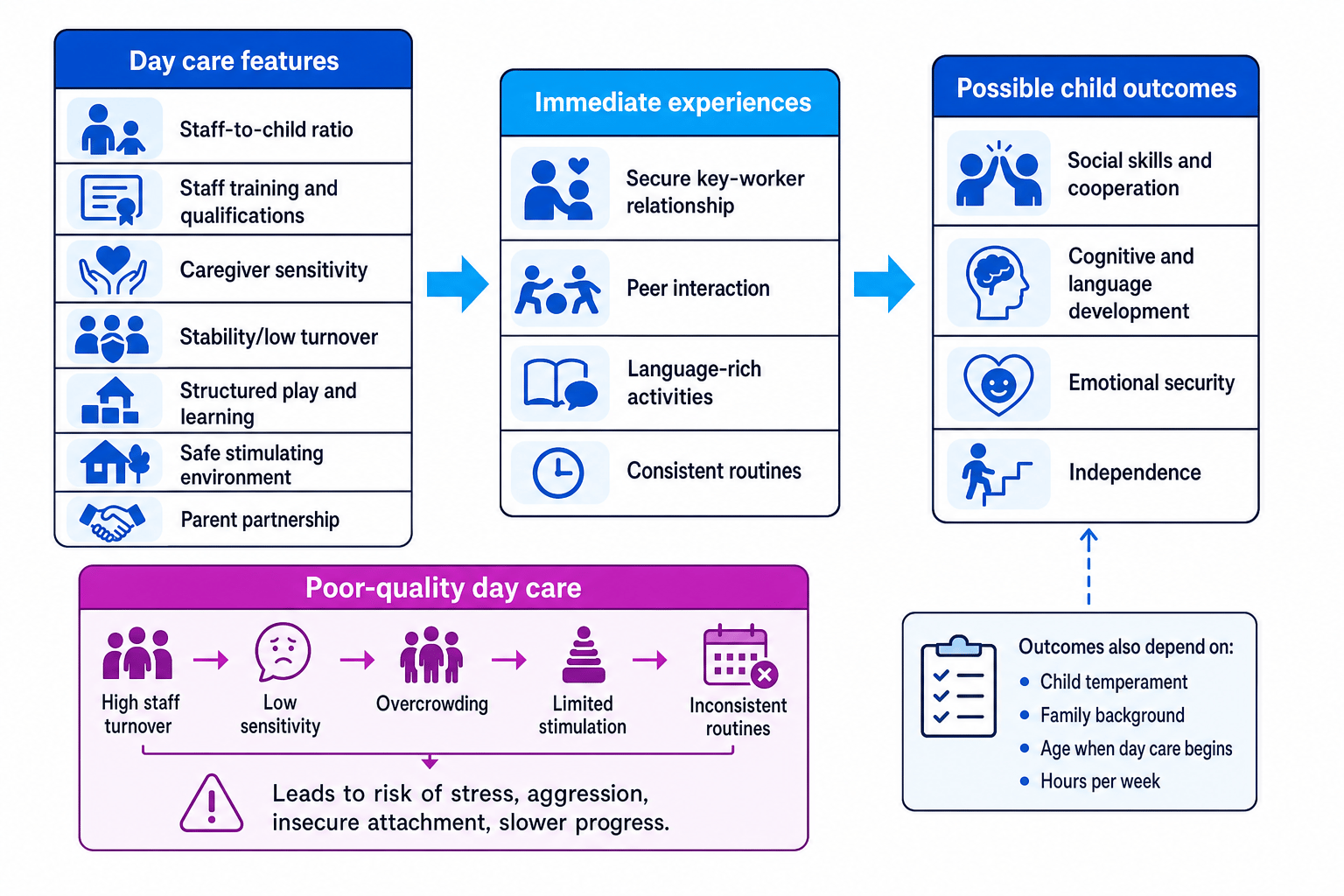
Howes and Hamilton (1993) found that children could form secure attachments with day-care providers, especially when care was stable and sensitive. This supports the idea that day care can be emotionally positive if children have a consistent key worker.
Judging quality from a scenario
A nursery has one adult for every 12 toddlers. Staff change frequently, activities are mainly free play with little adult interaction, and parents receive little feedback.
- Assess structural quality: the high number of toddlers per adult suggests limited individual attention, and frequent staff changes reduce stability.
- Assess process quality: little adult interaction means fewer chances for language development, emotional support and guided play.
- Link to likely outcomes: this setting may increase stress and reduce opportunities for secure key-worker relationships, so it would be classed as poor-quality day care.
What makes poor-quality day care?
Poor-quality day care is not just “day care that looks messy”. Young children do need active play, noise and exploration. Poor quality means the setting fails to provide safe, warm, consistent and developmentally useful care.
Signs of poor-quality day care include:
- high staff turnover
- large groups and overcrowding
- low staff training
- insensitive or harsh adult responses
- little stimulation or language interaction
- inconsistent routines
- poor communication with parents
- unsafe or unhygienic conditions
Vandell and Corasaniti (1990) found that poorer-quality day care was associated with less positive social and academic outcomes later in childhood. This supports the idea that quality, not just attendance, is crucial.
Quality is your evaluation anchor
If an exam question asks about advantages and disadvantages of day care, repeatedly bring the answer back to quality of care. It is the easiest way to make your answer balanced and sophisticated.
Key research evidence to know
Belsky and Rovine (1988)
Belsky and Rovine found an association between extensive non-maternal care in infancy and insecure attachment. This is useful for the “disadvantages” side of an essay.
AO3 caution: the research is correlational, and families using more day care may differ in other ways. It also risks oversimplifying attachment by focusing heavily on the mother-child bond.
NICHD Early Child Care Research Network (1997, 2001, 2006)
This large American longitudinal project followed children over time. It found that high-quality care was linked with better cognitive and language outcomes. It also found some links between longer hours and externalising behaviour, but effects were usually modest and influenced by home background.
AO3 strength: the longitudinal design allows researchers to track development over time. AO3 weakness: it still cannot fully remove all confounding variables.
Sylva et al. (2004) — EPPE project
The UK EPPE study found that pre-school experience could improve children’s cognitive and social development, especially when settings were high quality. Benefits were particularly important for disadvantaged children.
AO3 application: this research supports government investment in early years education and staff training.
Andersson (1992)
Andersson studied Swedish children and found that early day care was associated with positive social and academic outcomes. This challenges the idea that early day care is necessarily harmful.
AO3 caution: Sweden has strong childcare provision and family policies, so findings may not generalise perfectly to countries with different childcare systems.
Applying day care research to real life
Research into day care has influenced early-years policy. If high-quality day care supports development, then governments and nurseries should focus on:
- improving staff training
- keeping staff-to-child ratios low
- supporting stable key-worker relationships
- offering language-rich and play-based learning
- making good childcare accessible to disadvantaged families
This is a major strength of day-care research: it has clear real-world application.
Applying research to nursery policy
A local council wants to improve outcomes for children from disadvantaged backgrounds by funding nursery places.
- Use EPPE evidence: high-quality pre-school is linked with better cognitive and social outcomes, particularly for disadvantaged children.
- Add a quality condition: funding places alone may not help if settings have untrained staff, high turnover or little stimulation.
- Make the recommendation: the council should fund places and invest in staff training, low ratios and parent partnership.
Ethical issues in day care research
Because day-care research often involves young children, ethics are especially important. Under the BPS Code of Ethics and Conduct (2009), researchers should consider:
- consent from parents or guardians, plus child assent where possible
- right to withdraw, explained in an age-appropriate way
- protection from harm, especially avoiding distress or disruption
- confidentiality, so children, families and nurseries are not identifiable
- debrief, where parents and staff are told the purpose and findings
- deception, avoided unless clearly justified and ethically approved
Naturalistic observation in nurseries can be ethical if it is unobtrusive and consent is properly gained. However, researchers must be careful not to label individual children negatively.
Children are a vulnerable group
Young children cannot give fully informed consent in the same way as adults, so researchers have a stronger duty to protect them from harm and respect parental consent.
Evaluation: how to build AO3
Strengths
Day-care research often has high ecological validity, because it studies children in real nursery or home settings. Large longitudinal studies such as NICHD and EPPE also provide rich evidence about development over time.
It also has practical value. Findings can improve nursery quality, guide childcare policy and help parents make informed decisions.
Weaknesses
A major weakness is the problem of cause and effect. Many studies are correlational, so they cannot prove day care caused later outcomes.
Another weakness is that “day care” varies hugely. A childminder, a high-quality nursery and an overcrowded setting are all different experiences, so broad conclusions can be misleading.
There may also be cultural bias. Findings from Sweden, the USA or the UK may not apply equally across countries because childcare systems, parental leave and cultural expectations differ.
Contradictory findings
Evidence is mixed. Belsky and Rovine suggest possible risks for attachment, while Andersson and EPPE suggest benefits. This does not mean one side is simply “wrong”. It means the effect of day care depends on context.
Best essay conclusion
The most defensible conclusion is that high-quality day care can be beneficial, especially for cognitive and social development, but poor-quality or very extensive care may increase risks, particularly for emotional security and behaviour.
Small research-methods link
If you investigate day care in a practical activity, you might use observations, questionnaires or rating scales. For example, you could observe peer interaction in a nursery or ask parents about hours in day care.
If data are ranked or not normally distributed, a correlation between hours in day care and behaviour rating could be tested using Spearman’s rho. If data are categories, such as high-quality versus low-quality day care and secure versus insecure attachment, chi-square could test association. The usual significance level is p≤.05p \le .05p≤.05, but this belongs mainly in research-methods answers rather than a content essay.
In the exam
- Start with a clear AO1 definition of day care, then separate advantages, disadvantages and quality factors.
- Use named evidence: Belsky and Rovine (1988) for possible risks, NICHD for mixed findings, and Sylva et al. (2004) EPPE for benefits of high-quality pre-school.
- Evaluate carefully: avoid causal overclaims, mention individual differences and conclude that quality, hours, age and home background all affect outcomes.
Check yourself
- Why is it too simple to say that day care is either “good” or “bad” for children?
- What is the difference between structural quality and process quality?
- How could you use EPPE or NICHD evidence in an AO3 evaluation paragraph?
