What you'll learn
- How Mary Ainsworth studied infant-caregiver attachment.
- What happens in the Strange Situation procedure.
- How to recognise secure, insecure-avoidant and insecure-resistant attachment.
- How to evaluate Ainsworth’s work for AO3, including culture, ethics and methodology.
Starting point: what is attachment?
Ainsworth’s work builds on the idea that babies form close emotional bonds with caregivers. In psychology, we are not just interested in whether a child “likes” a caregiver — we look at how the child behaves when they need safety, comfort or reassurance.
Attachment
An attachment is a close, two-way emotional bond between an infant and a caregiver, shown through behaviours such as seeking closeness, distress on separation and pleasure on reunion.
A key idea is that a caregiver can act as a secure base: the infant feels safe enough to explore the environment because the caregiver is available if needed.
Secure base
A secure base is a trusted caregiver who gives an infant confidence to explore, while still being available for comfort and protection.
Ainsworth’s work
Mary Ainsworth studied attachment through natural observations and later through a controlled observation called the Strange Situation. Ainsworth and Bell (1970) described the procedure, and Ainsworth et al. (1978) used it to classify patterns of attachment in the Baltimore study.
Strange Situation
The Strange Situation is a structured observation in which an infant is exposed to mild stress through an unfamiliar room, a stranger, and brief separations from the caregiver, so researchers can observe attachment behaviours.
The word “strange” simply means unfamiliar. The infant is placed in a new playroom, meets an unfamiliar adult, and experiences short separations and reunions with the caregiver.
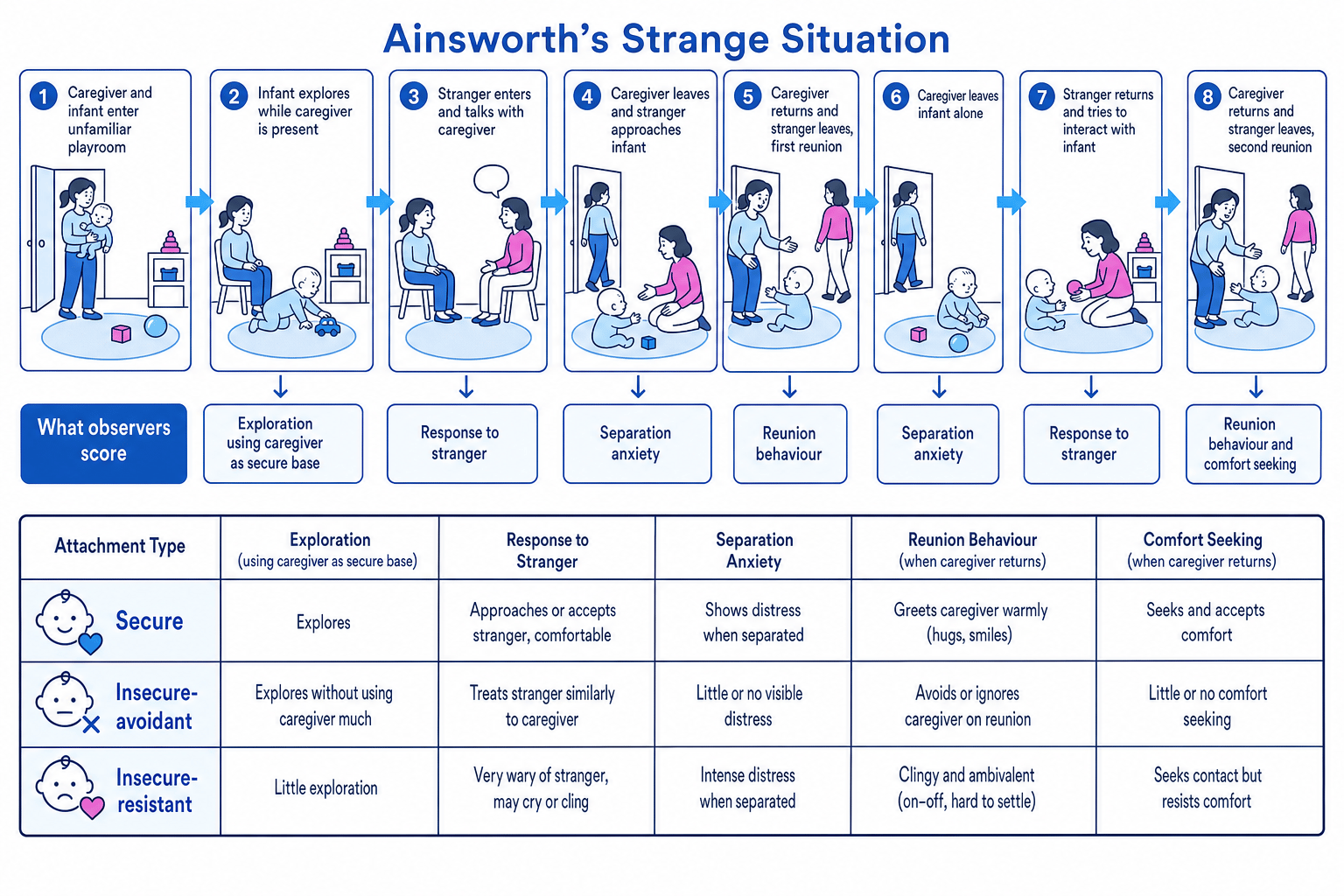
What researchers observe
Ainsworth was especially interested in how infants behave when the attachment system is activated — in other words, when the child feels uncertain, anxious or in need of comfort.
Exploration and secure-base behaviour
This means how confidently the infant explores toys and the room when the caregiver is present. A securely attached child usually explores, but still checks back with the caregiver.
Stranger anxiety
Stranger anxiety is distress or wariness shown towards an unfamiliar person. It is not automatically “bad” — some wariness can show that the infant distinguishes between the caregiver and a stranger.
Separation anxiety
Separation anxiety is distress when the caregiver leaves. Securely attached infants often show some distress, because the caregiver matters to them.
Reunion behaviour
Reunion behaviour is how the infant responds when the caregiver returns. This is often the most important evidence because it shows whether the caregiver is used for comfort.
The reunion is the big clue
In the Strange Situation, the most diagnostic moment is usually the reunion, because attachment is about whether the infant seeks and accepts comfort from the caregiver after stress.
The Strange Situation procedure
The full procedure has eight short episodes, usually lasting around three minutes each. Episodes can be shortened if the infant becomes too distressed.
| Episode | What happens | What is mainly observed |
|---|---|---|
| 1 | Caregiver and infant enter an unfamiliar playroom | Settling into the room |
| 2 | Infant explores while caregiver is present | Exploration and secure-base behaviour |
| 3 | Stranger enters and talks to caregiver | Stranger anxiety |
| 4 | Caregiver leaves; stranger interacts with infant | Separation anxiety and response to stranger |
| 5 | Caregiver returns; stranger leaves | First reunion behaviour |
| 6 | Caregiver leaves infant alone | Separation anxiety |
| 7 | Stranger returns and tries to comfort infant | Whether stranger can comfort the infant |
| 8 | Caregiver returns; stranger leaves | Second reunion behaviour and comfort seeking |
Researchers record the infant’s behaviour systematically, often using video or observers behind a screen. This makes the Strange Situation more controlled than everyday observation.
The three main attachment types
Ainsworth identified three main attachment types: secure, insecure-avoidant, and insecure-resistant. These are sometimes labelled Type B, Type A and Type C.
Type B: secure attachment
A securely attached infant uses the caregiver as a secure base. They explore when the caregiver is present, show some distress when the caregiver leaves, and are pleased when the caregiver returns.
They usually seek comfort and are relatively easy to soothe.
Ainsworth linked secure attachment with sensitive caregiving, where the caregiver responds appropriately and consistently to the infant’s needs.
Type A: insecure-avoidant attachment
An insecure-avoidant infant shows little visible distress when the caregiver leaves and avoids or ignores the caregiver on reunion.
They may appear independent, but this does not necessarily mean they are emotionally secure. The key feature is that they do not strongly seek comfort from the caregiver.
Ainsworth linked avoidant attachment with caregivers who may be rejecting, emotionally unavailable or discouraging of closeness.
Type C: insecure-resistant attachment
An insecure-resistant infant shows intense distress when the caregiver leaves, explores very little, and behaves ambivalently on reunion.
Ambivalent behaviour
Ambivalent means showing mixed or conflicting behaviour, such as wanting contact with the caregiver but also resisting comfort or pushing them away.
A resistant infant may cling to the caregiver but also cry, struggle or resist being soothed. Ainsworth linked this pattern with inconsistent caregiving, where the caregiver is sometimes responsive but sometimes unavailable.
Judging from separation distress only
Do not classify attachment just by how upset the infant is when the caregiver leaves. A secure infant may cry during separation. The stronger evidence is how the infant behaves when the caregiver returns.
Classifying an attachment pattern
A 13-month-old explores the room but does not look back at the caregiver much. When the caregiver leaves, the infant shows little visible distress. When the caregiver returns, the infant turns away and continues playing. The infant does not seek to be picked up and treats the stranger almost like the caregiver.
-
Compare the exploration behaviour: the infant explores, but does not use the caregiver much as a secure base, which weakens a secure classification.
-
Compare the separation response: little visible distress could fit insecure-avoidant, but it is not enough on its own because some infants vary in temperament.
-
Focus on reunion behaviour: turning away and not seeking contact strongly suggests avoidance of the caregiver.
-
Match the full pattern: low distress, little comfort seeking, and ignoring the caregiver on reunion are the clearest signs of insecure-avoidant attachment.
Ainsworth’s findings
In Ainsworth et al.’s (1978) American sample, about two-thirds of infants were classified as secure. Insecure-avoidant attachment was less common, and insecure-resistant attachment was the least common of the three.
Be careful: these percentages describe Ainsworth’s sample, not all children everywhere. Later research found cultural differences in how infants behave in the Strange Situation.
AO3 evaluation
Strength: controlled and standardised
The Strange Situation is a strength because it is a standardised procedure. Every infant experiences the same sequence of events, so researchers can compare behaviour across infants.
This helps reliability because observers can use the same behavioural categories, such as separation anxiety and reunion behaviour.
Strength: useful real-world applications
Ainsworth’s work helped psychologists understand the importance of caregiver sensitivity. This has influenced parenting advice, childcare practice and interventions that support caregiver-infant relationships.
For example, if a child struggles to seek comfort, professionals may focus on helping caregivers respond more sensitively and consistently.
Weakness: artificial setting
The Strange Situation takes place in an unfamiliar laboratory playroom. This gives control, but it may reduce ecological validity, meaning the findings may not fully reflect attachment behaviour in everyday life.
Some infants may react to the room, the toys or the stranger rather than only to separation from the caregiver.
Weakness: cultural bias
Ainsworth’s original research was based mainly on American families. Later cross-cultural research, such as van IJzendoorn and Kroonenberg (1988), found that secure attachment was generally the most common type, but the rates of avoidant and resistant attachment varied between cultures.
For example, in cultures where infants are rarely separated from caregivers, the Strange Situation may create unusually high distress. In cultures that encourage independence, avoidant behaviour may be more common and not necessarily unhealthy.
Useful AO3 phrase
You can say the Strange Situation may involve an imposed etic: applying one culture’s idea of “normal” attachment to other cultures where child-rearing practices are different.
Weakness: temperament may affect behaviour
Ainsworth interpreted Strange Situation behaviour as evidence of attachment quality. However, Kagan (1982) argued that temperament — an infant’s biologically influenced emotional style — may also affect behaviour.
For example, a naturally anxious infant may become highly distressed even with sensitive caregiving, while a calmer infant may show little distress.
Weakness: not all infants fit the three categories
Main and Solomon (1986) later identified disorganised attachment, where infants show confused, contradictory or frozen behaviours. This suggests Ainsworth’s three categories may not capture all attachment patterns.
Not a diagnosis
The Strange Situation is a research tool, not a quick diagnosis of a child or caregiver. A single observation should be interpreted carefully alongside wider evidence.
Ethics
The Strange Situation deliberately causes mild stress, so ethical safeguards matter. Under the BPS Code of Ethics and Conduct (2009), researchers should consider informed consent from the caregiver, the infant’s protection from harm, the right to withdraw, confidentiality and debriefing.
The procedure is usually justified because the separations are brief and similar to everyday experiences, but researchers should stop the procedure if the infant becomes too distressed.
In the exam
-
For AO1, describe the Strange Situation as a controlled observation with separations, reunions, a stranger and an unfamiliar room.
-
For AO2, classify attachment from a pattern of behaviours, especially reunion behaviour and comfort seeking.
-
For AO3, balance strengths such as standardisation and applications with weaknesses such as artificiality, cultural bias, temperament and ethics.
Check yourself
- Why is reunion behaviour usually more important than separation distress?
- What behaviours would suggest insecure-resistant attachment?
- Give one methodological strength and one cultural limitation of the Strange Situation.
