What you'll learn
- How psychologists compare attachment types across different cultures.
- Why the Strange Situation may not mean exactly the same thing everywhere.
- How cross-cultural findings link to the nature–nurture debate in development.
- How to evaluate this research for AO3: methodology, ethics, bias and real-world use.
The basics: what is attachment?
An attachment is a close, emotional bond between an infant and a caregiver, usually shown through behaviours like seeking comfort, staying near the caregiver and becoming distressed when separated.
Attachment
Attachment is an enduring emotional bond between an infant and caregiver that helps the infant feel safe, especially when anxious, tired or threatened.
In Ainsworth et al.’s (1978) Strange Situation, infants were observed during brief separations and reunions with their caregiver. This led to three main attachment types, meaning categories of attachment behaviour.
| Attachment type | Typical behaviour in the Strange Situation |
|---|---|
| Secure | Explores when caregiver is present, shows distress when separated, is comforted on reunion |
| Insecure-avoidant | Shows little visible distress on separation and avoids or ignores caregiver on reunion |
| Insecure-resistant | Very distressed on separation, seeks contact on reunion but resists comfort |
What is cross-cultural research?
Culture means the shared values, beliefs, customs and everyday practices of a group of people. These can affect caregiving: for example, whether independence, obedience, constant closeness or early separation is encouraged.
Cross-cultural research
Cross-cultural research compares people from different cultural groups to see whether a behaviour is universal or shaped by cultural experience.
In attachment research, psychologists ask:
- Are the same attachment types found across the world?
- Is secure attachment the most common type everywhere?
- Do different caregiving practices lead to different attachment behaviours?
- Is attachment mainly shaped by nature, nurture, or both?
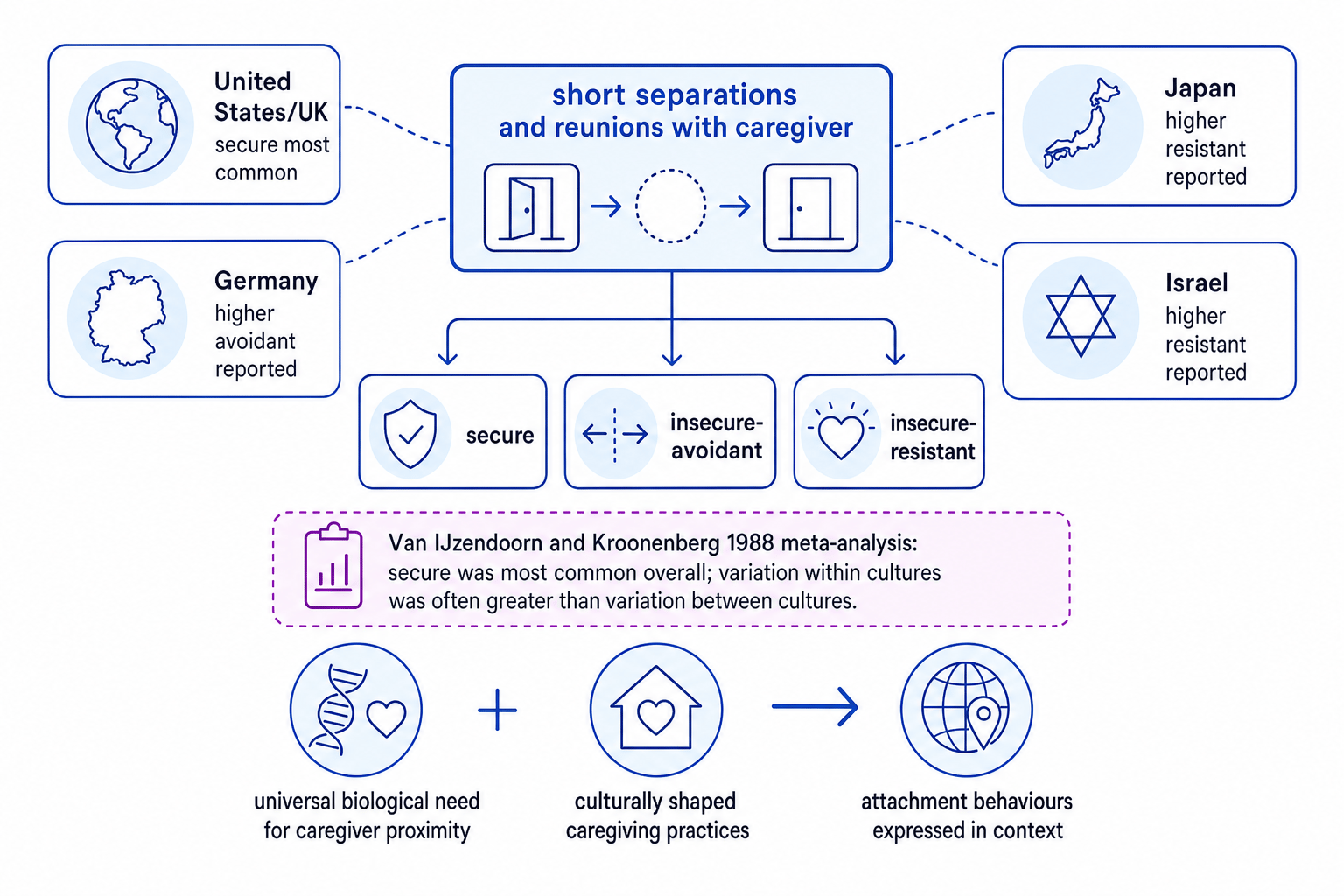
This diagram gives you the “big picture” of how the Strange Situation is used in cross-cultural attachment research.
Van IJzendoorn and Kroonenberg (1988): the key research
A major piece of evidence is Van IJzendoorn and Kroonenberg’s (1988) meta-analysis.
Meta-analysis
A meta-analysis is a study that combines the findings of many previous studies to look for overall patterns in the data.
Van IJzendoorn and Kroonenberg analysed 32 Strange Situation studies from eight countries, involving nearly 2,000 infants. They found that secure attachment was the most common type overall, which supports the idea that attachment may have a universal biological basis.
However, there were also cultural differences:
- Germany showed a relatively high proportion of insecure-avoidant attachment.
- Japan and Israel showed a relatively high proportion of insecure-resistant attachment.
- Differences within cultures were often greater than differences between cultures.
Main finding
Secure attachment appears to be common across cultures, but the way infants show attachment can vary depending on cultural caregiving practices.
Explaining the cultural patterns
The findings make more sense when you link infant behaviour to everyday caregiving.
In Germany, some researchers argued that independence is encouraged earlier, so infants may appear more avoidant in the Strange Situation. This does not necessarily mean German caregivers are less caring. Avoidant behaviour may be more culturally acceptable because independence is valued.
In Japan, Takahashi (1990) found that infants showed more distress and resistant behaviour. One explanation is that Japanese infants in the sample were rarely separated from their mothers, so the Strange Situation separation may have been especially stressful and unfamiliar.
In Israeli kibbutz studies, such as Sagi et al. (1985), higher resistant attachment was linked to communal child-rearing arrangements, where children were cared for by multiple adults and may have experienced different patterns of reunion and separation.
Assuming different means worse
Do not write that higher avoidant or resistant attachment in a culture automatically means “poorer parenting”. In the exam, explain that the same behaviour may have different meanings in different cultural contexts.
Nature and nurture in attachment
The nature–nurture debate asks whether development is mainly caused by biological factors or by environmental experience.
Nature and nurture
Nature refers to biological and genetic influences, such as evolved behaviours. Nurture refers to environmental influences, such as parenting, learning, culture and social experience.
Cross-cultural attachment research supports an interactionist view. This means nature and nurture work together rather than separately.
The nature side
Bowlby’s evolutionary theory suggests infants are biologically prepared to form attachments because attachment promotes survival. If an infant stays close to a caregiver, they are more likely to be protected, fed and comforted.
The fact that secure attachment is found across many cultures supports this idea. It suggests infants everywhere may have a universal need for caregiver proximity and emotional security.
The nurture side
Cultural differences in avoidant and resistant attachment suggest the environment also matters. Infants learn how to behave based on caregiver responses and cultural routines.
For example, if a culture encourages early independence, an infant may learn to show less obvious distress. If a culture involves very close mother–infant contact and few separations, separation in the Strange Situation may produce stronger distress.
Applying nature and nurture to a cross-cultural finding
A researcher finds that Japanese infants in a Strange Situation study show more insecure-resistant behaviour than American infants.
-
First, compare the behaviour with the procedure: insecure-resistant infants show high distress during separation and difficulty being comforted on reunion, so the finding is about how infants respond to separation and reunion.
-
Next, apply nurture: if infants in that cultural context are rarely separated from their mothers, the Strange Situation may be unusually stressful, increasing distress and contact-seeking.
-
Then apply nature: the distress still shows a universal attachment system — the infant seeks caregiver closeness when threatened.
-
Finally, reach an interactionist conclusion: the need for attachment may be biological, but the way attachment is expressed is shaped by cultural caregiving practices.
Methodological evaluation
Strength: standardised procedure
The Strange Situation is highly standardised. This means the same sequence of separations, reunions and observations can be used in different countries. That makes comparisons easier and improves reliability, meaning consistency of measurement.
Strength: large-scale evidence
Van IJzendoorn and Kroonenberg’s meta-analysis used data from many studies rather than relying on one small sample. This gives a broader picture than a single study and increases confidence that secure attachment is common across cultures.
Weakness: imposed etic
An etic approach studies behaviour from outside a culture, looking for universal patterns. An imposed etic happens when researchers apply a method or concept from one culture to another culture where it may not fit.
Imposed etic
An imposed etic is when a researcher assumes that a behaviour or test has the same meaning in every culture, even though it may be culturally specific.
The Strange Situation was developed in the United States. It assumes that separation and reunion behaviour reveals attachment quality. But in cultures where infants are rarely separated, distress may reflect unfamiliarity rather than insecure attachment.
Weakness: samples may not represent whole cultures
Many studies use small, urban or middle-class samples. It is risky to treat one sample as representing an entire country. For example, “Japanese attachment” or “German attachment” may hide major differences linked to region, social class, childcare arrangements and family structure.
A strong AO3 phrase
Instead of saying “cultures are different”, say: there may be greater variation within a culture than between cultures, so national averages can be misleading.
Weakness: cultural bias and ethnocentrism
Ethnocentrism means judging other cultures by the standards of your own culture. In attachment research, this can happen if secure attachment as measured in American samples is treated as the “best” or “normal” pattern everywhere.
This matters because behaviours like independence, clinginess or emotional restraint may be valued differently across cultures.
Ethics in cross-cultural attachment research
Attachment studies often involve infants, so ethical care is essential. Under the BPS Code of Ethics and Conduct (2009), researchers should consider:
- Consent: parents or guardians must give informed consent.
- Protection from harm: separations should be brief and stopped if distress becomes too high.
- Right to withdraw: caregivers should be able to end participation at any time.
- Confidentiality: family data should be anonymised.
- Debrief: caregivers should be told the purpose of the study and reassured about what the classifications mean.
Meta-analyses such as Van IJzendoorn and Kroonenberg (1988) do not directly test infants, but researchers still have a responsibility to avoid culturally insensitive conclusions or stereotypes.
Real-world applications
Cross-cultural attachment research is useful because it encourages psychologists, teachers, social workers and healthcare professionals to be culturally sensitive.
For example, a practitioner should not assume that a child is insecurely attached simply because they appear very independent or very distressed during separation. They need to consider the child’s cultural background, caregiving history and everyday experiences.
This research can also improve advice for childcare, adoption and early years support by reminding professionals that there is no single “one-size-fits-all” model of ideal caregiving.
Pulling it together for essays
For AO1, describe the Strange Situation, attachment types and Van IJzendoorn and Kroonenberg’s main findings.
For AO2, apply the findings to a scenario. If a child from a culture with rare mother–infant separation becomes very distressed, link this to cultural experience rather than immediately labelling the attachment as poor.
For AO3, evaluate whether the Strange Situation is valid across cultures, whether samples are representative, whether the meta-analysis gives strong evidence, and whether conclusions risk cultural bias.
In the exam
-
Start with the overall finding: secure attachment is most common across cultures, suggesting a universal element.
-
Then add nuance: avoidant and resistant patterns vary, and within-culture variation may be greater than between-culture variation.
-
For evaluation, avoid judging cultures as “better” or “worse”; focus on validity, imposed etic, sampling and culturally sensitive interpretation.
Check yourself
- Why might the Strange Situation not measure the same thing in every culture?
- How does Van IJzendoorn and Kroonenberg’s research support both nature and nurture?
- What is the difference between cultural variation and cultural bias?
