What you'll learn
- How Pavlov’s dog experiments demonstrated classical conditioning.
- The difference between unconditioned and conditioned stimuli and responses.
- How to apply the process to examples such as phobias and learned emotional responses.
- How to evaluate Pavlov’s research using AO3 points: control, objectivity, ethics, and generalisability.
The big idea: learning by association
Before Pavlov, many psychologists focused on behaviour that seemed automatic or biological. Pavlov showed that some automatic responses can become linked to new stimuli through experience.
Classical conditioning
Classical conditioning is learning through association, where a neutral stimulus becomes able to produce a reflex response after being repeatedly paired with a stimulus that naturally produces that response.
In Pavlov’s case, the reflex response was salivation. Dogs naturally salivate when food is placed in their mouths. Pavlov found that dogs could learn to salivate to a sound, such as a bell or metronome, if that sound had been repeatedly paired with food.
Core takeaway
Classical conditioning explains how an organism learns that one stimulus predicts another. The learned behaviour is not chosen deliberately; it is an automatic response triggered by association.
Pavlov’s starting point: reflexes
A reflex is an automatic, involuntary response to a stimulus. For example, salivating when food enters the mouth is reflexive because the dog does not need to think about it.
Stimulus and response
A stimulus is something in the environment that triggers behaviour. A response is the behaviour or bodily reaction that follows the stimulus.
For Pavlov, the key stimulus was food powder. The key response was salivation.
The classical conditioning terms
You need to be very secure with these labels because many exam questions test whether you can apply them accurately.
Unconditioned stimulus and unconditioned response
Unconditioned stimulus and unconditioned response
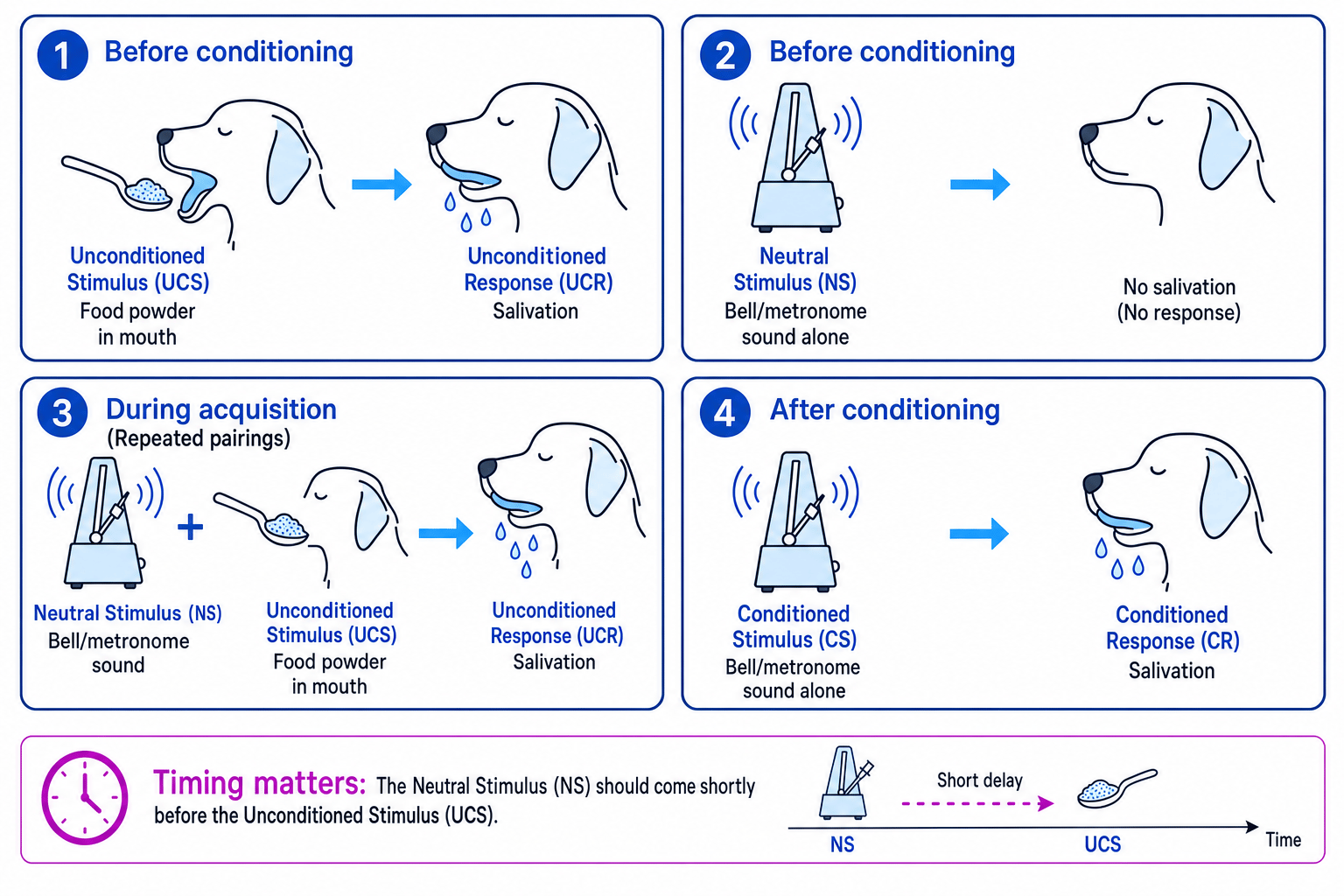
An unconditioned stimulus, or UCS, is a stimulus that naturally produces a response without learning. An unconditioned response, or UCR, is the automatic response produced by the UCS.
In Pavlov’s experiment:
- Food powder was the unconditioned stimulus.
- Salivation to food was the unconditioned response.
The word unconditioned means “not learned”. The dog does not need training to salivate when food is placed in its mouth.
Neutral stimulus
Neutral stimulus
A neutral stimulus, or NS, is a stimulus that does not initially produce the target response.
Before conditioning, the sound of the bell or metronome was neutral because it did not naturally make the dog salivate.
Conditioned stimulus and conditioned response
Conditioned stimulus and conditioned response
A conditioned stimulus, or CS, is a previously neutral stimulus that produces a learned response after association with the UCS. A conditioned response, or CR, is the learned response to the CS.
After repeated pairings, the sound became the conditioned stimulus, and salivation to the sound became the conditioned response.
Mixing up UCR and CR
The UCR and CR may look the same — both are salivation — but they are triggered by different stimuli. Salivation to food is the UCR; salivation to the bell or metronome is the CR.
Pavlov’s procedure
Pavlov was originally studying digestion, not learning. He surgically attached apparatus to dogs so that saliva could be collected and measured. This allowed him to record the amount of salivation objectively.
His conditioning procedure can be described in three stages.
Stage 1: Before conditioning
Food naturally produced salivation. The bell or metronome did not.
- Food powder → salivation.
- Bell/metronome alone → little or no salivation.
Stage 2: During conditioning
Pavlov repeatedly presented the bell or metronome shortly before giving the dog food powder.
This stage is called acquisition.
Acquisition
Acquisition is the stage of classical conditioning where the association between the neutral stimulus and the unconditioned stimulus is being learned.
The timing matters. The neutral stimulus should usually come just before the unconditioned stimulus, so the animal learns that it predicts what is about to happen.
Stage 3: After conditioning
Eventually, the bell or metronome alone caused salivation.
This showed that the dog had learned an association between the sound and food.
Remember the order
The usual sequence is: NS + UCS → UCR, then after repeated pairings, CS → CR.
Labelling Pavlov’s conditioning stages
- Identify the stimulus that naturally causes the response. In Pavlov’s study, food naturally causes salivation, so food is the UCS.
- Identify the response that happens automatically before learning. Salivation to food is automatic, so it is the UCR.
- Identify the stimulus that originally does not cause the target response. The bell/metronome originally does not cause salivation, so it is the NS.
- After repeated pairings with food, the sound now causes salivation by itself. The sound is now the CS, and salivation to the sound is the CR.
What Pavlov found
Pavlov found that dogs could be conditioned to salivate to a stimulus that previously had no special meaning. This supported the idea that learning can happen through association between stimuli.
This was important because it suggested behaviour could be studied scientifically by observing measurable responses.
Why Pavlov matters
Pavlov’s study provided evidence that learning can be explained through observable stimulus-response links, which became a foundation of the behaviourist approach.
Extinction, spontaneous recovery, generalisation and discrimination
Pavlov’s work also links to several extra concepts that often appear in classical conditioning questions.
Extinction
Extinction
Extinction occurs when the conditioned stimulus is repeatedly presented without the unconditioned stimulus, causing the conditioned response to weaken or disappear.
For example, if the bell is repeatedly sounded without food, the dog gradually stops salivating to the bell.
Spontaneous recovery
Spontaneous recovery
Spontaneous recovery is the reappearance of a conditioned response after a rest period, even after extinction has occurred.
This means learning may not be completely erased. It may simply be suppressed for a while.
Stimulus generalisation
Stimulus generalisation
Stimulus generalisation occurs when a response learned to one stimulus is also shown to similar stimuli.
A dog conditioned to salivate to one tone might also salivate to a similar tone.
Stimulus discrimination
Stimulus discrimination
Stimulus discrimination occurs when an organism learns to respond to one stimulus but not to similar stimuli.
A dog might learn to salivate to one specific tone but not to a different tone.
Applying conditioning to a phobia
- Find the natural fear-producing event. If a child is bitten by a dog, the bite is the UCS because it naturally produces fear.
- Identify the automatic reaction. The fear caused by the bite is the UCR.
- Identify the originally neutral stimulus. Before the bite, dogs may have been neutral and not frightening.
- After the dog is associated with the painful bite, dogs become the CS.
- If the child now feels fear when seeing a dog, that fear is the CR.
- If the child becomes scared of all dogs, not just the one that bit them, this shows stimulus generalisation.
AO1: How to describe Pavlov clearly
For AO1, you need accurate description. A strong answer should include:
- Pavlov’s study used dogs and measured salivation.
- Food powder was the UCS and naturally produced salivation, the UCR.
- A bell or metronome began as a neutral stimulus.
- The neutral stimulus was repeatedly paired with food.
- After conditioning, the sound alone produced salivation.
- The sound became the CS and salivation to the sound became the CR.
You do not need to tell the whole history of Pavlov’s career. Focus on the learning process.
AO2: Applying Pavlov to behaviour
Classical conditioning can explain behaviours where a person or animal develops an automatic emotional or physiological response because of association.
Examples include:
- fear of dogs after being bitten;
- anxiety in a classroom after repeated embarrassment;
- feeling hungry when hearing a lunch bell;
- feeling relaxed when hearing music associated with calm experiences.
AO2 often rewards using the labels correctly. If a scenario says someone becomes anxious when they hear a dentist’s drill, you should identify what was originally neutral, what naturally caused fear or pain, and what now triggers the learned response.
AO2 shortcut
When applying classical conditioning, ask: What naturally caused the response first? What was paired with it? What now causes the response by itself?
AO3: Evaluating Pavlov’s study
Strength: high control
Pavlov’s experiment was carried out in a controlled laboratory setting. He could control the timing of the bell or metronome and the presentation of food. This makes it easier to establish a cause-and-effect relationship between the pairing of stimuli and the salivation response.
This is useful for Psychology because it shows learning can be investigated scientifically rather than just guessed from everyday observation.
Strength: objective measurement
Pavlov measured salivation using apparatus rather than relying on subjective interpretation. This improves reliability because another researcher could repeat the procedure and compare the amount of saliva produced.
In AO3, this is stronger than simply saying “it was scientific”. Explain what made it scientific: control, measurement, and replicability.
Weakness: generalisability to humans
Pavlov used dogs, so there is a question about whether the findings apply fully to humans. Humans have more complex cognition, language, expectations, and social experiences. This means classical conditioning may explain some automatic responses, such as phobias, but it may not explain all human behaviour.
Overclaiming classical conditioning
Do not write as if classical conditioning explains every behaviour. It is best for reflexive or emotional responses, but it is weaker for complex behaviours involving reasoning, planning, or conscious choice.
Weakness: artificial setting
The laboratory setting gave Pavlov control, but it may reduce ecological validity. Dogs in the real world are not usually exposed to carefully timed bells and food powder in a controlled apparatus. This means the procedure may not fully represent how learning happens naturally.
However, this criticism should be balanced: artificial control was useful because Pavlov was testing a precise learning mechanism.
Ethical issues
Pavlov’s dogs were restrained and had surgical procedures to collect saliva. By modern standards, this raises concerns about animal welfare and protection from harm.
The BPS Code of Ethics and Conduct (2009) is written for human participants, so issues such as informed consent, right to withdraw, confidentiality, and debrief do not apply straightforwardly to dogs. However, the broader ethical principle of protection from harm is highly relevant. Modern animal research would need strong justification, careful welfare monitoring, and consideration of alternatives.
Ethics and animals
Avoid saying “there were no ethical issues because they were animals”. Animal research still raises serious ethical concerns, especially around harm, restraint, and whether the scientific value justifies the procedure.
Real-world applications
Pavlov’s work helps explain and treat some learned emotional responses. For example, phobias can develop through association and may be treated using therapies based on learning principles.
One example is systematic desensitisation, where a person gradually learns to associate the feared object with relaxation instead of anxiety. This is not Pavlov’s own study, but it shows why classical conditioning has practical value.
Application value
Pavlov’s findings matter because they helped psychologists understand how fears and other automatic responses can be learned — and therefore potentially unlearned.
In the exam
- Use the conditioning labels precisely: UCS → UCR, then NS + UCS, then CS → CR.
- For AO2 scenarios, identify the original natural trigger before deciding what became the conditioned stimulus.
- For AO3, balance strengths such as control and objective measurement with weaknesses such as animal ethics and limited generalisability.
Check yourself
- In Pavlov’s study, what were the UCS, UCR, NS, CS, and CR?
- Why is salivation to food not called a conditioned response?
- How could Pavlov’s findings be used to explain the development of a phobia?
