In classical conditioning, organisms learn by making passive associations between stimuli. However, we do not just react to our environment—we active operate upon it. This is where operant conditioning comes in. Developed by B.F. Skinner, this theory explains how our voluntary actions are shaped, maintained, and modified by the consequences that follow them.
What you'll learn
- The fundamental difference between classical and operant conditioning.
- How to distinguish between positive/negative reinforcement and positive/negative punishment.
- The mechanics of primary vs. secondary reinforcement, and different schedules of reinforcement.
- How to critically evaluate the strengths and limitations of operant conditioning in explaining human behaviour.
1. What is Operant Conditioning?
Operant conditioning is a theory of learning that proposes behaviour is a function of its consequences. If an action is followed by a desirable consequence, we are more likely to repeat it. If it is followed by an undesirable consequence, we are less likely to repeat it.
Operant Conditioning
Operant conditioning is a form of learning in which behaviour is shaped, maintained, or weakened by its consequences (reinforcement or punishment).
The pioneer of this theory, B.F. Skinner (1938), argued that learning is an active process. To study this scientifically, he designed the Skinner Box (an operant conditioning chamber). Inside this highly controlled chamber, a rat or pigeon would learn to press a lever or peck a disc to receive a food reward (reinforcement) or to turn off a painful electric grid on the floor (escape/avoidance learning).
2. Reinforcement vs. Punishment
Students frequently struggle to distinguish the different types of consequences. To master this topic, you must separate the terms into two independent decisions:
- Does the consequence make the behaviour more likely or less likely to happen again?
- If it increases the frequency of the behaviour, it is reinforcement.
- If it decreases the frequency of the behaviour, it is punishment.
- Does the consequence involve adding something or taking something away?
- If a stimulus is added (presented), it is positive (+).
- If a stimulus is removed (taken away), it is negative (-).
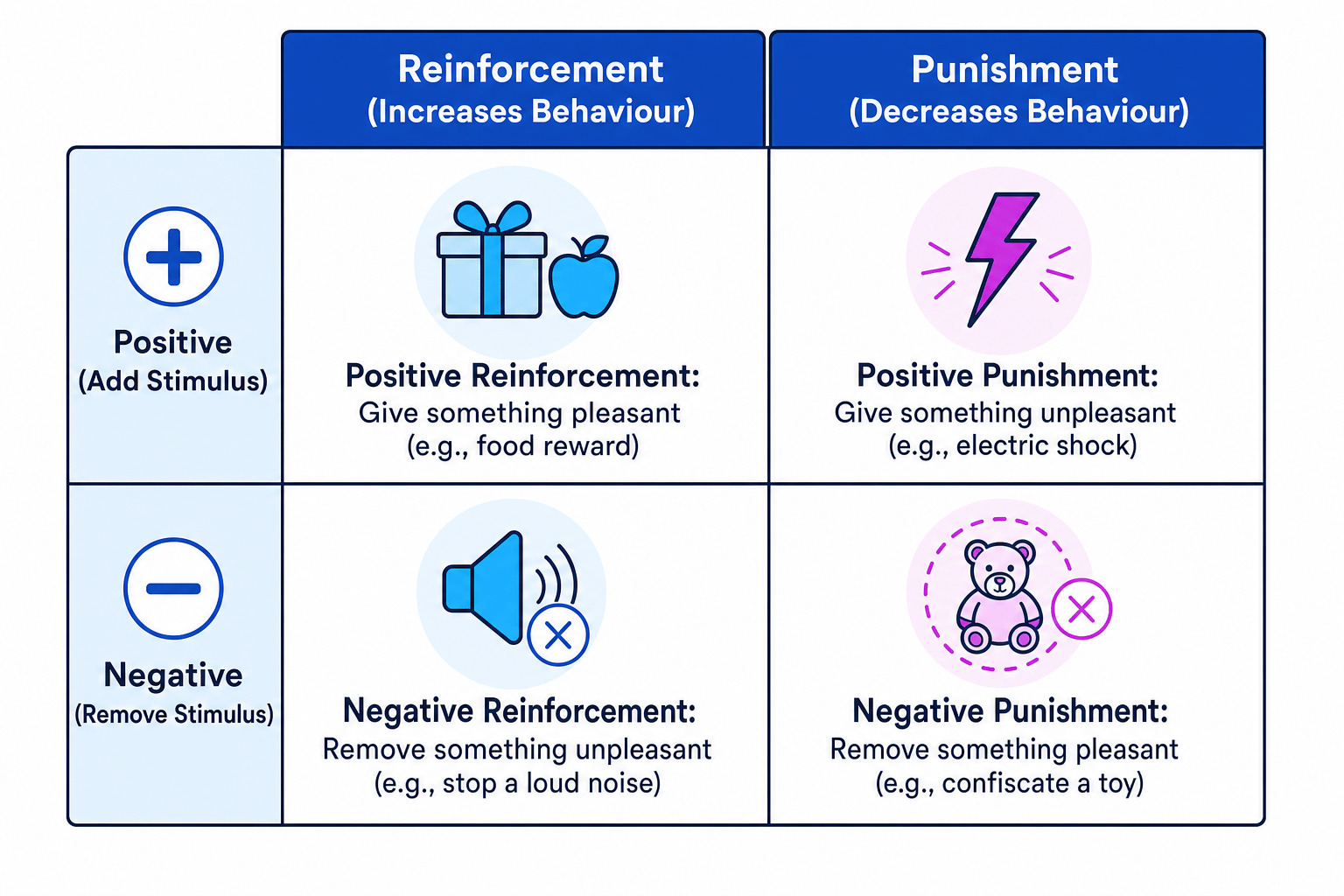
The Four Quadrants Explained
- Positive Reinforcement (+ R): Increasing a behaviour by presenting a pleasant/desirable stimulus immediately after the behaviour occurs.
- Example: A dog sits on command and is given a treat. The sitting behaviour increases.
- Negative Reinforcement (- R): Increasing a behaviour by removing or avoiding an unpleasant/aversive stimulus when the behaviour occurs.
- Example: You put on your seatbelt to stop the annoying beeping noise in your car. The seatbelt-wearing behaviour increases.
- Positive Punishment (+ P): Decreasing a behaviour by presenting an unpleasant/aversive stimulus immediately after the behaviour occurs.
- Example: A student talks out of turn and is verbally scolded by the teacher. The talking-out-of-turn behaviour decreases.
- Negative Punishment (- P): Decreasing a behaviour by removing a pleasant/desirable stimulus immediately after the behaviour occurs.
- Example: A teenager breaks curfew, so their parents confiscate their phone for a week. The curfew-breaking behaviour decreases.
Negative Reinforcement is NOT Punishment
Students almost always confuse negative reinforcement with punishment. Remember: reinforcement always increases behaviour, while punishment always decreases behaviour. "Negative" simply means something is subtracted or taken away. Negative reinforcement is a good thing for the individual because it removes an unpleasant state (like turning off a loud alarm or taking a painkiller to remove a headache).
3. Classifying Behavioural Scenarios
To secure top AO2 marks in your exams, you must be able to apply these four quadrants to novel scenarios.
Classifying consequences in behavioral scenarios
A parent confiscates their child's video game console because the child was fighting with their sibling. In the following weeks, the child fights with their sibling significantly less. Classify this consequence.
- Identify the target behaviour: The target behaviour is "fighting with their sibling".
- Determine if the behaviour is increasing or decreasing: The scenario states the child fights "significantly less". Because the frequency of the behaviour is decreasing, this is a form of punishment.
- Identify if a stimulus is being added or removed: The video game console (a pleasant, desirable stimulus) is being taken away/confiscated. This represents subtraction, which means it is negative.
- Combine the elements to state the final concept: Because a desirable stimulus was removed to decrease the target behaviour, this is an example of negative punishment.
4. Primary and Secondary Reinforcement
In your full A-Level, you need to understand that not all reinforcers are equal. Some are naturally rewarding, while others must be learned.
Primary Reinforcers
These are stimuli that are biologically, inherently reinforcing. They satisfy basic, survival-based needs.
- Examples: Food, water, warmth, sex, and sleep. You do not need to learn that food is rewarding when you are hungry; it is hardwired into your biology.
Secondary Reinforcers
These are stimuli that have no intrinsic biological value. They only become reinforcing because we have learned to associate them with primary reinforcers through classical conditioning.
- Examples: Money, grades, praise, and tokens.
- How they work: A £10 note is just a piece of paper, but we value it because it can be exchanged for primary reinforcers (like food or shelter).
Token Economy
Think of a arcade token. The plastic coin itself has zero value. You can't eat it, and it won't keep you warm. However, because you can trade the tokens at the counter for prizes (primary or strong secondary reinforcers), the tokens themselves become highly reinforcing. This is the core principle of behaviour modification programs in prisons and psychiatric hospitals.
5. Schedules of Reinforcement
How often and when we reinforce a behaviour has a massive impact on how fast it is learned, and how resistant it is to extinction (fading away).
Continuous Reinforcement
The behaviour is reinforced every single time it occurs.
- Effect: Fast learning (rapid acquisition), but very fast extinction if the reinforcement stops. If a vending machine stops giving you chocolate when you put money in, you will stop using it almost immediately.
Partial (Intermittent) Reinforcement
The behaviour is reinforced only some of the time. This creates a much stronger resistance to extinction. Partial schedules are broken down into four types:
| Schedule Type | Definition | Example | Behavioural Pattern |
|---|---|---|---|
| Fixed Interval (FI) | Reinforcement is delivered after a set, predictable amount of time has passed. | A weekly paycheck. | Behaviour drops off right after reinforcement, then speeds up dramatically as the time for the next reinforcer approaches. |
| Variable Interval (VI) | Reinforcement is delivered after unpredictable, changing periods of time. | Checking your phone for messages. | Produces a slow, steady, and highly consistent rate of response because you never know when the reward will arrive. |
| Fixed Ratio (FR) | Reinforcement is delivered after a set, predictable number of responses. | A coffee shop loyalty card (get a free coffee after buying 10). | Produces a high, rapid rate of response with only a brief pause after each reinforcement is delivered. |
| Variable Ratio (VR) | Reinforcement is delivered after an unpredictable, changing number of responses. | A slot machine (gambling). | Produces the highest rate of responding and is extremely resistant to extinction. The individual keeps responding because the "next turn could be the jackpot." |
6. Evaluating Operant Conditioning (AO3)
When writing an essay on operant conditioning, you must evaluate its strengths, limitations, and scientific validity.
Strengths
- Scientific and Objective Methodology: Skinner’s laboratory experiments utilized highly controlled environments (such as the Skinner Box). By manipulating the independent variable (consequences) and objectively measuring the dependent variable (frequency of responses), he established clear cause-and-effect relationships.
- Research Methods Integration: In studies comparing the effects of different reinforcement schedules, researchers gather quantitative data. For example, if we compare the total number of lever presses under a Fixed Ratio versus a Variable Ratio schedule, we can analyze the data using a Mann-Whitney U test (as it is an independent groups design analyzing ordinal data). We declare a statistically significant difference if our calculated UUU value is less than or equal to the critical value at the p≤.05p \le .05p≤.05 level.
- Real-World Applications: Operant principles have successfully shaped behaviour in society. Token economies are used in psychiatric wards and prisons to encourage pro-social behavior. In education, positive reinforcement (praise, merits) is used to manage classroom behaviour.
Limitations
- Environmental Determinism: Operant conditioning suggests that all human behaviour is entirely determined by external environmental consequences. This ignores the concept of free will and cognitive choice, suggesting that our sense of conscious decision-making is merely an illusion.
- Extrapolation from Animal Research: Much of the foundational evidence for operant conditioning comes from non-human animals (rats and pigeons). Critics argue that humans possess a far higher cognitive capacity, complex language, and moral reasoning, meaning our behaviour cannot be fully explained by the simple stimulus-response mechanisms observed in rodents.
- Ethical Issues: Animals in Skinner's research were deliberately kept hungry (deprived of food to ensure motivation) and subjected to stressful, noxious stimuli like electric shocks. This violates modern ethical standards regarding the protection of animals from psychological and physical harm.
In the exam
- Underline the verbs: When reading a scenario question, identify whether the behaviour was repeated (reinforcement) or ceased (punishment). This prevents you from confusing positive punishment with negative reinforcement.
- Define your terms: If a question asks you to apply operant conditioning to a scenario (AO2), always start your answer with a brief AO1 definition of the specific mechanism (e.g., define "negative reinforcement" before showing how the person in the scenario escaped an unpleasant situation).
- A-Level distinctions: If you are sitting the full A-Level, make sure to explicitly use advanced terminology. Refer to secondary reinforcers and specify if a behaviour is maintained on a variable ratio schedule when discussing real-world behaviours like gambling or video game addiction.
Check yourself
- Can you explain why taking an aspirin for a headache is an example of negative reinforcement rather than positive punishment?
- How does a secondary reinforcer (like money) acquire its power to shape behaviour?
- Why is a variable ratio schedule of reinforcement the most effective schedule for preventing behaviour from going extinct?
