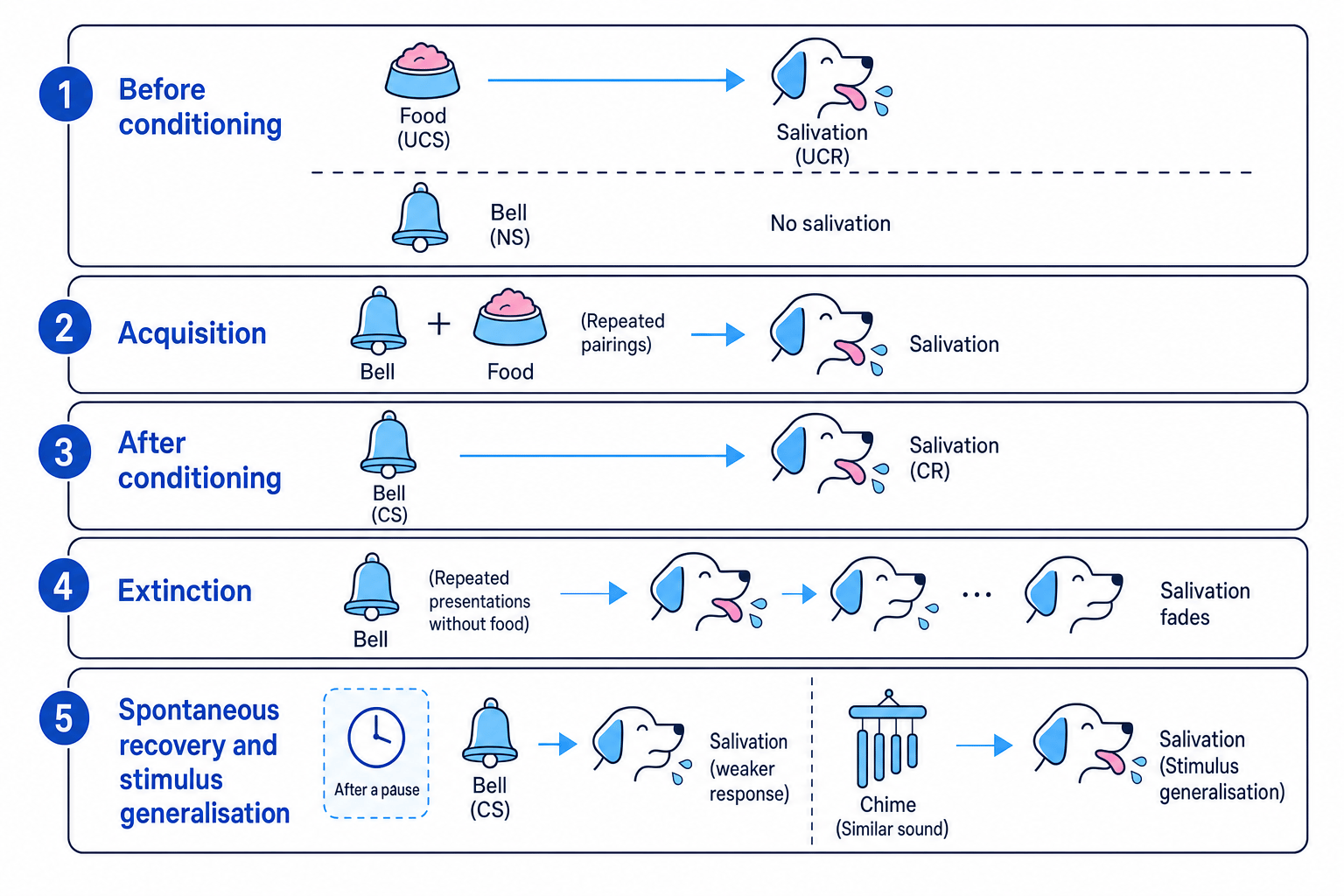
What you'll learn
- How classical conditioning explains learning through association.
- The difference between UCS, UCR, NS, CS and CR.
- What happens during extinction, spontaneous recovery and stimulus generalisation.
- How to apply these terms accurately to scenarios, especially phobias.
The starting point: learning by association
A stimulus is anything in the environment that can affect behaviour, such as food, a sound, a smell or a person. A response is the behaviour or reaction that follows, such as salivating, feeling fear or blinking.
Classical conditioning is one way psychologists explain how learning happens.
Classical conditioning
Classical conditioning is learning through association: a neutral stimulus is repeatedly paired with a stimulus that naturally produces a response, until the neutral stimulus produces a learned response on its own.
This approach is linked most strongly with Ivan Pavlov (1927), who studied dogs’ salivation. Pavlov noticed that dogs did not only salivate when food was placed in their mouths; over time, they began salivating to signals that predicted food.
The core idea
In classical conditioning, the learner does not choose a behaviour because of rewards or punishments. Instead, they form an association between two stimuli.
Before conditioning: natural responses
Some responses happen automatically before any learning has taken place. For example, food naturally causes salivation in a hungry dog. A loud unexpected noise may naturally cause fear or a startle response.
Unconditioned stimulus and unconditioned response
- The unconditioned stimulus (UCS) is a stimulus that naturally and automatically produces a response before learning.
- The unconditioned response (UCR) is the natural, automatic response to the UCS.
The word unconditioned means not learned. So, in Pavlov’s research, food was the UCS because it naturally produced salivation. Salivation to food was the UCR because the dog did not need to learn it.
The neutral stimulus
A neutral stimulus (NS) is a stimulus that does not initially produce the target response. In the classic Pavlov example, a bell or tone does not naturally make a dog salivate.
Neutral stimulus
A neutral stimulus (NS) is a stimulus that does not produce the target response before conditioning has taken place.
This is important: the neutral stimulus is not “meaningless” in every way. It just does not yet trigger the response being studied.
During conditioning: pairing the stimuli
The neutral stimulus is repeatedly presented just before, or at the same time as, the unconditioned stimulus. This repeated pairing is called acquisition, which means the learning phase when the association is being built.
In Pavlov’s example:
- Bell or tone = NS.
- Food = UCS.
- Salivation to food = UCR.
- Bell or tone is repeatedly paired with food.
Over time, the dog learns that the bell predicts food.
After conditioning: the learned response
Once conditioning has happened, the formerly neutral stimulus now triggers the response on its own.
Conditioned stimulus and conditioned response
- The conditioned stimulus (CS) is the formerly neutral stimulus that now produces a learned response.
- The conditioned response (CR) is the learned response to the CS.
The word conditioned means learned. So, after learning, the bell becomes the CS, and salivation to the bell becomes the CR.
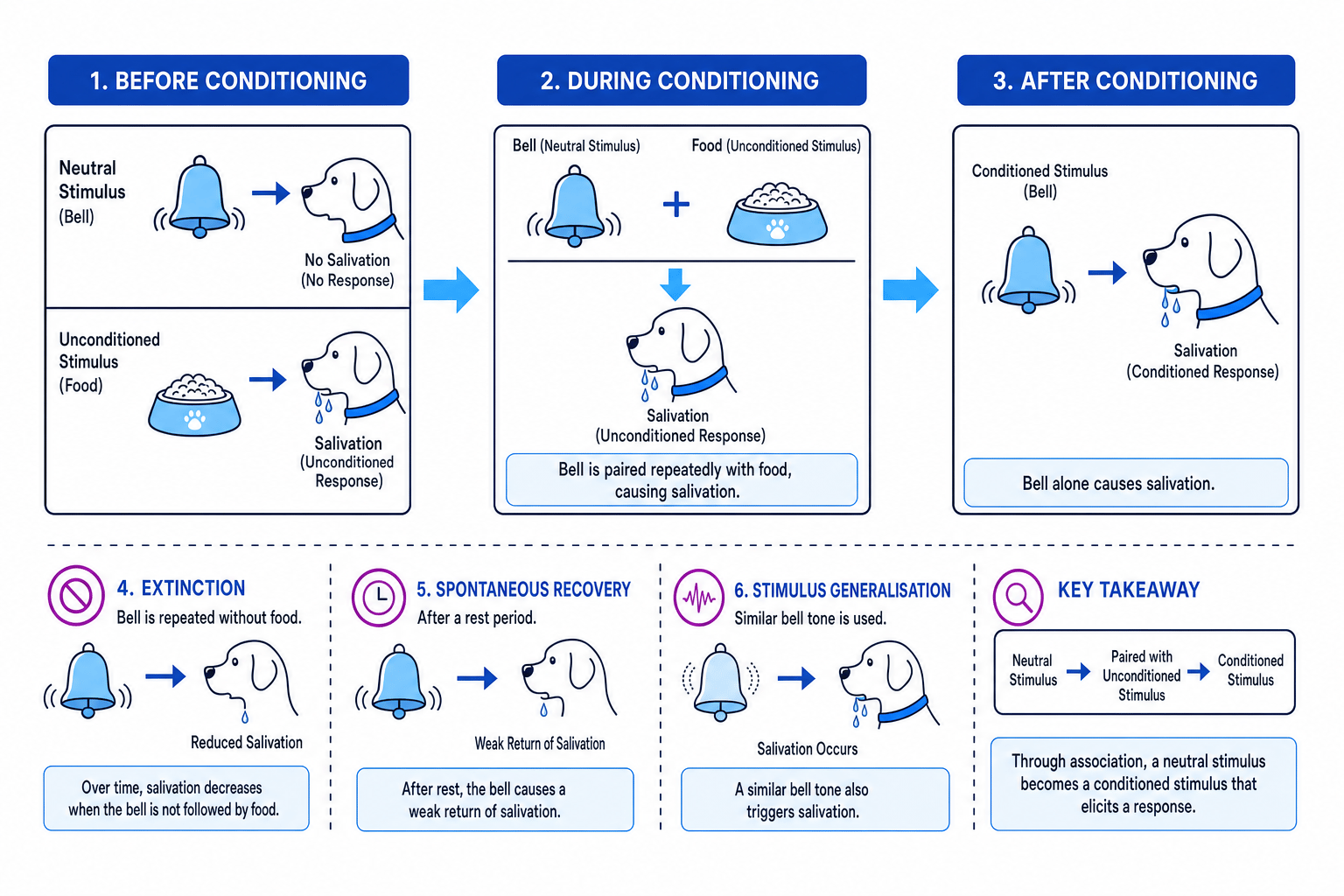
The diagram below shows the full sequence, including what can happen after learning has taken place.
Mixing up UCR and CR
The UCR and CR can look very similar, such as salivation or fear. Name the response according to what caused it: if food causes salivation, it is a UCR; if the bell causes salivation after learning, it is a CR.
Identifying conditioning components
A student is relaxed around needles at first. During a vaccination, the sharp pain of the injection makes them feel anxious. Later, simply seeing a needle makes them anxious.
- Identify the natural trigger before learning: the sharp pain naturally produces anxiety, so the pain is the UCS and the anxiety to pain is the UCR.
- Identify the stimulus that was originally neutral: the sight of the needle did not initially cause anxiety, so it begins as the NS.
- Apply the pairing: the needle is experienced at the same time as the painful injection, so the needle becomes associated with pain.
- Identify the learned outcome: the needle alone now causes anxiety, so the needle is the CS and anxiety to the needle is the CR.
Extinction: when the learned response fades
Conditioned responses are not always permanent. Extinction happens when the conditioned stimulus is repeatedly presented without the unconditioned stimulus, so the conditioned response gradually decreases.
Extinction
Extinction is the weakening or disappearance of the conditioned response after the conditioned stimulus is repeatedly presented without the unconditioned stimulus.
For example, if a bell is repeatedly sounded but no food follows, Pavlov’s dogs would gradually stop salivating to the bell.
This matters for clinical psychology because exposure-based treatments for phobias rely partly on this principle. If someone repeatedly encounters the feared stimulus safely, without the expected harm, the fear response may reduce.
Extinction is not simple forgetting
Extinction means the CS no longer predicts the UCS. It is better understood as new learning, not just the original association being erased.
Spontaneous recovery: when the response returns
After extinction, the conditioned response can sometimes reappear after a rest period. This is called spontaneous recovery.
Spontaneous recovery
Spontaneous recovery is the reappearance of a previously extinguished conditioned response after a period of time, without new pairing of the CS and UCS.
For example, a dog might stop salivating to the bell after extinction, but then salivate weakly when the bell is heard again the next day.
This helps explain why fears can sometimes return after seeming to improve. It does not mean extinction “failed”; it means the original association may still have some influence.
Stimulus generalisation: responding to similar stimuli
Stimulus generalisation occurs when a learned response is triggered by stimuli similar to the conditioned stimulus.
Stimulus generalisation
Stimulus generalisation is when a conditioned response occurs to stimuli that are similar to the original conditioned stimulus.
For example, if a child is bitten by one dog and later fears many dogs, they may be generalising from the original dog to similar animals. The more similar the new stimulus is to the original CS, the stronger the response is likely to be.
This was shown in a controversial classic study by Watson and Rayner (1920), who conditioned “Little Albert” to fear a white rat by pairing the rat with a loud noise. Albert later showed fear towards similar white, furry objects, which illustrates stimulus generalisation.
Distinguishing extinction, spontaneous recovery and generalisation
Mia learns to fear the dentist’s drill after a painful appointment. Later, she attends several check-ups where she hears the drill but nothing painful happens. Her fear reduces. After a few months away, she feels nervous again when she hears the drill. She also feels anxious when she hears a similar high-pitched hairdryer.
- The drill is repeatedly heard without pain, and Mia’s fear reduces, so this is extinction.
- The fear returns after a time gap without a new painful event, so this is spontaneous recovery.
- A similar sound, the hairdryer, also triggers anxiety, so this is stimulus generalisation.
AO2: applying classical conditioning to phobias
Classical conditioning is often used to explain how phobias may develop. A phobia is an extreme, irrational fear that interferes with everyday life.
For example, if a person has a frightening experience in a lift, the lift may become associated with panic. The lift begins as a neutral stimulus, the frightening event acts as the UCS, and fear is the UCR. After learning, the lift becomes the CS and fear in response to the lift becomes the CR.
In an essay, this is strong AO2 because you are not just defining terms — you are applying each label to a real scenario.
AO3: strengths and limitations
One strength of classical conditioning is that it is based on controlled scientific evidence. Pavlov’s work measured observable behaviour, such as salivation, making the theory more objective and replicable than explanations based only on internal thoughts.
Another strength is real-world application. Classical conditioning helps explain some phobias and supports treatments involving gradual safe exposure to feared stimuli.
However, classical conditioning may be too reductionist if used alone. Not all phobias begin with a clear traumatic pairing. Some fears may be influenced by biology, cognition or social learning, such as observing someone else’s fear.
There are also ethical issues. Watson and Rayner’s study would not meet modern ethical standards under the BPS Code of Ethics and Conduct (2009) because it involved distress in a young child. Modern research must consider informed consent, deception, right to withdraw, protection from harm, confidentiality and debriefing.
In the exam
- Use the labels precisely: UCS causes UCR naturally, while CS causes CR after learning.
- In scenario questions, identify the natural stimulus-response pair first, then work out what the neutral stimulus became.
- For evaluation, balance usefulness with limits: mention controlled evidence and applications, but also reductionism, individual differences and ethics.
Check yourself
- In Pavlov’s research, why is food called the UCS rather than the CS?
- How can the same behaviour, such as fear, be a UCR in one part of a scenario and a CR later?
- What is the difference between extinction, spontaneous recovery and stimulus generalisation?