What you'll learn
- How Atkinson and Shiffrin’s (1968) multi-store model explains memory as a flow of information through separate stores.
- The key features of sensory register, short-term memory and long-term memory.
- What psychologists mean by encoding, storage, retrieval, capacity and duration.
- How to evaluate the model using research evidence and counter-evidence.
The starting point: what is memory?
Memory is not just “remembering things”. In psychology, memory is treated as a set of mental processes that allow information to be taken in, held, and later used.
Memory
Memory is the psychological process of encoding information, storing it over time, and retrieving it when needed.
Atkinson and Shiffrin (1968) proposed the multi-store model of memory, often shortened to MSM. It is called “multi-store” because it argues that memory is made up of several separate stores, each with different features.
The big idea
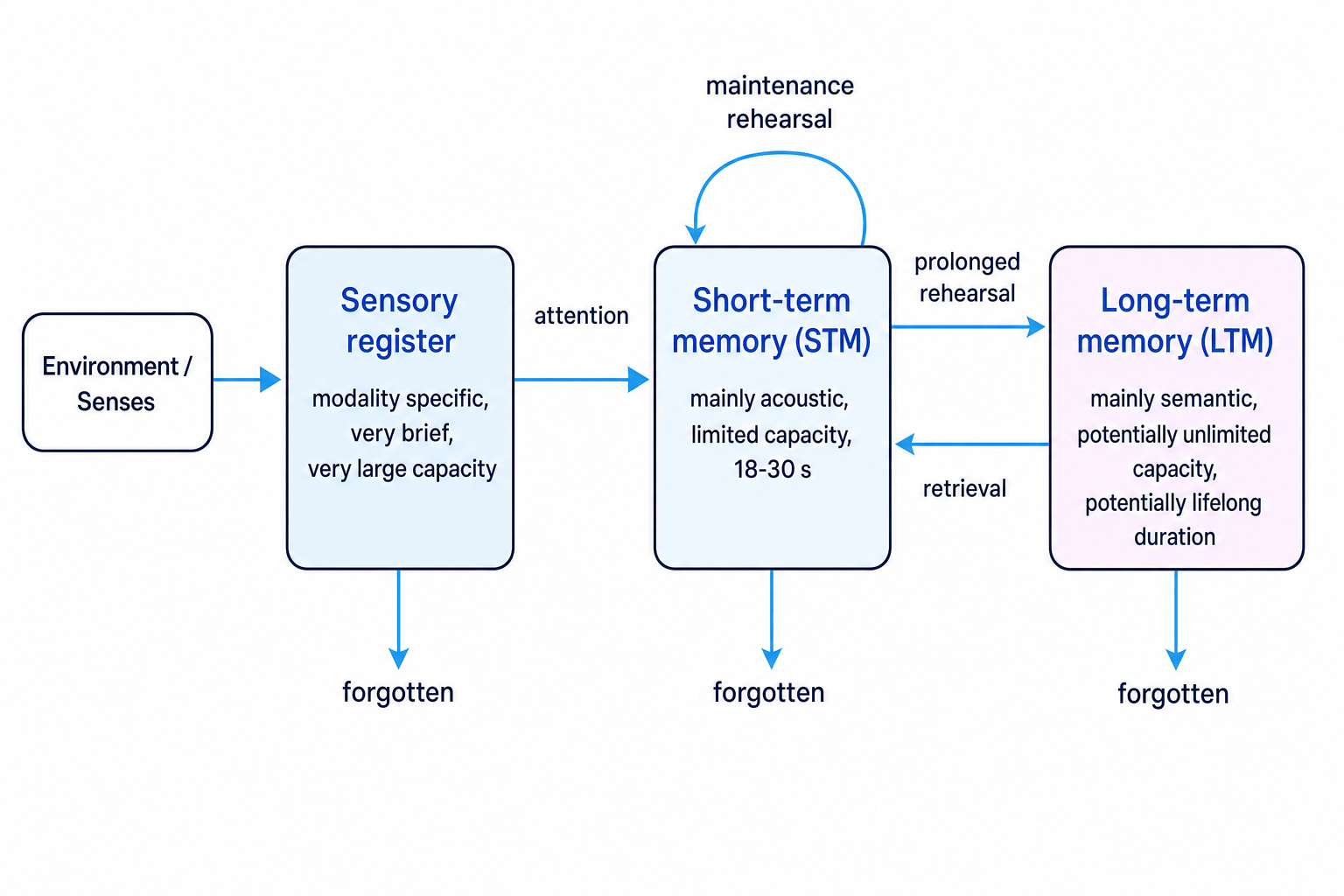
The multi-store model sees memory as a linear information-processing system: information enters through the senses, may pass into short-term memory, and can then be transferred into long-term memory through rehearsal.
Information processing: the basic language
Before the full model, you need four key terms.
Encoding, storage and retrieval
Encoding means changing information into a form the memory system can use. Storage means keeping that information over time. Retrieval means accessing stored information when you need it.
For example, if you hear the word “psychology”, you might encode it acoustically — by how it sounds. If you later remember what it means, you are retrieving it.
Two more terms describe the limits of each memory store.
Capacity and duration
Capacity is how much information a memory store can hold. Duration is how long information can remain in that store.
The full multi-store model
Atkinson and Shiffrin’s model has three main stores:
- Sensory register
- Short-term memory, or STM
- Long-term memory, or LTM
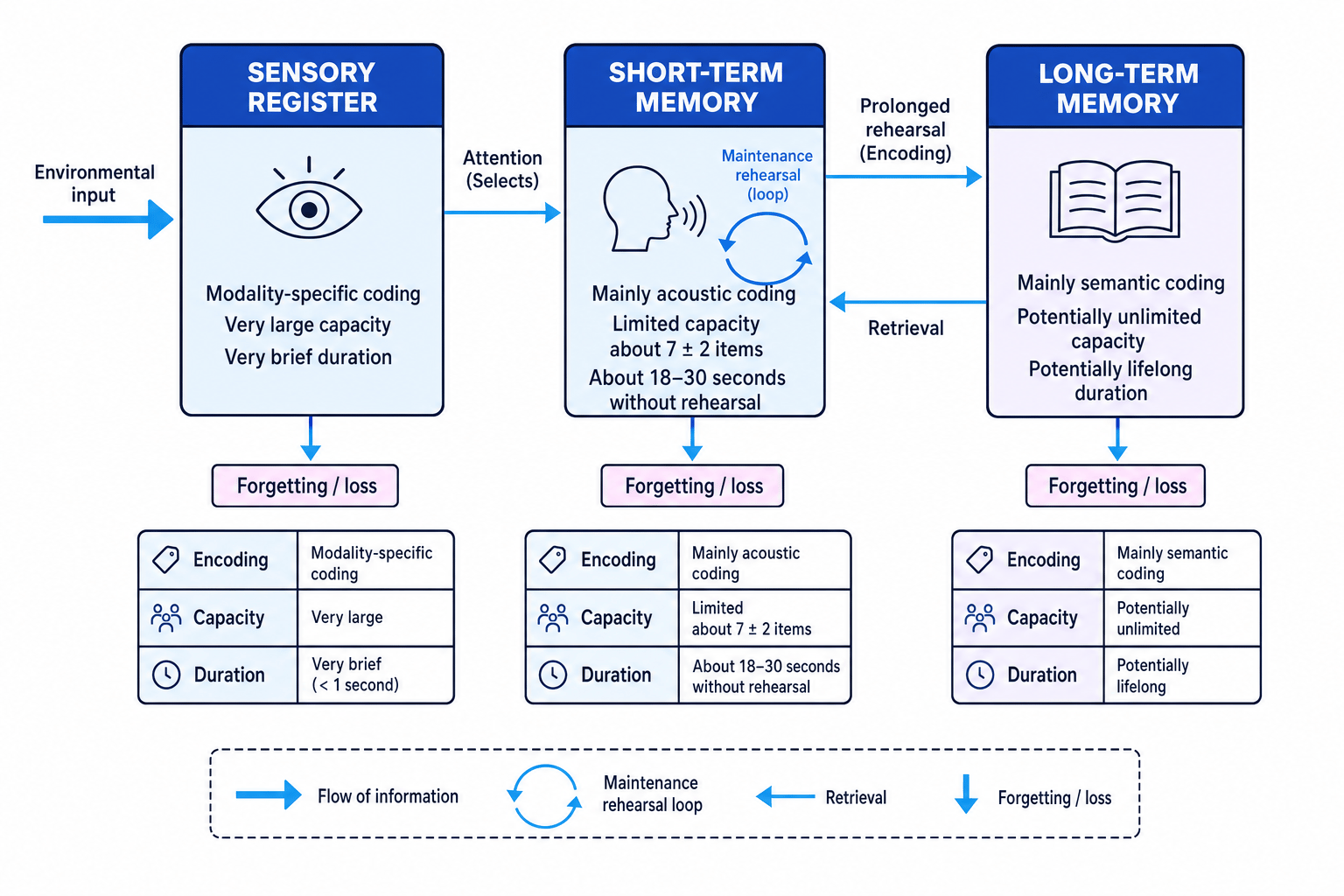
Information does not automatically reach long-term memory. The model says it must pass through stages, and it can be lost at each stage.
Store 1: sensory register
The sensory register is the first memory store. It briefly holds information from the environment through the senses, such as sight, sound, touch, taste and smell.
Sensory register
The sensory register is a very brief memory store that holds raw sensory information for a fraction of a second before it is either attended to or lost.
The sensory register has:
- Encoding: modality-specific, meaning the coding depends on the sense involved, such as visual coding for sights or acoustic coding for sounds.
- Capacity: very large, because your senses take in a huge amount of information at once.
- Duration: very brief, usually less than a second for visual information.
Most sensory information disappears quickly. Only information you pay attention to moves into short-term memory.
Attention
Attention is the process of selecting some information for further processing while ignoring other information.
Assuming everything reaches STM
A lot of information never reaches short-term memory at all. In the MSM, attention is the filter that allows selected sensory information to move into STM.
Store 2: short-term memory
Short-term memory is the temporary store for information you are currently aware of and actively using.
Short-term memory
Short-term memory, or STM, is a temporary memory store with limited capacity and brief duration, used for information currently being processed.
STM has:
- Encoding: mainly acoustic, meaning information is often coded by sound.
- Capacity: limited, often described as around 7±27 \pm 27±2 items, based on Miller’s (1956) research.
- Duration: about 18–30 seconds without rehearsal, supported by Peterson and Peterson’s (1959) findings.
For example, if someone reads you a phone number and you repeat it in your head, the number is being held in STM.
Rehearsal: keeping information active
Rehearsal means repeating information so it stays in short-term memory for longer.
Rehearsal
Rehearsal is the repetition of information. In the multi-store model, maintenance rehearsal keeps information in STM, while prolonged rehearsal can transfer it to LTM.
Atkinson and Shiffrin suggested that the more information is rehearsed, the more likely it is to enter long-term memory.
There are two useful phrases here:
- Maintenance rehearsal: repeating information to keep it in STM.
- Prolonged rehearsal: repeated rehearsal over time, which the MSM says transfers information to LTM.
Applying the model to a phone number
A friend tells you a phone number, but you forget it before saving it.
- The number first enters your sensory register as sound because you hear it from your friend.
- You pay attention to the number, so it moves into short-term memory and is mainly encoded acoustically.
- If you repeat the number in your head, you are using maintenance rehearsal, which keeps it active in STM.
- If you stop rehearsing before saving it, the number is likely to be lost because STM has a short duration of about 18–30 seconds without rehearsal.
- If you repeated the number many times and used it later, the model would predict that prolonged rehearsal could transfer it into long-term memory.
Store 3: long-term memory
Long-term memory is the store for information kept over long periods, from minutes to potentially a lifetime.
Long-term memory
Long-term memory, or LTM, is a relatively permanent memory store with potentially unlimited capacity and very long duration.
LTM has:
- Encoding: mainly semantic, meaning information is often coded by meaning.
- Capacity: potentially unlimited.
- Duration: potentially lifelong.
When you answer a psychology question in an exam, the knowledge is retrieved from LTM and brought back into STM so you can use it consciously.
Retrieval returns information to STM
In the MSM, information stored in LTM must be retrieved back into STM before you can actively think about it, say it, or write it down.
AO1 summary: describing the model clearly
For AO1, you need to describe the model accurately.
A strong description should say that Atkinson and Shiffrin (1968) proposed a linear model in which information flows from the sensory register to STM through attention, then from STM to LTM through rehearsal. Each store differs in encoding, capacity and duration. Information can be lost from any store if it is not attended to, rehearsed or successfully retrieved.
Easy AO1 structure
Use the order sensory register → STM → rehearsal → LTM → retrieval. Then add encoding, capacity and duration for STM and LTM.
AO2: applying the model
AO2 means using the theory to explain a situation.
If a student crams a definition the night before a test by repeating it over and over, the MSM would explain this as rehearsal. The definition is held in STM and may be transferred into LTM if rehearsal is prolonged enough. If the student cannot recall it in the exam, the model might suggest a retrieval failure or that the information was never securely transferred to LTM.
However, be careful: the MSM mainly emphasises repetition, but real learning often depends on meaning, organisation and understanding too.
AO3: evaluating the multi-store model
Strength: evidence for separate STM and LTM
One strength is that research supports a distinction between STM and LTM.
Baddeley (1966) found that short-term recall was worse for acoustically similar words, suggesting STM relies mainly on acoustic coding. Long-term recall was worse for semantically similar words, suggesting LTM relies mainly on semantic coding. This supports the MSM’s claim that STM and LTM are different stores with different forms of encoding.
Glanzer and Cunitz (1966) also found a serial position effect: people often remember words from the beginning and end of a list better than words in the middle. The primacy effect may show early words entering LTM through rehearsal, while the recency effect may show later words still being held in STM.
Strength: case study evidence
Case studies also support separate stores. For example, the patient HM, studied by Scoville and Milner (1957), could remember some information from before brain surgery but struggled to form new long-term memories. This suggests STM and LTM can be affected differently.
Shallice and Warrington (1970) studied patient KF, who had poor short-term memory for verbal information but relatively better long-term memory. This also challenges the idea that STM must always work normally for LTM to function.
Case studies are not automatically perfect evidence
Case studies can give rich detail about memory problems, but they often involve unusual individuals, so it can be difficult to generalise the findings to everyone.
Weakness: STM is probably too simple
The MSM describes STM as one single store. However, Baddeley and Hitch’s (1974) working memory model argues that short-term memory is more active and complex, with different components for different types of information.
This is a problem for the MSM because it treats STM as mainly acoustic and unitary. Patient KF is especially important here because his verbal STM was impaired more than his visual STM, suggesting STM is not just one simple store.
Weakness: LTM is probably too simple
The MSM also treats LTM as one store. However, Tulving (1972) argued that long-term memory includes different types, such as:
- Episodic memory: memory for personal events.
- Semantic memory: memory for facts and meanings.
- Procedural memory: memory for skills and actions.
This means the MSM may be too basic because it does not explain why someone might lose one type of long-term memory but keep another.
Weakness: rehearsal is not the whole story
The MSM says rehearsal is the main way information transfers from STM to LTM. But this is too limited.
Craik and Lockhart (1972) proposed the levels of processing approach, arguing that deep, meaningful processing leads to better long-term memory than shallow repetition. Craik and Tulving (1975) supported this by showing that semantic processing improved recall more than simply focusing on appearance or sound.
So, repeating information can help, but understanding it usually helps more.
Revision link
For your own revision, do not only repeat definitions. Add meaning: explain the idea in your own words, connect it to research evidence, and practise applying it to scenarios.
Methodological and ethical points
Much of the evidence for the MSM comes from controlled laboratory experiments, such as word-list recall tasks. This is useful because researchers can control extraneous variables and test specific parts of memory, such as duration or coding.
However, word-list tasks may lack ecological validity, meaning they may not fully represent memory in everyday life. Remembering a random list of syllables is not the same as remembering a meaningful conversation, a route to school, or a childhood event.
Ethically, memory research with human participants should follow the BPS Code of Ethics and Conduct (2009), including informed consent, right to withdraw, protection from harm, confidentiality and debriefing. Case studies of patients with brain damage require extra care because participants may be vulnerable and confidentiality is especially important.
In the exam
- For AO1, describe the flow of information: sensory register, attention, STM, rehearsal, LTM and retrieval.
- For AO2, apply the model to the exact scenario: identify where information is encoded, stored, rehearsed, forgotten or retrieved.
- For AO3, balance support with criticism: use evidence for separate stores, then challenge the model using working memory, types of LTM and levels of processing.
Check yourself
- What are the encoding, capacity and duration features of STM and LTM?
- How does rehearsal help information move through the multi-store model?
- Why do findings from Baddeley (1966), KF, and levels of processing challenge or support the model?