What you'll learn
- Why Baddeley and Hitch (1974) argued that short-term memory is not just one simple store.
- The roles of the central executive, phonological loop, visuo-spatial sketchpad, and episodic buffer.
- How dual-task evidence supports the model.
- How to evaluate the working memory model for Edexcel essay answers.
Starting point: what is “working memory”?
Working memory
Working memory is the part of memory used to hold and mentally manipulate information for a short time while you are doing a task, such as solving a problem, following directions, or reading a sentence.
Before Baddeley and Hitch, memory was often explained using the multi-store model proposed by Atkinson and Shiffrin (1968). That model described short-term memory, meaning a temporary store that holds a small amount of information for a brief period, and long-term memory, meaning a more permanent store with a very large capacity.
Baddeley and Hitch (1974) thought short-term memory was too active and complex to be one single store. They proposed the working memory model, which describes short-term memory as a system of separate but connected components.
The big idea
The working memory model sees short-term memory as an active workspace, not a passive box. Different parts deal with different types of information, such as speech sounds and visual images.
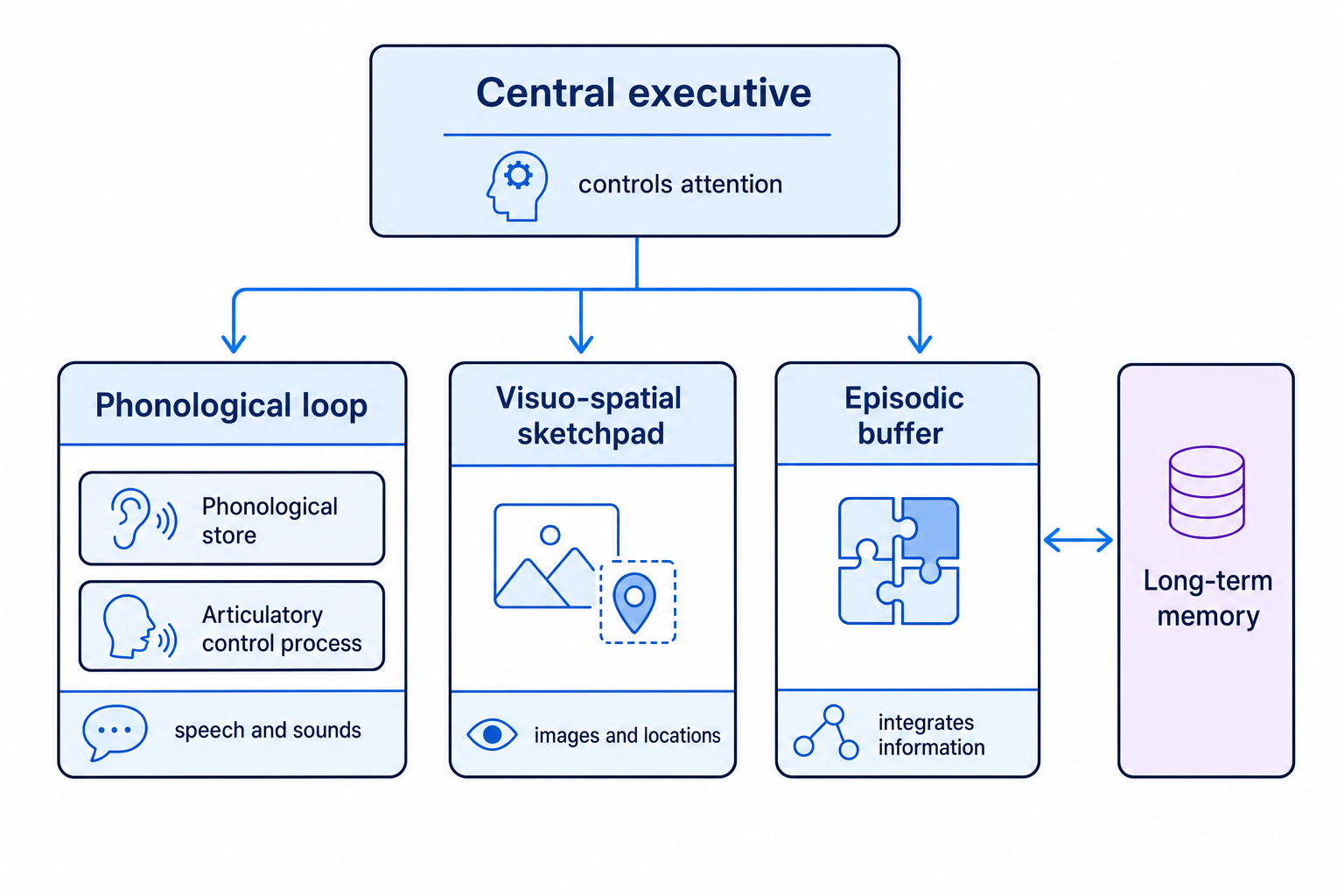
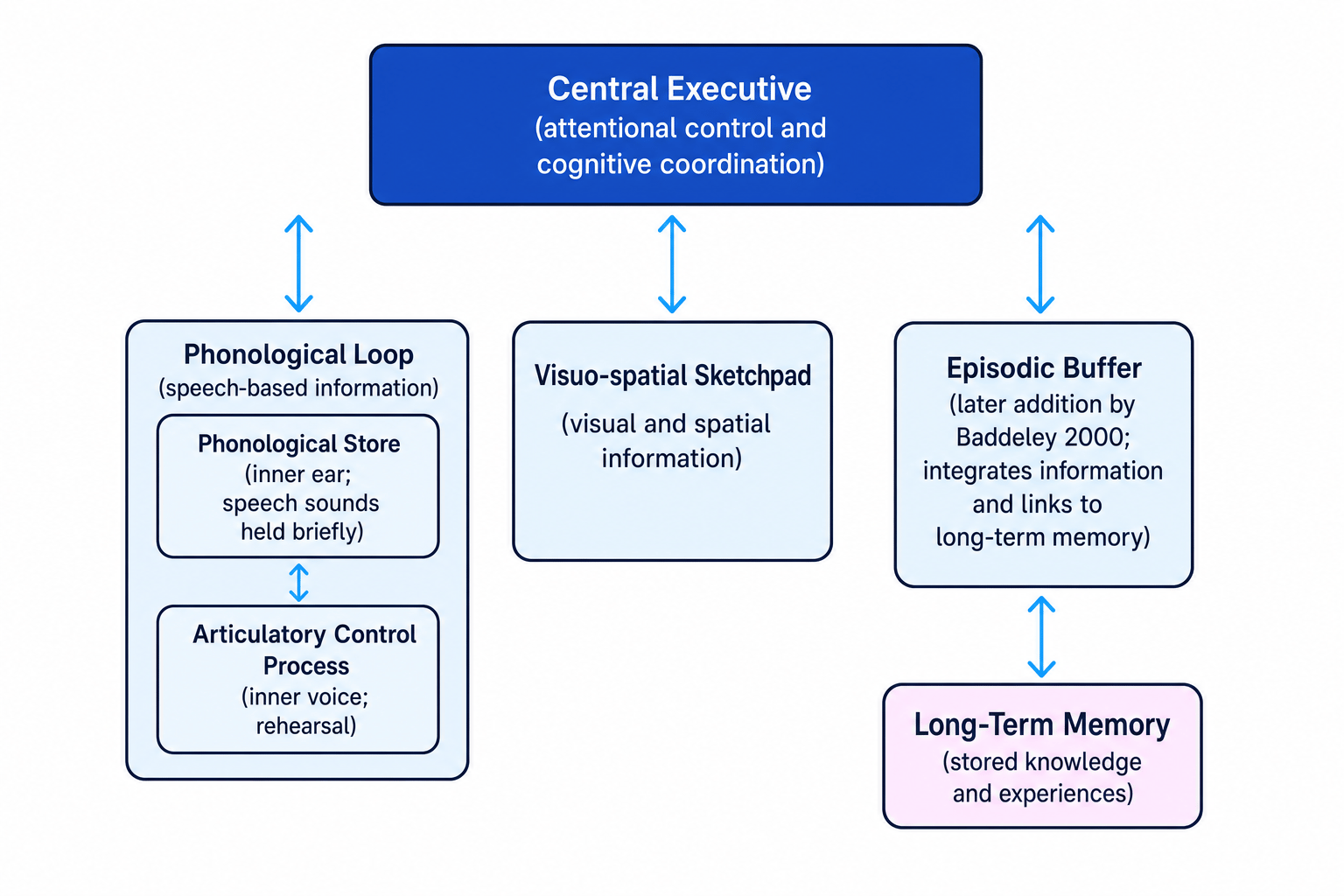
The diagram below shows the main structure of the model. The central executive controls attention, while the “slave systems” handle specific types of information.
Why was the model proposed?
Baddeley and Hitch (1974) used dual-task studies, where participants complete two tasks at the same time. If short-term memory were just one store, then doing two tasks together should always cause major interference.
Instead, they found that people could often do two tasks at once if the tasks used different kinds of processing. For example, a person might be able to do a verbal reasoning task while also holding a small number of digits in memory.
Dual-task study
A dual-task study is a research method where participants perform two tasks simultaneously, to see whether the tasks compete for the same mental resources.
This suggested that working memory has several components, rather than one general short-term store.
The central executive
Central executive
The central executive is the attentional control system in the working memory model. It directs attention, switches focus between tasks, and coordinates the other components.
The central executive is not mainly a storage system. Its job is more like management. It decides what you should pay attention to, suppresses irrelevant information, and allocates mental resources.
For example, if you are doing mental arithmetic while ignoring background noise, the central executive helps you stay focused on the calculation.
Strength of this idea
The central executive helps explain why some tasks are difficult even when they do not involve much storage. A task can be hard because it requires attention, planning, decision-making, or switching between steps.
Limitation of this idea
The central executive has been criticised as being vague. Early versions of the model did not fully explain how it controls attention. This makes it harder to test scientifically than more specific parts of the model.
Treating the central executive as a memory store
Do not describe the central executive as simply “holding information”. It mainly controls attention and coordinates the other systems.
The phonological loop
Phonological loop
The phonological loop is the part of working memory that temporarily holds and rehearses speech-based information, such as words, letters, and numbers.
The phonological loop has two subcomponents.
Phonological store
The phonological store briefly holds the sounds of words. It is sometimes called the “inner ear” because it stores what words sound like.
Articulatory control process
The articulatory control process refreshes verbal information through silent rehearsal. It is sometimes called the “inner voice” because it is like saying information to yourself in your head.
For example, if you repeat a phone number silently until you can type it in, you are using the articulatory control process.
Evidence for the phonological loop
Baddeley (1966) found that short-term recall is worse for words that sound similar, such as “cat”, “cap”, and “can”, than for words that sound different. This is called the phonological similarity effect, meaning sound-based similarity causes confusion in short-term recall.
Baddeley, Thomson and Buchanan (1975) also found the word length effect, meaning people recall short words better than long words. This supports the idea that verbal rehearsal is time-limited: longer words take longer to rehearse, so fewer can be maintained.
The visuo-spatial sketchpad
Visuo-spatial sketchpad
The visuo-spatial sketchpad is the part of working memory that temporarily holds and manipulates visual and spatial information.
Visual information refers to what something looks like, such as colour, shape, or pattern. Spatial information refers to where things are located and how they are arranged.
You use the visuo-spatial sketchpad when you imagine a route, rotate a shape in your mind, or remember where objects are on a desk.
For example, if someone says, “Picture your kitchen and count how many windows there are,” you are likely using the visuo-spatial sketchpad to form a mental image and inspect it.
The episodic buffer
Episodic buffer
The episodic buffer is a later addition to the working memory model, proposed by Baddeley (2000), which temporarily integrates information from different sources into a single meaningful episode.
The episodic buffer was not part of the original 1974 model. It was added because the original model struggled to explain how information from the phonological loop, visuo-spatial sketchpad, and long-term memory could be combined.
For example, when you understand a story, you combine spoken words, mental images, previous knowledge, and the order of events. The episodic buffer helps explain this integration.
Remember the components
Think: boss plus helpers. The central executive is the “boss” controlling attention; the phonological loop handles speech sounds; the visuo-spatial sketchpad handles images and locations; the episodic buffer binds information together.
Applying the components to a scenario
A student is silently repeating a revision definition while drawing a labelled diagram from memory.
- The repeated definition uses speech-based information, so it mainly uses the phonological loop.
- The diagram uses visual layout and spatial positioning, so it mainly uses the visuo-spatial sketchpad.
- Because the two tasks use different slave systems, the working memory model predicts less interference than if both tasks were verbal.
- The central executive is still needed to divide attention and coordinate both tasks, so performance may still drop if the tasks become demanding.
How dual-task evidence supports the model
Baddeley and Hitch (1974) asked participants to complete a reasoning task while also remembering strings of digits. Participants could still reason while holding some digits in memory, although performance became slower as the digit load increased.
This challenged the idea of one simple short-term memory store. If all short-term tasks used one limited store, the digit task should have blocked reasoning much more strongly. Instead, the results suggested that working memory has separate components and an attentional controller.
Predicting interference in a dual-task study
A participant has to remember a list of spoken letters while also repeating the word “the” again and again.
- Remembering spoken letters uses the phonological loop, because the material is speech-based.
- Repeating “the” uses the articulatory control process, because it occupies the inner voice needed for rehearsal.
- The two tasks compete for the same phonological system, so recall of the letters should become worse.
- This pattern supports the working memory model because interference depends on which component is being used, not just on whether there are two tasks.
AO2: applying the model
In scenario questions, look at the type of information being processed.
If the person is remembering sounds, words, letters, or numbers, apply the phonological loop. If they are imagining shapes, routes, faces, or locations, apply the visuo-spatial sketchpad. If they are planning, switching attention, ignoring distractions, or coordinating several tasks, apply the central executive.
For example, a driver following sat-nav instructions while checking road signs is using both verbal and visual-spatial processing. The central executive is needed to manage attention safely between the road, the spoken instructions, and decisions about where to turn.
AO3: strengths of the working memory model
It is more detailed than the multi-store model
A major strength is that the working memory model gives a more realistic account of short-term memory. It explains why people can sometimes multitask successfully, especially when tasks use different components.
This is an improvement on the multi-store model, which treated short-term memory as a more unitary store.
It has research support
There is experimental support from dual-task studies, including Baddeley and Hitch (1974). There is also evidence from verbal memory research, such as Baddeley (1966), which supports sound-based coding in short-term memory.
Neuropsychological evidence also supports separate components. For example, Shallice and Warrington (1970) described patient KF, who had brain damage and showed poor verbal short-term memory but better visual short-term memory. This suggests verbal and visual short-term memory can be affected separately.
It has useful real-world applications
The model can be applied to education, revision, driving, interface design, and support for people with memory difficulties. For example, teachers may avoid overloading the phonological loop by giving students both written diagrams and spoken explanations rather than too much verbal information at once.
AO3: weaknesses of the working memory model
The central executive is underspecified
A key criticism is that the central executive is not explained in enough detail. Saying that it “controls attention” is useful, but it does not fully explain the exact processes involved.
Later research has suggested that executive control may include several separate functions, such as inhibition, updating, and switching. This means the original model may be too simple.
Some evidence comes from artificial tasks
Many supporting studies use laboratory tasks such as digit recall, repeating words, or remembering letter strings. These tasks allow good control over variables, which is a methodological strength.
However, they may lack ecological validity, meaning they may not fully reflect how memory works in everyday life. Real-life tasks often involve emotion, motivation, prior knowledge, and meaningful context.
Case study evidence has limits
Patient evidence, such as KF, is useful because it shows what happens when particular cognitive abilities are damaged. However, case studies often involve one unusual individual, so findings may not generalise to everyone.
There are also ethical issues when studying brain-damaged patients. Researchers should follow the BPS Code of Ethics and Conduct (2009), including informed consent where possible, protection from harm, confidentiality, the right to withdraw, and debriefing.
The model has changed over time
The later addition of the episodic buffer by Baddeley (2000) is useful, but it also shows that the original 1974 model was incomplete. It did not fully explain how different types of information are combined with long-term memory.
Balanced evaluation
A strong essay should say that the working memory model is highly influential and well-supported, but not perfect: especially because the central executive is vague and some evidence comes from artificial laboratory tasks.
In the exam
- For AO1, describe the model as a multi-component active system, then explain the central executive, phonological loop, visuo-spatial sketchpad, and episodic buffer.
- For AO2, apply components to the scenario by identifying whether the information is verbal, visual-spatial, integrated, or attentional.
- For AO3, use evidence such as Baddeley and Hitch (1974), Baddeley (1966), and KF, then balance this with criticisms about the central executive, artificial tasks, and generalisability.
Check yourself
- Why did Baddeley and Hitch argue that short-term memory is not one single store?
- What is the difference between the phonological store and the articulatory control process?
- How would the working memory model explain difficulty doing two verbal tasks at the same time?