What you'll learn
- How Tulving (1972) divided long-term memory into episodic and semantic memory.
- How to classify memories in scenario questions without being tricked by wording.
- What evidence supports this distinction, including patient case studies and brain evidence.
- How to evaluate the explanation for AO3 essay points.
The starting point: long-term memory
Before Tulving, it is useful to remind yourself what long-term memory means. In memory psychology, information is usually discussed in terms of encoding — putting information into a usable form, storage — keeping it over time, and retrieval — accessing it later.
Long-term memory
Long-term memory (LTM) is the relatively permanent store of information that can last from minutes to a lifetime. It includes knowledge, personal experiences, skills, meanings and facts.
The key idea in this sub-topic is that LTM is not just one simple store. Tulving (1972) argued that conscious long-term memory can be divided into different systems.
Declarative memory
Declarative memory is memory that can be consciously brought to mind and “declared” or stated, such as facts or personal experiences. Episodic and semantic memory are both forms of declarative long-term memory.
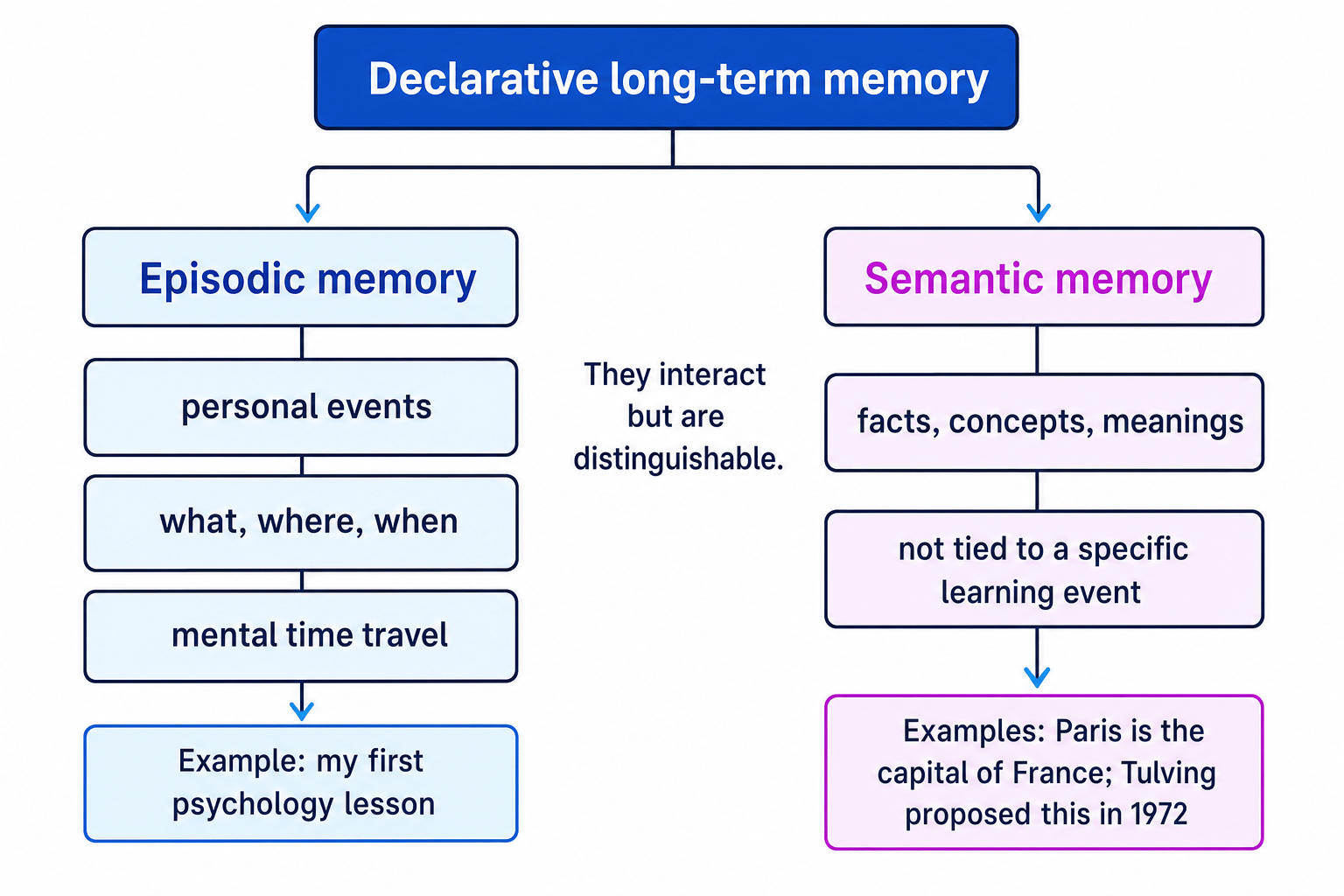
Tulving’s key move was to split conscious LTM into two related systems: episodic memory and semantic memory.
Tulving’s explanation of long-term memory
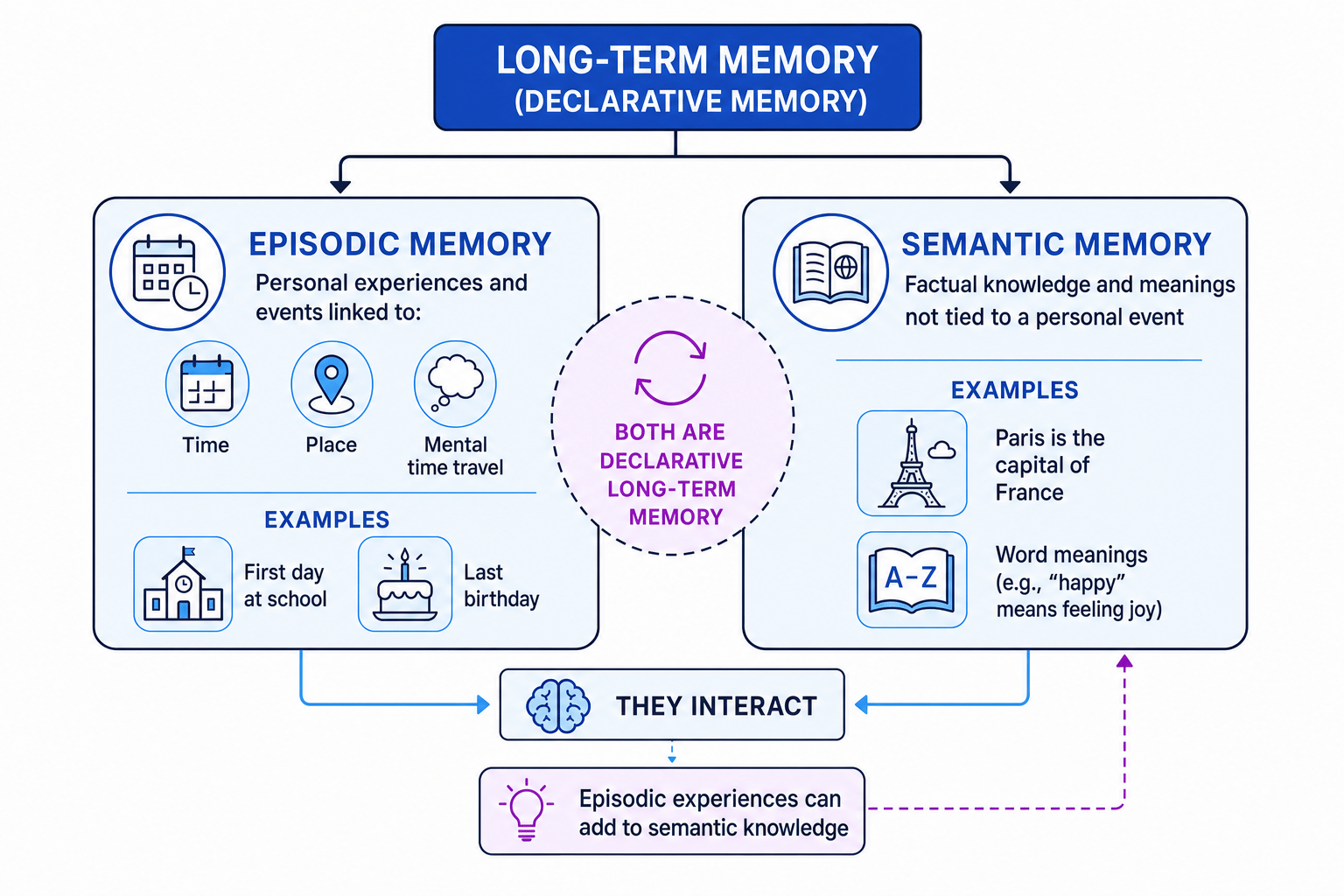
Tulving (1972) proposed that long-term memory is not unitary, meaning it is not one single, undivided store. Instead, different kinds of information are stored and retrieved in different ways.
The two types you need for Edexcel 9PS0 2.1.3 are:
- Episodic memory — memory for personally experienced events.
- Semantic memory — memory for facts, concepts and meanings.
The core distinction
Episodic memory is “remembering” an event you experienced; semantic memory is “knowing” information without needing to re-live when you learned it.
Episodic memory: personal events
Episodic memory
Episodic memory is long-term memory for personally experienced events, including information about what happened, where it happened and when it happened.
Episodic memories are often described as autobiographical because they relate to your own life story. For example, you might remember your first day at secondary school, a recent birthday meal, or walking into your first A-Level Psychology lesson.
Tulving later linked episodic memory to mental time travel, which means mentally placing yourself back into a past event. When you retrieve an episodic memory, you often have a sense of “I was there”.
Episodic memory is not a perfect video recording. It can be influenced by attention, emotion, later information and schemas — organised packets of knowledge and expectations.
Semantic memory: facts and meanings
Semantic memory
Semantic memory is long-term memory for factual knowledge, concepts and meanings that are not tied to a specific personal event.
Semantic memory includes things like knowing that Paris is the capital of France, knowing what the word “validity” means, or knowing that Tulving proposed episodic and semantic memory in 1972.
You may know these facts without remembering exactly when or where you learned them. That lack of a specific personal context is what makes them semantic rather than episodic.
A useful complication: facts about yourself can still be semantic. Knowing your date of birth, address or school name is usually semantic if you state it as knowledge rather than re-living a particular event.
Assuming all personal information is episodic
A memory is not episodic just because it is about you. Knowing your date of birth is semantic; remembering your last birthday party as an event is episodic.
Comparing episodic and semantic memory
| Feature | Episodic memory | Semantic memory |
|---|---|---|
| Main content | Personal experiences | Facts, concepts and meanings |
| Time and place | Usually linked to a specific context | Usually not tied to when/where learned |
| Conscious experience | “I remember being there” | “I know that” |
| Example | Remembering your first psychology lesson | Knowing what “episodic memory” means |
| Organisation | Often organised by time and personal context | Often organised by meaning and categories |
Classifying a memory description
A student says: “I remember sitting near the window in my first Psychology lesson, and I know that Tulving proposed episodic and semantic memory in 1972.”
- The first part is tied to a specific personal event: a particular lesson, location and perspective. This makes it episodic memory.
- The second part is a piece of factual knowledge that can be stated without re-living the lesson where it was learned. This makes it semantic memory.
- The whole statement contains both systems, so the strongest answer separates the event detail from the factual claim rather than forcing everything into one category.
How episodic and semantic memory interact
Although Tulving separated episodic and semantic memory, they are not completely isolated.
An episodic memory can help form semantic knowledge. For example, after several psychology lessons, individual classroom episodes may contribute to your general semantic knowledge of memory theory.
Semantic knowledge can also support episodic recall. If you know the layout of your school, that knowledge may help you reconstruct where you were during a particular event.
Quick classification check
Ask yourself: could this be written as a general fact in a textbook or encyclopaedia? If yes, it is probably semantic. If the person must mentally return to a unique event they experienced, it is probably episodic.
Evidence supporting Tulving’s distinction
Patient case studies
One strong source of evidence comes from people with amnesia, which means a serious impairment in memory, often after brain injury or illness.
Patient K.C., reported by Tulving and colleagues, had severe episodic memory problems after brain damage. He could not mentally re-experience personal events from his past, but he retained semantic knowledge. This supports the idea that episodic and semantic memory can be damaged separately.
Vargha-Khadem et al. (1997) also reported young people with hippocampal damage who had very poor episodic memory but could still develop language and factual knowledge. The hippocampus is a brain structure strongly involved in forming and retrieving memories.
Double dissociation
A double dissociation occurs when one ability is impaired while another is spared, and a different case shows the opposite pattern. It is strong evidence that two abilities rely on partly separate systems.
Using selective impairment as evidence
A patient cannot recall their last birthday party but can define the word “birthday” and state their date of birth.
- Not recalling the birthday party shows an impairment in memory for a personally experienced event, so this points to an episodic memory problem.
- Still understanding the concept of a birthday and knowing their date of birth shows that factual meaning-based knowledge is preserved, so semantic memory is relatively intact.
- This selective impairment makes a single-store explanation of LTM less convincing, because one type of long-term memory is damaged while another is still functioning.
Brain evidence
Brain-imaging research also suggests that episodic and semantic memory involve partly different brain networks. Episodic memory is often linked with the hippocampus and frontal areas involved in reconstructing past experiences. Semantic memory is often linked with temporal-lobe areas involved in meanings and concepts.
This supports Tulving because different memory tasks appear to rely on different neural systems. However, brain scans are usually correlational: they show that brain activity is associated with a task, but they do not always prove that a particular brain area causes that type of memory.
Evaluation: strengths and limitations
Strength: useful explanation of LTM
Tulving’s distinction is useful because it explains why someone may remember facts but not personal events, or vice versa. This has real-world value in understanding amnesia, dementia assessment and memory rehabilitation.
For example, clinicians may assess whether a patient struggles more with recalling recent events or with naming objects and understanding word meanings. That can help identify the kind of memory difficulty involved.
Strength: supported by case evidence
Case studies such as K.C. provide rich, detailed evidence that episodic memory can be severely impaired while semantic memory remains more intact. This supports Tulving’s claim that LTM contains different systems.
However, case studies have methodological limits. Brain-damaged patients are unusual, and their injuries are not controlled by the researcher. This means it can be difficult to generalise from one patient to everyone’s memory.
Limitation: the systems overlap
A major limitation is that episodic and semantic memory often work together. Bartlett (1932) showed that recall can be shaped by schemas, meaning general knowledge and expectations can influence memory for events. This suggests episodic recall is not separate from semantic knowledge in a clean, simple way.
So, Tulving’s categories are very helpful, but real memories are often mixed. A memory of your first psychology lesson may include episodic details, such as where you sat, and semantic knowledge, such as what you learned about memory.
Treating the distinction as absolute
Do not write that episodic and semantic memory never interact. A stronger AO3 point is that Tulving’s distinction is useful, but many real-life memories contain both event detail and factual knowledge.
Ethical considerations in supporting research
Much evidence for Tulving’s distinction comes from vulnerable participants, such as people with brain damage or amnesia. Research should follow the BPS Code of Ethics and Conduct (2009), including valid consent, protection from harm, confidentiality, the right to withdraw and debriefing. Researchers may need extra care if a participant has reduced capacity to consent or becomes distressed by memory testing.
Shaping this into an essay answer
For AO1, describe Tulving (1972), define episodic and semantic memory, and give clear examples of each.
For AO2, apply the terms to a scenario. If the scenario mentions a unique personal event, use episodic memory. If it mentions general knowledge or meanings, use semantic memory.
For AO3, evaluate using evidence from amnesia and brain research, then balance it with limitations such as case-study generalisability and the overlap between the two memory systems.
In the exam
- Start by naming Tulving (1972) and stating that long-term memory is not a single unitary store.
- In application questions, separate event details from factual knowledge; many scenarios include both episodic and semantic memory.
- For evaluation, balance supporting evidence from patient case studies with limitations such as overlap between systems, brain-scan correlation and ethical issues with vulnerable participants.
Check yourself
- What makes a memory episodic rather than simply “old”?
- Why does evidence from patients with amnesia support Tulving’s distinction?
- Give one reason why episodic and semantic memory may not be completely separate.