What you'll learn
- How Social Learning Theory (SLT) bridges the gap between traditional behaviorism and cognitive psychology.
- The roles of modelling, observation, imitation, and vicarious reinforcement in learning.
- The four cognitive mediational processes that determine whether an observed behavior is reproduced.
- How to apply and evaluate SLT for high-scoring AO2 and AO3 exam answers.
Introduction: Moving Beyond Traditional Behaviorism
Traditional behaviorism (classical and operant conditioning) explains learning as a direct result of personal, hands-on experience with classical association or consequences. However, in the 1960s, Albert Bandura argued that human behavior is far too complex to be explained solely by direct conditioning.
Bandura proposed Social Learning Theory (SLT), suggesting that we learn in a social context by watching other people. Instead of needing to experience a reward or punishment ourselves, we can learn from the experiences of others.
Social Learning Theory (SLT)
A way of explaining behavior that includes both direct and indirect reinforcement, combining learning theory with cognitive factors.
The Core Features of SLT
For social learning to occur, several key elements must interact. The specification highlights four central features: modelling, observation, imitation, and vicarious reinforcement.
1. Modelling
Before a behavior can be learned, there must be someone demonstrating it. This person is known as a model. There are two types of models:
- Live models: People physically present in our environment, such as parents, teachers, or peers.
- Symbolic models: Characters or celebrities portrayed in the media, books, movies, or video games.
For modelling to lead to imitation, the observer usually needs to experience identification.
Identification
A process where an observer associates themselves with a role model and aspires to be like them because they share similar characteristics (e.g., age, gender, or status).
2. Observation
Observation is the active process of watching and paying attention to a model's behavior and the consequences that follow it. Unlike passive exposure, observation requires cognitive engagement.
3. Imitation
Imitation is the physical act of copying the observed behavior of a model. While classic behaviorism assumes we only perform behaviors we have been directly reinforced for, SLT shows that complex behavioral patterns can be rapidly acquired through one-off imitation.
4. Vicarious Reinforcement
This is the single most important mechanism explaining why we choose to copy some behaviors but not others.
Vicarious Reinforcement
Learning by observing the consequences of another person’s behavior. If a model's behavior is rewarded, the observer is much more likely to imitate it.
Conversely, if the model is punished, the observer is less likely to copy them. This is known as vicarious punishment. Crucially, the observer does not experience the reward or punishment directly; they experience it vicariously through the model.
Direct vs. Vicarious Reinforcement
Traditional behaviorism relies on direct reinforcement (you do the action, you get the reward). SLT relies heavily on vicarious reinforcement (someone else does the action, they get the reward, you copy them to get the same reward).
Cognitive Mediational Processes
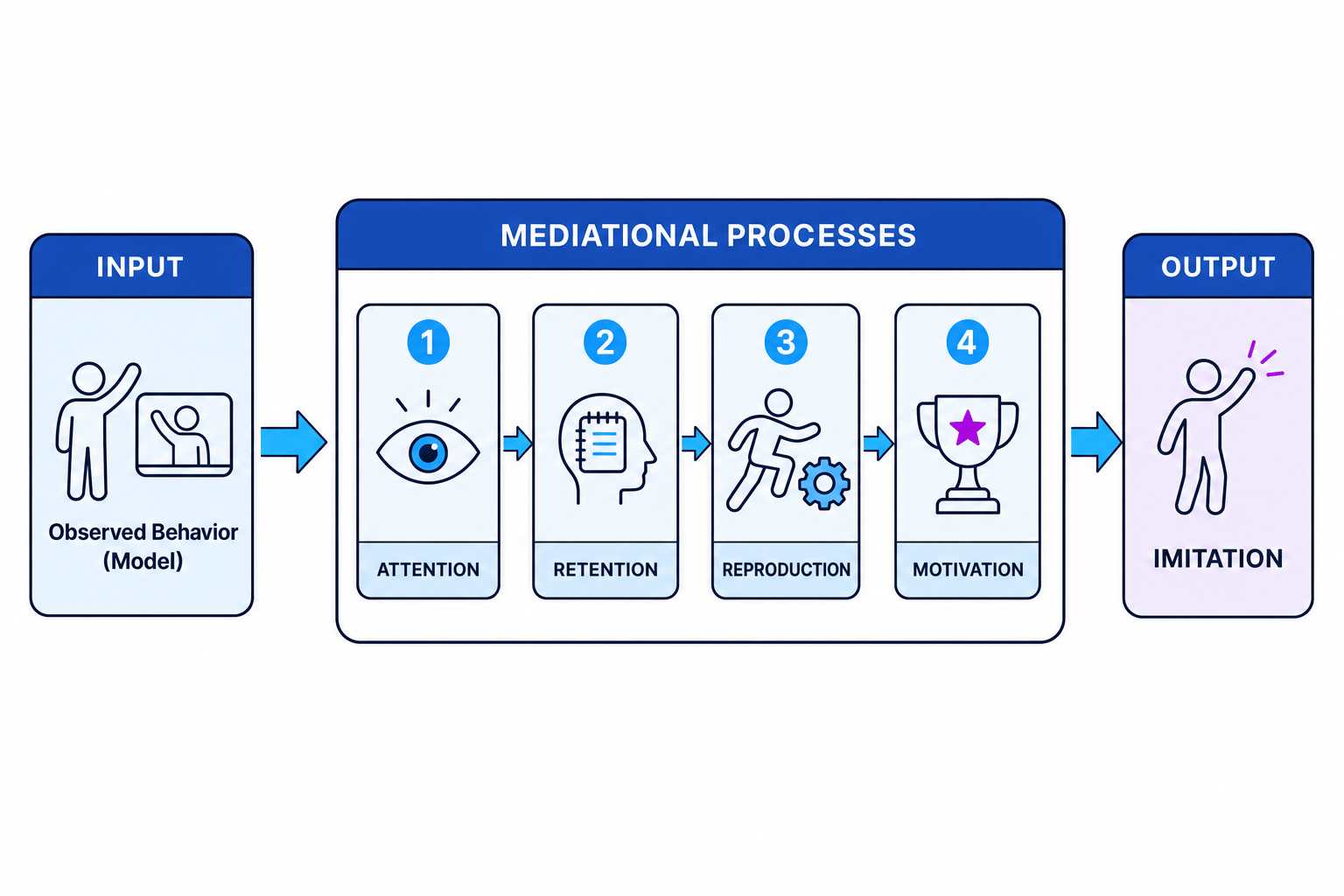
Bandura is often described as a "soft behaviorist" because he acknowledged that humans are not passive stimulus-response machines. Between the stimulus (observing the model) and the response (imitation), crucial cognitive factors operate. These are called mediational processes because they mediate (intervene) in the learning process to determine whether a behavior is reproduced.
There are four mediational processes:
- Attention: The extent to which we notice and focus on the behavior. A behavior must grab our attention to be learned.
- Retention: How well the behavior is remembered. A cognitive representation of the behavior must be stored in memory so it can be retrieved later.
- Motor Reproduction: The physical ability of the observer to perform the behavior. We may observe and retain a behavior, but we must be physically capable of copying it.
- Motivation: The will to perform the behavior. This is largely determined by whether the model was rewarded or punished (vicarious reinforcement) and our own internal desires.
Advanced SLT Concepts (A-Level Only)
For the full A-Level qualification, you must also be familiar with how Bandura explained the complex relationship between the individual, their behavior, and the wider environment:
- Reciprocal determinism: Traditional behaviorism argues that the environment completely shapes our behavior. Bandura argued that the influence is a two-way street. The environment influences our behavior, but our behavior and internal cognitive processes also shape and choose our environment.
- Self-efficacy: This refers to an individual's personal belief in their own capability to successfully perform a specific task or behavior. A person with high self-efficacy is much more motivated to attempt and persist with imitating a difficult observed behavior.
Applying SLT to a novel scenario
Scenario: Chloe is a five-year-old girl who watches her teenage sister, Sarah (who she admires deeply), apply red lipstick before going out. When Sarah puts on the lipstick, their mother smiles and says, "You look beautiful, Sarah!" Later that afternoon, when she is alone in the bathroom, Chloe finds the lipstick and attempts to put it on.
Explain Chloe's behavior using your knowledge of Social Learning Theory.
- Identify the model and the concept of identification: Sarah is a live, high-status model within the family. Chloe is likely to identify with her because they are sisters, share the same gender, and Chloe admires her.
- Apply the concept of observation and attention: Chloe actively observed Sarah applying the lipstick, meaning her cognitive mediational process of attention was engaged.
- Apply the concept of vicarious reinforcement: Chloe witnessed Sarah receive praise ("You look beautiful!") from their mother. This served as vicarious reinforcement, increasing Chloe's motivation to perform the same action to achieve a similar reward.
- Explain the cognitive retention and motor reproduction: Chloe stored the mental representation of how to apply lipstick in her memory (retention). When alone, she attempted to copy the behavior (motor reproduction), demonstrating imitation.
Confusing imitation and modelling
Students often write that "the model imitates the child" or "the child models the behavior". Remember: the model demonstrates the behavior, and the learner observes and imitates it. Keep your terminology precise!
Evaluating Social Learning Theory (AO3)
When evaluating SLT in essays, you need to balance its strengths (especially over pure behaviorism) with its scientific and biological limitations.
Strengths
- More comprehensive than behaviorism: By incorporating cognitive mediational processes (attention, retention), SLT provides a much more realistic and complete explanation of human learning than classical or operant conditioning alone.
- Strong experimental support: Bandura’s famous Bobo Doll studies (1961, 1963) showed that children exposed to aggressive adult models were significantly more likely to imitate aggressive behaviors (verbal and physical aggression) compared to a control group.
- Real-world applications: SLT has been used to explain how children acquire gender roles by identifying with same-sex models. It also explains the power of media violence on children, which has directly influenced age-rating policies on video games and movies.
Weaknesses
- Underestimates biological factors: Bandura consistently found that boys were more physically aggressive than girls across his Bobo doll studies, regardless of the condition. This difference is better explained by biological factors such as higher levels of testosterone in males, which SLT fails to account for.
- Artificiality of laboratory evidence: Many of the supporting studies (like the Bobo Doll experiments) were conducted in highly artificial laboratory settings. Children may have been responding to demand characteristics; a Bobo doll is designed to be hit, so the children may have simply been doing what they thought the researchers wanted them to do.
Key study link
When evaluating SLT, always refer back to Bandura, Ross, and Ross (1961). It is your ultimate piece of evidence for this theory. Showing how the children copied specific novel aggressive acts (e.g., hitting the doll with a mallet and saying "Pow!") is perfect proof of imitation of a model.
In the exam
- If an exam question asks you to "Outline Social Learning Theory," make sure you define and explain the relationship between all four key terms: modelling, observation, imitation, and vicarious reinforcement. Leaving one out will limit your marks.
- For AO2 application scenarios, highlight who the model is, explain why the individual identifies with them, and use the ARRM acronym to systematically run through the mediational processes.
- For evaluation, do not just describe the Bobo Doll study. Use it as evidence to support SLT's claim that we learn through observation, and then point out its methodological limitations (e.g., demand characteristics) to gain high-level AO3 analytical marks.
Check yourself
- What is the difference between imitation and vicarious reinforcement?
- Can you list the four mediational processes in the exact order they must occur for learning to result in behavior?
- Why does the concept of "identification" make a person more likely to copy a model?
