Social Learning Theory (SLT) is a core perspective in your Edexcel A-Level Psychology course. Proposed by Albert Bandura, it bridges the gap between traditional behaviorism and cognitive psychology. While behaviorists believe all learning comes from direct personal experience, Bandura argued that we learn a vast amount of our behavior indirectly by observing others.
What you'll learn
- How Social Learning Theory differs from traditional behaviorism by introducing cognitive processes.
- The four key mediational stages of observational learning: Attention, Retention, Reproduction, and Motivation.
- How to apply these stages to explain real-life scenarios and construct high-scoring exam responses.
From Behaviorism to Social Learning
To understand the social learning stages, we first need to look at how Bandura built upon traditional learning theories.
Traditional behaviorists (such as Pavlov and Skinner) focused exclusively on observable behavior. They argued that learning only occurs through direct conditioning (classical or operant) where an individual receives direct rewards or punishments.
Bandura (1977) agreed that behavior is learned from experience, but he argued that classical and operant conditioning could not account for all learning. Humans do not simply react to their environment like passive machines; we think about the relationship between our behavior and its consequences.
Mediational Processes
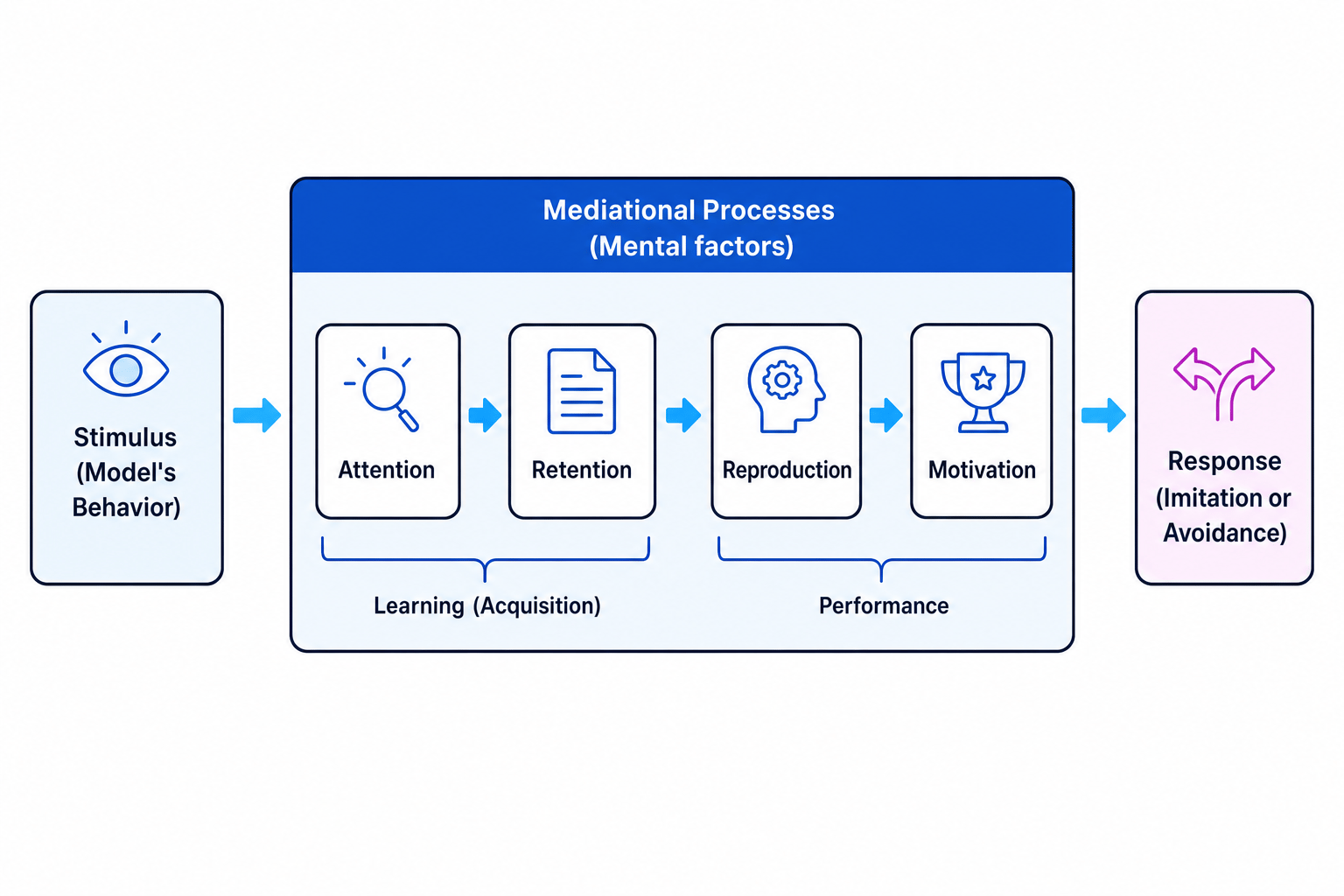
Mediational processes are the cognitive (mental) factors that occur between an environmental stimulus (observing a behavior) and the behavioral response (imitating or ignoring it).
Because these mental processes "mediate" (go-between) the stimulus and response, Social Learning Theory is often described as a cognitive-behavioral bridge.
Key Concepts in SLT
Before an individual can go through the cognitive stages of learning, several social elements must be in place:
- Modelling: For social learning to occur, there must be a model demonstrating the behavior. This could be a "live" model (e.g., a parent or peer) or a "symbolic" model (e.g., a character in a TV show or video game).
- Identification: Observers do not imitate just anyone. We are much more likely to imitate models we identify with. This is called identification. We tend to identify with models who share similar characteristics to us (such as age or gender) or who possess high status and power.
- Imitation: This is the act of copying the observed behavior of a model.
- Vicarious Reinforcement: This is a crucial concept. We do not need to experience direct rewards to learn. If we observe a model being rewarded for their behavior, we are much more likely to imitate them because we anticipate receiving the same reward. This is called vicarious reinforcement. Conversely, if we see a model punished, we are less likely to copy them (vicarious punishment).
The Four Mediational Stages (ARRM)
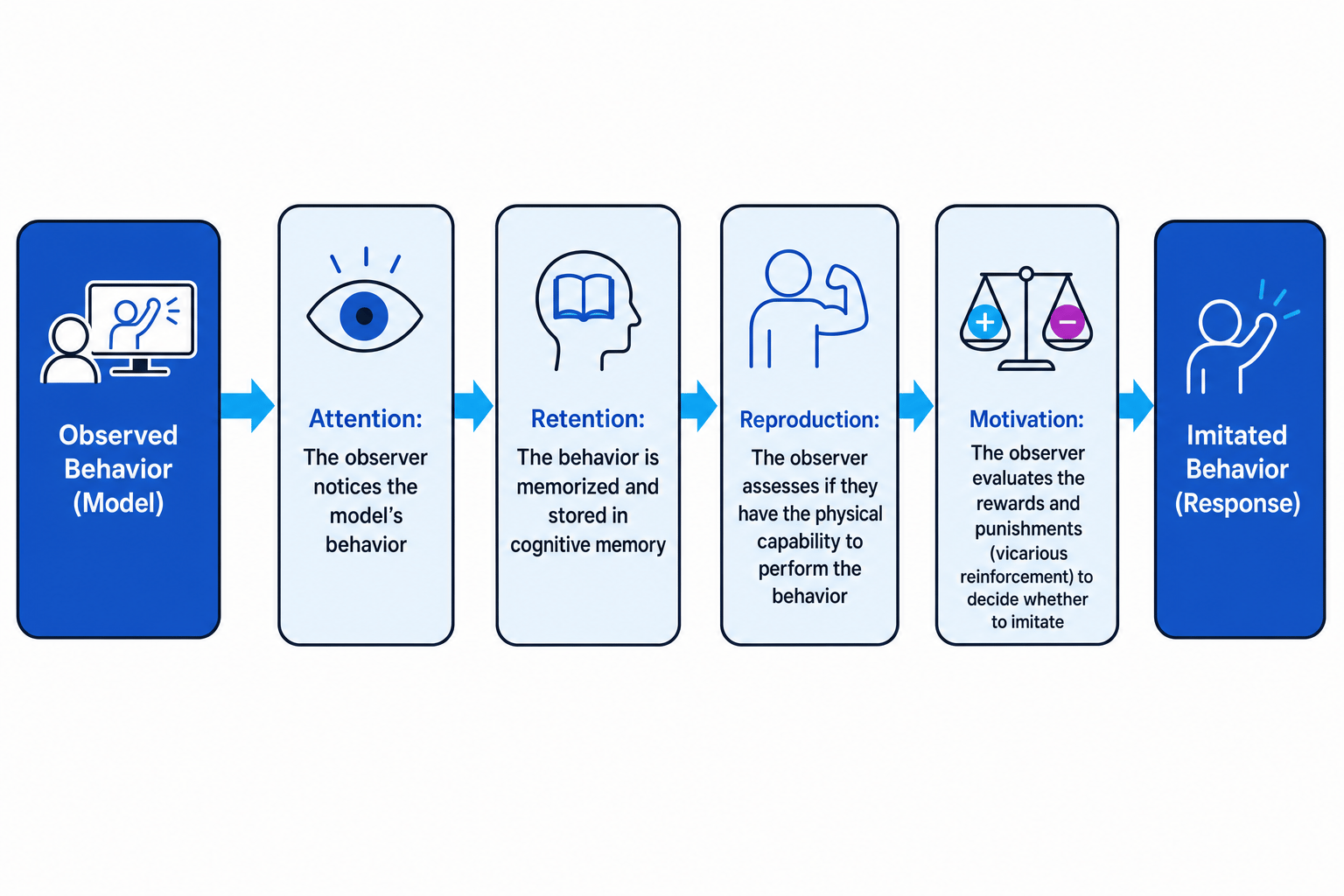
Bandura identified four distinct mental stages that determine whether a newly observed behavior is acquired and performed. You can easily remember these using the acronym ARRM: Attention, Retention, Reproduction, and Motivation.
The Cognitive Bridge
The first two stages (Attention and Retention) are concerned with the learning (acquisition) of the behavior, whereas the final two stages (Reproduction and Motivation) are concerned with the performance of the behavior. This proves that learning and performance do not have to occur at the same time.
1. Attention (Learning)
Before you can copy a behavior, you have to notice it. If a behavior is highly dramatic, unusual, or displayed by a highly attractive or high-status model, it is much more likely to grab your attention. If you do not pay attention to the model, the learning process stops immediately.
2. Retention (Learning)
How well is the behavior remembered? Since imitation does not always happen immediately after observation, the observer must form a cognitive mental representation (a memory) of the behavior. If the memory of how to perform the behavior is not stored, it cannot be retrieved later to be reproduced.
3. Reproduction (Performance)
This is the physical capability of the observer to carry out the behavior. We see many behaviors every day that we would like to imitate, but we are limited by our physical ability.
The Olympic Gymnast
Imagine you watch an Olympic gymnast perform a flawless, highly complex triple-backflip on television. You pay close attention and you retain the memory of exactly how they did it. However, if you went into your garden and tried to do it, you would fail because you lack the physical capability to reproduce it.
4. Motivation (Performance)
Even if you have paid attention, retained the memory, and are physically capable of performing the behavior, you still need the will to do it. This motivation is determined by the consequences of the behavior. If you expect a reward (due to prior vicarious reinforcement), your motivation to perform will be high. If you expect a punishment, your motivation will be low.
Acronym Check
Always write out the stages in order: Attention →\rightarrow→ Retention →\rightarrow→ Reproduction →\rightarrow→ Motivation. Examiners look for this logical, sequential flow when grading your essays.
Applying the Stages to Scenarios
In your Edexcel exam, you are highly likely to get an AO2 application question where you must use the four stages of social learning to explain a character's behavior. Let's look at how to structure this.
Applying ARRM to a behavioral scenario
Scenario:
Leo is a five-year-old boy who watches his older teenage brother, Jack, play a tennis match. Jack plays exceptionally well and, after winning the final point, raises his racket high and receives a large trophy and loud applause from the crowd. Later that afternoon, Leo is spotted in the garden. He grabs a toy tennis racket, holds it high above his head, and cheers.
Task: Explain Leo's behavior using Social Learning Theory.
Step-by-step application:
- Identify the model and explain Attention: Leo pays attention to Jack playing tennis. Jack is an older brother, meaning he is a high-status role model of the same gender with whom Leo is likely to identify. The dramatic nature of winning the match ensures Leo’s focus is sustained.
- Explain Retention: Leo encodes and stores the memory of Jack's behavior (raising the racket high after winning) in his long-term memory. He retains this information until later in the afternoon when he goes out to the garden.
- Explain Reproduction: Leo has the physical capability to reproduce the behavior. Raising a toy tennis racket above his head is a simple motor action that a five-year-old has the physical development to perform.
- Explain Motivation and Vicarious Reinforcement: Leo is motivated to perform the behavior because he witnessed Jack receive rewards (a trophy and applause). This is vicarious reinforcement. Leo imitates the behavior in the hope of experiencing similar positive feelings or praise.
Confusing Direct and Vicarious Reinforcement
Many students state that the observer was "vicariously reinforced when they received a reward." This is incorrect! Vicarious means experienced through someone else. The model receives the actual reward; the observer is vicariously reinforced by watching the model get rewarded. If the observer later copies the behavior and gets praised directly, that is direct operant reinforcement.
Evaluating Social Learning Theory (AO3)
When writing essays (such as 8-mark or 12-mark questions), you need to balance your description (AO1) with rigorous evaluation (AO3). Here are the key strengths and weaknesses of the social learning stages:
Strengths
- Scientific Credibility: Bandura’s theories are backed up by highly controlled laboratory experiments, such as the famous Bandura, Ross, and Ross (1961) Bobo Doll studies. In these studies, variables were strictly controlled to demonstrate a clear cause-and-effect relationship between observing aggressive models and subsequent imitative behavior in children.
- Recognises Cognitive Factors: Unlike strict behaviorism, SLT acknowledges that humans are active cognitive processors. By introducing the mediational stages (ARRM), it provides a far more comprehensive and realistic explanation of human learning than simple stimulus-response links.
- Explains Cultural Variations: SLT can easily explain how cultural norms are transmitted across generations. Children acquire the specific behaviors, language styles, and gender roles of their specific culture by observing the models around them.
Weaknesses
- Underestimates Biological Factors: A major limitation is that SLT downplays the role of biology. In the Bobo Doll experiments, boys consistently behaved more aggressively than girls, regardless of the model's gender. This difference could be explained by biological factors, such as higher levels of testosterone in boys, which SLT fails to account for.
- Low Ecological Validity of Supporting Research: Many of Bandura's findings rely on artificial laboratory setups. Bashing a plastic Bobo Doll (which is designed to bounce back when hit) does not represent how children express aggression against real people in everyday life. The children may have also succumbed to demand characteristics, simply behaving in a way they thought the researchers expected.
Real-World Applications
Social Learning Theory has had a massive, positive impact on society:
- Media Censorship and Watersheds: Understanding that children readily pay attention to and imitate violent symbolic models has led to strict age ratings on video games (PEGI ratings) and television (the 9:00 PM watershed in the UK).
- Prosocial Modelling: It is used positively in advertising and education. For example, health campaigns use high-status, relatable celebrities (models) to encourage healthy eating or exercise, relying on identification to drive behavioral change.
In the exam
- Define your terms first: If a question asks about social learning, always start by defining modelling, imitation, identification, and vicarious reinforcement before launching into the four stages.
- Use the ARRM acronym to structure AO2 responses: Dedicate one clear paragraph to each stage (Attention, Retention, Reproduction, Motivation) and link each one explicitly back to the details of the exam prompt.
- Balance your AO3: For 8-mark and 12-mark essays, ensure you have an equal balance of description (AO1) and evaluation (AO3). Use PEEL paragraphs (Point, Evidence, Explain, Link) to make your evaluation points highly robust.
- Reference named studies: Always anchor your evaluation in Bandura’s classic studies (1961, 1963, or 1965) to show examiners you have a deep, specification-specific knowledge base.
Check yourself
- Why is Social Learning Theory described as a "cognitive-behavioral bridge"?
- What is the precise difference between identification and imitation?
- In which of the four mediational stages (ARRM) does vicarious reinforcement play the most active role? Explain why.