What you'll learn
- How operant conditioning explains behaviour change through consequences.
- What behaviour modification is and how it is used in real settings.
- How shaping builds a complex behaviour gradually using reinforcement.
- How to evaluate behaviour modification for AO3, including evidence, ethics and practical limitations.
Starting point: operant conditioning
Before you can understand behaviour modification, you need the basic idea of operant conditioning.
Operant conditioning
Operant conditioning is learning through the consequences of behaviour. If a behaviour is followed by a desirable consequence, it is more likely to happen again; if it is followed by an undesirable consequence, it is less likely to happen again.
The word operant means an action that “operates” on the environment. For example, a child asks politely, the parent gives attention, and the child becomes more likely to ask politely again.
This approach is linked to Thorndike’s Law of Effect (Thorndike, 1911), which states that behaviours followed by satisfying consequences are more likely to be repeated. It was developed further by Skinner (1938), who studied rats and pigeons in controlled “Skinner boxes” to show how reinforcement and punishment affect behaviour.
The core idea
Behaviour is shaped by what happens after it. In operant conditioning, consequences change the future probability of a behaviour.
The ABC model
A useful way to apply operant conditioning is the ABC model:
- Antecedent: what happens before the behaviour.
- Behaviour: the observable action or response.
- Consequence: what happens after the behaviour.
For example, the antecedent might be “the teacher asks a question”, the behaviour might be “the student calls out”, and the consequence might be “the teacher gives attention”.
The diagram below shows how the ABC model links to reinforcement, punishment, extinction and shaping.
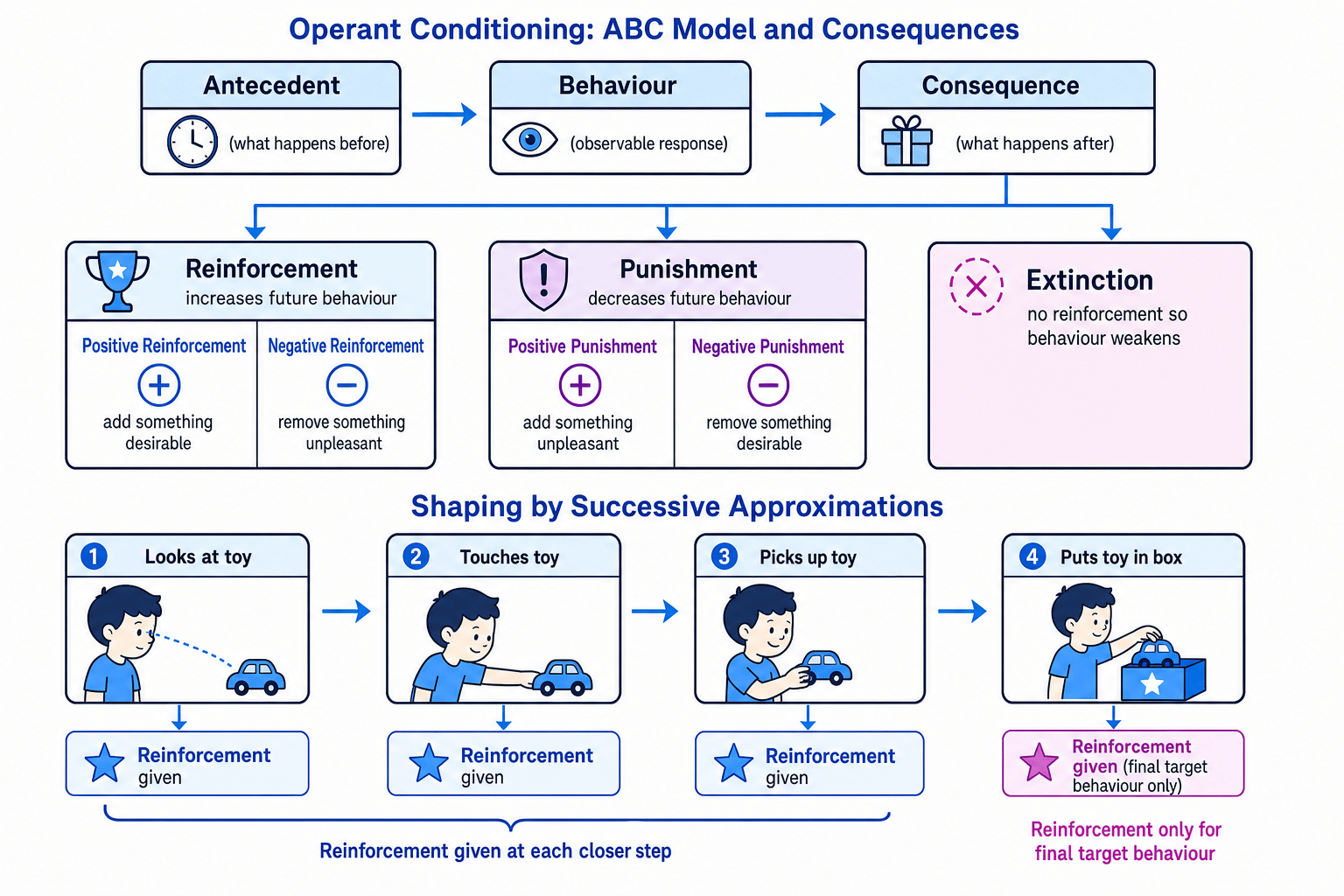
Consequences: reinforcement, punishment and extinction
Reinforcement
Reinforcement
Reinforcement is any consequence that increases the likelihood of a behaviour being repeated.
There are two types:
- Positive reinforcement: something desirable is added after the behaviour, such as praise, tokens or attention.
- Negative reinforcement: something unpleasant is removed after the behaviour, such as stopping nagging when homework is completed.
Negative reinforcement is not punishment
In psychology, negative means “removed”, not “bad”. Negative reinforcement increases behaviour because something unpleasant is taken away.
Punishment
Punishment
Punishment is any consequence that decreases the likelihood of a behaviour being repeated.
There are also two types:
- Positive punishment: something unpleasant is added, such as a telling-off.
- Negative punishment: something desirable is removed, such as losing phone privileges.
Punishment may stop a behaviour quickly, but it does not necessarily teach the person what to do instead. It can also create fear, anger or avoidance.
Extinction
Extinction
Extinction happens when a behaviour is no longer reinforced, so it gradually decreases.
For example, if a child has learned that tantrums lead to attention, consistently removing that attention may reduce tantrums over time. However, there may be an extinction burst, which is a temporary increase in the behaviour before it reduces.
Changing calling out in class
A student often calls out answers without raising their hand. The teacher wants to reduce this behaviour.
-
Identify the current consequence: when the student calls out, the teacher often responds. This attention is added after the behaviour, and the behaviour continues, so it is likely to be positive reinforcement.
-
Change the consequence for the unwanted behaviour: the teacher stops giving attention to calling out. If calling out reduces because it is no longer rewarded, this is extinction.
-
Reinforce an alternative behaviour: the teacher gives praise when the student raises their hand before answering. This uses positive reinforcement to increase the desired behaviour.
What is behaviour modification?
Behaviour modification
Behaviour modification is the systematic use of learning principles, especially operant conditioning, to change behaviour.
It is often used in schools, clinical settings, parenting programmes, prisons and care environments. The aim is not just to “reward good behaviour” vaguely. A good behaviour modification programme is planned, measured and consistent.
A key term is target behaviour, which means the specific behaviour the programme aims to increase or decrease. The behaviour must be operationalised, meaning defined clearly enough that different observers would know exactly what to record.
For example, “be better behaved” is too vague. “Remain seated during independent work for 10 minutes” is operationalised.
Another key term is baseline, which is the level of behaviour before the intervention begins. Measuring the baseline helps you judge whether the programme has actually worked.
AO2 shortcut
When applying behaviour modification to a scenario, use the ABC structure: identify the antecedent, define the target behaviour, then explain how the consequence will be changed.
Token economies
A common behaviour modification technique is a token economy.
Token economy
A token economy is a system where tokens are given for desired behaviours and later exchanged for rewards.
The tokens are secondary reinforcers, meaning they have value because they can be exchanged for something else. The rewards they are exchanged for are called backup reinforcers, such as extra activity time, snacks or privileges.
For example, in a classroom, students may earn points for completing work, helping others or arriving on time. Later, they exchange the points for a chosen reward.
Evidence for token economies includes applied work by Ayllon and Azrin (1968), who used token systems to increase adaptive behaviours in psychiatric settings. More recent reviews, such as Maggin et al. (2011), suggest token economies can improve classroom behaviour, although effectiveness depends on consistency, suitable rewards and good implementation.
What is shaping?
Sometimes the desired behaviour does not happen at all yet. In that case, you cannot simply reinforce the final behaviour because there is nothing to reward. This is where shaping is useful.
Shaping
Shaping is a behaviour modification technique where successive approximations of a target behaviour are reinforced until the final desired behaviour is achieved.
A successive approximation is a behaviour that is closer to the target behaviour than the person’s current behaviour. The psychologist, teacher or caregiver reinforces each closer step, then gradually raises the standard.
Shaping often uses differential reinforcement, which means reinforcing the desired or closer behaviour while not reinforcing less desired behaviours.
For example, if a child does not speak in class, the teacher might first reinforce eye contact, then whispering to a peer, then answering quietly, and eventually answering aloud.
How shaping works step by step
A shaping programme usually follows this sequence:
- Define the final target behaviour clearly.
- Measure the baseline behaviour.
- Choose a reinforcer that is genuinely motivating for that person.
- Reinforce the first small step towards the target.
- Once that step is reliable, only reinforce a closer approximation.
- Continue until the final target behaviour is reached.
- Gradually reduce artificial rewards so the behaviour is maintained naturally.
This last stage is important. Maintenance means the behaviour continues over time. Generalisation means the behaviour happens in other settings, not just in the training situation.
Planning a shaping programme
A child currently avoids reading aloud. The target behaviour is to read one short paragraph aloud to the class.
-
Operationalise the target behaviour: the final behaviour is “reads one prepared paragraph aloud to the whole class without leaving the activity”.
-
Choose the first approximation: because the child currently avoids reading aloud, the first reinforced step might be reading one sentence quietly to the teacher.
-
Raise the criterion gradually: once that is reliable, reinforcement is given only for reading two sentences, then a short paragraph to the teacher, then a paragraph to a small group.
-
Move towards the final target: the child is finally reinforced for reading the paragraph to the whole class, while earlier easier steps are no longer enough to earn the same reinforcement.
-
Plan maintenance: rewards are gradually faded so natural consequences, such as confidence, teacher praise and successful participation, help maintain the behaviour.
Reinforcement schedules
A reinforcement schedule is the pattern of how often reinforcement is given.
- Continuous reinforcement means reinforcing the behaviour every time it occurs. This is useful early in learning because it makes the link between behaviour and consequence clear.
- Intermittent reinforcement means reinforcing only some correct responses. This is useful later because behaviour often becomes more resistant to extinction.
In shaping, continuous reinforcement is usually useful at the start. Later, intermittent reinforcement helps the behaviour last without needing constant rewards.
Stopping too early
A behaviour may appear learned in one setting but disappear elsewhere. Good behaviour modification plans include maintenance and generalisation, not just short-term improvement.
AO3 evaluation: strengths
Behaviour modification is practical and measurable
A major strength is that behaviour modification focuses on observable behaviour. This makes it easier to measure change objectively.
For example, rather than saying “the child is more cooperative”, a researcher or teacher can record “the child completed four out of five tasks without refusal”. This improves reliability because observers can agree on what happened.
It has useful real-world applications
Behaviour modification has been used in schools, mental health settings, parenting programmes and interventions for developmental difficulties. Reinforcement-based approaches can help increase adaptive behaviours such as communication, self-care and classroom engagement.
For example, Eldevik et al. (2009) reviewed early behavioural interventions for autistic children and found evidence of benefits for some children, although outcomes varied. This supports the idea that operant principles can be useful when applied carefully and individually.
It is based on controlled research
Skinner’s work had strong control over variables, which helps establish cause and effect. In a Skinner box, the researcher could control the consequence after a response and measure how response rates changed.
However, this strength also creates a limitation: much early evidence came from animal studies in artificial environments, so generalising directly to complex human behaviour can be difficult.
AO3 evaluation: limitations and ethics
It can be reductionist
Behaviour modification can be criticised as reductionist, meaning it explains complex behaviour in a simplified way. It focuses heavily on external consequences and may ignore thoughts, emotions, biological factors, social relationships and personal meaning.
For example, a child refusing schoolwork may not simply need more rewards. They may be anxious, struggling with literacy, or reacting to peer problems.
It may create dependency on rewards
If rewards are used badly, the person may only perform the behaviour when rewards are available. This is why reinforcement should be faded gradually and replaced with natural reinforcers.
There is also a debate about whether external rewards can reduce intrinsic motivation, which is motivation that comes from interest or satisfaction in the activity itself.
Ethical issues matter
Behaviour modification can involve controlling another person’s behaviour, so ethics must be considered carefully. Under the BPS Code of Ethics and Conduct (2009), psychologists should consider consent, protection from harm, confidentiality, right to withdraw, deception and debriefing.
With children or vulnerable people, valid consent may need to come from parents, guardians or carers, but the person’s own assent and dignity still matter. Punishment-based programmes are especially ethically risky because they may cause distress or harm.
Use punishment with caution
For A-Level evaluation, it is safer to argue that reinforcement-based behaviour modification is generally more ethical and constructive than punishment-based approaches, because it teaches desired alternatives.
Bringing it together for essays
For AO1, clearly describe operant conditioning, behaviour modification and shaping. For AO2, apply the ABC model to the scenario. For AO3, evaluate using evidence, real-world usefulness, reductionism, maintenance and ethics.
In the exam
-
Define the target behaviour clearly before explaining the technique; vague behaviours make weak AO2.
-
Use the terms positive reinforcement, negative reinforcement, punishment, extinction and shaping accurately.
-
For AO3, balance practical strengths with limitations such as ethics, reductionism, reward dependency and whether the behaviour generalises.
Check yourself
-
How is negative reinforcement different from punishment?
-
Why is baseline measurement important in behaviour modification?
-
Outline a shaping programme for a behaviour that does not currently happen at all.
