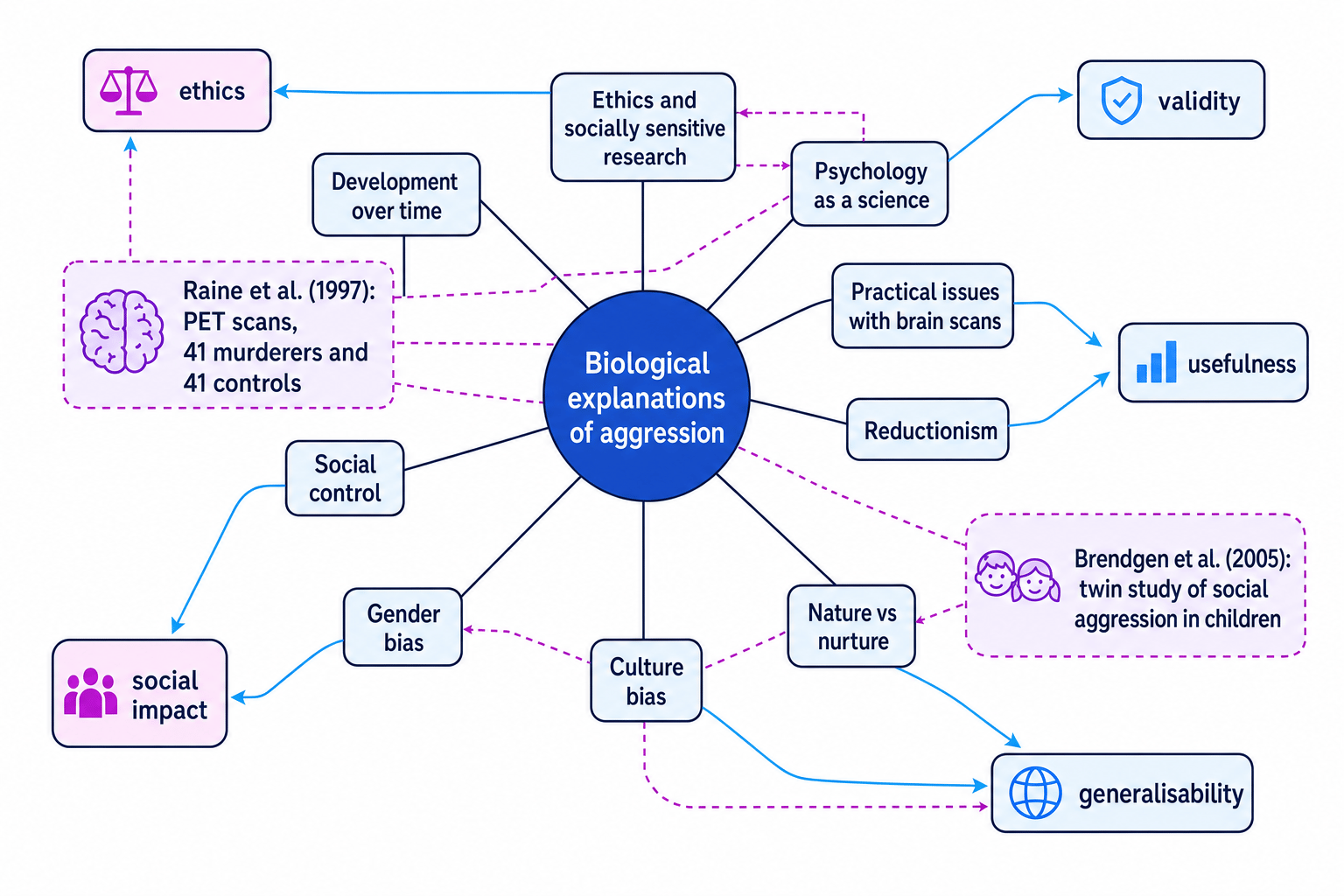
What you'll learn
- How to use issues and debates to evaluate biological explanations of aggression.
- Why brain-scanning, hormones, genes and neurotransmitters can be scientific but still limited.
- How ethics, culture, gender and social control affect the use of biological research.
- How to turn these ideas into AO3 evaluation paragraphs.
Starting point: what are “issues and debates”?
Biological psychology explains behaviour through the brain, nervous system, hormones, genes and neurotransmitters. In this topic, that often means explaining aggression biologically, using evidence such as Raine et al. (1997) and Brendgen et al. (2005).
Issues and debates
An issue is a broad problem or question in psychology, such as whether research is ethical. A debate compares different viewpoints, such as nature versus nurture or reductionism versus holism.
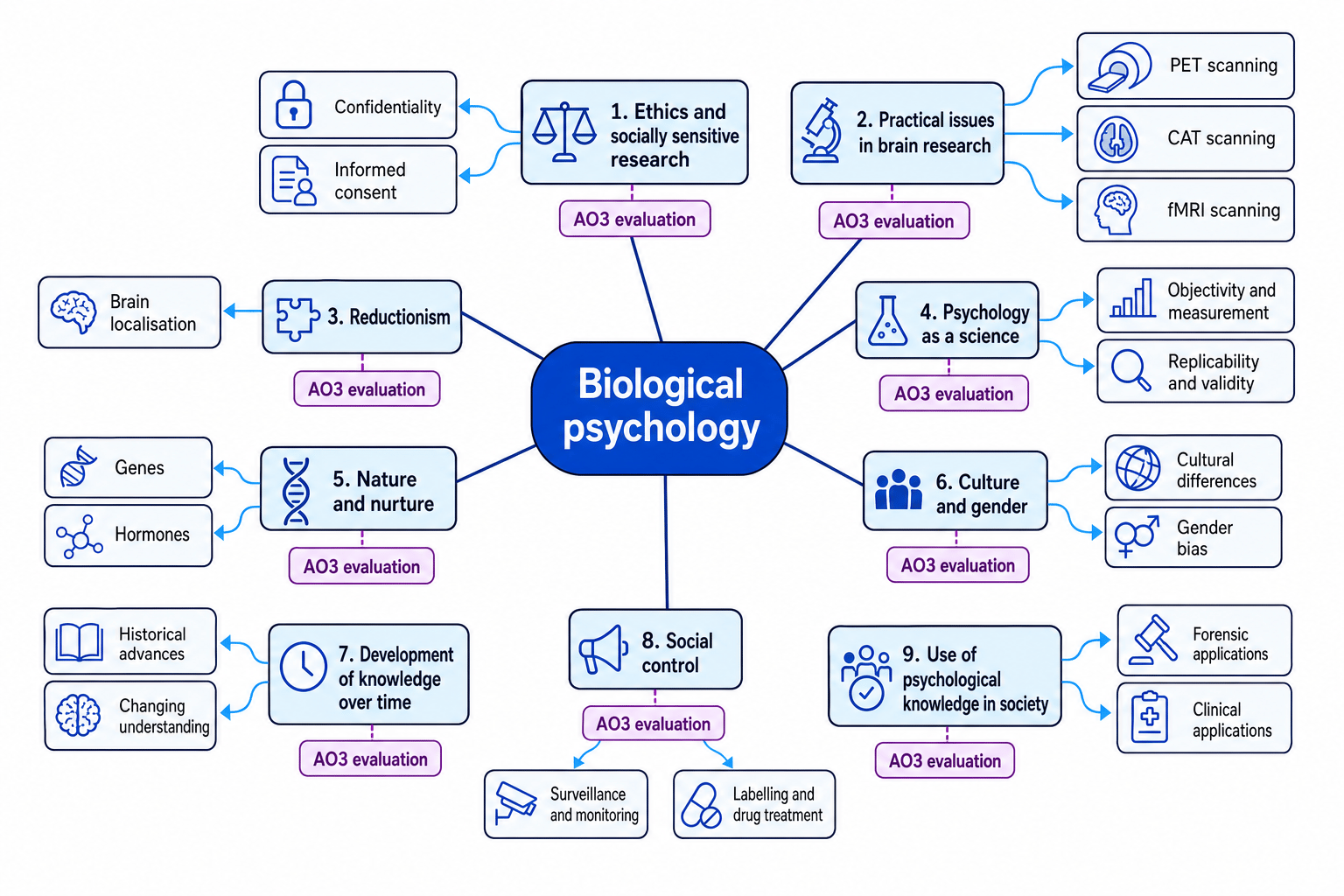
Use the map below as an overview: each branch is a possible AO3 “lens” you can apply to a biological explanation or study.
The AO3 move
A strong evaluation point does three things: names the issue, links it to a specific theory or study, and explains why it matters for validity, usefulness, ethics or generalisability.
Ethics and socially sensitive research
Ethics
Ethics are the moral guidelines psychologists follow to protect participants and society. The BPS Code of Ethics and Conduct (2009) includes informed consent, right to withdraw, protection from harm, confidentiality, deception and debriefing.
Biological research into aggression can be ethically sensitive because findings may affect how people are treated in schools, courts or healthcare. For example, if low prefrontal cortex activity is linked with aggression, people might wrongly assume someone is “dangerous” because of their brain scan.
Socially sensitive research
Socially sensitive research is research with potential consequences for participants or groups beyond the study itself, such as stigma, discrimination, labelling or misuse by institutions.
In Raine et al. (1997), PET scans were used with murderers pleading not guilty by reason of insanity. This raises confidentiality and social labelling issues because brain data could affect legal decisions. In Brendgen et al. (2005), twin research into aggression involved children, genetic information and ratings of behaviour, so confidentiality and protection from harm were especially important.
Ethics is not just consent
Do not write “it was ethical because they gave consent” and stop there. Biological aggression research also needs confidentiality, protection from harm, debriefing, right to withdraw and careful handling of socially sensitive findings.
Practical issues in biological research
Biological psychology often uses brain-scanning techniques, which are powerful but difficult to design well.
Brain-scanning techniques
A PET scan measures brain activity using a radioactive tracer. A CAT scan or CT scan produces structural images of the brain. fMRI measures changes in blood oxygenation as an indicator of brain activity.
These methods can provide objective data, which supports psychology as a science. For example, Raine et al. (1997) compared brain activity in 41 murderers with 41 matched controls and found differences in areas such as the prefrontal cortex.
However, practical problems remain. Scans are expensive, may involve specialist equipment, and can be affected by movement, medication, task design or participant anxiety. Aggression is also complex: a scan can show brain activity during a task, but not fully explain a real-life violent act.
Brain scans do not prove causation
If aggressive individuals show unusual brain activity, this does not automatically mean the brain difference caused the aggression. The relationship may be correlational, and life experiences may also have shaped the brain.
Reductionism
Reductionism
Reductionism means explaining a complex behaviour by breaking it down into smaller parts, such as brain areas, genes, hormones or neurotransmitters.
Biological explanations of aggression can be reductionist because they may focus on one biological factor, such as testosterone, serotonin, the amygdala or the prefrontal cortex. This can be useful because it creates testable predictions and possible treatments. For example, knowledge of synaptic transmission — chemical communication between neurons — helps psychologists study how neurotransmitters may influence behaviour.
But reductionism can oversimplify aggression. Aggression may also involve learning, social norms, frustration, family background, culture and cognition.
Applying reductionism to Raine et al. (1997)
-
Select the biological claim: Raine et al. found differences in brain activity in murderers, including reduced activity in areas linked to impulse control.
-
Apply the issue: This is reductionist because it focuses on brain functioning as an explanation for violent behaviour.
-
Weigh the impact: The evidence is useful because brain activity can be measured objectively, but it may ignore childhood experiences, mental health, social learning and situational triggers.
-
Make the judgement: This weakens a purely biological explanation of aggression, but does not make the research useless; it suggests biology should be combined with environmental explanations.
Comparing biological explanations with Freud
The specification gives Freud as an example of another way to explain aggression. Freud’s psychodynamic ideas linked aggression to unconscious drives, including the death instinct, and to processes such as displacement.
Biological explanations are more scientific in some ways because they use measurable evidence such as hormones, genes and brain scans. Freud’s ideas are harder to test objectively because unconscious drives cannot be directly measured.
However, a comparison can be balanced. Freud’s ideas may highlight emotional conflict and early experience, while biological explanations highlight brain systems and physiology. A strong essay can argue that aggression is best understood using more than one level of explanation.
Psychology as a science
Psychology as a science
Psychology is more scientific when it uses objective measurement, controlled methods, replicable procedures, testable hypotheses and evidence-based conclusions.
Biological psychology often scores well here. Synaptic transmission, hormones and brain activity can be measured more objectively than some self-report data. Brain scanning also allows researchers to produce quantitative evidence.
In research methods, biological data may be summarised using measures of central tendency such as mean, median and mode, and measures of dispersion such as range and standard deviation. Frequency tables, bar charts and histograms can show patterns; qualitative comments can be analysed using thematic analysis.
When testing significance, Edexcel expects you to know the usual convention of p≤.05p \le .05p≤.05, with p≤.01p \le .01p≤.01 as a stricter level and p≤.10p \le .10p≤.10 as a more lenient level. Researchers compare an observed value with a critical value from a table, but the rule depends on the test.
Useful test choices include:
- Mann-Whitney U for a difference between two independent groups.
- Wilcoxon signed-ranks for a difference between repeated measures or matched pairs.
- Spearman’s rho for a correlation.
- Chi-square for an association between categories.
A one-tailed test is used when the prediction is directional, such as “aggressive participants will show lower prefrontal activity”. A two-tailed test is used when the prediction says there will be a difference but not the direction. A Type I error is a false positive; a Type II error is a false negative. Normal distributions are symmetrical, while skewed distributions are uneven, which can affect how data are described and interpreted.
Science evaluation sentence
A good AO3 point is: biological research gains scientific strength from objective measurement, but validity may still be limited if the task, sample or scanning situation does not reflect real-life aggression.
Culture and gender
Culture bias
Culture bias occurs when findings from one cultural group are wrongly assumed to apply to all people.
Biological explanations can sometimes underplay cultural differences in aggression. For example, aggression may be expressed differently depending on social norms, parenting, peer groups and expectations about masculinity or femininity.
Gender bias
Gender bias occurs when research or theory treats one gender as the norm, exaggerates differences, or ignores similarities.
Hormonal explanations often discuss testosterone and male aggression, but this can become gender-biased if it implies all males are naturally aggressive or ignores female aggression, such as relational or social aggression. Brendgen et al. (2005) is useful here because it considered social aggression in children, not only obvious physical violence.
Nature and nurture
Nature-nurture debate
The nature-nurture debate asks whether behaviour is mainly caused by inherited biological factors or by environmental experiences.
Biological psychology often supports the nature side because it focuses on genes, hormones, brain structures and neurotransmitters. For example, brain localisation suggests that areas such as the amygdala and prefrontal cortex may influence aggressive responses.
But nurture still matters. Twin studies such as Brendgen et al. (2005) do not usually show “genes only”; they estimate both genetic and environmental influences. Brain functioning can also be affected by trauma, learning, stress and upbringing.
Interaction is strongest
The best nature-nurture answer is usually interactionist: biology may create vulnerability or tendency, while the environment can trigger, reduce or shape aggressive behaviour.
How psychological understanding has developed over time
Biological psychology has changed as technology has improved. Earlier research often relied on case studies, post-mortems or basic structural scans. Later methods such as CAT, PET and fMRI allowed psychologists to study the living brain in more detail.
This development is a strength because explanations can be updated with better evidence. For example, knowledge of aggression has moved from broad claims about “violent people” towards more precise ideas about impulse control, emotion regulation and neural systems.
However, newer technology does not automatically mean perfect evidence. Scanning still requires interpretation, and complex behaviour cannot be reduced to colourful brain images alone.
Social control and use within society
Social control
Social control means using psychological knowledge to monitor, regulate or influence people’s behaviour.
Biological knowledge may be useful in society. If aggression is linked to poor impulse control, stress responses or brain injury, interventions could be developed in schools, prisons or clinics. This is a real-world application of psychological knowledge.
But there are risks. Biological explanations could be used to label people as dangerous, justify surveillance, influence sentencing, or pressure individuals into treatment. This links closely to socially sensitive research and confidentiality.
Usefulness is not automatically positive
Saying “research is useful” is not enough. Always ask: useful for whom, used in what way, and could it cause harm through labelling or social control?
In the exam
-
Name the issue clearly: ethics, reductionism, nature-nurture, science, culture, gender, social control or practical issues.
-
Anchor it in evidence: refer to a specific explanation or study, such as Raine et al. (1997) or Brendgen et al. (2005).
-
Explain the consequence: say whether it affects validity, reliability, generalisability, ethics, usefulness or social impact.
-
Balance your judgement: biological explanations can be scientific and useful, but often become stronger when combined with environmental and social explanations.
Check yourself
- How could Raine et al. (1997) be used to discuss both science and reductionism?
- Why is Brendgen et al. (2005) better described as interactionist than purely biological?
- What is one possible benefit and one possible danger of using biological knowledge to manage aggression?