Welcome to the Issues and debates section of Learning Theories! This is where you pull together all the theories, therapies, and studies you have learned so far—including Pavlov (1927), Skinner (1938), Watson and Rayner (1920), Bandura (1961), Capafóns et al. (1998), and Becker et al. (2002)—and evaluate them from a broader, philosophical perspective.
Being able to discuss these debates is essential for scoring highly in your AO3 evaluation marks, particularly in the longer 8-mark and 20-mark essay questions.
What you'll learn
- How classical and operant conditioning sit on the reductionist and scientific end of psychology.
- The ethical and practical challenges of using animals to explain human learning.
- How learning principles can be applied as forms of social control and socially sensitive interventions.
- How learning theories navigate the nature-nurture debate, culture, and gender.
1. Reductionism vs. Holism
Reductionism
Reductionism is the belief that complex human behaviour can be explained by breaking it down into simpler, smaller constituent components.
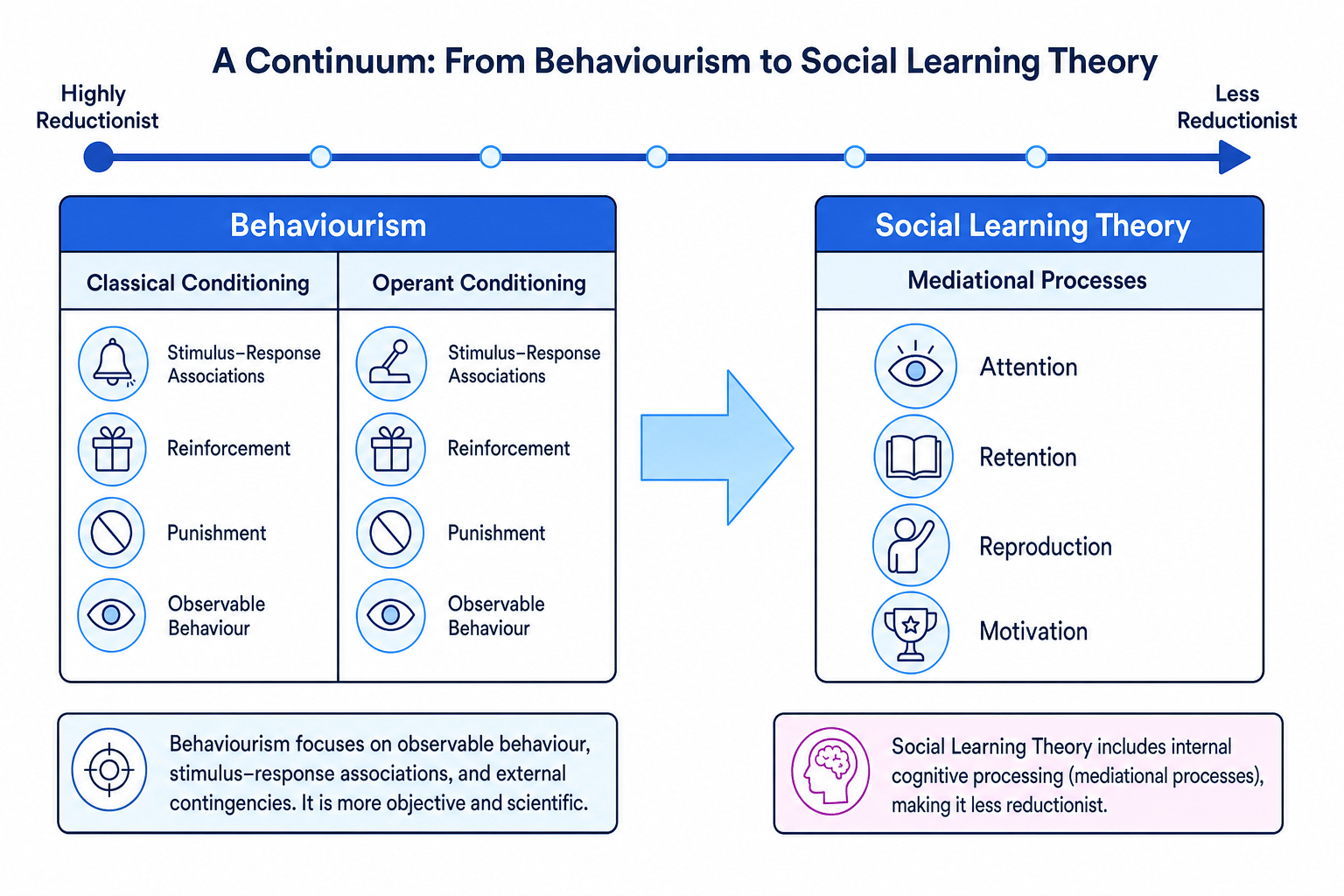
Learning theories, particularly classical and operant conditioning (the behaviourist approach), are highly reductionist. They reduce complex psychological phenomena (such as phobias, language acquisition, or gender roles) to simple stimulus-response (S-R) associations or reinforcement histories.
By contrast, holism argues that behaviour can only be understood by looking at the whole person and the interaction of different factors.
Behaviourism (High Reductionism)
- Mechanism: Pavlov explained reflex conditioning through the pairing of a Unconditioned Stimulus (UCS) with a Neutral Stimulus (NS) to create a Conditioned Response (CR). Skinner reduced voluntary behaviour to positive/negative reinforcement and punishment.
- AO3 Strength: By isolating simple S-R variables, researchers can conduct highly controlled, objective laboratory experiments. This makes it easier to establish cause-and-effect relationships.
- AO3 Weakness: It ignores cognitive mediational processes, emotional states, and biological predispositions. It treats humans as passive machine-like responders to their environment.
Social Learning Theory (SLT) (Moderate Reductionism)
By contrast, Bandura’s SLT is less reductionist because it includes cognitive mediational processes (Attention, Retention, Reproduction, Motivation). It acknowledges that humans do not merely react to environmental stimuli; we actively process information before choosing to imitate a model.
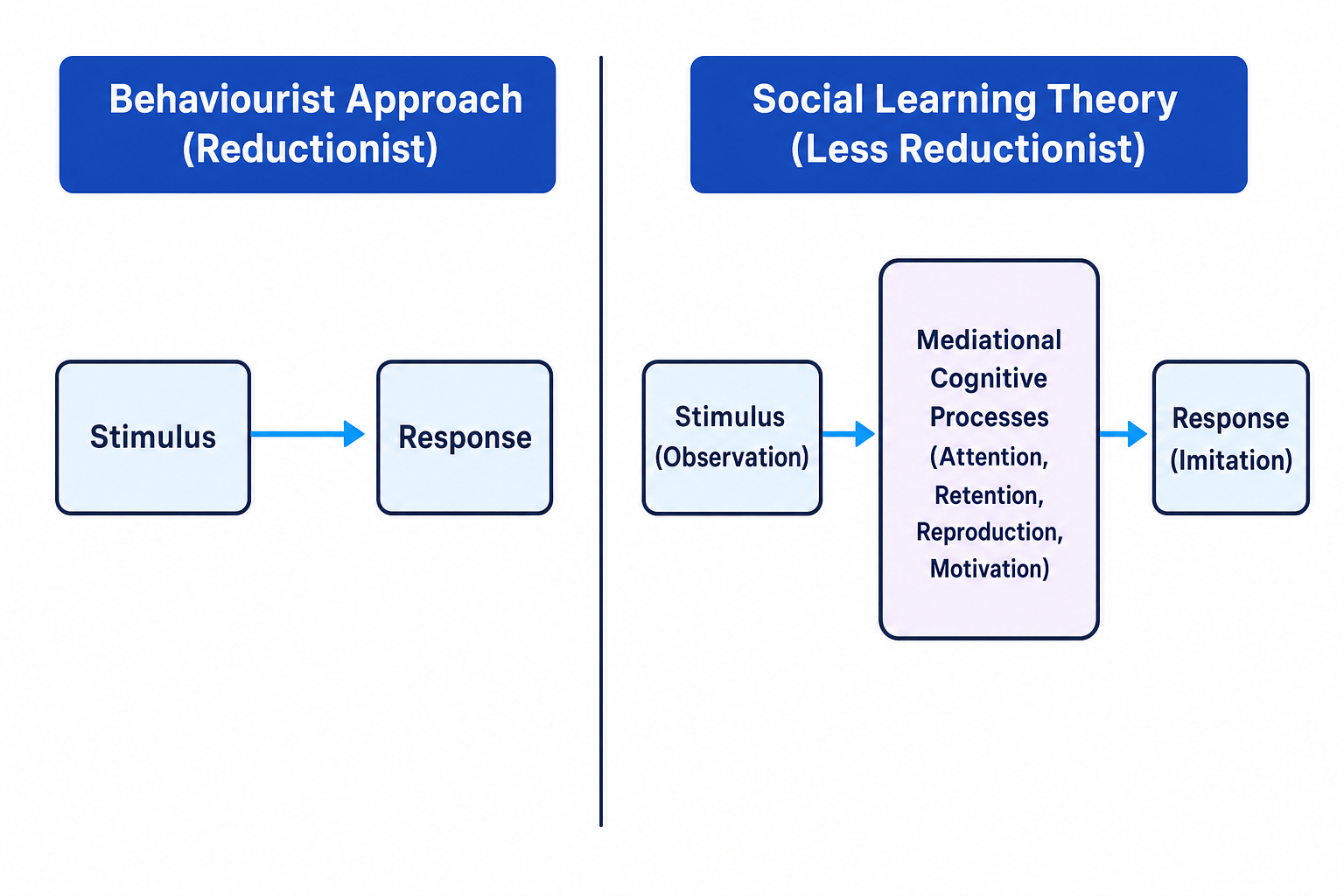
The Reductionism Takeaway
While reducing behaviour to S-R links allows learning theories to be highly scientific and objective, it risks oversimplifying complex human experiences by ignoring free will, thought processes, and neurochemistry.
2. Psychology as a Science
One of the greatest strengths of the learning approach is its commitment to the scientific method.
Early behaviourists like John B. Watson wanted to rescue psychology from the subjective "introspectionism" of early psychotherapists and establish it as a rigorous natural science.
Scientific Features in Learning Theories:
- Objectivity: Behaviourists focus only on observable and measurable behaviours. What happens in the "mind" cannot be directly observed, so it is disregarded.
- Replicability: Studies like Pavlov's salivary conditioning in dogs and Skinner's operant chambers (Skinner boxes) used highly standardised procedures that can be replicated easily.
- Control over variables: Extraneous variables are strictly controlled in lab environments to ensure that the Independent Variable (e.g., presence of a loud noise in Watson and Rayner's Little Albert study) is the only factor affecting the Dependent Variable (the fear response).
Overstating Science in SLT
Don't assume all learning theories are equally scientific. While SLT (Bandura, 1961) uses controlled lab experiments, it relies on inferring internal cognitive processes (mediational factors), which are not directly observable and are therefore less objective than pure operant or classical conditioning.
3. Ethics and Practical Issues in Research
A major debate within the learning theories concerns how the data is gathered. This brings up two distinct areas: the use of animals and the use of vulnerable human participants.
Ethical Issues with Animal Research
Historically, key behaviourist laws were built on animal experiments. Under the British Psychological Society (BPS) guidelines, researchers must weigh the scientific benefit of using animals against the potential suffering caused.
- Scientific benefit: Animals have simpler nervous systems and faster breeding cycles, making them useful for tracking conditioned behaviours over time.
- Suffering: Keeping animals in small, isolated cages (Skinner boxes) or surgically modifying them (Pavlov’s salivary fistulas) causes physical and psychological harm.
To systematically evaluate whether animal research is ethically justified, psychologists often use Bateson’s Decision Cube.
Applying Bateson's Cube to Animal Research
Suppose a researcher wants to investigate a new operant conditioning therapy for addiction by exposing rats to self-administered electrical brain stimulation (which causes moderate distress/pain). Let's evaluate if this is ethically acceptable using the three dimensions of Bateson's Cube.
- Assess the level of suffering (SSS): The procedure involves moderate pain and physical confinement, meaning suffering is graded as Medium/High.
- Assess the quality of the research design (QQQ): The study is a tightly controlled lab experiment with clear hypotheses, high construct validity, and robust controls. The research quality is graded as High.
- Assess the certainty of medical/scientific benefit (BBB): Addiction is a severe disorder in human society. If this operant conditioning model helps map brain pathways to design effective behavioral therapies, the potential human benefit is graded as High.
- Make the ethical decision: Bateson's Cube dictates that research is only acceptable if high quality (QQQ) and high benefit (BBB) outweigh the suffering (SSS). Because QQQ and BBB are high, the research sits in the acceptable region of the three-dimensional space, and the study may proceed (provided efforts are made to minimise SSS where possible).
Practical Issues: Extrapolation
Even if a study on animals is ethically approved, a major practical issue remains:
Extrapolation
Extrapolation is the application of findings from one group or species (e.g., rats or pigeons) to another group or species (e.g., humans).
Because humans have highly developed prefrontal cortexes, complex linguistic abilities, and social norms, we cannot assume that our behaviour is governed by the same simple reinforcement schedules that control a pigeon in a box.
4. Nature vs. Nurture
The learning approach sits firmly on the nurture side of this debate. It argues that we are born a tabula rasa (blank slate) and that all behaviour is acquired through environmental interactions.
- Nurture: Watson and Rayner (1920) demonstrated that a phobia of white rats could be environmentally engineered in Little Albert through association, showing classical conditioning in action. Becker et al. (2002) found that Fijian girls developed disordered eating behaviours due to the cultural influx of Western television, illustrating nurture through social modeling.
- Nature: For the full A-Level, you must recognise that pure nurture explanations are often incomplete. For instance, biological preparedness (an evolutionary, nature-based factor) explains why humans condition fear to stimuli like snakes and heights much faster than to modern objects like cars or electrical outlets.
The Interactionist View
To get top marks in an essay, argue for an interactionist perspective. For example, while we may have a genetic, biological vulnerability to anxiety (nature), it often requires an environmental trigger, such as a classical conditioning experience (nurture), for a full-blown phobia to develop.
5. Social Control and Socially Sensitive Research
Social Control
Social control refers to the regulation of individual or group behaviour by society or authority figures to enforce conformity and maintain order.
Because learning theories explain how to systematically shape behaviour, they can be incredibly powerful tools for social control.
Token Economy Systems (TES)
Operant conditioning principles are used in institutional settings like prisons, psychiatric wards, and schools to manage behavior. Desirable behaviours (e.g., making a bed, attending therapy) are rewarded with secondary reinforcers (tokens) that can be exchanged for primary reinforcers (e.g., leisure time, sweets).
- The Issue: Who decides what behaviour is "desirable"? In prisons, token economies can be used to force compliance, stripping away the basic rights of prisoners (e.g., visiting rights) to use them as exchangeable rewards. This gives the institutional staff immense power.
Behavioural Therapies
Systematic desensitisation (as evaluated by Capafóns et al., 1998, in curing the fear of flying) and flooding are highly effective therapies. However, they can border on social control:
- Power of the Therapist: In therapies like aversion therapy (historically used to try to change homosexual preferences), the therapist holds significant power to modify a patient's natural emotional responses.
Socially Sensitive Research (SSR)
Research into learning theories can be socially sensitive. For example, Bandura's findings on media violence and aggression can lead to the censorship of video games or films, which impacts civil liberties and places blame on parents and media creators.
Summary of Key Theories and Debates
| Theory / Study | Core Issues & Debates Illustrated | AO3 Key Evaluation Point |
|---|---|---|
| Pavlov (1927) | Animal ethics, Reductionism, Psychology as a Science | Proved classical conditioning in an objective, controlled way, but raised severe animal welfare issues and has low generalisability to humans. |
| Watson & Rayner (1920) | Human ethics, Nature vs. Nurture | Demonstrated phobias are learned (nurture), but caused psychological distress to a vulnerable infant without deconditioning. |
| Bandura (1961) | Psychology as a Science, Gender, Media Social Control | Used highly scientific lab methods to show observational learning, but laboratory aggression may not reflect real-life violence. |
| Becker et al. (2002) | Culture, Socially Sensitive Research | Revealed how Western TV shaped eating habits in Fiji (nurture), but raised social sensitivity regarding body image and cultural imperialism. |
In the exam
- Unpack the debate first: Never just write "This study is reductionist." Define reductionism/science/social control first, then link it directly to the learning theory or study.
- Balance your arguments: If you argue that behaviourist therapies are a form of coercive social control, balance this by discussing how they empower patients to overcome debilitating phobias (e.g., Capafóns et al., 1998) and regain independence.
- Use the specific terminology: Ensure you use words like extrapolation, tabula rasa, mediational processes, objective measurement, and BPS ethical guidelines.
Check yourself
- Why is Social Learning Theory considered less reductionist than classical or operant conditioning?
- What are the three dimensions of Bateson's Decision Cube used to evaluate animal research?
- How can a Token Economy System be criticized as an unethical form of social control?