What you'll learn
- How systematic desensitisation treats phobias such as fear of flying.
- What Capafóns et al. (1998) did, found, and concluded.
- How to evaluate the study using AO3 points: validity, reliability, generalisability, ethics and applications.
- How to apply the study to exam scenarios about treating phobias.
Where this study fits
Capafóns et al. (1998) is the contemporary study for the clinical psychology topic. It links closely to the classic study by Watson and Rayner (1920), where Little Albert learned a fear response through classical conditioning.
The big storyline is:
- Watson and Rayner showed that fear can be learned.
- Capafóns et al. showed that learned fear can be treated using behavioural therapy.
Specific phobia
A specific phobia is an intense, persistent fear of a particular object or situation, leading to avoidance and distress that interferes with everyday life.
Fear of flying is a specific phobia because the feared situation is clearly identifiable: being on, near, or thinking about aircraft and flights.
Prerequisite: how fear of flying can be maintained
A fear of flying may begin after a frightening experience, such as turbulence, a panic attack on a plane, or hearing about crashes. It can also develop through observation or information, such as seeing frightening news reports.
A key behavioural idea is avoidance. Avoidance means staying away from the feared situation. This feels helpful in the short term because anxiety drops, but it can maintain the phobia because the person never learns that flying can be safe.
Negative reinforcement
Negative reinforcement happens when a behaviour becomes more likely because it removes something unpleasant. In phobias, avoidance is reinforced because it removes anxiety.
How avoidance maintains fear of flying
- A person thinks about booking a flight and their anxiety increases because flying is associated with danger or panic.
- They decide not to book the flight, so their anxiety immediately decreases.
- That relief rewards the avoidance behaviour, making it more likely they will avoid flying again in the future.
Why treatment needs exposure
If the person only avoids flying, the fear is never tested. Behavioural treatments aim to create safe contact with the feared situation so the anxiety response can reduce.
The treatment: systematic desensitisation
Systematic desensitisation
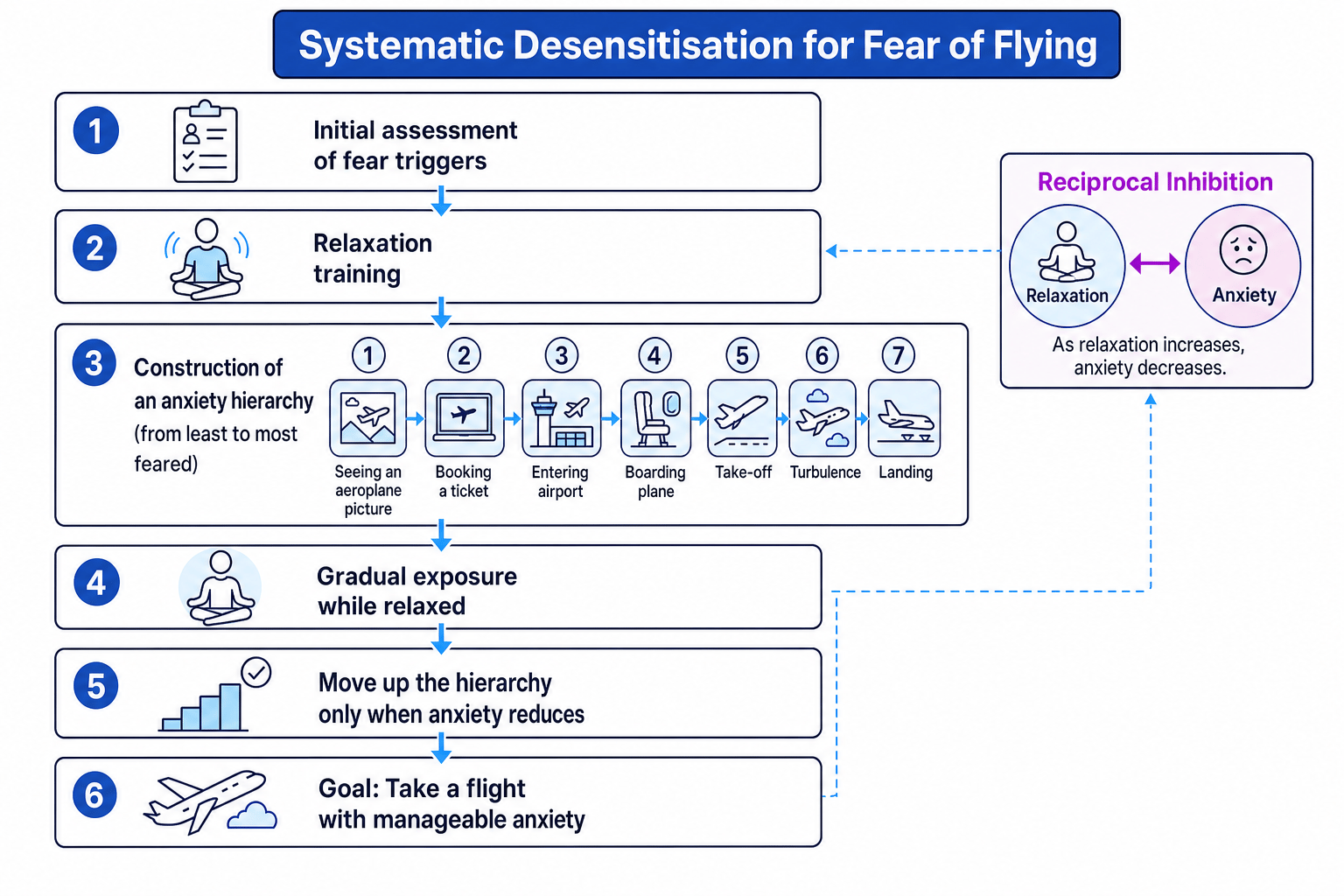
Systematic desensitisation is a behavioural therapy for phobias where the person learns relaxation skills, builds an anxiety hierarchy, and gradually faces feared stimuli while staying relaxed.
It is called systematic because the exposure is planned step by step. It is called desensitisation because the person becomes less sensitive to the feared stimulus over time.
The technique is easiest to see as a sequence:
The anxiety hierarchy
An anxiety hierarchy is a ranked list of feared situations, from least frightening to most frightening. For fear of flying, the lower steps might include looking at a picture of a plane, while the highest step might be taking an actual flight.
Reciprocal inhibition
Reciprocal inhibition
Reciprocal inhibition is the idea that relaxation and anxiety cannot easily occur at the same time. If a person is deeply relaxed while facing a feared stimulus, the anxiety response should weaken.
The therapist does not start with the most frightening step. They begin with a mild trigger and only move up the hierarchy when anxiety has reduced.
Do not confuse this with flooding
Systematic desensitisation is gradual. Flooding exposes the person to the most feared situation immediately and for a prolonged time. Capafóns et al. is linked to gradual desensitisation, not flooding.
Applying reciprocal inhibition to a flight-fear hierarchy
- A client rates “looking at a photo of a plane” as low anxiety and “take-off” as high anxiety, so the therapist places the photo near the bottom and take-off near the top of the hierarchy.
- The client practises relaxation, then imagines or views the low-anxiety item while relaxed, so relaxation competes with the fear response.
- Once anxiety reduces at that step, the therapist moves to a more difficult item, such as entering an airport, because the client has shown they can manage the previous step.
- The process continues until the client can face high-level flying stimuli, such as boarding or taking off, with more manageable anxiety.
Capafóns et al. (1998): AO1 description
Aim
The aim was to investigate whether a systematic desensitisation programme could reduce fear of flying.
In exam answers, keep the aim tightly linked to treatment: Capafóns et al. were not just describing fear of flying; they were testing whether a behavioural therapy could reduce it.
Participants and design
The study used a small clinical sample of adults with a marked fear of flying. Participants were assessed before treatment and after treatment, with follow-up used to check whether improvement lasted.
This makes it a clinical intervention study with a strong repeated-measures element, because the same people’s fear was measured across time.
Repeated-measures design
A repeated-measures design is where the same participants take part in more than one condition or are measured more than once, such as before and after therapy.
Some descriptions of the study include a waiting-list or no-treatment comparison. A waiting-list control group is a group that does not receive treatment immediately, allowing researchers to see whether improvement is due to the therapy rather than simply time passing.
Procedure
The therapy programme followed the logic of systematic desensitisation:
- Participants’ fear of flying was assessed.
- They were taught relaxation techniques.
- They constructed a hierarchy of flying-related fears.
- They were gradually exposed to flying-related stimuli while using relaxation.
- Their fear was reassessed after treatment and at follow-up.
The exposure could include imagined flight situations and realistic flight-related stimuli. The important feature is that the feared material was introduced gradually, not all at once.
Measures
Capafóns et al. used quantitative measures of fear, such as questionnaire scores about flying anxiety. A questionnaire is a set of written questions used to measure thoughts, feelings or behaviour in a standardised way.
They also looked at whether participants could manage flying-related behaviour more successfully after therapy, which is important because a therapy should improve real-life functioning, not just questionnaire scores.
Findings
The main finding was that fear of flying reduced after the systematic desensitisation programme. Participants showed lower fear scores after treatment, and improvements were generally maintained at follow-up.
The conclusion is that systematic desensitisation can be an effective treatment for fear of flying, supporting behavioural explanations and treatments of phobias.
Study takeaway
Capafóns et al. provides evidence that a learned fear can be reduced by pairing flying-related stimuli with relaxation through gradual exposure.
AO2: applying the study
If a scenario describes someone who avoids holidays, work trips or family visits because they are terrified of planes, you can apply Capafóns et al. directly.
A strong AO2 answer would say the therapist should:
- assess the person’s specific flying triggers;
- teach relaxation first;
- build a hierarchy from mild to severe flight situations;
- expose the person gradually while relaxed;
- measure improvement using fear ratings and real-life flying behaviour.
A simple application chain
For AO2, use this chain: fear trigger → relaxation → hierarchy → gradual exposure → reciprocal inhibition → reduced anxiety → improved flying behaviour.
AO3: evaluating Capafóns et al.
Strength: real-world application
A major strength is that the study has clear practical value. Fear of flying can restrict holidays, family contact and work opportunities. If systematic desensitisation reduces this fear, the treatment can improve everyday life.
This gives the study strong real-world application, because it informs actual therapy for phobias.
Strength: structured and measurable treatment
The treatment followed a structured behavioural programme, and fear was measured before and after therapy. This improves reliability because the procedure and outcome measures can be repeated.
Using standardised fear questionnaires also makes the findings easier to compare across participants.
Weakness: small and self-selected sample
A limitation is that the sample was small and likely self-selected. Self-selection means participants volunteered, often because they were motivated to receive treatment.
This reduces generalisability. People who volunteer for therapy may be more motivated than people with severe avoidance who never come forward.
Weakness: self-report data
Questionnaires can be useful, but they rely on self-report. Participants may understate or overstate their fear, especially if they want to please the therapist or show improvement.
This may reduce validity, because lower scores do not always prove the person is fully comfortable flying in real life.
Weakness: treatment package problem
Although the study is linked to systematic desensitisation, therapy programmes can include several elements, such as education, reassurance, relaxation practice and therapist support.
This makes it harder to know whether improvement was caused specifically by systematic desensitisation, or by the wider therapeutic package.
Ethics
Capafóns et al. involved people with a real fear, so ethical care was essential. Under the BPS Code of Ethics and Conduct (2009), researchers should consider consent, protection from harm, right to withdraw, confidentiality and debriefing.
The therapy was potentially beneficial, but exposure to feared stimuli could cause distress. This is why gradual exposure, informed consent, monitoring, and the right to stop are important.
Research-methods link
- Pre-treatment versus post-treatment scores for the same participants could be analysed with Wilcoxon signed-ranks.
- Therapy group versus control group scores could be analysed with Mann-Whitney U.
- Spearman’s rho would suit a correlation, such as initial fear score and amount of improvement.
- Chi-square would suit categorical data, such as flew/not flew by treatment/control group.
- The usual significance level is p≤.05p \le .05p≤.05; p≤.10p \le .10p≤.10 increases Type I error risk, while p≤.01p \le .01p≤.01 is stricter and can increase Type II error risk.
How to write this in an essay
For AO1, describe the study clearly: aim, participants, procedure, measures, findings and conclusion.
For AO3, do not just list “small sample” or “ethical issues”. Explain why each point matters. For example, a small self-selected sample matters because the findings may not generalise to all people with fear of flying.
In the exam
- Name the study and year early: Capafóns et al. (1998).
- Link the study to the treatment mechanism: relaxation plus gradual exposure leads to reciprocal inhibition.
- For AO3, use developed points: state the strength/weakness, explain it, and link it back to validity, generalisability, ethics or application.
- If applying to a scenario, tailor the hierarchy to the person’s specific flying fears rather than giving a generic therapy description.
Check yourself
- How does reciprocal inhibition explain the reduction of fear in systematic desensitisation?
- What were Capafóns et al. trying to find out in their 1998 study?
- Give one strength and one limitation of using a small clinical sample in this study.
