What you'll learn
- What psychologists mean by diagnosis and mental disorder.
- How the four Ds — deviance, dysfunction, distress and danger — help clinicians judge whether behaviour may be abnormal.
- How to apply the four Ds to short scenarios for AO2.
- Key AO3 evaluation points: culture, subjectivity, stigma and ethics.
Why diagnosis needs careful judgement
In clinical psychology, diagnosis means identifying and naming a mental disorder based on a person’s symptoms, behaviour and experiences. Diagnosis matters because it can guide treatment, support access to services, and help professionals communicate clearly.
However, diagnosing mental disorders is not as simple as doing a blood test. Clinicians often have to interpret what a person says, how they behave, how long the problem has lasted, and how much it affects everyday life.
Mental disorder
A mental disorder is a pattern of thoughts, emotions or behaviours that causes significant problems for the person or others, often involving distress, impaired functioning, or increased risk of harm.
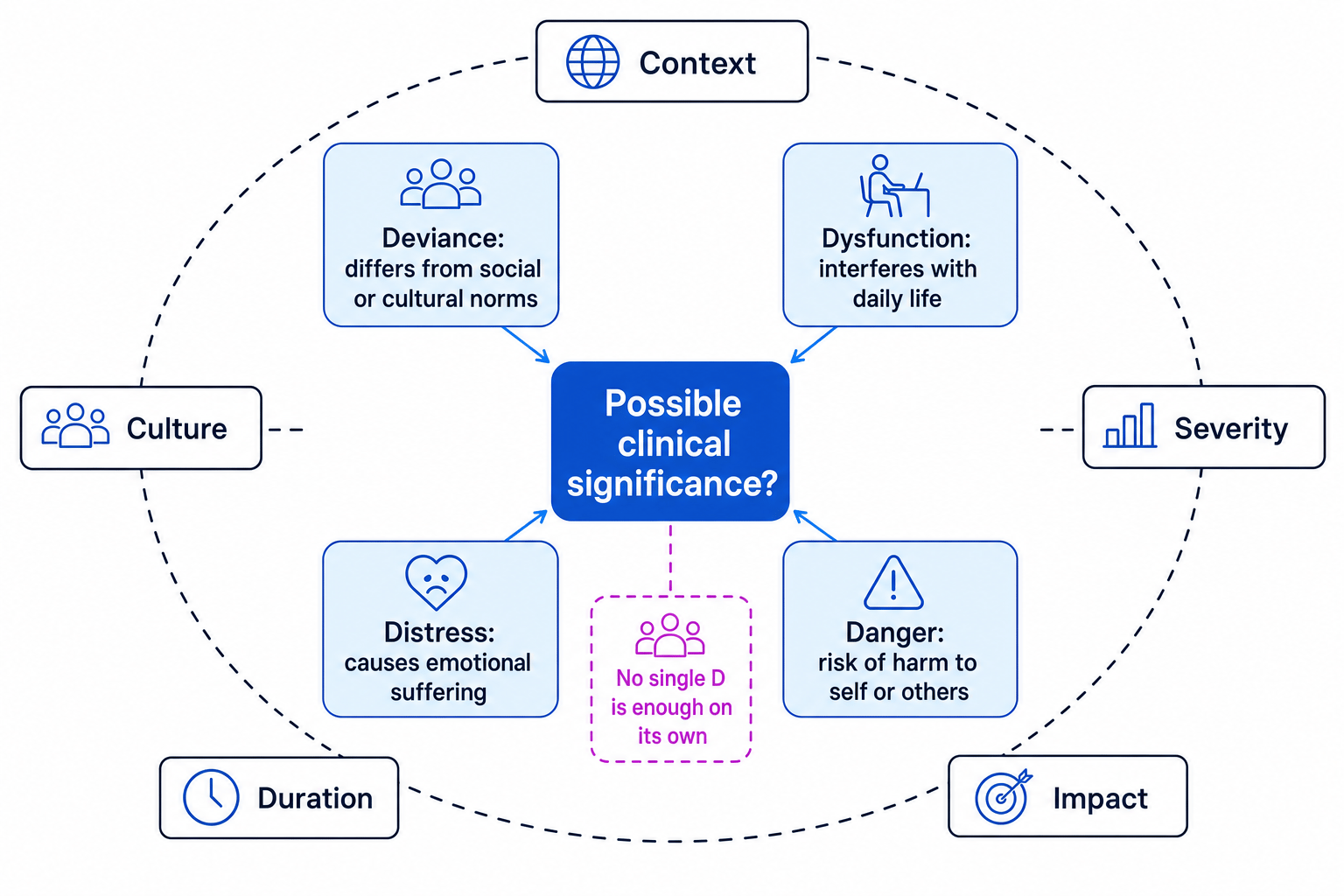
Diagnosis usually works alongside classification systems such as the DSM and ICD, which list recognised mental disorders and their diagnostic criteria. The four Ds are a useful starting framework for deciding whether a behaviour may be clinically significant.
The 4 Ds are prompts, not a checklist
The four Ds help you think like a clinician, but no single D automatically proves that someone has a mental disorder. Context, culture, severity and duration all matter.
The four Ds work best as a balanced framework: deviance, dysfunction, distress and danger each highlight a different reason why behaviour might need clinical attention.

The first D: Deviance
Deviance
Deviance means behaviour, thoughts or emotions that differ from social or cultural norms.
A social norm is an unwritten rule about what behaviour is expected in a particular society or group. For example, talking quietly in a library is a social norm. A cultural norm is an expectation shaped by a culture’s beliefs, traditions and values.
In diagnosis, deviance asks: Is this behaviour unusual compared with what is expected in this context?
This can include behaviour that is statistically rare, socially unexpected, or culturally unusual. However, unusual does not always mean disordered. Creative, religious, political or non-conforming behaviour may be deviant from the majority without being a mental disorder.
Judging deviance in context
A person says they hear the voice of a deceased relative during a religious ceremony.
- Compare the behaviour with the relevant norm: hearing voices may be considered unusual in many everyday settings.
- Check the context: if the experience occurs during a culturally accepted religious ritual, it may fit the person’s cultural expectations.
- Avoid over-diagnosis: deviance alone is weak evidence unless the experience is also causing distress, dysfunction or danger.
Treating deviance as automatically abnormal
Do not write “deviant behaviour means mental illness.” A stronger answer says deviance may be a sign of disorder, but only when considered alongside context and the other Ds.
The second D: Dysfunction
Dysfunction
Dysfunction means a person’s thoughts, emotions or behaviours interfere with everyday functioning.
Everyday functioning includes things like studying, working, sleeping, eating, maintaining hygiene, managing relationships, keeping safe, and carrying out normal responsibilities.
Dysfunction is often one of the most important clinical indicators because it shows that the problem is not just unusual — it is affecting the person’s ability to live their life.
Identifying dysfunction
A student spends three hours each morning checking that doors and windows are locked. They are often late to college and their grades have dropped.
- Identify the life areas affected: the checking behaviour interferes with education, punctuality and daily routine.
- Judge the degree of impairment: spending three hours each morning suggests the behaviour is severe enough to disrupt normal functioning.
- Link to diagnosis carefully: dysfunction supports the possibility of a mental disorder, especially if it is persistent and combined with distress or other symptoms.
Dysfunction is not always obvious. Some people may appear successful at work or school while privately struggling with sleep, relationships or self-care.
The third D: Distress
Distress
Distress means emotional suffering, discomfort or upset experienced by the person, or sometimes by people around them.
Distress is important because many people seek help when their thoughts or emotions feel unbearable. Examples include intense anxiety, sadness, guilt, fear, shame or emotional numbness.
However, distress must be interpreted carefully. Feeling distressed after bereavement, exams, conflict or relationship breakdown can be a normal response to life events. The key question is whether the distress is intense, long-lasting, disproportionate, or linked to other signs of disorder.
Interpreting distress after a life event
A person feels tearful and anxious for a week after a relationship ends, but continues attending college and seeing friends.
- Identify the distress: the person is clearly upset and anxious.
- Consider the trigger: a relationship ending is a meaningful life event, so some distress is expected.
- Look for clinical significance: because functioning is mostly maintained and the distress is recent, this example alone may not strongly indicate a mental disorder.
Distress is not always present
Some disorders may involve limited insight. For example, a person experiencing mania may not feel distressed even though their behaviour is risky or highly dysfunctional.
The fourth D: Danger
Danger
Danger means behaviour or experiences that increase the risk of harm to the person themselves or to other people.
Danger can include suicidal thoughts, self-harm, severe self-neglect, reckless behaviour, or aggression. In clinical settings, risk assessment is important because professionals have a duty to protect the person and others.
But danger must be handled sensitively. Most people with mental disorders are not dangerous to others, and linking mental illness too strongly with violence can increase stigma.
Assessing danger without stigma
A person says they “do not want to be here anymore” and has been collecting large quantities of medication.
- Identify the risk evidence: the statement suggests possible suicidal thoughts, and collecting medication may increase risk of self-harm.
- Separate risk from diagnosis: danger shows urgent need for support, but it does not by itself identify which disorder, if any, is present.
- Combine with the other Ds: a clinician would also assess distress, dysfunction, symptoms, duration and context before making a diagnosis.
Safety comes before labelling
In real clinical practice, immediate risk of harm requires urgent support and safeguarding. The diagnostic label is less important than protecting the person from harm.
Putting the 4 Ds together
The four Ds are strongest when used together. A behaviour may be unusual but harmless; distressing but temporary; risky but not caused by a mental disorder; or dysfunctional without being socially deviant.
A good diagnostic judgement considers:
- Severity — how intense the symptoms or behaviours are.
- Duration — how long they have continued.
- Context — what situation the person is in.
- Culture — whether the behaviour fits cultural beliefs or practices.
- Impact — how much the person’s life is affected.
Combining the four Ds
A person has stopped going to work, avoids friends, says they feel worthless, and has stopped washing regularly.
- Apply dysfunction: not attending work, withdrawing from friends and neglecting hygiene show impaired everyday functioning.
- Apply distress: feeling worthless suggests emotional suffering and possible low mood.
- Check deviance and context: the behaviour may be unusual compared with the person’s previous functioning, but you would still consider recent life events or cultural factors.
- Consider danger: neglecting hygiene is not automatically dangerous, but clinicians would assess self-neglect and possible suicidal thoughts.
- Reach a cautious judgement: the combination of dysfunction and distress suggests clinical concern, but diagnosis would require a fuller assessment using recognised criteria.
AO3: Evaluating the 4 Ds
Strength: A broad and practical framework
The 4 Ds are useful because they encourage clinicians to consider more than one sign of abnormality. This is more balanced than relying only on whether behaviour is unusual. For example, dysfunction highlights the real-life impact of symptoms, while distress focuses on the person’s subjective experience.
This gives the framework good real-world application: it can help clinicians, teachers, carers and support workers recognise when someone may need help.
Weakness: Cultural norms can bias diagnosis
Deviance depends heavily on social and cultural expectations. Behaviour seen as abnormal in one culture may be accepted or valued in another. This means diagnosis can be affected by cultural bias, where one culture’s norms are treated as the standard for judging everyone else.
A strong AO3 point is that deviance can pathologise difference. For example, homosexuality was historically treated as a disorder in earlier diagnostic systems, but this reflected social attitudes rather than genuine mental illness.
Weakness: The Ds involve subjective judgement
The four Ds are not perfectly objective. Different clinicians may disagree about how much distress or dysfunction is “significant”. This links to reliability, which means consistency of diagnosis between clinicians or across time.
Named research you may meet later, such as Rosenhan’s 1973 study, is often used to question whether psychiatric diagnosis can be reliable and free from labelling effects. For this content point, you only need the basic link: diagnostic judgements can be influenced by interpretation and expectations.
Weakness: Danger can increase stigma
The danger criterion is clinically important, but it can create a misleading association between mental disorder and violence. This is ethically important because stigma can make people less likely to seek help.
A balanced answer should say danger is relevant for risk assessment, especially for self-harm or self-neglect, but it should not dominate diagnosis.
Ethical issues in diagnosis
Diagnosis can help people access treatment, but it also gives them a label. Ethical practice should follow principles from the BPS Code of Ethics and Conduct, including respect, competence, responsibility and integrity.
In practical terms, this means clinicians should aim for informed consent, confidentiality, protection from harm, sensitive communication, and clear explanation of what a diagnosis means. If diagnosis is being studied in research, participants should also have the right to withdraw and receive an appropriate debrief, especially if deception is used.
In the exam
- For AO1, define each D clearly: deviance, dysfunction, distress and danger.
- For AO2, apply the Ds directly to the scenario rather than just listing them.
- For AO3, evaluate the framework using culture, subjectivity, stigma and ethical issues.
- Avoid saying one D is enough for diagnosis; stronger answers stress severity, duration and context.
Check yourself
- Why might deviance be a weak criterion if it is used on its own?
- How is dysfunction different from distress?
- Why should psychologists be careful when using danger as part of diagnosis?