What you'll learn
- How biological explanations link addiction to neurotransmitters, receptors and the brain’s reward pathway.
- The mode of action for alcohol, heroin and nicotine addiction.
- How tolerance and withdrawal help maintain addiction.
- How to evaluate these explanations using research evidence, ethics and treatment applications.
Starting point: what is a biological explanation?
A biological explanation explains behaviour in terms of physical processes in the body, especially the brain, nervous system, hormones, genes and neurotransmitters.
For drug addiction, the key idea is that addictive drugs change communication between neurons and affect the brain’s reward system. This can make the drug feel rewarding at first, then necessary to avoid unpleasant withdrawal symptoms.
Drug addiction
Drug addiction is a pattern of compulsive drug use where a person finds it difficult to stop despite harmful consequences. It often involves craving, tolerance and withdrawal.
Mode of action
A drug’s mode of action is the specific biological way it works in the body, such as which receptor it binds to or which neurotransmitter system it changes.
The basic brain chemistry you need
Neurotransmitters and receptors
A neurotransmitter is a chemical messenger released by one neuron to communicate with another neuron. A receptor is a specialised site on a neuron that a neurotransmitter, or a drug, can bind to.
Some drugs act as agonists, meaning they increase or mimic the action of a neurotransmitter. Other drugs act as antagonists, meaning they block or reduce a neurotransmitter’s action.
The reward pathway
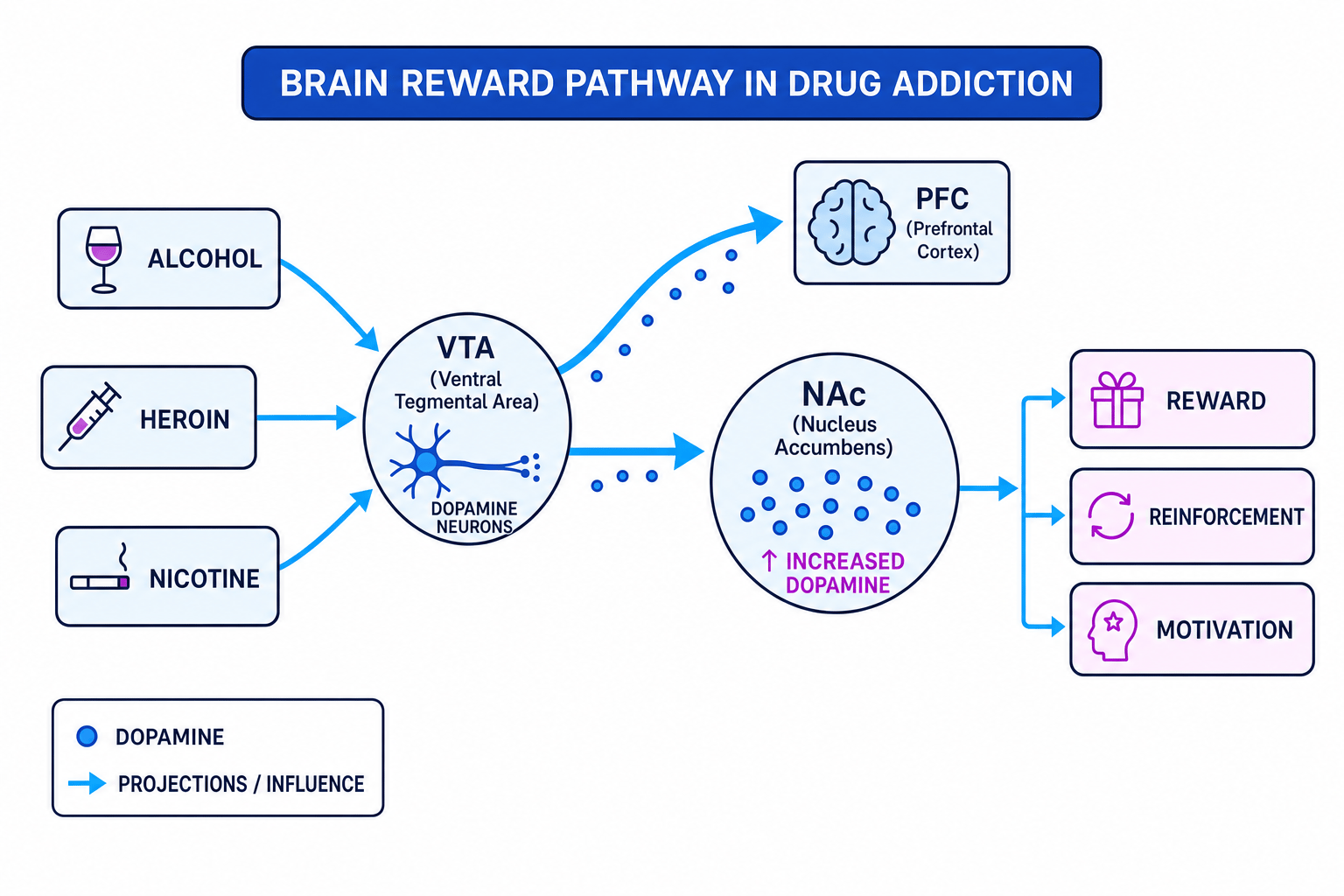
The reward pathway most often discussed in addiction is the mesolimbic dopamine pathway. It includes:
- The ventral tegmental area (VTA), where many dopamine-producing neurons begin.
- The nucleus accumbens (NAc), which is involved in reward, motivation and reinforcement.
- The prefrontal cortex (PFC), which is involved in planning, decision-making and self-control.
Dopamine is a neurotransmitter involved in reward learning, motivation and reinforcement. It is not simply a “pleasure chemical”; it helps the brain learn that something is important and worth repeating.
The shared biological chain
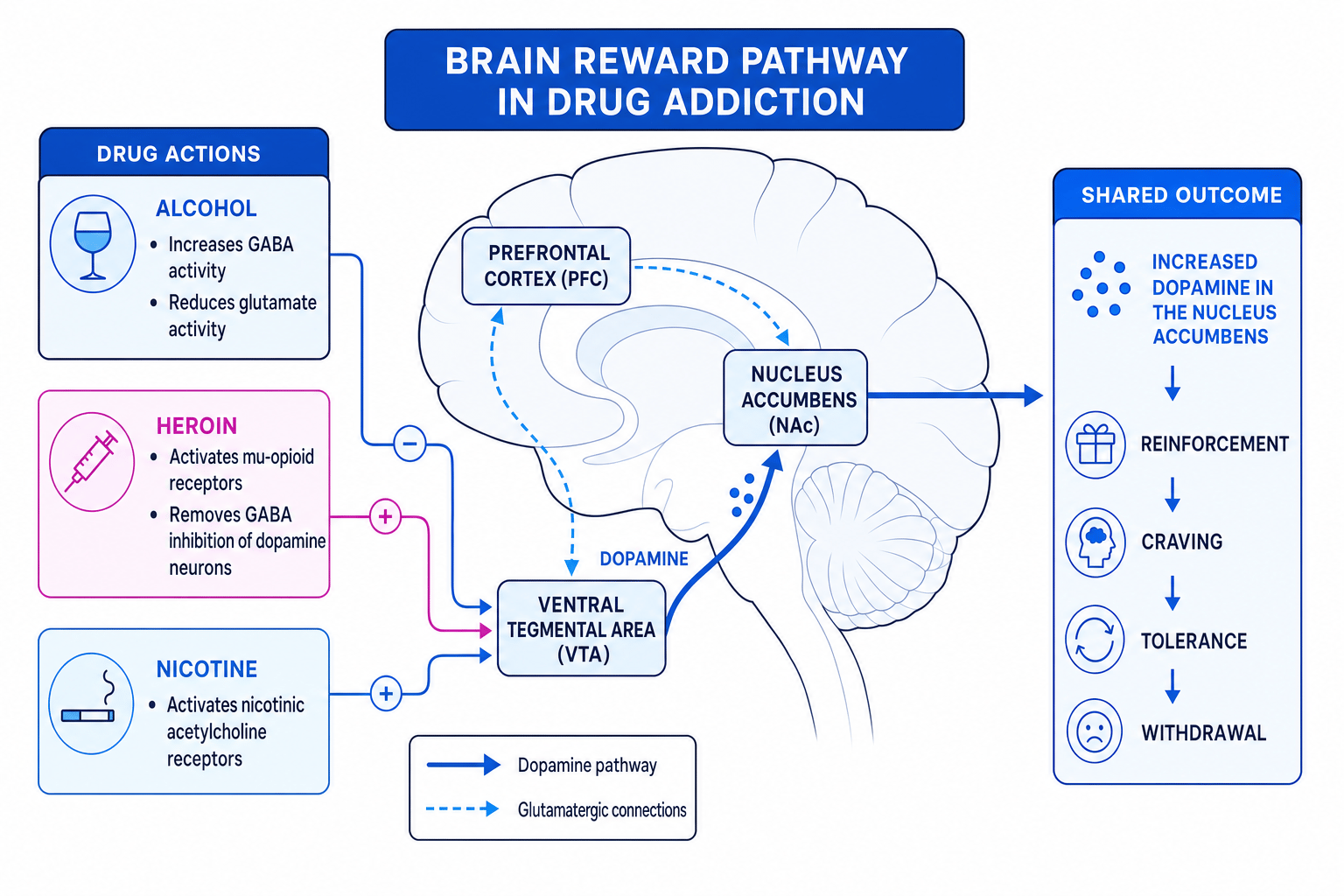
For many addictive drugs, the core chain is: drug action at receptors → increased dopamine activity in the reward pathway → reinforcement → brain adaptation → tolerance and withdrawal.
Tolerance, withdrawal and reinforcement
Tolerance means the person needs more of the drug to get the same effect. This happens because the brain tries to maintain balance, called homeostasis, by adapting to repeated drug use.
Withdrawal refers to unpleasant physical and psychological symptoms that happen when the drug is reduced or stopped.
Two types of reinforcement help maintain addiction:
- Positive reinforcement: the drug use is repeated because it produces a rewarding effect, such as euphoria or relaxation.
- Negative reinforcement: the drug use is repeated because it removes an unpleasant state, such as withdrawal anxiety or pain.
Linking drug action to dependence
- Identify the first biological effect: a drug changes neurotransmitter activity in the reward pathway, often increasing dopamine in the nucleus accumbens.
- Explain why the behaviour is repeated: the dopamine response reinforces drug-taking, so the person is more likely to seek the drug again.
- Add the long-term adaptation: with repeated use, the brain compensates, so the person develops tolerance and experiences withdrawal when the drug is absent.
Alcohol addiction: GABA, glutamate and dopamine
Alcohol is a central nervous system depressant, meaning it slows activity in the brain and nervous system.
Its main biological explanation involves two neurotransmitter systems:
- GABA: an inhibitory neurotransmitter, meaning it reduces neural activity.
- Glutamate: an excitatory neurotransmitter, meaning it increases neural activity.
Alcohol increases GABA activity and reduces glutamate activity, especially at NMDA-type glutamate receptors. This helps explain the short-term effects of alcohol, such as relaxation, reduced anxiety, slower reaction times and impaired judgement.
Alcohol also increases dopamine activity in the reward pathway, which helps explain why drinking can be reinforcing.
With repeated heavy drinking, the brain adapts. It may reduce sensitivity to GABA and increase glutamate activity to compensate for alcohol’s depressant effects. When alcohol is removed, the nervous system can become overactive, producing withdrawal symptoms such as anxiety, shaking, sweating, insomnia and, in severe cases, seizures.
Explaining alcohol withdrawal
- Link alcohol to its mode of action: alcohol increases inhibitory GABA activity and reduces excitatory glutamate activity.
- Apply neuroadaptation: after repeated drinking, the brain compensates by becoming less responsive to inhibition and more prepared for excitation.
- Explain withdrawal: when alcohol is absent, the compensatory excitation is no longer balanced by alcohol, so the person may feel anxious, shaky or physically over-aroused.
Heroin addiction: opioid receptors and dopamine disinhibition
Heroin is an opioid drug. It is converted into morphine in the body and binds to mu-opioid receptors.
The body naturally produces opioid-like chemicals called endorphins, which help reduce pain and can produce feelings of wellbeing. Heroin mimics these natural chemicals but has a much stronger effect.
A key part of heroin’s mode of action happens in the VTA. Normally, some GABA neurons act like a brake on dopamine neurons. Heroin activates mu-opioid receptors on these GABA neurons, reducing GABA release. This “removes the brake”, so dopamine neurons fire more strongly and more dopamine is released in the nucleus accumbens.
This produces powerful reinforcement. Over time, the brain adapts by reducing natural opioid activity and changing receptor sensitivity. This contributes to tolerance and severe withdrawal symptoms, including pain, nausea, sweating, diarrhoea, anxiety and intense craving.
Heroin and GABA
Do not write that heroin simply “increases GABA”. In the reward pathway, heroin reduces GABA’s inhibitory effect on dopamine neurons, which indirectly increases dopamine release.
Explaining heroin reinforcement
- Identify the receptor action: heroin acts as an agonist at mu-opioid receptors.
- Trace the pathway effect: activation of these receptors reduces GABA inhibition of dopamine neurons in the VTA.
- Link to addiction: increased dopamine in the nucleus accumbens reinforces heroin-taking, while later withdrawal negatively reinforces further use.
Nicotine addiction: acetylcholine receptors and rapid reinforcement
Nicotine is the main addictive substance in tobacco. When smoked, it reaches the brain very quickly, often within seconds. This rapid delivery makes the link between smoking and reward especially strong.
Nicotine’s mode of action is that it acts as an agonist at nicotinic acetylcholine receptors, often shortened to nAChRs. Acetylcholine is a neurotransmitter involved in attention, arousal and muscle activity.
Nicotine activates nAChRs on dopamine neurons in the VTA. This increases dopamine release in the nucleus accumbens, reinforcing smoking.
With repeated exposure, nicotine receptors can become desensitised, meaning they respond less strongly for a time. The brain may also increase the number of nicotinic receptors, called upregulation. When nicotine levels fall, the person may experience cravings, irritability, low mood and poor concentration. Smoking again temporarily relieves these symptoms.
Explaining nicotine cravings
- Start with the drug target: nicotine binds to nicotinic acetylcholine receptors in the brain.
- Connect to reward: activation of these receptors increases dopamine activity in the reward pathway, strengthening the smoking habit.
- Explain craving: when nicotine levels drop, altered receptor activity contributes to withdrawal symptoms, so smoking is negatively reinforced by relief.
Quick comparison
| Drug | Main biological target | Immediate effect | How addiction is maintained |
|---|---|---|---|
| Alcohol | GABA and glutamate systems | Relaxation, reduced anxiety, slowed nervous system activity | Dopamine reinforcement, tolerance, withdrawal from nervous system overactivity |
| Heroin | Mu-opioid receptors | Euphoria, pain relief, dopamine increase through disinhibition | Powerful reward, reduced natural opioid activity, severe withdrawal |
| Nicotine | Nicotinic acetylcholine receptors | Increased arousal and dopamine release | Rapid reinforcement, receptor desensitisation/upregulation, cravings |
A strong AO1 chain
For each drug, write in this order: drug → receptor/neurotransmitter → reward pathway → tolerance/withdrawal → continued use.
AO3: evaluating biological explanations
Strength: research support
There is strong evidence that addictive drugs affect the reward pathway. Olds and Milner (1954) found that rats would repeatedly press a lever to stimulate reward areas of the brain. Di Chiara and Imperato (1988) used animal research to show that addictive drugs can increase dopamine activity in the nucleus accumbens.
This supports the idea that drug addiction has a biological basis, especially involving dopamine and reinforcement.
Strength: real-world applications
Biological explanations have led to useful treatments.
For alcohol addiction, drugs such as acamprosate may help stabilise glutamate and GABA systems, while naltrexone blocks opioid receptors and can reduce the rewarding effects of alcohol.
For heroin addiction, methadone and buprenorphine can reduce cravings and withdrawal because they act on opioid receptors in a more controlled way. Naloxone can reverse opioid overdose.
For nicotine addiction, nicotine replacement therapy gives nicotine more slowly and safely than cigarettes, while varenicline partially stimulates nicotinic receptors and reduces the reward from smoking.
Weakness: reductionism
A biological explanation can be reductionist, meaning it may oversimplify addiction by focusing mainly on brain chemistry. Addiction is also affected by learning, stress, mental health, peer influence, availability, culture and poverty.
For example, two people may take the same drug, but only one develops addiction. This suggests that biology matters, but it is not the whole explanation.
Weakness: dopamine is not the whole story
The dopamine explanation is useful, but not complete. Robinson and Berridge’s incentive-sensitisation theory argues that dopamine may be more about “wanting” and craving than simple pleasure or “liking”.
This helps explain why people may continue taking a drug even when it no longer feels very enjoyable.
Methodological and ethical issues
Much evidence comes from animal studies because researchers can control drug dose, brain measurement and environment. However, animal findings may not fully generalise to humans, whose addiction is shaped by conscious decision-making, social context and personal meaning.
Animal research also raises ethical concerns because it may involve inducing dependence or withdrawal. Human research into addiction must follow the BPS Code of Ethics and Conduct (2009), including valid consent, protection from harm, confidentiality, the right to withdraw, careful use of deception and full debriefing.
Avoid determinism
Do not imply that brain chemistry makes addiction inevitable. A better answer says biological vulnerability and drug action increase risk, but behaviour is still influenced by psychological and social factors.
In the exam
- For AO1, describe the precise mode of action: name the neurotransmitter or receptor, then link it to dopamine in the reward pathway.
- For AO2, apply symptoms carefully: tolerance means needing more; withdrawal means unpleasant effects when the drug is absent.
- For AO3, balance evidence and application with limitations such as reductionism, animal generalisation issues and ethics.
Check yourself
- How does alcohol’s effect on GABA and glutamate help explain withdrawal?
- Why does heroin indirectly increase dopamine in the nucleus accumbens?
- How does nicotine’s action at acetylcholine receptors help explain cravings?