What you'll learn
- What psychologists mean by addiction, tolerance, dependence and withdrawal.
- How biological, psychological and social factors can combine to maintain drug-taking behaviour.
- Why dependence is not just “liking a drug” or “having poor willpower”.
- How to explain these issues in AO1, apply them in AO2, and evaluate them in AO3.
Why drug taking becomes an issue
Some people take drugs occasionally without becoming addicted. For others, drug use becomes difficult to control, continues despite harm, and causes distress or impairment in everyday life.
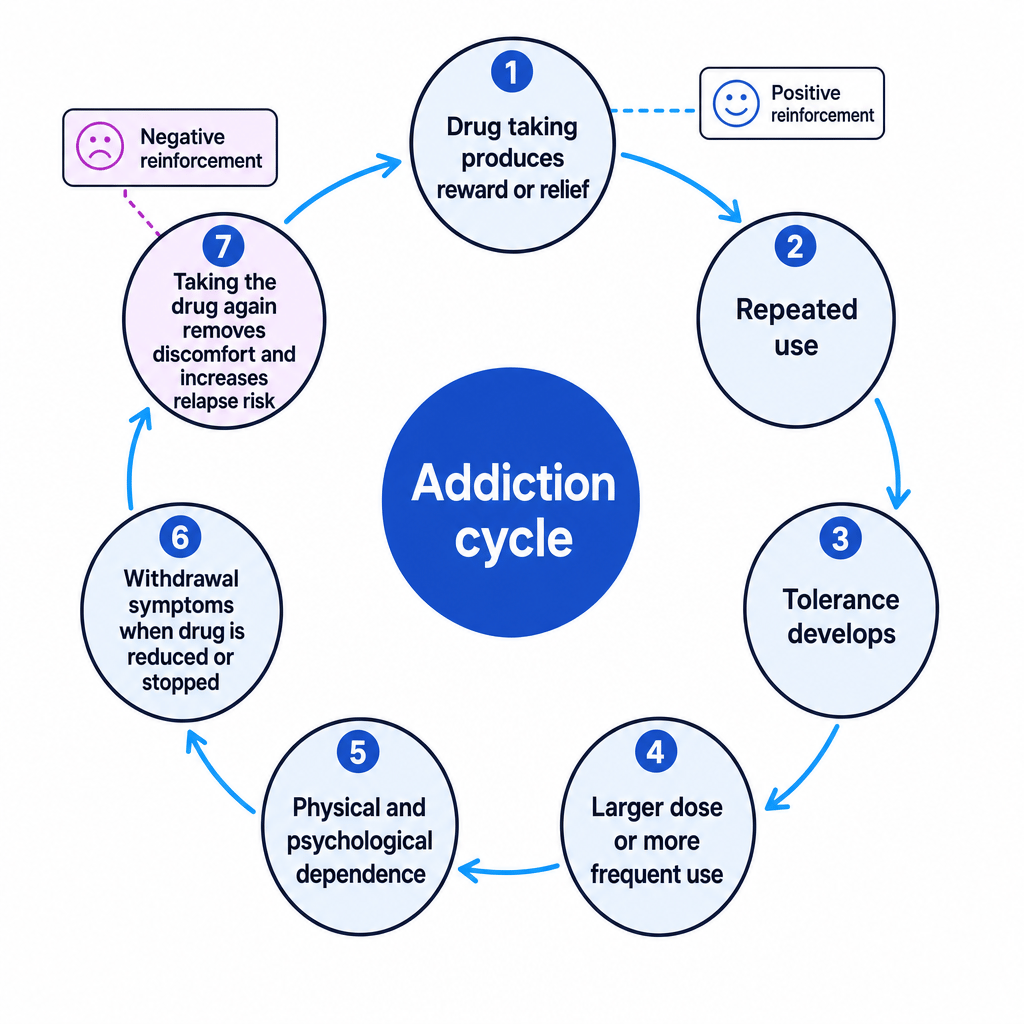
In A-Level Psychology, the key idea is that drug taking can become a cycle: the person takes the drug, experiences rewarding effects, adapts to the drug, needs more to get the same effect, and may then experience unpleasant symptoms when they stop.
Drug
A drug is a substance that changes the way the body or brain functions. In this topic, this usually means psychoactive drugs: substances that affect mood, perception, thinking or behaviour.
Drugs may be legal, such as alcohol and nicotine, or illegal, such as heroin or cocaine. Some prescription drugs can also become addictive if misused.
Addiction
Addiction
Addiction is a repeated pattern of drug use where a person has difficulty controlling use, continues despite negative consequences, and may experience craving, dependence and withdrawal.
Addiction is not simply “using a drug a lot”. It involves a loss of control and the drug becoming unusually important in the person’s life. A person may keep using even when it damages their health, relationships, work, education or finances.
Main features of addiction
Common features include:
- Compulsion: feeling driven to take the drug.
- Craving: a strong desire or urge to use.
- Salience: the drug becomes a central priority.
- Reduced control: difficulty cutting down or stopping.
- Continued use despite harm: use carries on even after clear negative consequences.
- Relapse: returning to drug use after trying to stop.
Addiction is more than pleasure
Addiction often starts with positive reinforcement, where the drug produces a rewarding effect. Over time, it may be maintained by negative reinforcement, where the person takes the drug to avoid withdrawal, anxiety, low mood or craving.
Reward and reinforcement
Many addictive drugs influence the brain’s reward system, including dopamine pathways. Dopamine is a neurotransmitter, which means a chemical messenger used by neurons to communicate. It is associated with reward, motivation and learning.
Classic biological research by Olds and Milner (1954) showed that rats would repeatedly press a lever to stimulate reward-related brain areas. Although this was an animal study rather than a study of human drug addiction, it helped psychologists understand why rewarding experiences can become powerfully motivating.
Explaining addiction in a short scenario
A student says: “My cousin started smoking socially, but now he smokes before college, during breaks and when stressed. He says he wants to stop, but he gets irritable and anxious when he tries.”
- The behaviour shows reduced control because he wants to stop but finds it difficult.
- Smoking has become salient because it occurs across several parts of the day, including before college and during breaks.
- Irritability and anxiety when stopping suggest withdrawal, so the smoking may now be maintained by negative reinforcement.
Tolerance
Tolerance
Tolerance occurs when repeated drug use causes the same dose to have a weaker effect, so the person needs more of the drug to achieve the previous effect.
Tolerance happens because the body and brain adapt. For example, receptors may become less sensitive, or the body may process the drug more efficiently. This means the original dose no longer produces the same level of reward or relief.
Why tolerance matters
Tolerance can increase risk. If someone takes higher doses, they may be more likely to experience overdose, poisoning or severe side effects. With drugs such as opioids, this can be life-threatening.
Tolerance can also create psychological pressure: the person may interpret the weaker effect as a reason to take more, rather than as a sign that their body has adapted.
Tolerance is not the same as dependence
Tolerance means the drug has a reduced effect at the same dose. Dependence means the person feels they need the drug to function normally or avoid discomfort. They often occur together, but they are not identical.
Recognising tolerance
A person used to feel relaxed after one alcoholic drink. After months of regular drinking, they need three or four drinks to feel the same level of relaxation.
- Compare the original dose with the later dose: one drink has increased to three or four drinks.
- Compare the effect being sought: the same relaxation is wanted.
- Because a larger amount is needed for the same effect, this is tolerance.
Physical dependence
Physical dependence
Physical dependence occurs when the body adapts to a drug so that the drug becomes needed for normal bodily functioning. If the drug is reduced or stopped, physical withdrawal symptoms occur.
Physical dependence is especially associated with substances such as alcohol, opioids and benzodiazepines. It shows that the body has changed in response to repeated drug exposure.
Physical dependence can include changes in sleep, appetite, heart rate, sweating, shaking, nausea or pain sensitivity. In severe cases, withdrawal from some drugs can be medically dangerous, which is why supervised treatment may be needed.
Stopping suddenly can be risky
Withdrawal from some substances, especially heavy alcohol use or some sedative drugs, can be dangerous. In real life, people may need medical support rather than simply being told to “stop”.
Psychological dependence
Psychological dependence
Psychological dependence occurs when a person feels they need a drug for emotional, cognitive or social reasons, such as coping with stress, feeling confident or avoiding cravings.
Psychological dependence can be very powerful even when physical withdrawal symptoms are mild. A person may believe they cannot relax, socialise, sleep, study or cope without the drug.
For example, someone may use cannabis every evening because they believe it is the only way they can calm down. Another person may use stimulants because they feel unable to perform socially or academically without them.
Physical vs psychological dependence
Physical and psychological dependence often overlap, but they focus on different aspects:
- Physical dependence: the body has adapted; stopping causes bodily symptoms.
- Psychological dependence: the person’s thoughts, emotions or routines become tied to the drug.
Quick comparison
If the stem focuses on symptoms such as shaking, sweating, nausea or seizures, think physical dependence. If it focuses on coping, confidence, craving, habits or beliefs, think psychological dependence.
Distinguishing dependence types
A person says they cannot sleep without sleeping tablets. When they try to stop, they feel panicky, believe they will not cope, and also experience sweating and trembling.
- Sweating and trembling are bodily symptoms, so they suggest physical dependence.
- Panic and the belief “I will not cope” involve thoughts and emotions, so they suggest psychological dependence.
- The scenario includes both types, so an accurate answer should not force it into only one category.
Withdrawal
Withdrawal
Withdrawal is the set of unpleasant physical and/or psychological symptoms that occur when a dependent person reduces or stops taking a drug.
Withdrawal can include physical symptoms, such as headaches, nausea, sweating, shaking, fatigue or sleep disturbance. It can also include psychological symptoms, such as irritability, anxiety, low mood, craving and difficulty concentrating.
Withdrawal helps maintain addiction because taking the drug again can remove the unpleasant symptoms. This is negative reinforcement, because the behaviour is strengthened by removing something unpleasant.
Withdrawal and relapse
A relapse is a return to drug use after a period of reduction or abstinence. Withdrawal increases relapse risk because the person may take the drug again to feel “normal” or to escape distress.
Contemporary addiction theory, such as Koob and Le Moal’s (1997) model of addiction, argues that long-term drug use can shift motivation from seeking pleasure to avoiding negative emotional states. This helps explain why some people continue using even when the drug no longer feels especially enjoyable.
Withdrawal as negative reinforcement
A person trying to stop nicotine feels irritable and restless. After smoking a cigarette, the irritability reduces.
- Identify the unpleasant state: irritability and restlessness.
- Identify the behaviour that removes it: smoking a cigarette.
- Because smoking is strengthened by removing discomfort, this is negative reinforcement.
How the issues connect
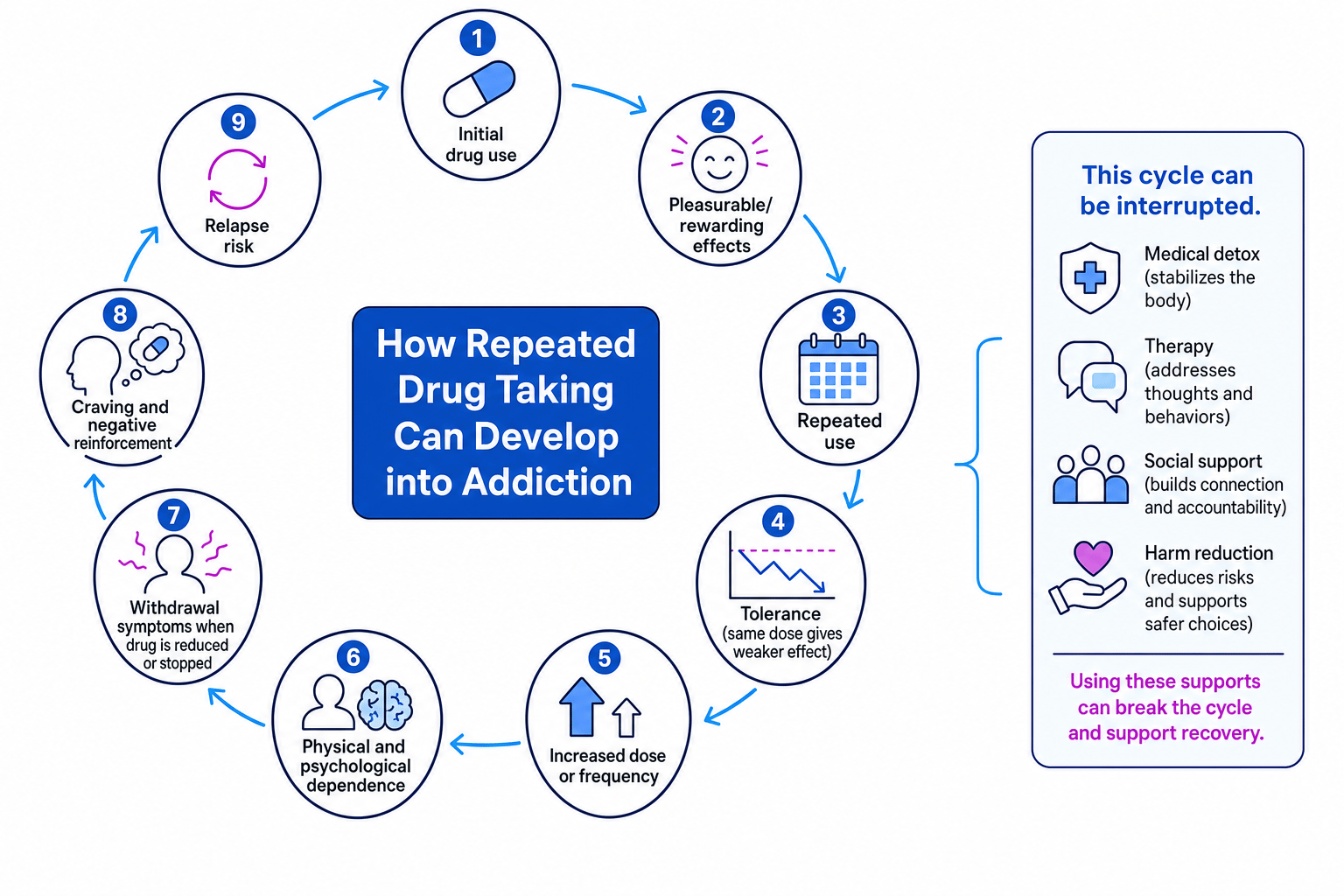
Addiction, tolerance, dependence and withdrawal are separate terms, but in real life they often interact.
A simplified sequence might be:
- A person takes a drug and experiences reward or relief.
- Repeated use leads to tolerance.
- The person increases dose or frequency.
- The body and mind become dependent.
- Stopping causes withdrawal.
- The person takes the drug again to reduce withdrawal.
- This strengthens the addictive cycle.
The cycle can be broken
Addiction is difficult, but not fixed or hopeless. Treatments such as medication, psychological therapy, social support and harm reduction can interrupt the cycle at different points.
AO3 evaluation
Strength: explains why stopping is difficult
A strength of these concepts is that they explain why drug addiction is not just a matter of “choosing badly”. Tolerance, dependence and withdrawal show that repeated drug use can involve biological and psychological changes. This is useful because it supports more compassionate treatment approaches.
Strength: real-world applications
Understanding withdrawal and dependence has practical value. For example, nicotine replacement therapy can reduce withdrawal symptoms, while psychological therapies can target cravings, coping beliefs and triggers. Harm reduction approaches can also reduce risk even if a person is not yet abstinent.
Weakness: not everyone follows the same pattern
A limitation is that addiction does not develop in exactly the same way for everyone. Some people develop psychological dependence without severe physical withdrawal. Others experience tolerance but do not meet criteria for addiction. This means exam answers should avoid presenting the cycle as automatic or inevitable.
Weakness: social context matters too
A purely biological account may ignore social factors such as poverty, peer influence, stress, trauma, availability of drugs and cultural attitudes. For AO3, you can argue that a biopsychosocial approach is stronger because it combines biological, psychological and social explanations.
Methodological and ethical issues
Research into drug taking can be difficult because it often relies on self-report, and people may under-report illegal or socially undesirable behaviour. Laboratory studies may control variables well but lack ecological validity if they do not reflect real-world drug use.
Ethically, research and treatment must consider informed consent, confidentiality, protection from harm, right to withdraw and debriefing, in line with the BPS Code of Ethics and Conduct (2009). This is especially important because people with addictions may be vulnerable participants.
In the exam
- Define the key term first: addiction, tolerance, physical dependence, psychological dependence or withdrawal.
- Apply the term directly to the scenario using evidence from the stem, rather than writing a generic paragraph.
- For AO3, avoid moral judgement; evaluate using evidence, individual differences, real-world applications and ethical issues.
Check yourself
- How is tolerance different from physical dependence?
- Why can withdrawal make relapse more likely?
- What is one strength and one limitation of explaining addiction through tolerance and dependence?