What you'll learn
- How juries are supposed to make verdict decisions using evidence and the judge’s directions.
- How defendant characteristics such as attractiveness, race/ethnicity, accent and emotional expression may influence jurors.
- How pre-trial publicity can bias jurors before a case even begins.
- How to evaluate studies in this area using AO3 points such as realism, ethics and real-world application.
The starting point: what does a jury do?
In serious criminal cases in the Crown Court, a jury is usually a group of 12 members of the public who hear evidence and decide whether the defendant is guilty or not guilty. The judge explains the law, but the jury decides the verdict.
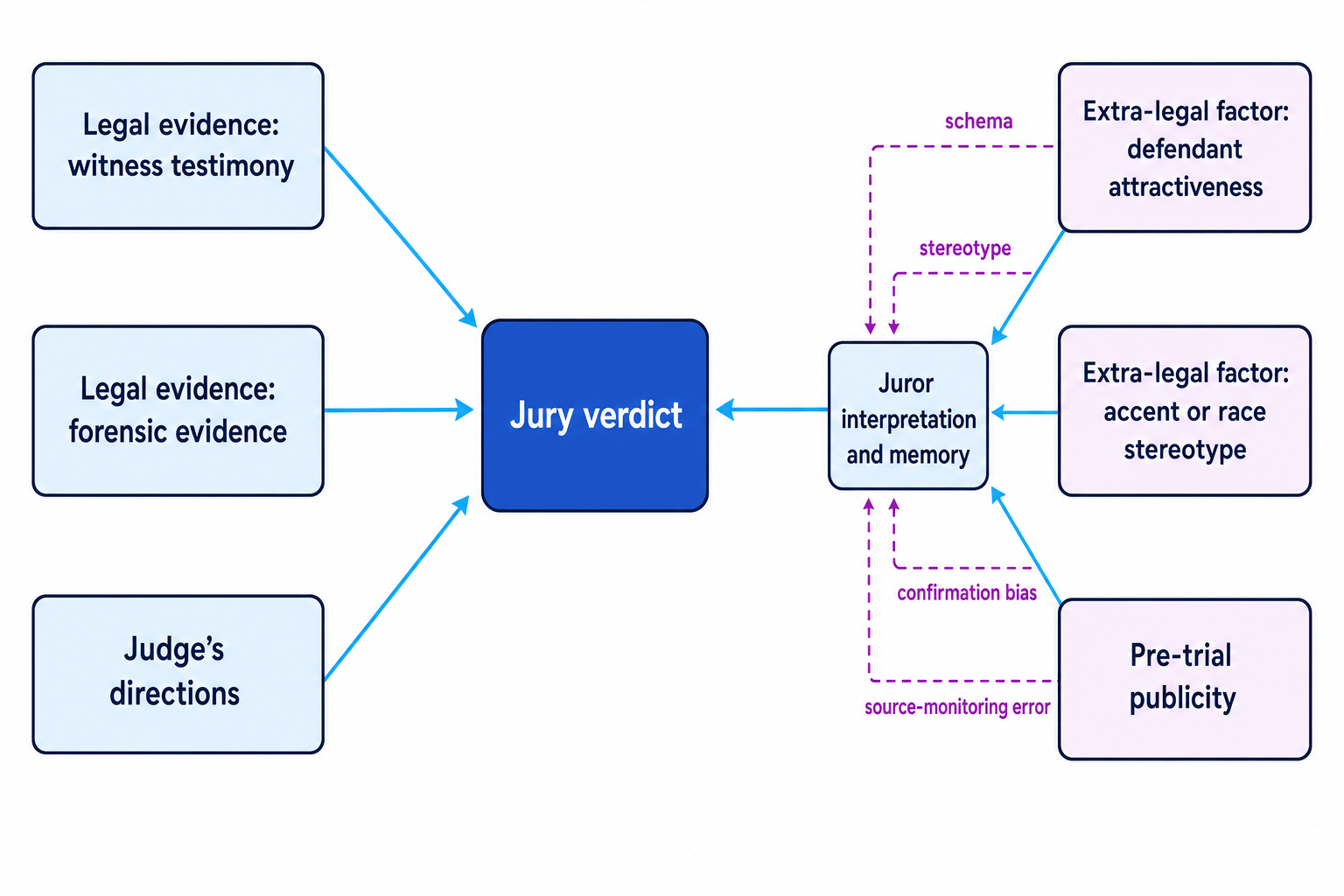
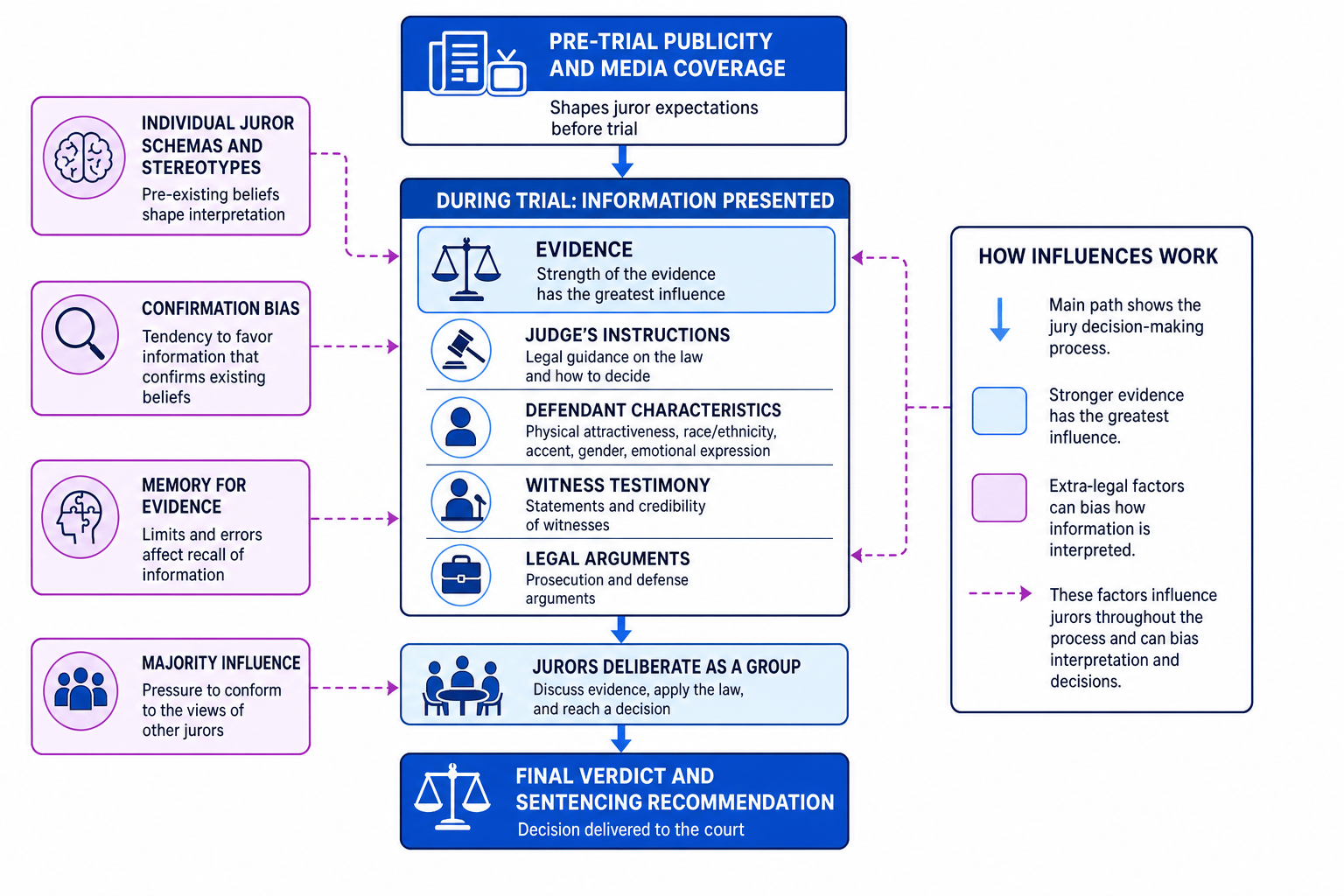
Jurors are meant to base their decision on legal evidence: witness testimony, forensic evidence, cross-examination, and the judge’s instructions. However, psychological research shows that extra-legal factors can sometimes influence how jurors interpret that evidence.
Extra-legal factors
Extra-legal factors are influences on a jury’s decision that are not part of the formal evidence in the case, such as the defendant’s appearance, race, accent, or information seen in the media before the trial.
The big idea
Jurors do not simply “record” evidence like machines. They interpret evidence through memory, expectations, stereotypes, emotions and group discussion.
Why can jurors be biased?
A useful prerequisite is the idea of a schema. A schema is a mental framework built from past experience. Schemas help us process information quickly, but they can also create bias.
For example, if a juror has a schema that “professional-looking people are trustworthy”, they may interpret a smartly dressed defendant more positively. This does not mean the juror is deliberately unfair; the bias may be subtle and unconscious.
A related idea is a stereotype, which is an oversimplified belief about a group of people. Stereotypes can affect judgements about guilt, credibility, dangerousness or honesty.
Applying bias to a jury scenario
A defendant is on trial for robbery. The evidence is mixed. Before the trial, local news reports described him as “well known to police”, and in court he speaks with an accent some jurors associate with criminality.
- First separate the legal evidence from the extra-legal factors. The witness and forensic evidence are legal evidence; the news report and accent are not evidence of guilt.
- The phrase “well known to police” may create pre-trial bias because jurors may assume previous criminality, even if this is not proven in court.
- The accent may activate a stereotype, affecting how trustworthy or dangerous the defendant seems.
- If the evidence is mixed, these biases may have more influence than they would in a very strong evidence case.
Defendant characteristics
Physical attractiveness
Research often finds an attractiveness-leniency effect: attractive defendants may be judged less harshly than unattractive defendants. Jurors may see attractive people as more honest, likeable or socially successful.
A classic study by Sigall and Ostrove (1975) found that attractiveness affected sentencing. When attractiveness was unrelated to the crime, attractive defendants received lighter sentences. However, when attractiveness helped the defendant commit the crime, such as in a fraud or “swindle” case, attractiveness could lead to harsher sentencing.
This is useful because it shows defendant characteristics do not work in a simple way. The effect depends on the type of offence.
Another study, Castellow, Wuensch and Moore (1990), used a sexual harassment scenario. They found that judgements were influenced by the attractiveness of both the defendant and the victim. This supports the idea that jurors may be influenced by social perceptions rather than evidence alone.
Do not oversimplify attractiveness
Avoid writing “attractive defendants always get lighter sentences.” Research suggests attractiveness can help or harm depending on whether it seems relevant to the crime.
Race and ethnicity
Race and ethnicity can influence jury decision-making through stereotypes, perceived similarity and social identity. Jurors may be more sympathetic to defendants they see as similar to themselves, or they may be influenced by racial stereotypes about criminality.
A key contemporary study is Bradbury and Williams (2013), who examined jury diversity and verdicts using real-world data from the USA. Their findings suggested that the racial composition of juries can be related to trial outcomes, showing that jury decision-making may be affected by both defendant characteristics and juror characteristics.
This is important because much jury research uses mock trials, whereas Bradbury and Williams used more naturalistic data. However, because it was not a tightly controlled laboratory experiment, it is harder to prove cause and effect.
Research by Sommers and Ellsworth (2001) also found that racial bias can be complex. When race is made especially obvious in a case, White mock jurors may sometimes show less bias because they become aware of the danger of appearing prejudiced. This suggests that bias may be strongest when jurors do not consciously notice that race could be influencing them.
Accent and social class
A defendant’s accent can affect perceptions of credibility, intelligence and guilt. Dixon, Mahoney and Cocks (2002) found that a suspect with a Birmingham accent was rated as more guilty than a suspect with a standard accent, particularly for certain types of crime.
This matters because accent is not evidence. If jurors associate an accent with lower status or criminality, this may unfairly influence their decision.
Gender, age and emotional expression
Other characteristics may also matter. Jurors may interpret male and female defendants differently depending on the offence. They may also judge a defendant’s emotional expression: a defendant who cries may be seen as remorseful, while a defendant who appears calm may be seen as cold or guilty.
However, these effects are not automatic. Strong evidence, clear judge’s directions and jury deliberation can reduce the impact of superficial characteristics.
AO3 shortcut
For defendant characteristics, a strong evaluation point is “controlled but artificial”: mock-jury experiments can isolate one variable, such as attractiveness, but they often lack the pressure and seriousness of a real trial.
Pre-trial publicity
What is pre-trial publicity?
Pre-trial publicity means information about a case that jurors are exposed to before the trial starts. This might include newspaper reports, television coverage, documentaries, online articles or social media posts.
Pre-trial publicity
Pre-trial publicity is media or public information about a case before the jury hears the official evidence in court.
Pre-trial publicity may include legally irrelevant or prejudicial information, such as previous convictions, emotional victim details, rumours, or opinions about the defendant’s guilt.
This can affect jurors in three main ways:
- It creates expectations before the evidence is heard.
- It may cause confirmation bias, where jurors pay more attention to evidence that supports their initial belief.
- It may create source-monitoring errors, where jurors remember information but forget whether it came from the trial or from the media.
Studies on pre-trial publicity
Kramer, Kerr and Carroll (1990) found that pre-trial publicity influenced mock jurors’ verdicts. Importantly, judicial instructions to ignore publicity did not fully remove the bias. This suggests that simply telling jurors to disregard media information may not be enough.
Ogloff and Vidmar (1994) also found that exposure to prejudicial publicity could affect juror decision-making, even when jurors were instructed to base their verdict only on trial evidence.
A major strength comes from Steblay, Besirevic, Fulero and Jimenez-Lorente (1999), who conducted a meta-analysis of studies on pre-trial publicity. They found that negative pre-trial publicity increased the likelihood of guilty verdicts. A meta-analysis is valuable because it combines findings across many studies, making the conclusion more reliable than a single experiment.
Later research, such as Ruva and McEvoy (2008), has suggested that pre-trial publicity can affect memory for evidence. Jurors may misattribute publicity information to the trial itself, meaning they genuinely believe they are relying on court evidence.
Why publicity is powerful
Pre-trial publicity can bias both judgement and memory: jurors may not only think differently about the defendant, but also remember the evidence differently.
Evaluation of research into jury decision-making
Strength: control in mock-jury studies
Many studies use mock trials where researchers manipulate one factor, such as attractiveness or publicity, while keeping other details the same. This gives good control and helps establish cause and effect.
For example, if two groups see the same trial but only one group sees negative media coverage beforehand, any difference in verdicts is likely to be due to the publicity.
Weakness: low ecological validity
A major problem is that mock jurors know their decision has no real consequences. Real jurors may feel much more responsibility because the defendant’s liberty is at stake.
Mock trials may also use students rather than representative juries. This matters because real juries include people of different ages, backgrounds and life experiences.
Ecological validity
Ecological validity refers to how far research reflects real-life settings and behaviour. A study has low ecological validity if its task or environment is unlike the real situation being studied.
Strength: real-world importance
This research has clear practical value. It can help courts think about:
- restricting prejudicial media reporting
- warning jurors about using social media
- delaying trials after intense publicity
- improving judicial directions
- increasing jury diversity
- protecting defendants from unfair stereotype-based judgements
Weakness: difficult to study real juries
In the UK, real jury deliberations are protected by law, so researchers cannot freely observe or question jurors about what happened in the jury room. This protects the justice system, but it limits psychological research.
As a result, researchers often rely on simulations, archival data or post-trial surveys. Each method has strengths, but none gives perfect access to real decision-making.
Ethics in jury research
Jury studies often involve sensitive material such as murder, assault or sexual harassment cases. Researchers must follow the BPS Code of Ethics and Conduct (2009).
This means participants should usually give informed consent, have the right to withdraw, be protected from distress, have their data kept confidential, and receive a proper debrief. If deception is used, for example by hiding the true aim of a study on bias, it must be justified and explained afterwards.
Bringing it together for AO1, AO2 and AO3
For AO1, describe the factor clearly: for example, “negative pre-trial publicity can create bias before the trial begins.”
For AO2, apply it to the scenario: for example, “if jurors read online posts claiming the defendant had previous convictions, they may interpret ambiguous evidence as more incriminating.”
For AO3, evaluate the evidence: for example, “mock-jury studies have high control but may lack ecological validity because participants know their verdict is not real.”
In the exam
- Separate legal evidence from extra-legal influences so your answer stays focused on jury decision-making.
- Use named studies accurately, such as Sigall and Ostrove (1975), Castellow et al. (1990), Kramer et al. (1990), Steblay et al. (1999), and Bradbury and Williams (2013).
- For evaluation, balance laboratory control against low ecological validity, then add a real-world application such as media restrictions or jury diversity.
Check yourself
- How can defendant attractiveness affect jury decision-making, and why is the effect not always lenient?
- Why might pre-trial publicity still influence jurors even after a judge tells them to ignore it?
- What is one strength and one weakness of using mock-jury studies in this area?