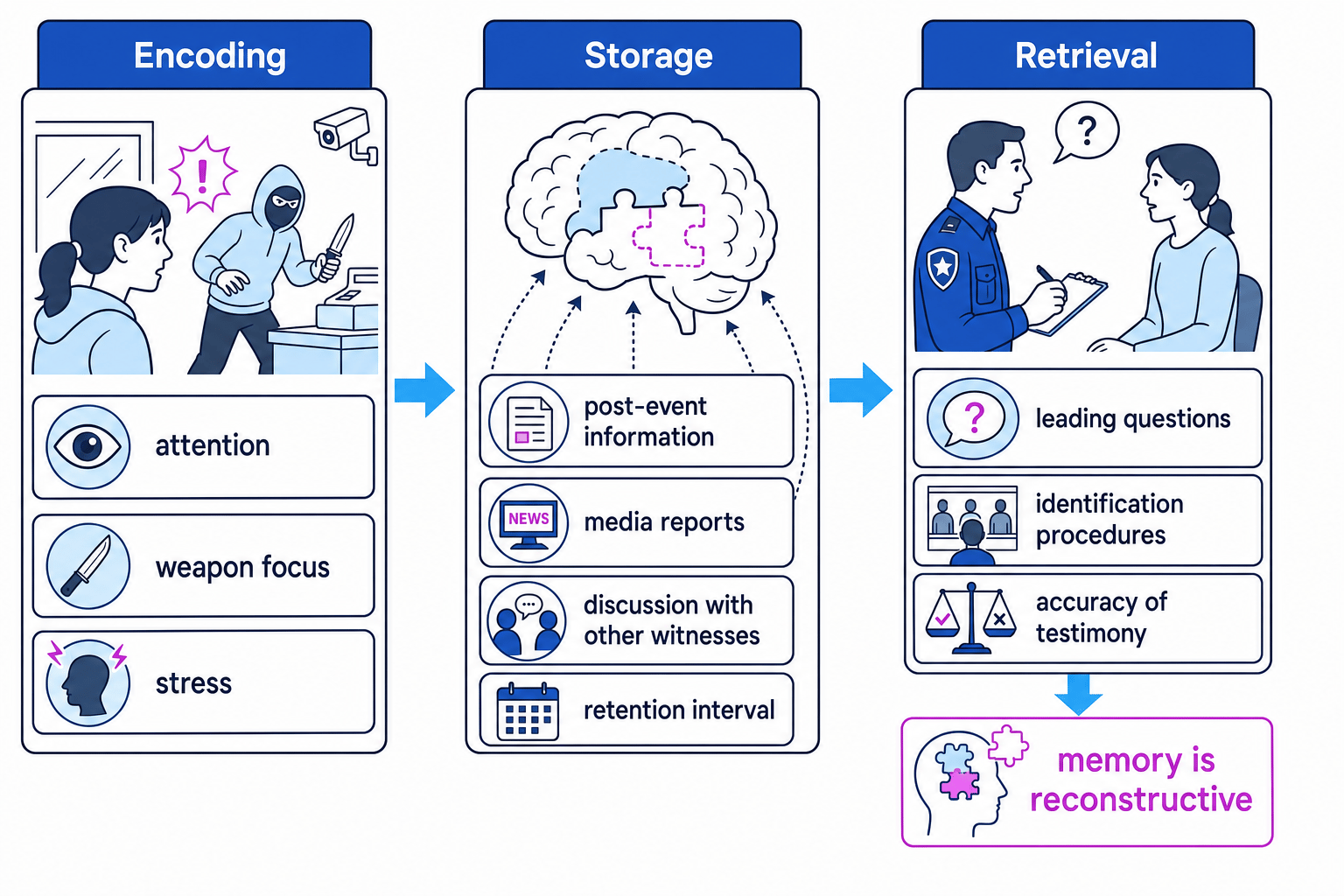
What you'll learn
- What eye-witness testimony is and why courts need to treat it carefully.
- How post-event information can distort memory after the event.
- Why weapon focus may reduce accuracy for identifying a suspect.
- How to evaluate research into eye-witness testimony using AO1, AO2 and AO3.
The starting point: what is eye-witness testimony?
Eye-witness testimony
Eye-witness testimony is evidence given by someone who has seen an event, usually a crime or accident. It may include a description of what happened, who was involved, or an identification of a suspect.
In criminological psychology, eye-witness testimony matters because juries and police officers often find confident witnesses persuasive. However, psychological research shows that witness memory is not always accurate.
A key idea is that memory is reconstructive.
Reconstructive memory
Reconstructive memory means that remembering is an active process. Instead of replaying a perfect recording, the brain rebuilds the memory using stored information, expectations, emotions and later information.
This links back to Bartlett’s classic research on memory. Bartlett (1932) argued that people use schemas, which are mental frameworks based on previous experience, to make sense of information. These schemas can help memory, but they can also distort it.
Memory is not a camera
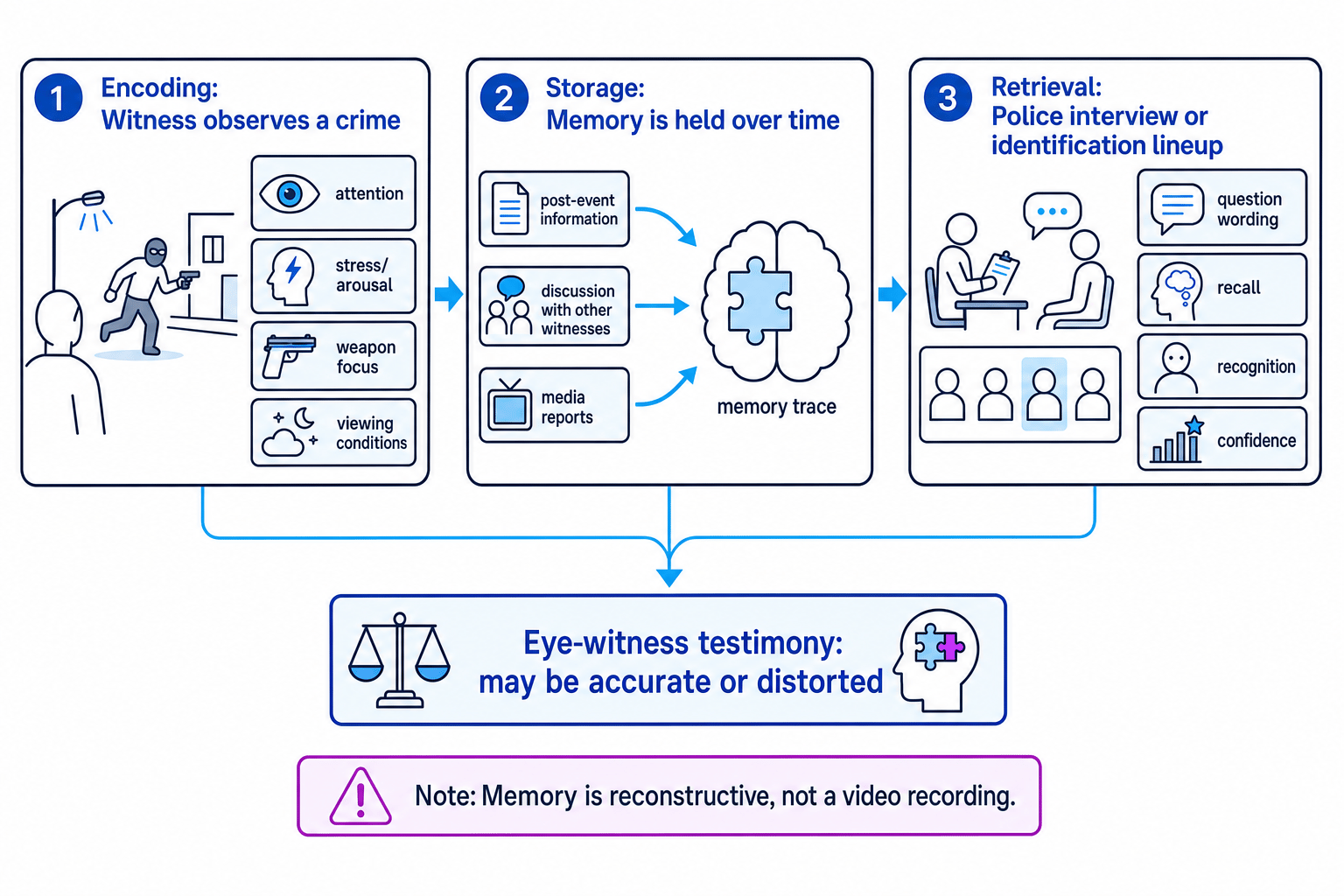
Eye-witnesses may be honest and confident but still wrong, because memory can be changed during encoding, storage and retrieval.
The diagram below shows the basic journey from seeing the event to giving testimony.
Reliability: what psychologists mean
Reliability
Reliability means consistency. In eye-witness testimony, it refers to whether a witness gives stable and accurate evidence across time, interviews or identification procedures.
Reliability is not the same as truth. A witness might repeat the same incorrect detail several times, making their testimony consistent but inaccurate. In exam answers, it is usually better to explain accuracy as well as reliability.
For example, if a witness says “the robber had a tattoo on his neck” in three separate interviews, that is consistent. But if CCTV shows no tattoo, the testimony is not accurate.
Confidence does not equal accuracy
Do not assume that a confident witness is automatically reliable. Confidence can be increased by feedback, repeated questioning or discussion with other witnesses, even when the memory is inaccurate.
Factor 1: post-event information
Post-event information
Post-event information is any information a witness receives after the event that may alter their memory of what happened. It can come from leading questions, media reports, police interviews or conversations with other witnesses.
Post-event information is important because it can create a misinformation effect.
Misinformation effect
The misinformation effect happens when misleading information presented after an event becomes incorporated into a person’s memory of the original event.
Loftus and Palmer (1974): leading questions
Loftus and Palmer (1974) carried out a classic laboratory study on how question wording affects memory. Participants watched film clips of car accidents and were asked how fast the cars were going when they “hit”, “smashed”, “collided”, “bumped” or “contacted” each other.
The verb changed the speed estimates. “Smashed” produced higher estimates than “contacted”. In a second experiment, participants who heard “smashed” were more likely to report seeing broken glass, even though there was none.
This supports the idea that leading questions can distort memory.
Leading question
A leading question is a question phrased in a way that suggests a particular answer, such as “How fast was the car going when it smashed into the other car?”
Applying post-event information to a witness interview
- Identify the original event: the witness saw a man run from a shop after a robbery.
- Identify the later information: a police officer asks, “Did you see the knife in his hand?” even though the witness did not mention a knife before.
- Explain the likely effect: the wording implies there was a knife, so the witness may later remember seeing one.
- Link to reliability: the testimony may become less reliable because the memory has been contaminated by post-event information.
Loftus, Miller and Burns (1978): misleading details
Loftus, Miller and Burns (1978) showed participants slides of a car accident. Some saw a car stop at a stop sign, while others later received misleading information suggesting it was a yield sign. When asked to choose the original slide, those exposed to misleading information were less accurate.
This study is useful because it demonstrates how a specific detail can be replaced by later misleading information.
Evaluation of post-event information research
A strength is that many studies, especially Loftus and Palmer (1974), used controlled laboratory methods. This means researchers could standardise the film clips and questions, making it easier to establish cause and effect between question wording and memory distortion.
However, laboratory studies may lack ecological validity, which means they may not reflect real-life witness situations. Watching a film of an accident is not the same as personally witnessing a frightening crime. Participants may pay less attention or feel less emotional involvement.
There are also ethical issues. Research into misleading information often involves deception, because participants are not told the true aim at the start. Under the BPS Code of Ethics and Conduct (2009), researchers should protect participants through informed consent where possible, the right to withdraw, confidentiality and a full debrief afterwards.
AO3 balance
For a strong evaluation, pair the laboratory strength of control with the weakness of lower realism. Then add one real-world application, such as improving police interview techniques.
Factor 2: weapon focus
Weapon focus
Weapon focus is the tendency for a witness’s attention to be drawn towards a weapon, such as a gun or knife, reducing their ability to notice other details such as the offender’s face.
Weapon focus affects the encoding stage of memory. If attention is captured by a threatening object, fewer cognitive resources are available for processing the suspect’s appearance.
Loftus, Loftus and Messo (1987)
Loftus, Loftus and Messo (1987) investigated weapon focus using slides. In one condition, participants saw a customer holding a gun in a restaurant queue. In another condition, the customer held a cheque. Eye-tracking showed that participants looked more at the gun than the cheque, and those in the gun condition were less accurate at identifying the customer.
This suggests that weapons can narrow attention and reduce identification accuracy.
Pickel (1998): is it threat or unusualness?
Pickel (1998) argued that weapon focus may happen not only because weapons are threatening, but also because they are unusual in a particular context. For example, a raw chicken or a handgun in a hair salon might both attract attention because they are unexpected.
This challenges a simple “weapon equals fear” explanation. It suggests that attention may be captured by unusual objects more generally.
Explaining weapon focus in a robbery scenario
- Consider where the witness’s attention is likely to go: during a robbery, a knife is highly threatening and unusual, so attention may focus on it.
- Consider what receives less attention: the witness may encode fewer details about the offender’s face, height or clothing.
- Apply this to testimony: the witness may accurately describe the knife but be less accurate when identifying the suspect in a line-up.
- Evaluate the evidence: research such as Loftus, Loftus and Messo (1987) supports this, but real crimes may involve stronger emotions than lab slides.
Evaluation of weapon focus research
A strength is that weapon focus research has real-world relevance. It helps explain why victims of armed crimes may struggle to identify offenders accurately, even when they clearly remember the weapon.
A weakness is that much of the evidence comes from artificial settings. Viewing slides is not the same as being present during a violent crime. Real-life arousal, fear and survival responses may be much stronger.
However, real-world research can be difficult to control. In actual crimes, many variables change at once: lighting, distance, stress, duration, alcohol use, disguise and police procedures. This makes it harder to isolate weapon focus as the cause of poor recall.
Other factors that can affect eye-witness testimony
Although the spec highlights post-event information and weapon focus, you should understand that reliability can also be influenced by several related factors.
Stress and arousal
Arousal means physiological alertness, such as increased heart rate and adrenaline. Moderate arousal may improve attention, but very high arousal may impair memory.
This can link to weapon focus: if a weapon increases fear, it may narrow attention. But findings are mixed. Some real-life studies suggest witnesses to serious crimes can remember central details well, while laboratory research often finds stress reduces accuracy.
Retention interval
Retention interval
The retention interval is the time between witnessing the event and recalling it.
A longer retention interval usually gives more opportunity for forgetting and contamination by post-event information. For example, a witness interviewed immediately may give a more accurate account than a witness interviewed weeks later after reading news reports.
Questioning and identification procedures
Police questioning can influence recall. Open questions such as “Tell me what you saw” are less leading than closed or suggestive questions such as “Was the attacker wearing a black hoodie?”
Line-up procedures also matter. If a suspect stands out from the other people in a line-up, witnesses may choose them because they look different, not because they recognise them.
Reliability depends on the whole process
Eye-witness testimony is shaped by what happens during the crime, after the crime, and during questioning.
Practical applications: improving witness evidence
Research into eye-witness testimony has helped improve police practice. One important application is the Cognitive Interview, developed by Fisher and Geiselman (1992). It aims to improve recall without using leading questions.
It includes techniques such as asking the witness to recreate the context, report everything, recall events in different orders and describe the event from different perspectives. The goal is to increase accurate recall while reducing interviewer contamination.
This is a strong real-world application of psychological research: if post-event information can distort memory, police should avoid leading questions and interview witnesses carefully.
More recall is not always better
Some interview techniques may increase the amount of information recalled, but exam answers should consider whether the extra information is accurate as well as plentiful.
Ethics in eye-witness testimony research
Studies in this area often use deception because participants may not be told that misleading information is being tested. They may also watch distressing material, such as accidents or crimes.
Under the BPS Code of Ethics and Conduct (2009), researchers should consider:
- Consent: participants should agree to take part, even if full aims are withheld until later.
- Deception: any deception must be justified and explained during debriefing.
- Right to withdraw: participants should be free to leave without penalty.
- Protection from harm: distressing materials should be avoided or carefully managed.
- Confidentiality: participants’ data should be kept private.
- Debrief: participants should be told the true aims and reassured if their memory was inaccurate.
Building an essay answer
For AO1, describe the factor clearly. For example, explain that post-event information can alter memory because recall is reconstructive, then outline Loftus and Palmer (1974).
For AO2, apply the factor to a scenario. If a witness discusses the crime with another witness or hears a leading question, explain how that could contaminate memory.
For AO3, evaluate the evidence. Consider control, ecological validity, ethics, contradictory findings and real-world applications.
In the exam
- Define the factor first, then link it directly to reliability or accuracy of eye-witness testimony.
- Use named evidence, such as Loftus and Palmer (1974) for leading questions or Loftus, Loftus and Messo (1987) for weapon focus.
- Balance your evaluation: include one methodological strength, one limitation and one practical application to police interviewing or line-ups.
Check yourself
- How can post-event information change a witness’s memory after a crime?
- Why might a weapon reduce accuracy when identifying a suspect?
- What is one strength and one weakness of using laboratory studies to investigate eye-witness testimony?