What you'll learn
- What psychologists mean by individual differences in criminological psychology.
- How personality, especially Eysenck’s PEN model, may increase risk of criminal or anti-social behaviour.
- How a self-fulfilling prophecy can help explain why some people develop criminal or anti-social identities.
- How to evaluate these explanations using AO1, AO2 and AO3.
The starting point: what are individual differences?
In psychology, individual differences are the characteristics that make one person psychologically different from another. These can include personality, self-esteem, beliefs about control, emotional stability, intelligence, resilience and past experiences.
Individual differences
Individual differences are personal characteristics that vary between people and may affect how they think, feel and behave.
In criminological psychology, we ask whether these differences help explain why one person may become involved in criminal behaviour or anti-social behaviour, while another person in a similar situation does not.
Criminal behaviour means behaviour that breaks the law. Anti-social behaviour is broader: it includes behaviour that harms, intimidates or disrupts others, such as aggression, vandalism or persistent rule-breaking.
The key idea is not that personality or labels “cause crime” on their own. They are better seen as risk factors that interact with social experiences, learning, family background, peer groups and opportunities.
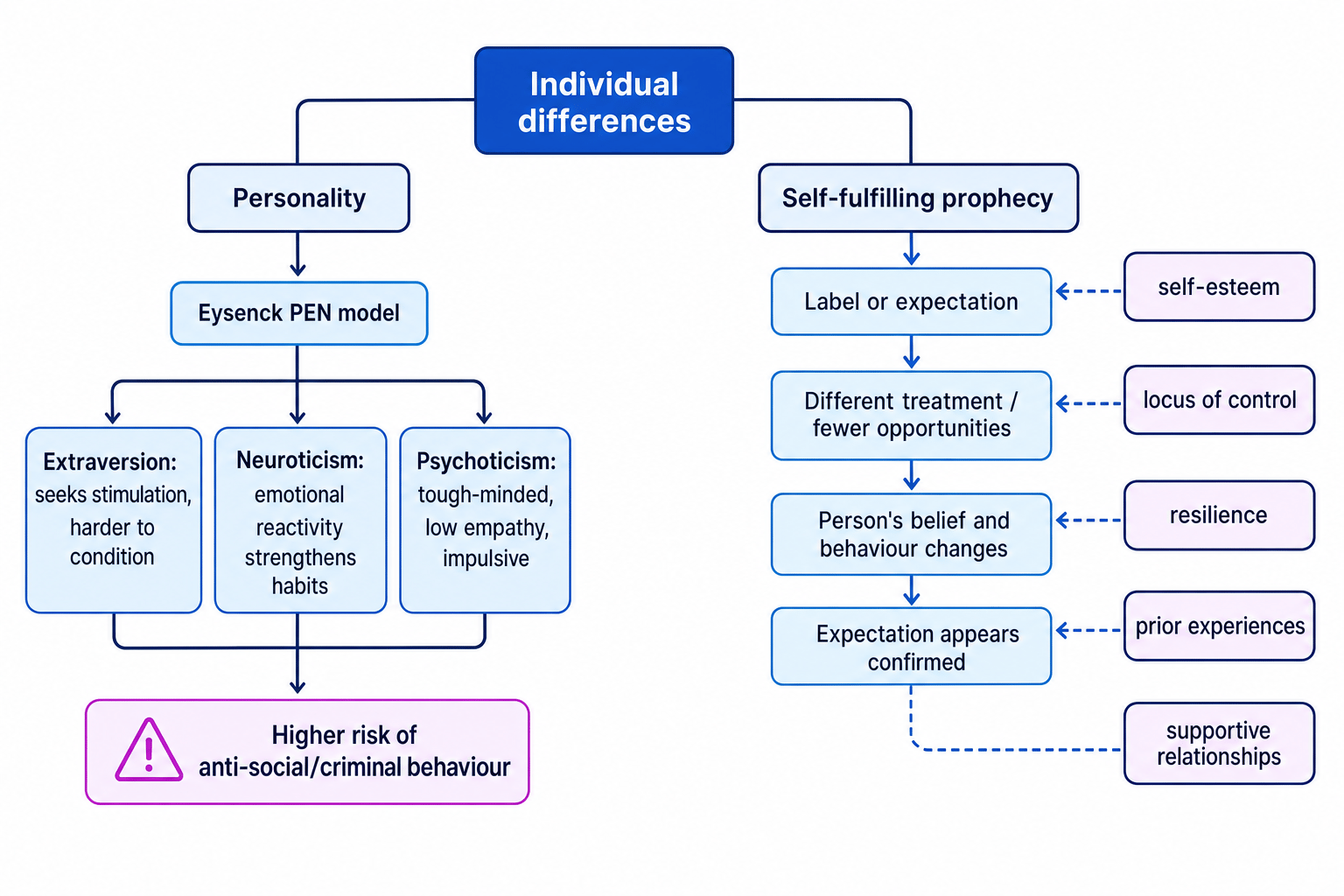
This overview shows the two main routes in this sub-topic: personality factors and self-fulfilling prophecy.
Personality as a factor in criminal and anti-social behaviour
Personality
Personality is a person’s typical pattern of thoughts, emotions and behaviours across situations and over time.
A major personality explanation of offending comes from Hans Eysenck, who argued that some people have personality traits that make them more likely to seek excitement, respond poorly to punishment, or show low empathy.
Eysenck’s PEN model
Eysenck described personality using three main dimensions, often called the PEN model:
| Dimension | Meaning | Possible link to offending |
|---|---|---|
| Psychoticism | Tough-mindedness, impulsivity, aggressiveness, low empathy | May reduce guilt and concern for victims |
| Extraversion | Sociability, stimulation-seeking, lower cortical arousal | May lead to risk-taking and boredom with rules |
| Neuroticism | Emotional instability, anxiety, strong emotional reactions | May strengthen emotional responses and habits |
Eysenck’s theory suggested that people high in extraversion may be harder to condition through punishment because they seek stimulation and may not develop strong fear responses to consequences. People high in neuroticism may form persistent emotional habits. People high in psychoticism may be more impulsive, aggressive and less empathetic.
Eysenck’s core claim
A “criminal personality” is not a guarantee of crime, but Eysenck argued that high psychoticism, extraversion and neuroticism can increase the risk of anti-social or criminal behaviour.
Applying the PEN model
Applying Eysenck’s personality theory
A teenager repeatedly shoplifts with friends, says it is “exciting”, shows little guilt, and becomes angry when challenged.
-
Link stimulation-seeking to extraversion. The excitement of shoplifting suggests high extraversion because the behaviour provides arousal and risk.
-
Link low guilt to psychoticism. Showing little concern for victims or consequences suggests higher psychoticism, especially low empathy and impulsivity.
-
Consider emotional reactivity. Becoming angry when challenged could suggest neuroticism if the person reacts intensely and struggles to regulate emotion.
-
Avoid a deterministic conclusion. The theory suggests increased risk, but peer influence, family context, opportunity and learning also matter.
AO3: evaluating personality explanations
One strength is that personality can be measured using questionnaires such as the Eysenck Personality Questionnaire, allowing researchers to test whether offenders score differently from non-offenders. Research such as Farrington’s Cambridge Study in Delinquent Development found that impulsivity and risk-taking were linked with later offending, supporting the idea that stable individual differences can matter.
A further strength is practical application. If impulsivity or low empathy is linked to offending, interventions can target emotional regulation, empathy training and decision-making rather than only punishing behaviour.
However, personality explanations can be reductionist. This means they may oversimplify criminal behaviour by focusing too much on the individual and not enough on poverty, parenting, school experiences, peer groups or social inequality.
Another weakness is that much evidence is correlational. If offenders score highly on impulsivity, this does not prove impulsivity caused the offending. Offending experiences, prison environments or social labelling might also affect personality scores.
There are also methodological issues. Self-report questionnaires can be affected by social desirability, dishonesty or misunderstanding. Prison samples may not represent all offenders, especially those who are never caught.
Personality is not destiny
Do not write as if high psychoticism, extraversion or neuroticism automatically causes crime. A stronger answer says these traits may increase risk, especially when combined with environmental factors.
Self-fulfilling prophecy and criminal behaviour
Self-fulfilling prophecy
A self-fulfilling prophecy occurs when an expectation about a person leads others to treat them differently, causing the person to behave in a way that makes the original expectation appear true.
The idea was developed by Merton (1948) and is closely linked to labelling theory, associated with writers such as Becker (1963). In criminology, a person may be labelled as a “troublemaker”, “delinquent” or “future criminal”. That label can change how teachers, police, parents or peers treat them.
The specification gives criminal or anti-social behaviour as an example. That means the application is important, but the same self-fulfilling process can also occur in school, families, workplaces or peer groups.
The self-fulfilling prophecy process
A typical sequence is:
- An authority figure forms an expectation, such as “this pupil is trouble”.
- The person is treated differently, perhaps with more suspicion, harsher punishment or fewer opportunities.
- The person notices the treatment and may internalise the label.
- Their self-concept changes: “Maybe I am just bad.”
- Behaviour shifts towards the expectation, such as truancy, aggression or offending.
- The original label appears confirmed.
Applying self-fulfilling prophecy
Tracing a self-fulfilling prophecy
A student is repeatedly called “a criminal in the making” after one incident of vandalism. Over time, they stop trying in school and begin spending more time with anti-social peers.
-
Identify the initial label. The phrase “criminal in the making” creates a negative expectation about the student’s future behaviour.
-
Connect the label to changed treatment. Teachers may watch the student more closely, punish them faster, or offer fewer chances to take responsibility.
-
Explain the internal change. The student may begin to see themselves as rejected or deviant, reducing motivation to follow school rules.
-
Link behaviour to confirmation. Truancy and anti-social peers then make the original label appear accurate, even though the label helped produce the outcome.
Individual differences affecting whether a self-fulfilling prophecy occurs
Not everyone reacts to a label in the same way. Individual differences can make a self-fulfilling prophecy more or less likely.
Self-esteem
Self-esteem means how positively or negatively a person evaluates themselves. Someone with low self-esteem may be more likely to accept a negative label, especially if it comes from an authority figure.
Someone with higher self-esteem may be more able to reject the label: “That is not who I am.”
Locus of control
Locus of control
Locus of control, introduced by Rotter (1966), refers to whether a person believes outcomes are mainly controlled by their own actions or by external forces.
A person with an internal locus of control believes their actions can influence outcomes. This may protect against a self-fulfilling prophecy because they feel able to resist the label.
A person with an external locus of control believes outcomes are controlled by luck, fate or other people. They may be more vulnerable because they feel the label is unavoidable.
Resilience and social support
Resilience is the ability to cope with adversity and recover from setbacks. Supportive relationships with parents, teachers, mentors or friends can protect against harmful labels.
For example, if one teacher labels a pupil as aggressive but another adult consistently treats them as capable and trustworthy, the negative prophecy is less likely to take hold.
Prior experiences and identity
Labels may be more powerful if they fit previous experiences. If someone has already been excluded, rejected or involved in minor offending, a criminal label may feel believable.
However, identity can also work as a protective factor. A young person who strongly identifies as a good student, athlete, sibling or carer may have alternative positive identities that reduce the impact of a deviant label.
AO2 application shortcut
For scenario questions, use the chain: label → different treatment → changed self-belief → changed behaviour → expectation appears confirmed.
AO3: evaluating self-fulfilling prophecy
A strength is that there is classic support for expectation effects. Rosenthal and Jacobson (1968) found that teacher expectations could influence children’s academic progress. Although this was an education study rather than a crime study, it shows that authority expectations can affect behaviour and outcomes.
There is also evidence from risk behaviour. Madon et al. (2004) found that parents’ beliefs about adolescents’ alcohol use could predict later drinking behaviour, suggesting expectations within close relationships may shape behaviour over time.
A further strength is real-world usefulness. The explanation encourages schools, police and youth justice services to avoid stigmatising labels and to use restorative approaches that separate the person from the behaviour: “You did something harmful” rather than “You are bad.”
However, a key weakness is that expectation effects are often modest. Jussim and Harber (2005) argued that teacher expectations are sometimes accurate rather than self-fulfilling. If a pupil has repeatedly behaved aggressively, adult concern may be based on evidence, not just a false label.
Another limitation is that much research comes from education or family settings, so applying it directly to criminal behaviour requires caution. Crime is influenced by many factors, including opportunity, peer reinforcement, poverty, substance use and policing practices.
There are also ethical concerns. Studies involving labels, children or offenders must follow the BPS Code of Ethics and Conduct (2009), including informed consent, protection from harm, confidentiality, right to withdraw and debriefing. Deliberately giving harmful labels would be difficult to justify ethically.
Not every label is a self-fulfilling prophecy
A self-fulfilling prophecy requires the expectation to help produce the behaviour. If the behaviour would have happened anyway, or the expectation was simply accurate, the explanation is weaker.
Bringing the two explanations together
Personality and self-fulfilling prophecy are both individual-difference explanations, but they focus on different mechanisms.
Personality explanations look inside the person: traits such as impulsivity, emotional instability and low empathy may increase risk.
Self-fulfilling prophecy looks at the interaction between the person and others: labels may affect self-concept and opportunities, but individual differences such as self-esteem, locus of control and resilience influence whether the label takes hold.
A strong essay answer avoids choosing one explanation as the whole answer. It shows how personality, labelling and social context can interact.
In the exam
-
For AO1, describe the mechanism clearly: for personality, use Eysenck’s PEN traits; for self-fulfilling prophecy, use the label-to-behaviour sequence.
-
For AO2, apply every part of the theory to the scenario rather than just naming it. Show exactly how the person’s traits or label could lead to anti-social behaviour.
-
For AO3, balance support and criticism: use named evidence, then challenge it with issues such as correlation, determinism, ethics, modest effects and alternative explanations.
Check yourself
- How might high psychoticism increase the risk of anti-social behaviour?
- Why might an external locus of control make a self-fulfilling prophecy more likely?
- What is one strength and one weakness of using Rosenthal and Jacobson’s research to support self-fulfilling prophecy in criminology?
