What you'll learn
- Why memory is not a perfect “recording” of what happened.
- How schemas shape what you encode, store, and recall.
- How Bartlett’s (1932) research supports reconstructive memory.
- How to apply and evaluate the theory in A-Level essay answers.
The starting point: memory is active
In everyday life, it can feel as if you are replaying a memory like a video. Reconstructive memory theory challenges this. It argues that remembering is an active process: you rebuild the past using fragments of stored information plus what you already know, expect, and believe.
This matters because two people can experience the same event but later remember it differently. Their memories may be shaped by their cultural background, expectations, emotional state, and later information.
Reconstructive memory
Reconstructive memory is the idea that recall involves rebuilding an event rather than retrieving an exact copy of it. The remembered version may include omissions, changes, or added details.
Core idea
Memory is not simply reproductive — copying the past exactly. It is often reconstructive — rebuilding the past using stored fragments and schemas.
Schema theory
A schema is a mental framework built from your past experiences. Schemas help you organise information and make sense of the world quickly.
For example, you probably have a “restaurant schema”: you expect menus, tables, ordering food, paying a bill, and staff serving customers. If something fits that schema, it is easy to understand. If something does not fit, you may ignore it, misunderstand it, or later change it in memory.
Schema
A schema is an organised packet of knowledge, expectations, and beliefs about a person, place, object, event, or situation.
Schemas can be:
- Personal: based on your own experiences.
- Social: based on expectations about roles, groups, or behaviour.
- Cultural: based on shared meanings within a culture.
This diagram shows how schemas can influence memory from the moment an event is experienced through to the final report of that memory.
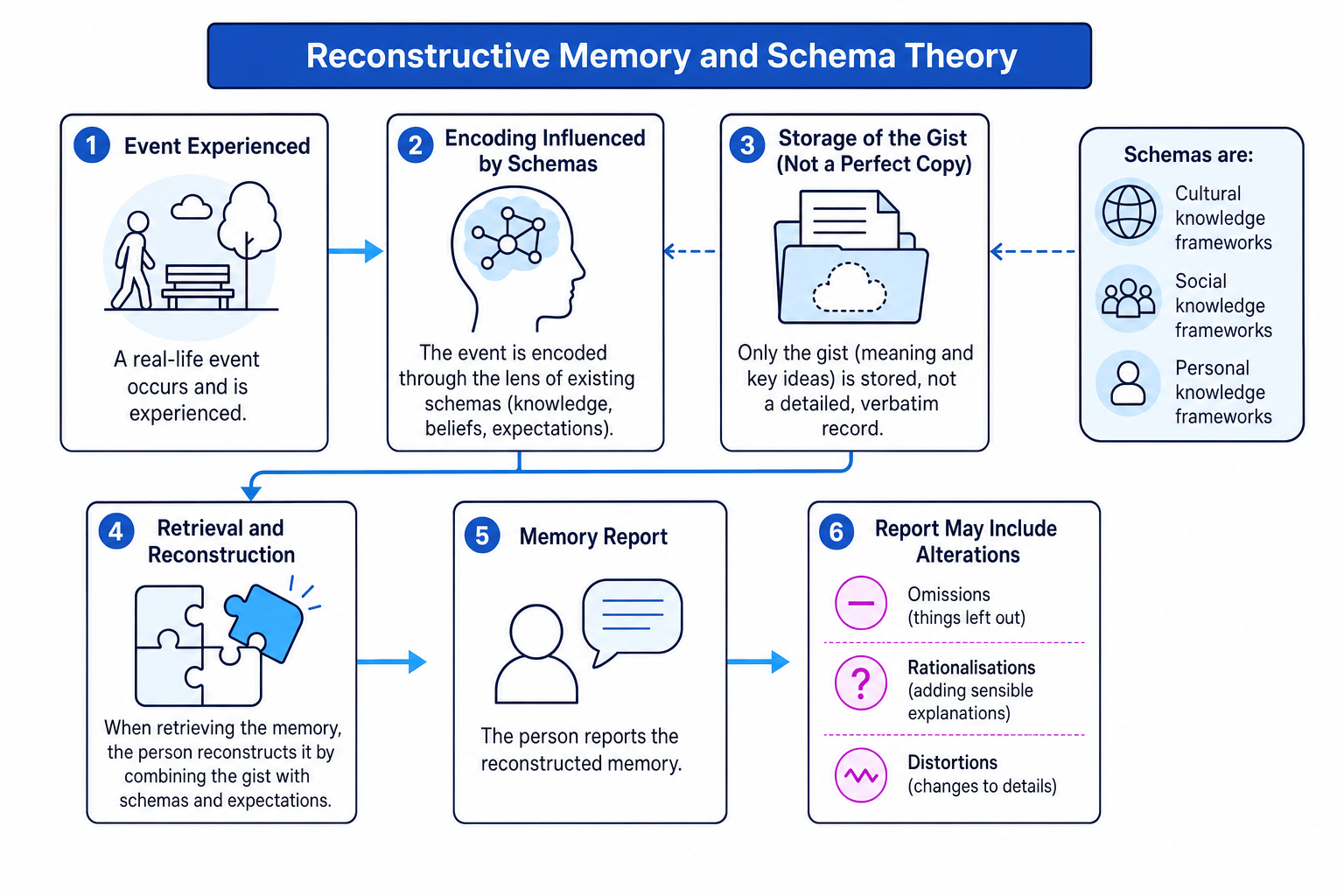
How schemas affect memory
1. Encoding
Encoding means taking in information and turning it into a form that can be stored in memory. Schemas influence what you pay attention to and how you interpret it.
If an event fits your schema, you may understand it quickly. If it does not fit, you may find it confusing or reinterpret it so that it makes more sense.
2. Storage
Storage means keeping information in memory over time. Reconstructive memory theory suggests that people often store the gist of an event rather than every exact detail.
Gist
The gist is the general meaning or main idea of something, rather than the precise wording or exact details.
For example, you might remember that a conversation was “an argument” but forget the exact words used.
3. Retrieval
Retrieval means accessing information from memory. When you retrieve a memory, you may fill in gaps using schemas. This can make the memory feel complete, even if some details have been added or altered.
This is not the same as lying. The person may genuinely believe the reconstructed memory is accurate.
Calling all distortion deliberate
Do not write as if reconstructive memory means people are intentionally making things up. The theory is about unconscious reconstruction, where schemas shape recall without the person realising.
Types of change in reconstructive memory
Bartlett described several ways recall can change.
Omission
Omission happens when unfamiliar, confusing, or schema-inconsistent details are left out.
For example, if a story contains a culturally unfamiliar ritual, a person may simply forget that part.
Rationalisation
Rationalisation happens when a person changes details so the memory makes more sense to them.
For example, an unusual supernatural detail might be changed into a more ordinary explanation.
Assimilation
Assimilation means information is changed so it fits better with an existing schema.
For example, someone from one culture may recall an unfamiliar object as a more familiar object from their own culture.
Applying schema theory to an eyewitness
A witness sees a brief argument outside a shop. They later report that the person “pulled out a knife”, although the object was actually a phone.
- The witness already has a schema for a threatening street argument: raised voices, danger, and possibly weapons.
- During encoding, the event is brief and stressful, so the witness may focus on the general threat rather than the exact object.
- During retrieval, the witness reconstructs the memory using the stored gist — “aggressive confrontation” — plus the schema that dangerous confrontations may involve weapons.
- The phone is therefore misremembered as a knife. This is a distortion caused by reconstruction, not necessarily a deliberate lie.
Bartlett (1932): reconstructive memory in action
Frederic Bartlett is the key researcher linked to reconstructive memory. In 1932, he investigated how people remembered unfamiliar material using a Native American folk tale called “The War of the Ghosts.”
British participants read the story and later recalled it. Bartlett used methods including:
- Repeated reproduction: the same participant recalled the story several times after delays.
- Serial reproduction: one participant recalled the story, then another participant recalled that version, and so on.
Serial reproduction
Serial reproduction is a method where information is passed from one person to another through recall, so researchers can observe how it changes across retellings.
Bartlett found that recall became shorter and more conventional over time. Participants tended to omit unfamiliar details, change strange parts into more familiar ones, and make the story fit their own cultural expectations.
For example, supernatural or unusual parts of the story were often changed or rationalised. This supported Bartlett’s claim that memory is reconstructed using schemas.
Bartlett’s conclusion
Bartlett argued that people remember by making information meaningful. When material is unfamiliar, they may reshape it so it fits their existing schemas.
AO1: describing the theory clearly
For AO1 marks, you need accurate description.
A strong AO1 explanation might say:
- Reconstructive memory argues that recall is an active rebuilding process.
- People store the gist of events rather than exact copies.
- Schemas are mental frameworks based on experience and culture.
- Schemas influence encoding, storage, and retrieval.
- Bartlett’s (1932) “War of the Ghosts” study showed that people changed unfamiliar material to make it more familiar.
Essay wording
Use the phrase “memory is reconstructed using schemas”. It is concise, accurate, and easy to apply to scenarios.
AO2: applying the theory
For AO2, link the theory directly to a scenario. Do not just define schemas and stop.
If a question describes someone misremembering an event, ask:
- What schema might they have used?
- What detail was omitted, changed, or added?
- Was the memory made more familiar or logical?
- Did the person recall the gist but distort the details?
For example, if someone remembers a hospital waiting room as having magazines even though there were none, you could explain that their “waiting room schema” includes magazines, so they reconstructed the memory to include schema-consistent details.
AO3: evaluating reconstructive memory and schema theory
Strength: explains everyday memory errors
A major strength is that the theory explains real-life memory distortions. People often remember the meaning of an event but not the exact details. This is useful when understanding eyewitness testimony, where witnesses may unintentionally reconstruct events based on expectations or leading information.
Research such as Loftus and Palmer (1974) also supports the idea that memory can be altered after an event. Participants estimated different vehicle speeds depending on whether they were asked how fast cars were going when they “hit” or “smashed” into each other. This suggests recall can be shaped by later information, consistent with reconstructive memory.
Strength: Bartlett used meaningful material
Bartlett’s use of a story was more realistic than earlier memory research that used meaningless syllables. This gives his work some ecological validity, because real-life memory usually involves meaningful information, not random nonsense.
Ecological validity
Ecological validity refers to how far research reflects real-life behaviour and settings.
Weakness: Bartlett’s methods lacked control
A limitation is that Bartlett’s study was not highly standardised. Participants may not all have received identical instructions, and the delays before recall varied. This makes it harder to establish cause and effect.
His data were also largely qualitative, meaning interpretation may have been subjective. Bartlett described patterns in recall, but he did not always use the kind of controlled procedures or statistical analysis expected in modern psychology.
Weakness: schema theory can be vague
Schema theory is useful, but schemas are difficult to observe directly. If someone distorts a memory, it is easy to say “a schema caused it” after the event. This can make the theory harder to test scientifically because schemas are inferred rather than directly measured.
Balanced point: schemas can help memory too
Schemas do not only distort memory. They can also improve memory by helping you organise information. For example, your school schema helps you understand lessons, classrooms, timetables, and teacher expectations. Without schemas, the world would be much harder to process.
So, a balanced evaluation is that schemas are useful and often adaptive, but they can also lead to errors when they fill in gaps inaccurately.
Ethics and real-world application
Bartlett’s research was relatively low risk, but modern memory research still needs to follow the BPS Code of Ethics and Conduct (2009). Researchers should consider informed consent, deception, right to withdraw, protection from harm, confidentiality, and debriefing.
This is especially important in eyewitness research. If participants are shown distressing footage or led to doubt their memory, they must be protected from psychological harm and fully debriefed.
In the real world, reconstructive memory has important implications for police interviews. Interviewers should avoid leading questions because they may accidentally shape a witness’s reconstruction of the event.
In the exam
- For AO1, define reconstructive memory and schema, then explain how schemas affect encoding, storage, and retrieval.
- For AO2, apply the theory precisely: identify the person’s schema and explain the specific omission, rationalisation, or distortion.
- For AO3, evaluate using Bartlett’s strengths and weaknesses, then link to real-world applications such as eyewitness testimony.
Check yourself
- What is the difference between reproductive memory and reconstructive memory?
- How did Bartlett’s “War of the Ghosts” study support schema theory?
- Why can schemas be both helpful and harmful for memory accuracy?
