What you'll learn
- What the central nervous system (CNS) is and how it helps control behaviour.
- The main parts of a neuron and how nerve impulses travel.
- How neurotransmitters carry messages across a synapse.
- How to apply this biological knowledge to human behaviour in AO1, AO2 and AO3 answers.
The nervous system: the starting point
Your nervous system is the body’s communication network. It allows you to sense the world, process information, and respond through actions, thoughts, emotions and bodily changes.
Central nervous system
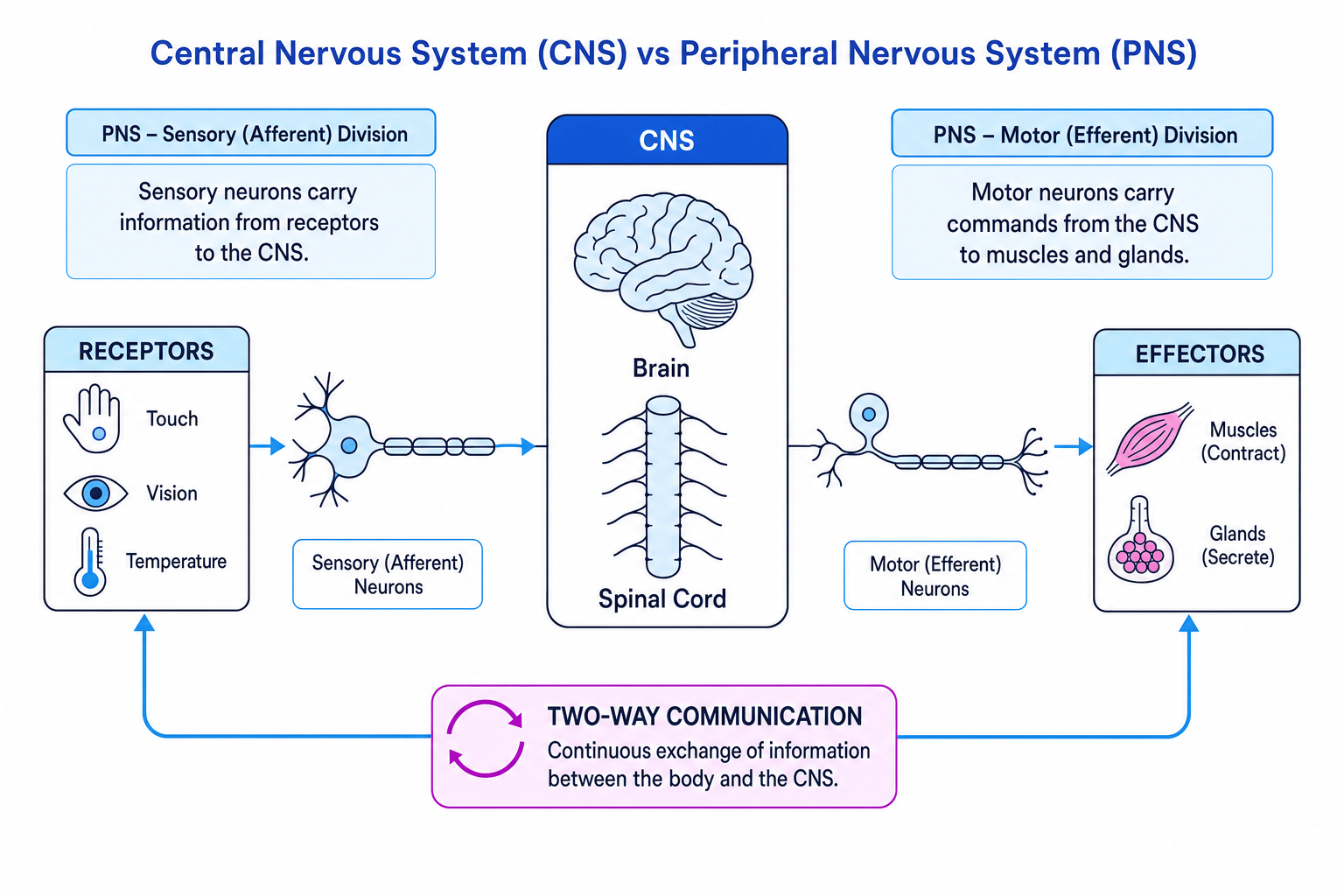
The central nervous system (CNS) is the part of the nervous system made up of the brain and spinal cord. It receives information, processes it, and coordinates responses.
The brain is heavily involved in complex behaviour, including memory, emotion, decision-making, movement and language. The spinal cord carries messages between the brain and body, and can also coordinate very fast responses such as reflexes.
The CNS works with the peripheral nervous system (PNS), which includes the nerves outside the brain and spinal cord. The PNS carries sensory information into the CNS and motor commands out to muscles and glands.
CNS as the control centre
A simple way to remember the CNS is: input comes in, processing happens, output goes out. Behaviour depends on this constant communication between body, brain and spinal cord.
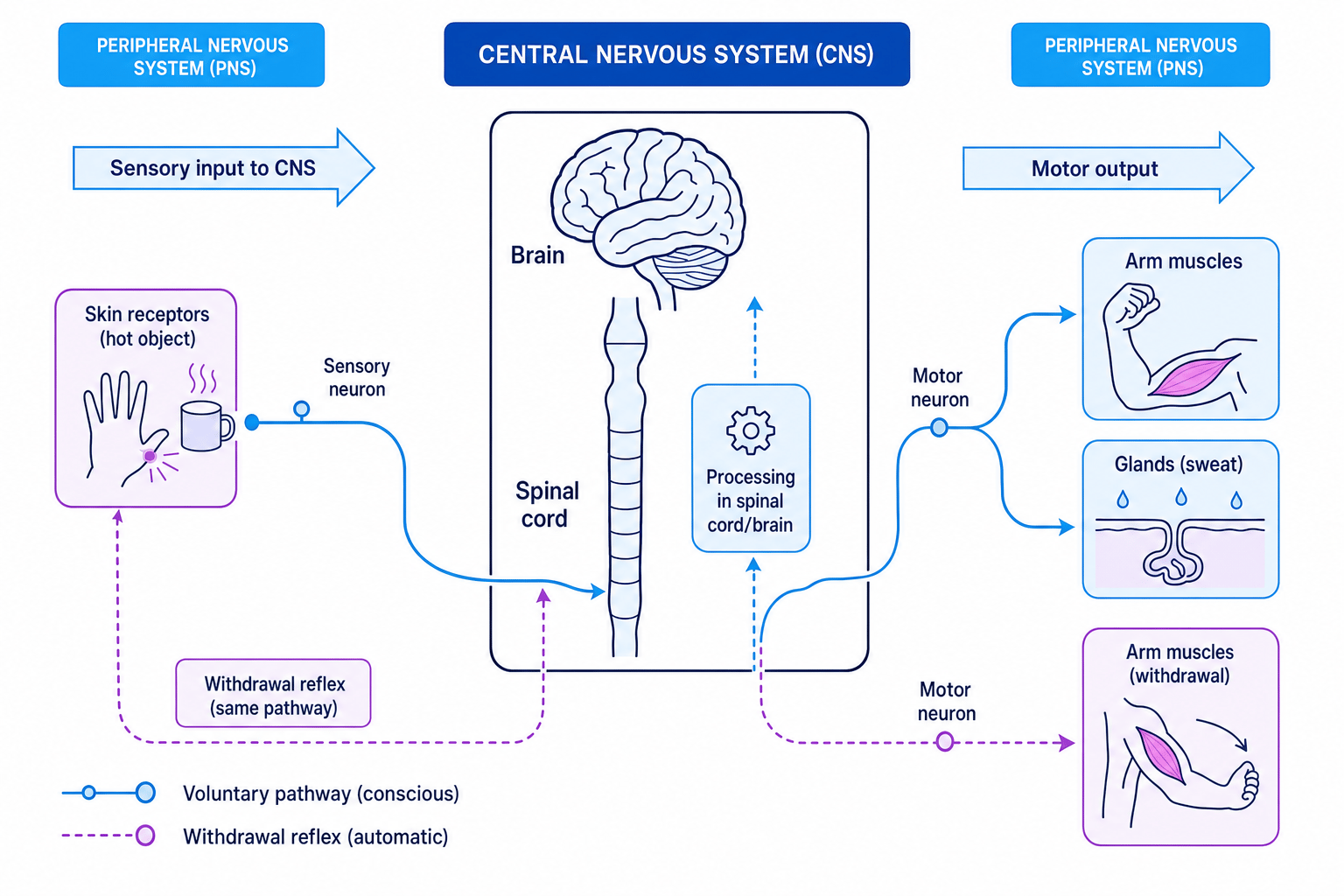
Following a withdrawal reflex
Imagine you touch a very hot surface and pull your hand away before you consciously think about it.
- Sensory receptors in your skin detect heat and damage, then send an electrical message along a sensory neuron towards the spinal cord.
- The spinal cord processes the danger signal quickly through relay neurons, so the response does not have to wait for slower conscious decision-making in the brain.
- A motor neuron carries a command from the CNS to muscles in your arm, causing them to contract and pull your hand away.
- The brain then receives information about pain and location, helping you understand what happened and avoid repeating it.
Neurons: the cells that carry messages
Neuron
A neuron is a specialised nerve cell that transmits information using electrical impulses and chemical messengers.
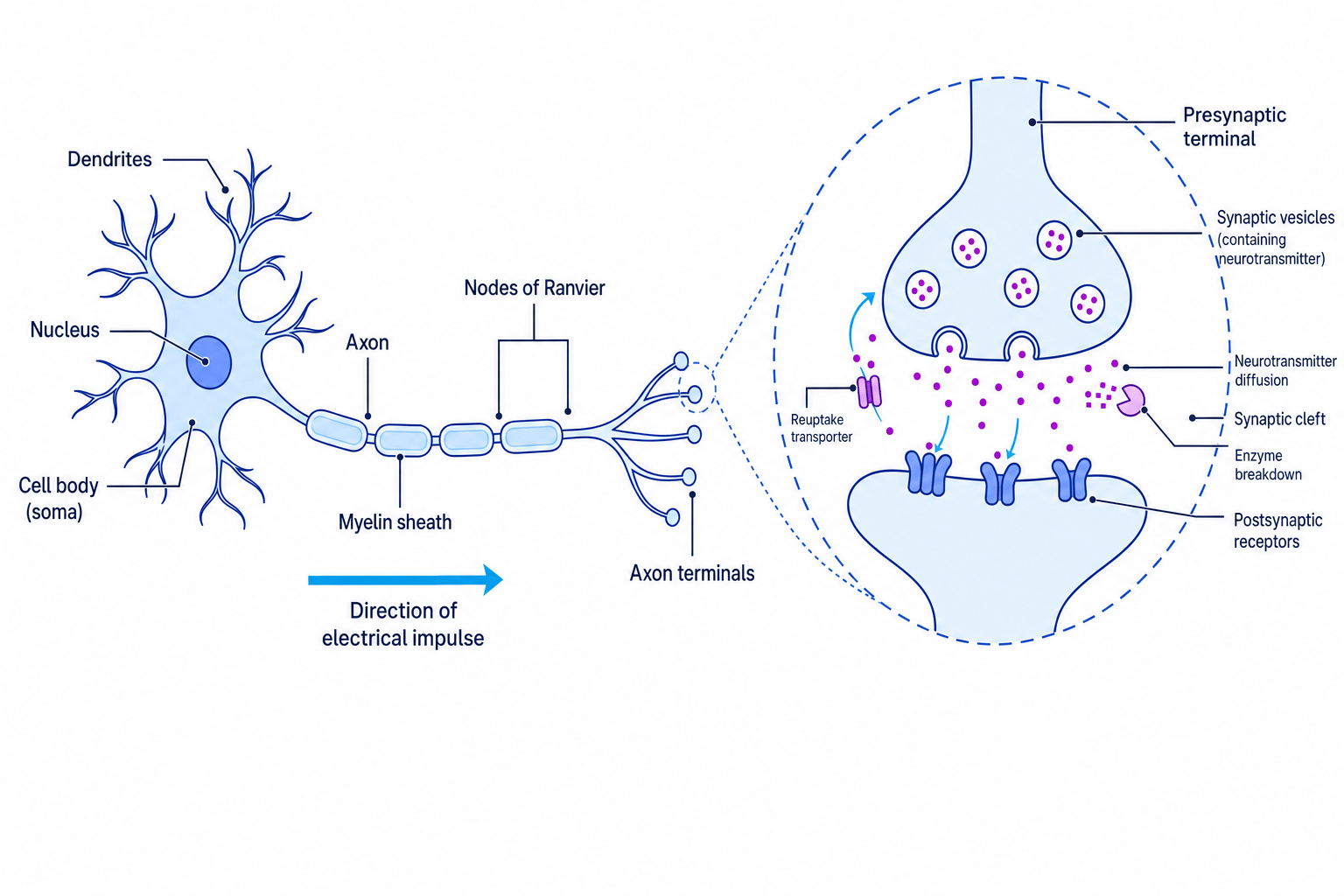
Neurons are built for communication. They have several important parts:
- Dendrites receive messages from other neurons.
- The cell body contains the nucleus and keeps the neuron alive.
- The axon carries an electrical impulse away from the cell body.
- The myelin sheath is a fatty insulating layer that speeds up transmission.
- Nodes of Ranvier are small gaps in the myelin sheath where the impulse effectively “jumps” along the axon.
- Axon terminals are the branches at the end of the neuron that pass messages to the next cell.
There are different types of neuron. Sensory neurons carry information from receptors to the CNS. Relay neurons, also called interneurons, connect neurons within the CNS. Motor neurons carry messages from the CNS to muscles or glands.
Action potential
An action potential is a brief electrical impulse that travels along the axon of a neuron. It allows information to move quickly from one end of the neuron to the other.
The message inside a neuron is mainly electrical. The message between neurons is mainly chemical. That distinction is very useful in exam answers.
Electrical versus chemical transmission
Do not write that neurotransmitters travel down the axon. The electrical impulse travels down the axon; neurotransmitters are released at the synapse to cross the gap between neurons.
The synapse: the gap between neurons
Synapse
A synapse is the tiny junction between two neurons where information is passed from one cell to another.
At the end of one neuron, the axon terminal does not usually touch the next neuron directly. Instead, there is a small gap called the synaptic cleft.
The neuron sending the message is the presynaptic neuron. The neuron receiving the message is the postsynaptic neuron.
Synaptic transmission happens in a sequence:
- An action potential reaches the presynaptic axon terminal.
- Small sacs called synaptic vesicles release neurotransmitter into the synaptic cleft.
- The neurotransmitter diffuses across the gap.
- The neurotransmitter binds to receptors on the postsynaptic neuron.
- This makes the postsynaptic neuron more or less likely to fire its own action potential.
- The neurotransmitter is removed by reuptake, enzyme breakdown, or diffusion away from the synapse.
Neurotransmitter
A neurotransmitter is a chemical messenger released by a neuron that crosses a synapse and affects the activity of another neuron.
Excitation and inhibition
Neurotransmitters do not all have the same effect. Some are mainly excitatory, meaning they make the postsynaptic neuron more likely to fire. Others are mainly inhibitory, meaning they make it less likely to fire.
This matters because behaviour depends on patterns of neural activity. A thought, movement or emotional response is not caused by one single neuron firing. It depends on many neurons communicating in networks.
Balance matters
Human behaviour depends on the balance of excitation and inhibition across neural networks. Too much or too little neurotransmitter activity can affect mood, attention, movement and arousal.
Common examples include:
| Neurotransmitter | Often linked with | Simple behavioural relevance |
|---|---|---|
| Dopamine | Reward, motivation, movement | Involved in reinforcement and motor control |
| Serotonin | Mood, sleep, appetite | Often discussed in relation to depression and anxiety |
| Acetylcholine | Memory, attention, muscle movement | Important in learning and communication with muscles |
| GABA | Inhibition and calming neural activity | Helps prevent over-activation of the nervous system |
Avoid one-neurotransmitter explanations
It is too simplistic to say “low serotonin causes depression” or “dopamine causes pleasure”. Neurotransmitters are part of complex systems involving receptors, brain areas, genes, experience and environment.
Reuptake, breakdown and drug effects
After neurotransmitters bind to receptors, they need to be cleared from the synaptic cleft. If they stayed there indefinitely, the postsynaptic neuron could be stimulated for too long.
Two key removal processes are:
- Reuptake: the neurotransmitter is taken back into the presynaptic neuron.
- Enzyme breakdown: enzymes break the neurotransmitter down into inactive substances.
Some drugs affect synaptic transmission. For example, some antidepressants called selective serotonin reuptake inhibitors (SSRIs) reduce the reuptake of serotonin. This leaves more serotonin available in the synaptic cleft for longer.
Tracing a reuptake inhibitor
Suppose a drug blocks serotonin reuptake transporters at a synapse.
- Normally, serotonin is released from the presynaptic neuron, crosses the synaptic cleft, binds to postsynaptic receptors, and is then partly removed by reuptake.
- If reuptake transporters are blocked, less serotonin returns immediately to the presynaptic neuron.
- More serotonin remains in the synaptic cleft for longer, increasing the chance that it will bind to postsynaptic receptors.
- Over time, this can alter activity in neural pathways linked with mood, although the behavioural effect depends on wider brain networks and individual differences.
Linking the CNS and neurotransmitters to behaviour
In psychology, biological explanations often argue that behaviour is influenced by the activity of the brain, spinal cord, neurons and neurotransmitters.
For example:
- A fear response may involve activity in brain areas linked to threat detection and arousal.
- Movement depends on communication between the CNS and muscles through motor neurons.
- Mood and motivation can be affected by neurotransmitter systems such as serotonin and dopamine.
- Reflexes show that some behaviours can be coordinated rapidly by the spinal cord without conscious planning.
This does not mean behaviour is only biological. Experiences, learning, cognition and social context also matter. In a strong essay, you can show that biological processes are important but not complete explanations by themselves.
AO1, AO2 and AO3: how to write about this topic
AO1: description
For AO1, describe the process accurately and in order. A strong description of synaptic transmission might say:
The action potential travels along the axon to the presynaptic terminal. Neurotransmitters are released from vesicles into the synaptic cleft. They diffuse across the gap and bind to receptors on the postsynaptic membrane. This affects whether the postsynaptic neuron fires. The neurotransmitter is then removed by reuptake or enzyme breakdown.
AO2: application
For AO2, connect the biology to a scenario. If a question describes someone reacting quickly to danger, you could apply the CNS by explaining how sensory information reaches the spinal cord or brain, is processed, and leads to a motor response.
If a question describes a drug that changes mood, you could apply neurotransmission by explaining how the drug affects release, receptor binding, reuptake or breakdown.
Application shortcut
When applying synaptic transmission, ask: which neurotransmitter, which synapse process, and what effect on postsynaptic firing? That keeps your answer focused.
AO3: evaluation
A strength of biological explanations is that they are scientific and measurable. Researchers can investigate brain activity, neurotransmitter systems and drug effects using controlled methods. Classic biological work such as Loewi (1921) helped demonstrate chemical transmission between nerve cells, while later brain-imaging research such as Raine et al. (1997) showed how CNS activity could be studied in relation to behaviour.
Another strength is real-world application. Understanding synaptic transmission has helped develop drug treatments, such as antidepressants that affect serotonin reuptake, and treatments for disorders involving dopamine or acetylcholine.
However, biological explanations can be reductionist. They may reduce complex behaviours such as depression, aggression or addiction to neurotransmitters alone, ignoring childhood experience, cognition, culture and social context.
There are also issues of cause and effect. If a person has unusual neurotransmitter activity, this may contribute to behaviour, result from behaviour, or be linked through another factor such as stress, sleep, medication or genes.
Ethically, biological explanations can be helpful because they may reduce blame and stigma. But they can also encourage biological determinism, where people assume behaviour is fixed by the brain and cannot change. Good psychology avoids that oversimplification.
In the exam
- For AO1, write the sequence clearly: electrical impulse along the neuron, chemical transmission across the synapse, then postsynaptic effect.
- For AO2, use the scenario details: link the named behaviour to sensory input, CNS processing, motor output, or neurotransmitter action.
- For AO3, balance strengths such as scientific evidence and treatment applications against reductionism, cause-and-effect problems and biological determinism.
Check yourself
- What are the brain and spinal cord responsible for within the CNS?
- How does an electrical impulse become a chemical message at the synapse?
- Why is it too simplistic to say that one neurotransmitter directly “causes” one behaviour?