What you'll learn
- What classification systems are and why clinicians use them in mental health.
- The key differences between the DSM and ICD.
- How reliability and validity apply to psychiatric diagnosis.
- How to evaluate classification systems for AO3 essay answers.
Why classification matters in mental health
Before a clinician can treat a mental health disorder, they usually need to identify and name the pattern of symptoms the person is experiencing. This is where classification systems come in.
In everyday life, classification means sorting things into categories. In clinical psychology, it means grouping symptoms into recognised disorders, such as depression, schizophrenia, anxiety disorders, or eating disorders.
Classification system
A classification system is an organised set of categories used to identify and label mental health disorders according to agreed symptoms and criteria.
A classification system helps clinicians:
- communicate clearly with other professionals
- decide which treatment may be appropriate
- make referrals to services
- carry out research using shared definitions
- collect statistics on mental health disorders
A diagnosis is the decision that a person’s symptoms fit one of these recognised categories.
Diagnosis
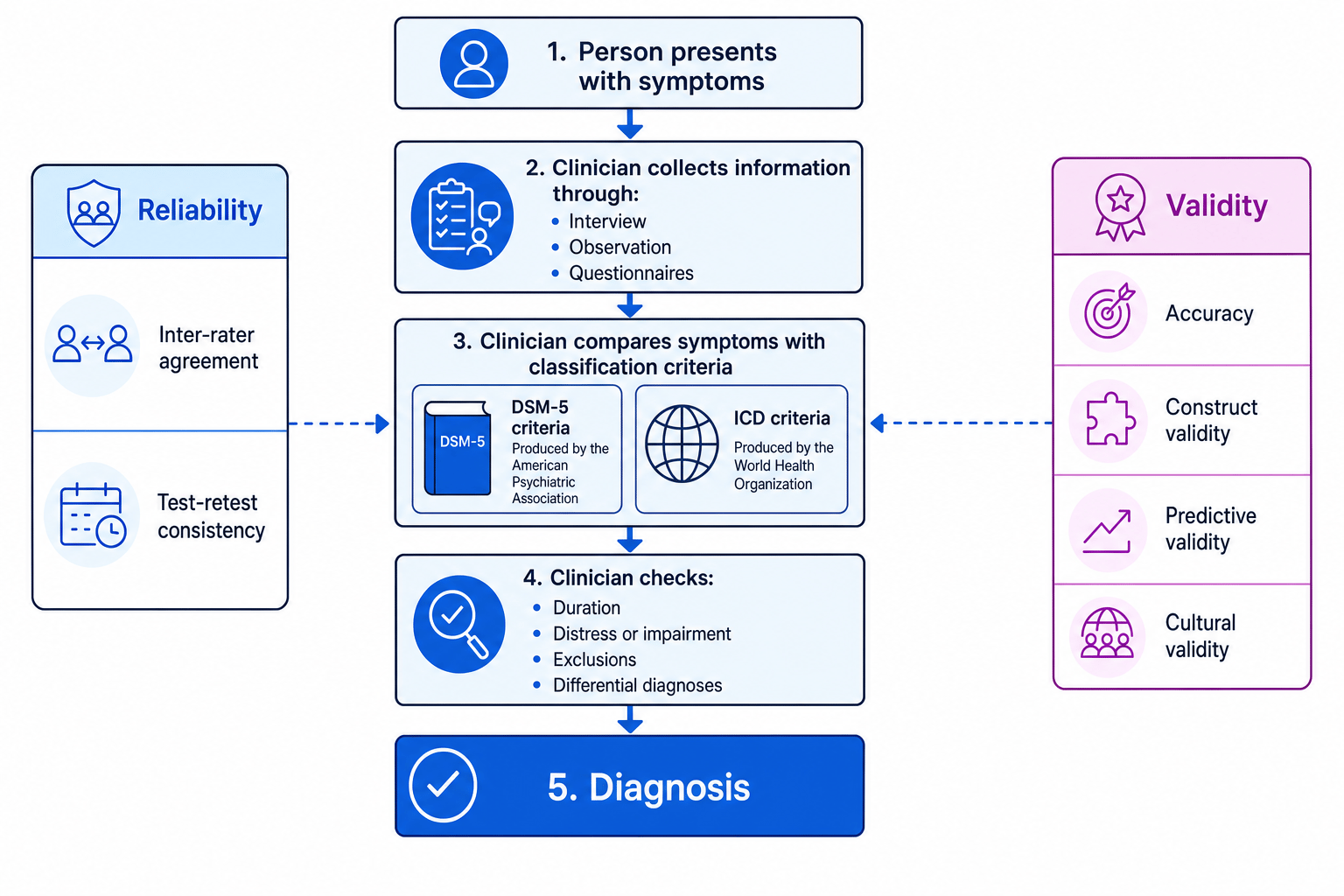
A diagnosis is the process and outcome of identifying a disorder by comparing a person’s symptoms, history and functioning with classification criteria.
The DSM
The DSM stands for the Diagnostic and Statistical Manual of Mental Disorders. It is published by the American Psychiatric Association.
Edexcel may refer to DSM-IVR or DSM-V. In practice, you may also see DSM-IV-TR, meaning the text-revised version of DSM-IV. The current version is DSM-5.
The DSM focuses specifically on mental disorders. It gives lists of symptoms and rules for diagnosis. For example, it may specify:
- which symptoms must be present
- how many symptoms are needed
- how long symptoms must last
- whether symptoms must cause distress or impairment
- whether another explanation must be ruled out
DSM in one sentence
The DSM is a mental-health classification manual mainly associated with the USA, using detailed diagnostic criteria to help clinicians decide whether a person fits a disorder category.
DSM-IV-TR and DSM-5
DSM-IV-TR used a multi-axial system, meaning the person could be assessed across several “axes”, including clinical disorders, personality disorders, medical conditions and social stressors.
DSM-5 removed this multi-axial system. It instead presents disorders in a more integrated way and tries to reflect current research more closely.
A key change in DSM-5 was the move towards recognising that some disorders may exist on a spectrum.
Spectrum
A spectrum means symptoms vary by degree rather than fitting neatly into separate all-or-nothing categories.
For example, autism is now classified as autism spectrum disorder, rather than split into several separate categories as in earlier systems.
The ICD
The ICD stands for the International Classification of Diseases. It is published by the World Health Organization.
Unlike the DSM, the ICD classifies all diseases and health conditions, not only mental disorders. Mental and behavioural disorders form one section of the ICD.
The ICD is used internationally, including in many healthcare systems such as the NHS. Current practice increasingly uses ICD-11, although ICD-10 is still often referred to in older research and teaching materials.
ICD in one sentence
The ICD is a worldwide health classification system produced by the WHO, with mental disorders included as part of a broader medical classification system.
DSM and ICD compared
| Feature | DSM | ICD |
|---|---|---|
| Full name | Diagnostic and Statistical Manual of Mental Disorders | International Classification of Diseases |
| Published by | American Psychiatric Association | World Health Organization |
| Main focus | Mental disorders | All health conditions, including mental disorders |
| Common use | Especially associated with the USA and research | Used internationally and in healthcare systems |
| Versions you may see | DSM-IV-TR, DSM-5 | ICD-10, ICD-11 |
Easy distinction
Think DSM = mental disorders manual, while ICD = international diseases manual. Both can be used for mental health, but the ICD has a wider medical purpose.
How classification works
Classification is not just “spot a symptom and label it”. A clinician should consider the whole pattern of behaviour, emotion, thinking and functioning.
Important parts of the diagnostic process include:
- symptoms: what the person reports, such as low mood or hallucinations
- signs: what the clinician observes, such as slowed speech
- duration: how long symptoms have lasted
- severity: how intense the symptoms are
- impairment: how much symptoms interfere with work, relationships or daily life
- exclusions: whether substances, medical illness or bereavement better explain the symptoms
- differential diagnosis: deciding which of several possible diagnoses best fits
Differential diagnosis
A differential diagnosis is the process of comparing similar possible disorders and deciding which diagnosis best explains the person’s symptoms.
Applying diagnostic criteria
A clinician is assessing Amira, who has experienced persistent low mood, loss of interest, sleep problems and difficulty concentrating for several weeks. Her school attendance has dropped and she has stopped seeing friends.
- The clinician checks whether the symptoms form a recognisable pattern rather than treating each symptom separately. Low mood, loss of interest, sleep disturbance and concentration problems may fit a depressive disorder.
- The clinician considers duration and impairment. Several weeks of symptoms plus reduced school attendance and social withdrawal suggest the problem is clinically significant rather than a brief mood change.
- The clinician checks exclusions and alternatives. They would consider whether substances, physical illness, grief, anxiety or another disorder better explains the presentation before making a diagnosis.
Reliability of diagnosis
A classification system is useful only if it can be applied consistently.
Reliability
Reliability means consistency. In diagnosis, a reliable classification system produces the same or very similar diagnoses when used by different clinicians or at different times.
There are two especially important forms.
Inter-rater reliability
Inter-rater reliability means different clinicians reach the same diagnosis for the same person.
For example, if two psychiatrists independently assess the same patient using DSM-5 criteria and both diagnose the same disorder, this suggests good inter-rater reliability.
Test-retest reliability
Test-retest reliability means the same person receives the same diagnosis when assessed again later, assuming their symptoms have not genuinely changed.
This matters because a diagnosis should not shift simply because of clinician mood, interview style or unclear criteria.
Judging reliability
Two clinicians independently assess the same client. Clinician A diagnoses generalised anxiety disorder. Clinician B diagnoses major depressive disorder. A week later, Clinician A changes the diagnosis to adjustment disorder, even though the client’s symptoms have not changed.
- Compare the two clinicians’ first decisions. Because Clinician A and Clinician B gave different diagnoses for the same client, inter-rater reliability is low.
- Compare Clinician A’s decisions over time. Because the same clinician changed the diagnosis without a symptom change, test-retest reliability is also low.
- Link this to classification. The criteria may be unclear, overlapping or open to interpretation, making the diagnostic system harder to apply consistently.
Evidence about reliability
Reliability has improved over time because DSM and ICD criteria are more operationalised than older diagnostic approaches.
Operationalised
A concept is operationalised when it is defined in a clear, measurable way so that different people can apply it consistently.
For example, rather than saying someone is “very sad”, a manual may specify symptoms, duration and impairment.
However, reliability is still not perfect. Cooper et al. (1972) found differences between US and UK psychiatrists in diagnosing the same patients, with US psychiatrists more likely to diagnose schizophrenia. This shows how professional culture and diagnostic habits can affect reliability.
Later DSM field trials, such as Regier et al. (2013), found reliability varied across disorders. Some diagnoses showed acceptable agreement, while others were much less consistent. This supports the idea that standardised manuals help, but do not solve all reliability problems.
Reliability is not the same as validity
A diagnosis can be reliable but still invalid. Clinicians might consistently agree on the same label, but that label may still fail to reflect the person’s real underlying problem.
Validity of diagnosis
Reliability asks: “Do clinicians agree?”
Validity asks: “Are they right?”
Validity
Validity means accuracy. In diagnosis, a valid classification system identifies real disorders and meaningfully distinguishes them from other conditions.
A diagnosis has good validity if it:
- describes a real pattern of symptoms
- separates one disorder clearly from another
- predicts likely course or outcome
- helps guide effective treatment
- applies fairly across cultures and groups
Types of validity
Construct validity means the diagnosis reflects a genuine psychological or biological construct. If “depression” is a valid construct, people with that diagnosis should share meaningful underlying features.
Predictive validity means the diagnosis helps predict future outcomes, such as prognosis or response to treatment.
Concurrent validity means the diagnosis agrees with other measures taken at the same time, such as questionnaires, clinical interviews or behavioural observations.
Cultural validity means the diagnosis is appropriate across cultural contexts and does not wrongly label culturally normal experiences as symptoms.
Separating reliability from validity
A hospital team uses a checklist for a disorder. All clinicians agree that a client meets the criteria, but research later shows the checklist groups together several unrelated problems with different causes and treatments.
- Assess reliability first. The clinicians agree when using the checklist, so inter-rater reliability is high.
- Assess validity next. If the category combines unrelated problems, the diagnosis may not represent one genuine disorder, so construct validity is weak.
- Consider treatment implications. If people with the same label need very different treatments, predictive validity may also be poor.
Validity problems in classification
Symptom overlap
Many disorders share symptoms. For example, sleep disturbance, poor concentration and irritability may occur in depression, anxiety, trauma-related disorders and physical illness.
This makes it difficult to decide where one disorder ends and another begins.
Comorbidity
Comorbidity means a person has two or more diagnoses at the same time.
Comorbidity
Comorbidity is the co-occurrence of two or more disorders in the same person.
High comorbidity can challenge validity. If anxiety and depression are frequently diagnosed together, it raises the question of whether they are truly separate categories or overlapping parts of a broader difficulty.
Heterogeneity
Heterogeneity means people with the same diagnosis can show different symptom patterns.
For example, two people may both receive the same diagnosis but have different combinations of symptoms, different causes and different treatment needs.
Labelling effects
Rosenhan (1973) challenged the validity of psychiatric diagnosis in the classic study “On Being Sane in Insane Places”. Pseudopatients presented at psychiatric hospitals claiming to hear a voice, but afterwards behaved normally. They were admitted and diagnosed, often with schizophrenia.
The study suggested that psychiatric labels can shape how behaviour is interpreted. Once someone is labelled mentally ill, ordinary behaviour may be seen as further evidence of illness.
There are methodological criticisms of Rosenhan’s study, including deception and questions about replicability. However, it remains important for AO3 because it highlights how diagnosis can be affected by context, expectation and stigma.
Ethical issues in classification
Diagnosis can be helpful, but it has ethical consequences.
A diagnosis may give someone access to treatment and support. It can also reduce self-blame by helping the person understand their experiences.
However, labels can lead to:
- stigma from others
- discrimination in employment or relationships
- self-fulfilling prophecy
- lowered expectations
- confidentiality risks if diagnostic information is shared inappropriately
The BPS Code of Ethics and Conduct (2009) is relevant when psychologists assess, diagnose or research mental health. Important principles include informed consent, protection from harm, confidentiality, right to withdraw and debriefing where research is involved.
Diagnosis affects real lives
A diagnosis is not just an academic label. It can influence treatment, identity, education, employment, insurance and how other people respond to the person.
AO3 evaluation: strengths of DSM and ICD
They improve communication
Standardised systems give clinicians a shared language. This helps psychiatrists, psychologists, GPs, researchers and services communicate more clearly.
They support treatment planning
Diagnosis can help clinicians choose evidence-based treatments. For example, a diagnosis may guide decisions about psychological therapy, medication or specialist referral.
They support research
Researchers need agreed definitions to study disorders. Without classification systems, it would be difficult to compare findings across studies or evaluate treatments.
They are more reliable than informal judgement
Modern DSM and ICD criteria are more structured than vague clinical impressions. Operationalised criteria can improve consistency between clinicians.
AO3 evaluation: weaknesses of DSM and ICD
Reliability is still variable
Even with manuals, clinicians may interpret symptoms differently. Interviews, cultural assumptions and professional training can all influence diagnosis.
Validity is uncertain for some disorders
Many mental health diagnoses do not have clear biological tests. This makes validity harder to establish than for many physical illnesses.
Categories may oversimplify complex experiences
Human distress may not fit neatly into boxes. A categorical diagnosis can miss individual differences, trauma history, culture and personal meaning.
Cultural bias is a risk
Behaviour that appears unusual in one culture may be normal or meaningful in another. If classification systems are based mainly on Western assumptions, they may pathologise culturally appropriate experiences.
AO3 sentence frame
A strong evaluation point often sounds like: “This challenges the validity of classification because…” or “This improves reliability because…”. Keep linking your criticism back to the key terms.
The big takeaway
DSM and ICD are essential tools in clinical psychology, but they are not perfect mirrors of reality. They help professionals classify distress in a shared way, yet diagnosis still involves judgement.
Reliability versus validity
Reliability is about consistency; validity is about accuracy. The best classification system needs both.
In the exam
- Define DSM and ICD clearly before evaluating them; do not assume the examiner knows which system you mean.
- For AO3, use the terms reliability and validity precisely, and support points with evidence such as Cooper et al. (1972), Rosenhan (1973) or Regier et al. (2013).
- Always link evaluation back to diagnosis in real life: treatment access, stigma, cultural fairness and whether clinicians can agree.
Check yourself
- What is the main difference between the DSM and the ICD?
- How is inter-rater reliability different from test-retest reliability?
- Why might comorbidity and symptom overlap reduce diagnostic validity?
