What you'll learn
- The main features of autism and how to apply them to a child’s behaviour.
- One biological explanation: genetic vulnerability and atypical brain development.
- One cognitive explanation: theory of mind difficulties.
- How therapies and support can help children with autism, plus key AO3 evaluation points.
Big picture: autism as features, explanations and support
For 9PS0, you need to describe autism clearly, explain why it may develop, and evaluate therapies that aim to support children’s communication, independence and wellbeing. The explanations are not “competing guesses” in a simple way: autism is complex, so biological, cognitive and environmental factors can interact.
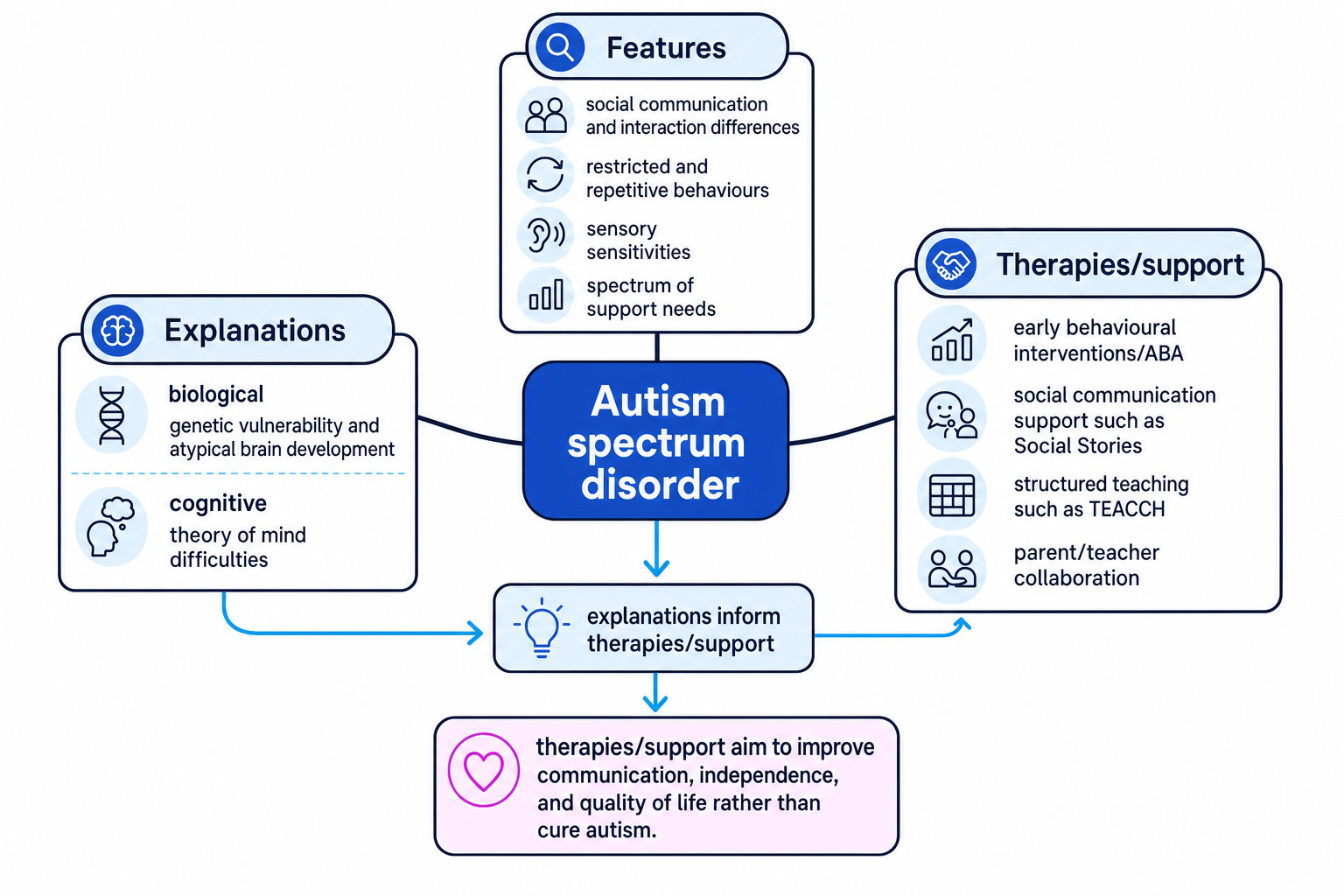
Core idea
Autism is a spectrum: autistic children can have very different strengths, difficulties and support needs, so avoid writing as if every autistic child is the same.
What autism is
Autism spectrum disorder (ASD)
Autism spectrum disorder is a neurodevelopmental condition, meaning it involves differences in brain development that appear early in life and affect development, especially social communication, interaction, flexibility of behaviour and sensory processing.
Autism was described by Kanner (1943) as involving early social and communication differences, insistence on sameness and unusual responses to the environment. Later, Wing and Gould (1979) helped develop the idea of a wider autism spectrum.
In modern exam answers, it is best to write about autistic children or children with autism respectfully. Many autistic people prefer identity-first language, but the key is to avoid implying that autism is an illness to be “cured”.
The features of autism
Current descriptions usually focus on two broad areas.
Social communication and social interaction differences
This can include differences in:
- using and understanding eye contact, facial expression, gesture and tone of voice
- starting or maintaining reciprocal conversation
- sharing interests or emotions with others
- understanding social rules, sarcasm, jokes or implied meanings
- developing and maintaining friendships
This does not mean autistic children do not want relationships. Some do want friends but may find social situations confusing, tiring or unpredictable.
Restricted, repetitive behaviours and interests
This can include:
- repetitive movements, such as hand-flapping or rocking
- repeating words or phrases, known as echolalia
- strong preference for routines and distress when routines change
- intense interests in particular topics or objects
- repetitive play patterns
Sensory differences
Many autistic children experience sensory sensitivity, meaning they may be over-sensitive or under-sensitive to sound, light, texture, smell, taste, pain or movement. For example, a school bell may feel painfully loud, or a child may seek deep pressure because it feels calming.
Applying features to a child’s behaviour
A teacher says: “Sam finds group work stressful, repeats lines from his favourite programme, becomes very upset if the timetable changes, and covers his ears when the lunch hall is noisy.”
- Identify the social communication/interaction feature: finding group work stressful may suggest difficulty managing reciprocal interaction or unpredictable social demands.
- Identify the restricted/repetitive behaviour feature: repeating lines from a programme is an example of echolalia, and distress at timetable changes shows insistence on sameness.
- Identify the sensory feature: covering his ears in the lunch hall suggests sensitivity to noise.
- Add the diagnostic caution: these behaviours could support an autism assessment, but a diagnosis would need a persistent pattern across contexts, not one isolated observation.
Do not diagnose from one trait
A child liking routines or avoiding eye contact is not enough on its own. In exams, describe a pattern of features and link them to everyday functioning.
Biological explanation: genetic vulnerability and brain development
A biological explanation argues that autism is partly caused by inherited or early-developing biological factors. A strong version for A-Level is: genetic vulnerability influences atypical brain development, which affects communication, social understanding, flexibility and sensory processing.
Autism is not caused by one “autism gene”. It is better described as polygenic, meaning many genes each contribute a small amount of risk. Some genetic influences are inherited, while others may involve new genetic changes. These genes may affect early brain development, including neural connectivity — the way brain areas communicate with each other.
Concordance rate
A concordance rate is the percentage likelihood that two people who are genetically related, such as twins, both show the same characteristic or diagnosis.
Twin evidence supports a genetic role. Folstein and Rutter (1977) found higher autism concordance in monozygotic twins than dizygotic twins. Bailey et al. (1995) also found much higher concordance for autism and broader autistic traits in monozygotic twins. Monozygotic twins share virtually all their genes, while dizygotic twins share about half, so higher concordance in monozygotic twins suggests genetic influence.
Using twin evidence
Imagine a study finds autism concordance is 60% in monozygotic twins and 5% in dizygotic twins.
- Compare the two rates: 60% is much higher than 5%, so the characteristic appears more similar when twins are more genetically alike.
- Apply the logic of twin studies: because monozygotic twins share more genes than dizygotic twins, this pattern supports a genetic contribution.
- Avoid overclaiming: 60% is not 100%, so genes cannot be the whole explanation; non-genetic developmental or environmental factors must also matter.
AO3 evaluation of the biological explanation
A strength is that genetic explanations are supported by consistent twin and family findings. Reviews such as Tick et al. (2016) suggest autism is highly heritable, although estimates vary depending on sample and diagnostic criteria. This helps explain why autism often appears early in development and why autistic traits can run in families.
A limitation is that twin studies rely on assumptions. Monozygotic twins may be treated more similarly than dizygotic twins, so higher concordance may partly reflect shared environment, not just genetics. Also, autism is highly varied: a genetic explanation may explain risk, but it does not fully explain why one child has strong language skills while another has severe communication difficulties.
Genes are not destiny
Saying autism has genetic influences does not mean autism is fixed, predictable or untreatable. Genetic vulnerability can interact with development, environment and support.
There are ethical issues too. Genetic research must protect confidentiality and avoid increasing stigma. In line with the BPS Code of Ethics and Conduct (2009), researchers need informed consent, protection from harm, confidentiality, right to withdraw and debriefing, especially when families and children are involved.
Other explanation: theory of mind
Theory of mind
Theory of mind is the ability to understand that other people have their own beliefs, intentions, knowledge and feelings, which may be different from reality and different from your own.
The cognitive explanation argues that some features of autism arise from difficulties with theory of mind. This can make it harder to predict what other people know, mean or expect, especially in ambiguous social situations.
A classic study is Baron-Cohen, Leslie and Frith (1985), who used the Sally-Anne false-belief task. Many autistic children found it difficult to predict where a character would look for an object after it had been moved without her knowledge. This suggested difficulty representing another person’s false belief.
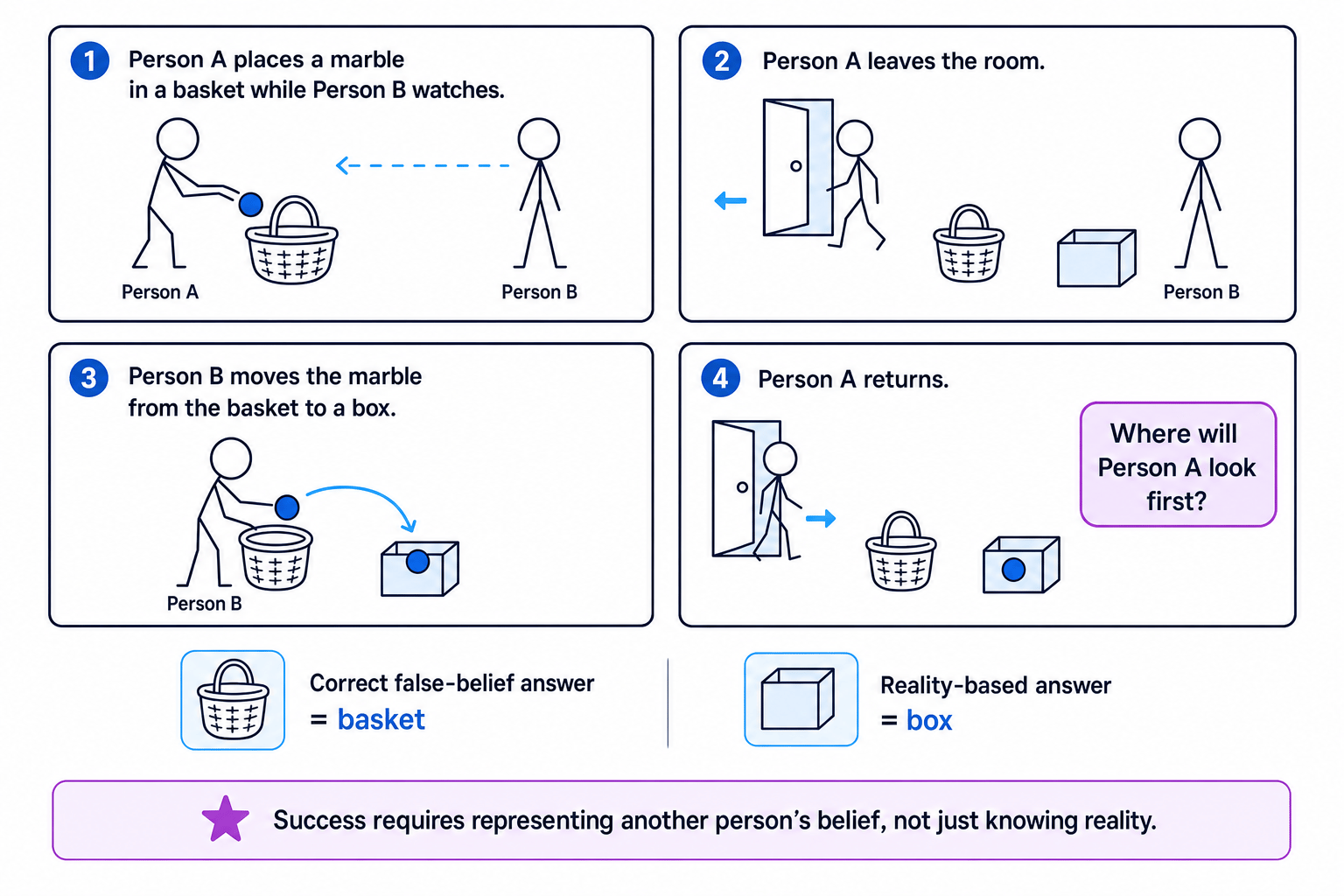
Solving a false-belief task
In the task, Person A puts a marble in a basket, leaves, and Person B moves it to a box. Person A returns.
- Separate reality from belief: the marble is really in the box, but Person A did not see it being moved.
- Work out Person A’s belief: Person A believes the marble is still in the basket.
- Predict behaviour from the belief, not reality: Person A should look in the basket first.
AO3 evaluation of theory of mind
A strength is that theory of mind explains social communication difficulties well. It can account for why autistic children may struggle with hidden meanings, sarcasm, deception or understanding another person’s perspective. It also has practical value because it links to interventions such as Social Stories and explicit teaching of social situations.
A limitation is that it does not explain all features of autism. It is less good at explaining sensory sensitivities, repetitive behaviours or intense interests. Some autistic people pass false-belief tasks, especially with age or strong verbal ability, so theory of mind difficulty may be a delay for some children rather than a universal absence. False-belief tasks may also involve language and memory demands, so failure may not be purely about social understanding.
Theory of mind is not lack of empathy
Do not write that autistic children “have no empathy”. The theory is about difficulty inferring mental states, not about being uncaring.
Therapies and support for children with autism
Therapy/support
In autism, therapy means structured support designed to improve communication, learning, independence, emotional wellbeing and quality of life. It should not be presented as a cure.
Behavioural interventions: ABA and EIBI
Applied Behaviour Analysis (ABA) uses principles of operant conditioning, where behaviour is shaped by consequences such as reinforcement. Skills are broken into small steps, prompted, practised and reinforced. Early Intensive Behavioural Intervention (EIBI) is an intensive form often used with younger children.
Lovaas (1987) reported large improvements for some children receiving intensive behavioural intervention, but the study has been criticised for small samples, lack of full random allocation and outcome measures that reflected “normalisation”. Modern ethical practice should focus on useful skills, communication and wellbeing, not suppressing harmless autistic behaviours.
Structured teaching: TEACCH
TEACCH is a structured teaching approach. It uses visual schedules, clearly organised spaces, predictable routines and individualised tasks. This can reduce anxiety because the child can see what will happen next and what is expected.
Research such as Ozonoff and Cathcart (1998) suggests TEACCH-based home programmes can improve developmental skills, though studies often vary in quality and sample size.
Social communication support: Social Stories
Social Stories, developed by Gray (1994/2000), are short personalised stories that explain a social situation, what other people may think or feel, and what the child could do. For example, a Social Story might prepare a child for a fire drill, birthday party or change of classroom.
Developmental and parent-mediated approaches
Some therapies train parents and teachers to support communication during everyday play and routines. Dawson et al. (2010) found that the Early Start Denver Model, a naturalistic developmental behavioural intervention, improved outcomes for some toddlers compared with community treatment. This is useful because support can be built into daily life.
Matching support to a child’s needs
A child becomes distressed when moving from playtime to maths and often runs from the classroom.
- Identify the need: the main issue is difficulty with transition and unpredictability, not deliberate misbehaviour.
- Match the support: a TEACCH-style visual timetable and countdown could make the transition more predictable.
- Add a communication strategy: a Social Story could explain what happens after playtime and what the child can do if anxious.
- Check ethics and outcomes: the support should reduce distress and increase independence, not simply force compliance.
AO3 evaluation of therapies
A major strength is real-world application. Effective support can improve communication, reduce anxiety, support school inclusion and help families. Therapies are strongest when individualised, started early where appropriate, and coordinated between parents, teachers and clinicians.
A weakness is that outcomes vary widely. Some children make clear gains, while others benefit less. Many therapy studies have methodological issues such as small samples, lack of random allocation, no blinded assessors, or different outcome measures, making it hard to compare approaches.
Ethically, therapies must follow the BPS Code of Ethics and Conduct (2009): informed consent from parents or carers, the child’s assent where possible, right to withdraw, protection from harm, confidentiality and debriefing. There should be no deception about aims or likely outcomes. Support should respect autistic identity and avoid trying to eliminate harmless behaviours just because they look unusual.
Best therapy answer
The strongest exam answers say therapies can be helpful, but only when they are individualised, ethical, evidence-based and focused on the child’s quality of life.
In the exam
- For AO1, describe autism using the two main feature areas: social communication/interaction and restricted, repetitive behaviours, with sensory differences if relevant.
- For AO2, apply features carefully to the scenario: label the behaviour, then explain why it fits that feature.
- For AO3, evaluate with evidence and balance: twin studies support biology, false-belief tasks support theory of mind, but autism is varied and no single explanation or therapy explains everything.
Check yourself
- What is the difference between a social communication feature and a restricted/repetitive behaviour?
- Why does higher concordance in monozygotic twins support a genetic explanation, but not prove genes are the only cause?
- How could a Social Story or visual timetable help a child with autism in school?
