What you'll learn
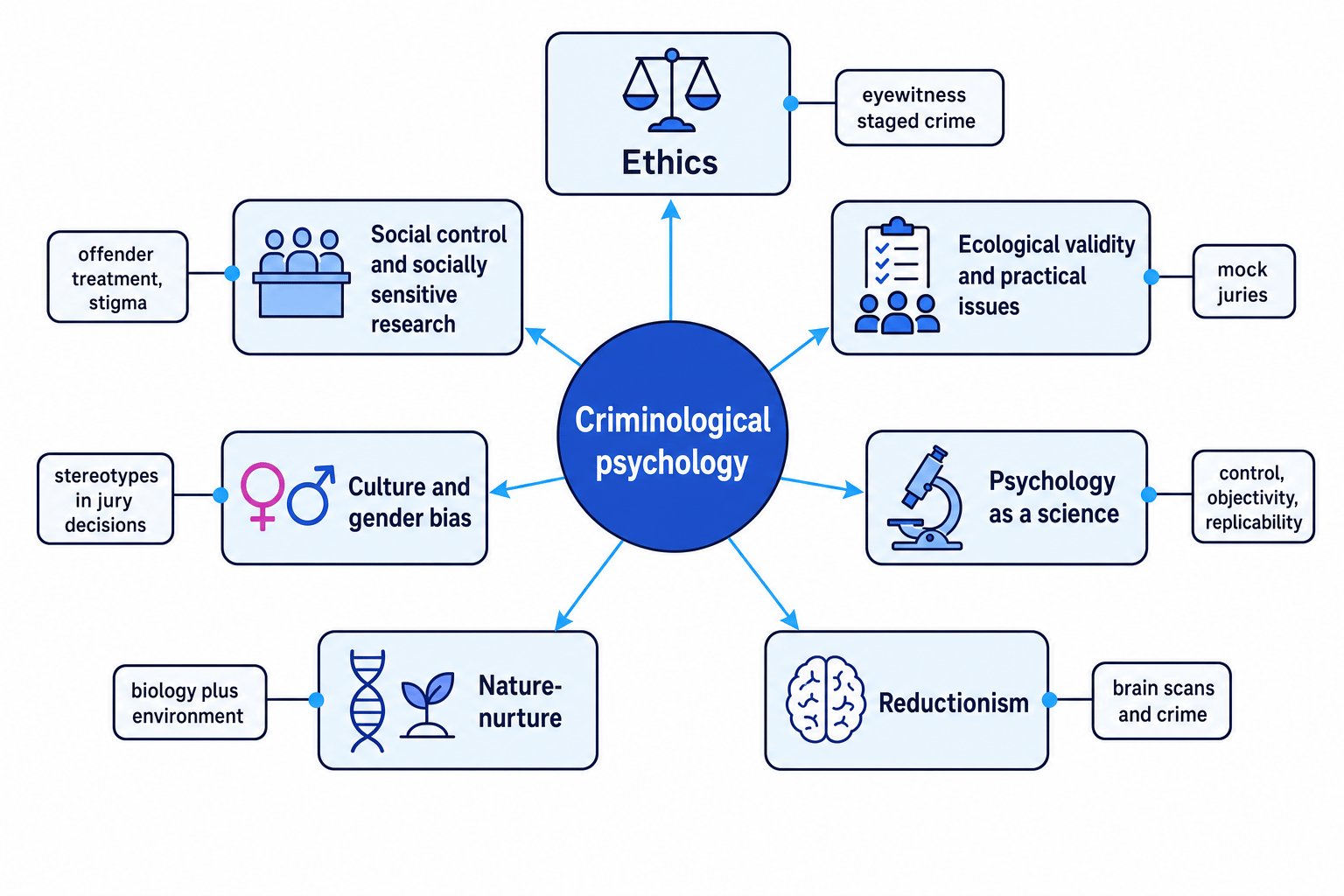
- How major issues and debates apply to criminological psychology.
- How to evaluate research on eyewitness testimony, jury decision-making, criminal behaviour and treatments.
- How to build AO3 points using ethics, reductionism, culture/gender, nature–nurture and social control.
- How psychology can be used in society — helpfully, but sometimes controversially.
Starting point: what are “issues and debates”?
In A-Level Psychology, issues and debates are broad evaluation themes that cut across many topics. They help you move beyond “what the study/theory says” into “why it matters, what its limits are, and how it affects real people”.
In criminological psychology, these debates are especially important because the topic deals with crime, witnesses, juries, offenders, victims and justice. Mistakes can have serious consequences: a wrongful conviction, an unfair trial, or an unethical treatment programme.
Issues and debates
Issues and debates are recurring questions about psychological research and theory, such as whether research is ethical, scientific, reductionist, culturally biased, socially sensitive, or useful in real life.
Ethics in criminological psychology
Ethics means protecting participants and others affected by research. In the UK, psychologists are guided by the BPS Code of Ethics and Conduct, 2009, including consent, deception, right to withdraw, protection from harm, confidentiality and debriefing.
Criminological research can be ethically tricky. For example, studies on eyewitness testimony may use staged crimes or misleading questions. Loftus and Palmer (1974) investigated how leading questions affected memory for a car accident, but participants were deceived about the true aim. Field experiments on eyewitness unreliability may create more realistic data, but participants might witness a staged theft or argument without giving prior consent.
Ethics matters more when consequences are serious
In criminological psychology, ethical problems are not just about participants in a study. Findings may influence police interviews, court procedures, treatment programmes and public views of offenders.
Eyewitness testimony and ethical responsibility
Research has shown that eyewitness testimony can be unreliable. Loftus and Palmer (1974) found that the wording of questions changed estimates of speed and later memory for broken glass. This matters because confident witnesses can still be inaccurate.
A useful real-world application is that courts and police can be warned about the effects of leading questions, post-event information and the weapons effect, where attention is drawn to a weapon and memory for other details may be reduced, as shown in research such as Johnson and Scott (1976).
Eyewitness testimony
Eyewitness testimony is evidence given by someone who has witnessed an event, often a crime, and later reports what they saw to police or in court.
Applying an ethical evaluation to eyewitness research
-
Identify the ethical issue: if participants see a staged crime, they may be deceived and may not have given fully informed consent.
-
Weigh this against the benefit: realistic eyewitness research can improve police procedures and reduce wrongful convictions.
-
Add protection: researchers should debrief participants, explain the deception, allow withdrawal of data where possible, and monitor distress.
Only listing ethical guidelines
Do not just write “consent, deception, debrief”. For AO3, explain why the ethical issue matters in criminological psychology and how it affects the value of the research.
Practical issues in research design
Criminological psychologists often cannot study real crimes, real juries or real offenders in fully controlled ways. This creates practical issues.
For example, researchers cannot ethically manipulate a real trial to see whether jury bias changes the verdict. Instead, they may use mock juries, where participants read or watch a trial scenario and give a verdict. This improves control but may reduce ecological validity, meaning the task may not reflect real-life seriousness.
Ecological validity
Ecological validity is the extent to which research reflects real-life behaviour and settings.
Mock jury research can investigate the effects of defendant characteristics such as gender, ethnicity, accent or attractiveness. However, mock jurors know no real defendant will be imprisoned, so their decision-making may be less careful than in a real court.
Research methods and scientific measurement
Criminological psychology uses laboratory experiments, field experiments, interviews, questionnaires, case studies and sometimes biological methods such as brain scanning. Scientific research aims to be controlled, replicable and based on evidence.
Where quantitative data are collected, researchers may use descriptive statistics such as measures of central tendency, range and standard deviation, frequency tables, bar charts or histograms. Data may be normally distributed or skewed, which affects interpretation. Inferential tests may also be used: Mann-Whitney U or Wilcoxon signed-ranks for differences, Spearman’s rho for correlations, and chi-square for associations. Researchers usually compare an observed value with a critical value at a significance level such as p≤.05p \le .05p≤.05, with stricter or more lenient levels such as p≤.01p \le .01p≤.01 or p≤.10p \le .10p≤.10. One-tailed and two-tailed decisions affect the critical value used.
Qualitative data, such as offender interviews, may be analysed using thematic analysis, where repeated patterns or themes are identified.
Science evaluation shortcut
For “psychology as a science”, think control, objectivity, measurement, replicability — then balance it against artificiality, ethics and real-world complexity.
Reductionism
Reductionism is the issue of explaining complex behaviour using a very narrow level of explanation. In criminological psychology, this often appears in biological explanations of crime.
For example, Raine et al. (1997) used PET scans to compare brain activity in murderers pleading not guilty by reason of insanity with control participants. The study suggested differences in areas such as the prefrontal cortex. This supports biological explanations, but it risks reducing criminal behaviour to brain functioning alone.
Reductionism
Reductionism is explaining a complex behaviour by breaking it down into simpler components, sometimes ignoring wider social, cognitive or emotional influences.
Biological explanations can be useful because they are scientific and may lead to treatment. However, they may ignore poverty, childhood experiences, peer influence, education, media, labelling and opportunity.
Evaluating a biological explanation of crime
-
Start with the strength: biological research can use objective measures, such as brain scans, which may improve scientific credibility.
-
Add the limitation: criminal behaviour involves choices, social context and learning, so brain differences alone may not fully explain offending.
-
Reach a balanced judgement: biological explanations are strongest when combined with environmental factors rather than used as a complete explanation.
Comparing explanations: biology, learning and social psychology
Criminological psychology includes several ways of explaining criminal behaviour.
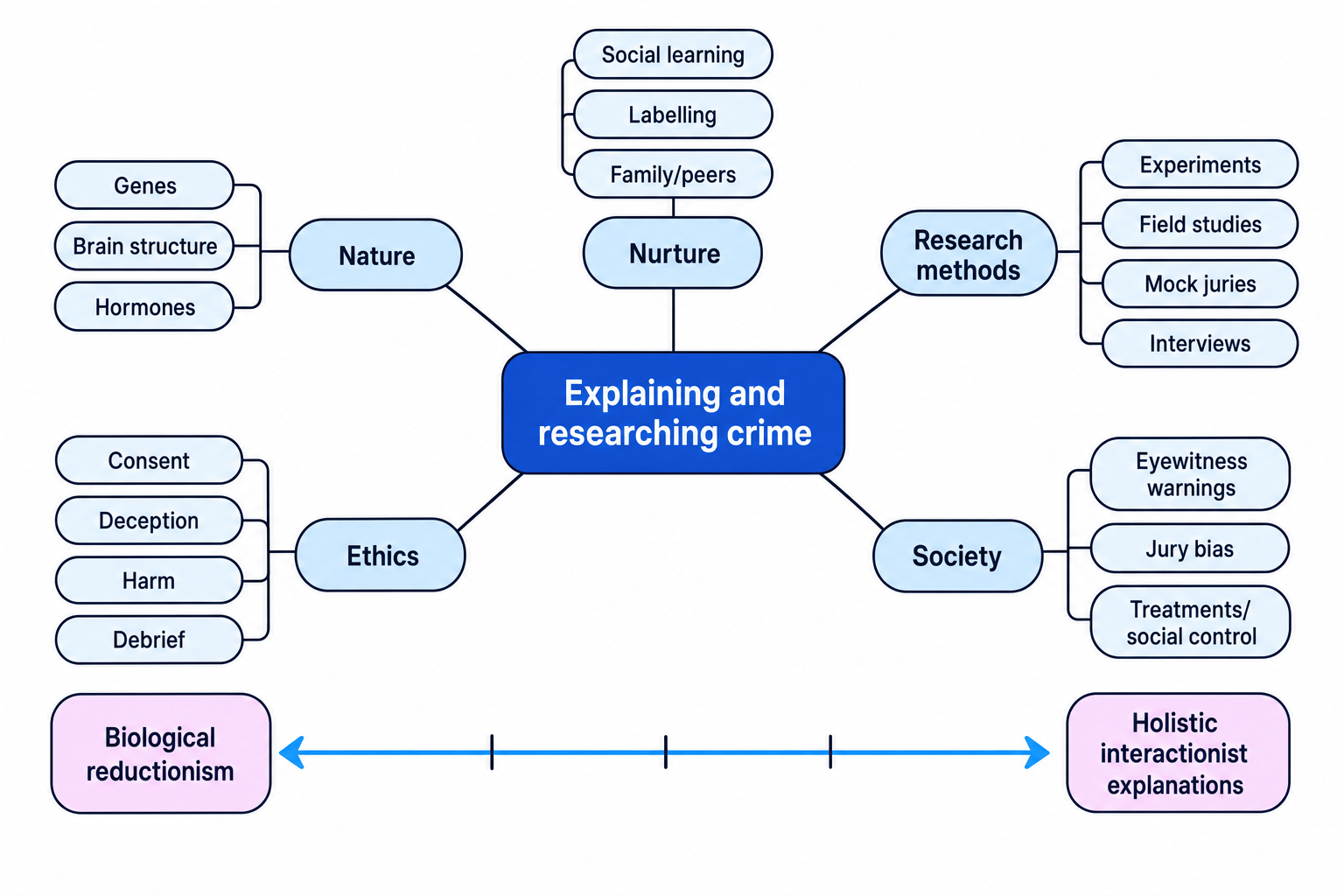
A biological explanation may focus on genes, brain structure, hormones or neurotransmitters. A learning explanation may suggest that criminal behaviour is acquired through reinforcement, punishment, imitation or modelling, as in Bandura’s social learning theory. A social psychological explanation may focus on labelling, prejudice, group influence or expectations.
Different explanations answer different questions
Biological explanations often ask “what is happening inside the person?”, learning explanations ask “how was the behaviour acquired?”, and social explanations ask “how does the social world shape behaviour?”
This links to the nature–nurture debate. Nature refers to inherited or biological influences. Nurture refers to environmental influences such as family, peers, education and culture. A strong essay usually avoids choosing only one side and instead argues for an interactionist view: biology may create vulnerability, but environment influences whether offending develops.
Nature–nurture debate
The nature–nurture debate asks whether behaviour is mainly influenced by biological inheritance or by environmental experience.
Culture and gender
Culture and gender can affect both criminal behaviour research and legal decision-making.
In jury decision-making, stereotypes about gender, ethnicity, age or social class may influence perceptions of the defendant or victim. This can disadvantage defendants if jurors rely on assumptions rather than evidence. For example, a young male defendant from a lower socio-economic background may be judged as more “criminal” because of social stereotypes.
Culture also affects how behaviour is interpreted. A theory developed in one country may not apply equally across cultures because norms, policing, court systems and crime definitions vary.
Treating culture as an add-on
Do not simply write “the study is culturally biased”. Explain which culture was studied, who is underrepresented, and why this limits generalisation.
Gender bias can also appear in explanations of crime. Many offender samples contain more males than females, so theories may describe male offending better than female offending. If a theory is based mainly on male offenders, it may not fully explain female pathways into crime, such as trauma, coercion, poverty or caregiving pressures.
Development of psychological understanding over time
Psychological understanding of eyewitness testimony has developed significantly. Bartlett (1932) argued that memory is reconstructive, meaning people rebuild memories using schemas. Loftus and Palmer (1974) then showed experimentally that misleading questions could distort memory. Later research and applied work by Loftus continued to show that memory can be influenced by post-event information.
This led to practical improvements such as the cognitive interview, developed by Fisher and Geiselman (1992). The cognitive interview uses techniques such as reinstating context, reporting everything, changing order and changing perspective to improve recall without using leading questions.
Cognitive interview
The cognitive interview is a police interview technique designed to improve eyewitness recall using psychological knowledge about memory retrieval.
This development shows psychology becoming more applied and ethically aware. Rather than simply testing memory errors, psychologists now help design better interview methods that reduce contamination and support more reliable evidence.
Social control and offender treatment
Social control refers to the way institutions use power to regulate behaviour. In criminological psychology, this can include prisons, courts, probation services, forensic psychologists and therapists.
Treatments for offenders, such as cognitive behavioural therapy, anger management, token economies or restorative justice, may be beneficial. They can reduce reoffending, help offenders understand harm and support rehabilitation.
However, they also raise issues of power. Offenders may feel pressured to take part because treatment affects parole, privileges or sentencing. A therapist or forensic psychologist may have authority over the offender’s progress, which raises ethical questions about consent and autonomy.
Social control
Social control is the use of psychological knowledge or institutional power to influence, manage or regulate people’s behaviour.
Treatment is not automatically ethical
A treatment can have good aims but still be ethically questionable if the offender cannot freely consent, does not understand the process, or is harmed by the intervention.
Socially sensitive research
Socially sensitive research investigates topics that may affect particular groups or have social consequences. Crime research is often socially sensitive because it may examine links between offending and socio-economic status, race, age or gender.
This research can be useful if it identifies risk factors and improves support. For example, finding that poverty, exclusion or early trauma increases risk may encourage prevention rather than punishment.
But it can also be harmful if findings are misused. If a study appears to link a social group with crime, it may increase stigma, discrimination or biased policing. Researchers must be careful in how they design, interpret and report findings.
Socially sensitive research
Socially sensitive research is research that may have consequences for individuals or groups in society, especially if findings could increase stigma, discrimination or unequal treatment.
Using psychological knowledge in society
Criminological psychology has clear real-world value. It can warn courts about unreliable eyewitness testimony, improve police interviewing, identify possible jury bias, support offender rehabilitation and guide crime prevention.
But usefulness must be balanced with caution. Psychological evidence should not be treated as perfect. A brain scan cannot prove someone will offend. A witness who is confident is not always accurate. A jury may believe it is fair while still being influenced by stereotypes.
Best overall judgement
Criminological psychology is most valuable when it improves justice while staying ethically cautious, scientifically critical and aware of social consequences.
In the exam
-
For AO1, briefly describe the issue or debate using criminological examples, such as Loftus and Palmer (1974), Raine et al. (1997), mock juries or offender treatment.
-
For AO2, apply the debate directly to the scenario: eyewitnesses, jurors, offenders, victims, police interviews or therapy settings.
-
For AO3, make a balanced judgement: explain both the usefulness of the research and the ethical, methodological or social risks.
Check yourself
- Why might mock jury research have high control but lower ecological validity?
- How can biological explanations of criminal behaviour be both scientific and reductionist?
- Why is research into race, gender, age or socio-economic status and crime socially sensitive?