What you'll learn
- What Howells et al. (2005) investigated about brief anger management programmes with offenders.
- How the study was designed, including its outcome measures and predictors of change.
- The main findings: anger management helped some offenders, but not all.
- How to evaluate the study for AO3, including methodology, ethics and real-world application.
Why this study matters in Criminological Psychology
In Topic 6, you study explanations of crime and ways of reducing offending. Howells et al. (2005) is important because it tests a real-world treatment used in correctional settings: anger management.
A key starting point is that anger is not the same as aggression.
- Anger is an emotional state involving irritation, hostility and physiological arousal.
- Aggression is behaviour intended to harm another person.
- Offending may involve anger, but it can also be planned, financial, drug-related, peer-influenced or opportunistic.
So, an anger management programme will only be useful if anger is genuinely linked to that person’s offending.
Anger management programme
An anger management programme is a psychological intervention that teaches people to recognise anger triggers, control physiological arousal, challenge angry thoughts and use more appropriate coping behaviours.
The study in one sentence
Howells et al. (2005) investigated whether brief anger management programmes improved offenders’ anger-related outcomes, and which offender characteristics predicted the most change.
Core takeaway
The study did not simply show that anger management “works”. It showed that outcomes were generally modest and depended on factors such as the offender’s initial anger level and readiness to engage with treatment.
Background: CBT and offender treatment
Most anger management programmes are based on cognitive-behavioural therapy, often shortened to CBT. CBT is a therapy approach based on the idea that thoughts, feelings and behaviours influence each other.
For anger, CBT might target:
- Cognitive triggers: hostile interpretations, such as “he disrespected me”.
- Physiological arousal: increased heart rate, tension and adrenaline.
- Behavioural responses: shouting, threatening, assaulting or retaliating.
- Alternative coping skills: relaxation, self-talk, problem-solving and walking away.
A brief programme is a short intervention, usually delivered over a limited number of sessions rather than long-term therapy. This matters because prisons and community correction services often need programmes that are practical, cheap and easy to deliver.
Aim of Howells et al. (2005)
The researchers aimed to find out:
- Whether brief anger management programmes with offenders produced measurable improvements.
- Whether some offenders improved more than others.
- Whether predictor variables such as treatment readiness and initial anger level could explain differences in outcome.
Predictor variable
A predictor variable is a factor measured before or during treatment that may help forecast the outcome. In this study, predictors included things like initial anger level and readiness to change.
Method: what the researchers did
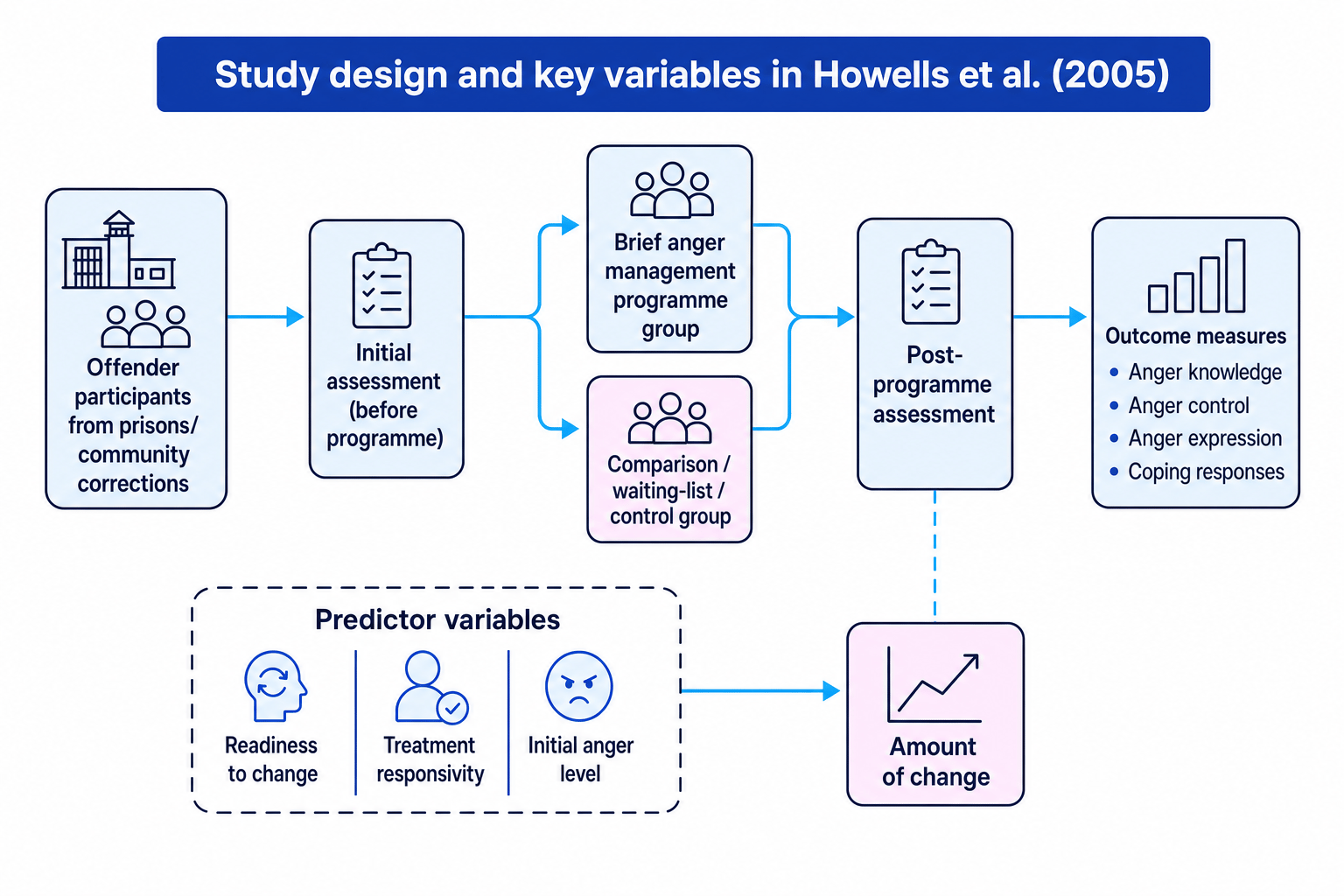
Howells et al. used a quasi-experimental design. A quasi-experiment studies the effect of an intervention, but participants are not randomly allocated in the fully controlled way you would expect in a laboratory experiment.
The participants were offenders in correctional settings, including prison and/or community-based correction services. They completed anger-related measures before and after the programme. Some were compared with offenders who had not yet received the programme, such as a waiting-list or comparison group.
Independent and dependent variables
The main independent variable was whether offenders took part in the brief anger management programme.
The main dependent variables were outcome measures related to anger, such as:
- anger knowledge
- anger control
- anger expression
- coping responses
- general anger levels
The researchers also considered predictors of change, including:
- how angry the offender was at the start
- how ready they were to change
- how responsive they seemed to treatment
Treatment readiness
Treatment readiness means the extent to which a person is willing, motivated and able to engage with an intervention. An offender who denies having a problem is usually less ready than one who recognises the need to change.
Procedure: the anger management programme
Although exact programmes can vary between settings, brief anger management programmes typically include:
- identifying personal anger triggers
- recognising early warning signs of anger
- understanding the consequences of angry behaviour
- relaxation or arousal-reduction strategies
- cognitive restructuring, which means challenging unhelpful thoughts
- social problem-solving
- practising alternative responses to provocation
Participants completed measures before the programme and again afterwards, allowing the researchers to compare change over time.
Interpreting pre-test and post-test change
Imagine a treatment group improves by 8 points on an anger-control scale, while a waiting-list group improves by 2 points over the same period.
- First, compare each group with itself over time. The treatment group improved by 8 points, while the waiting-list group improved by 2 points.
- Next, compare the size of the changes. The treatment group improved more, with an extra change of 8−2=68 - 2 = 68−2=6 points compared with the waiting-list group.
- Finally, interpret this cautiously. The larger improvement suggests the programme may have helped, but because the design is quasi-experimental, other factors such as motivation, selection into treatment or facilitator differences could also affect the result.
Findings: what Howells et al. found
The overall findings were quite balanced.
The brief anger management programmes produced some positive change, especially in areas such as anger knowledge, coping and control. However, the changes were not dramatic for all offenders.
A major finding was that not every offender had high anger levels at the start. This is important because if someone does not have a serious anger problem, there is less room for improvement. It also raises the question of whether anger management is always the right intervention.
The strongest improvements tended to be linked with factors such as:
- higher initial anger, meaning there was more genuine anger-related need to target
- greater readiness to change
- better engagement with the programme
So the study supports a targeted approach: assess offenders first, then match the intervention to the individual.
Do not overclaim the findings
A common mistake is to write that Howells et al. proved anger management reduces reoffending. The study mainly measured anger-related outcomes, not long-term recidivism. Recidivism means reoffending after punishment or intervention.
Conclusions
Howells et al. concluded that brief anger management programmes can be useful, but they should not be treated as a universal solution for all offenders.
The study suggests correctional services should:
- assess whether anger is actually linked to the offender’s behaviour
- consider the offender’s readiness to change
- avoid sending low-anger offenders to anger programmes simply because they have offended violently
- use more intensive or different interventions where brief anger management is not enough
This fits with the broader risk-need-responsivity approach in offender rehabilitation. In simple terms, treatment works best when it matches the offender’s risk level, criminogenic needs and ability to respond to treatment.
AO2: applying the study to an offender scenario
You may be asked to apply Howells et al. to a situation, such as a prison deciding whether to place an offender on an anger management course.
Deciding whether anger management fits an offender
An offender has been convicted of assault after reacting violently during an argument. He reports frequent angry outbursts, accepts that anger is a problem and says he wants strategies to avoid future violence.
- Identify whether anger is relevant to the offence. In this case, the assault followed an angry argument, so anger seems directly linked to the offending behaviour.
- Consider treatment readiness. The offender accepts there is a problem and wants strategies, so he appears more ready to engage than someone who denies responsibility.
- Apply Howells et al.’s findings. Because he has anger-related need and readiness to change, he is more likely to benefit from anger management than an offender whose crime was planned and not anger-driven.
AO3 evaluation
Strength: real-world setting
A major strength is ecological validity, meaning the study took place in realistic correctional contexts rather than an artificial laboratory. This makes the findings useful for prisons, probation services and offender rehabilitation planning.
Because the participants were actual offenders, the study has strong practical relevance.
Strength: focus on predictors of change
The study did more than ask “does anger management work?” It asked “for whom does it work best?” This is valuable because offender programmes are expensive and should be targeted carefully.
This makes the research useful for real-world decision-making. For example, services can assess anger level and motivation before allocating someone to a programme.
Weakness: limited control over variables
Because the study was quasi-experimental, participants were not randomly allocated in a tightly controlled way. This means confounding variables may have influenced the results.
A confounding variable is an extra factor that affects the outcome. For example, offenders who complete treatment may already be more motivated than those who drop out or remain on a waiting list.
Weakness: self-report measures
The study relied heavily on questionnaires and psychological scales. These can be standardised and easy to compare, but they may be affected by social desirability bias.
Social desirability bias occurs when participants give answers that make them look better. In a correctional setting, an offender may want staff to believe they are improving.
Weakness: anger outcomes are not the same as offending outcomes
Even if an offender reports better anger control, this does not automatically mean they will commit fewer offences. Long-term follow-up data on actual behaviour would be needed to show whether the programme reduces recidivism.
Evaluation shortcut
A strong AO3 paragraph can use this chain: real offenders = high ecological validity, but quasi-experimental design and self-report = weaker internal validity.
Ethical issues
Research with offenders must be handled carefully under the BPS Code of Ethics and Conduct.
Key ethical issues include:
- Consent: offenders may feel pressured to take part if they think it affects parole, privileges or staff opinions.
- Right to withdraw: participants should know they can leave the research without punishment.
- Confidentiality: data should be kept private, although there may be limits if someone discloses serious risk of harm.
- Protection from harm: discussing anger, violence or past offences may cause distress.
- Debrief: participants should be told the purpose of the research and given support information if needed.
Ethically, waiting-list comparison groups can be acceptable if they still receive treatment later, but researchers must avoid denying useful support unfairly.
Real-world applications
The study has clear application to offender rehabilitation.
It suggests that prisons and probation services should not use anger management as a “one-size-fits-all” response. Instead, they should screen offenders first and prioritise those whose offending is genuinely linked to anger.
It also supports work on motivation before treatment. If someone is not ready to change, a preparatory intervention may be needed before anger management begins.
In the exam
- For AO1, describe the aim, offender sample, brief anger management programme, pre/post measures and predictors of change.
- For AO2, apply the study by asking whether anger is actually linked to the offender’s behaviour and whether the offender is ready to change.
- For AO3, balance practical strengths with methodological limits: real-world setting is useful, but self-report, lack of random allocation and limited recidivism evidence reduce certainty.
Check yourself
- Why is it important that some offenders had low anger levels before the programme?
- What is the difference between an outcome measure and a predictor variable in this study?
- Why should you avoid claiming that Howells et al. proved anger management reduces reoffending?
